
New Jersey packs big stories into a small space, from Revolutionary War sites and sky-high bridges to boardwalk treats and pine forests full of wildlife.
Whether you live here or just visit, these fast facts make the Garden State easy to explore and fun to learn about. Let’s go!
Origins & definitions
- New Jersey is the fourth-smallest U.S. state by area at about 22,591 km² (8,722 sq mi).
- The state’s nickname is the Garden State, highlighting its long farming tradition.
- Trenton is the state capital, and Newark is the largest city by population.
- New Jersey became the third state to ratify the U.S. Constitution on December 18, 1787.
- The state motto is “Liberty and Prosperity,” adopted in 1777.
- New Jersey has 21 counties and, as of 2025, 564 municipalities.
- People from New Jersey are commonly called New Jerseyans.
- The official two-letter postal abbreviation for New Jersey is NJ.
- New Jersey lies in the Mid-Atlantic region of the United States.
- The state flag features the coat of arms with two goddesses, a horse’s head, and the year 1776.

Geography & nature
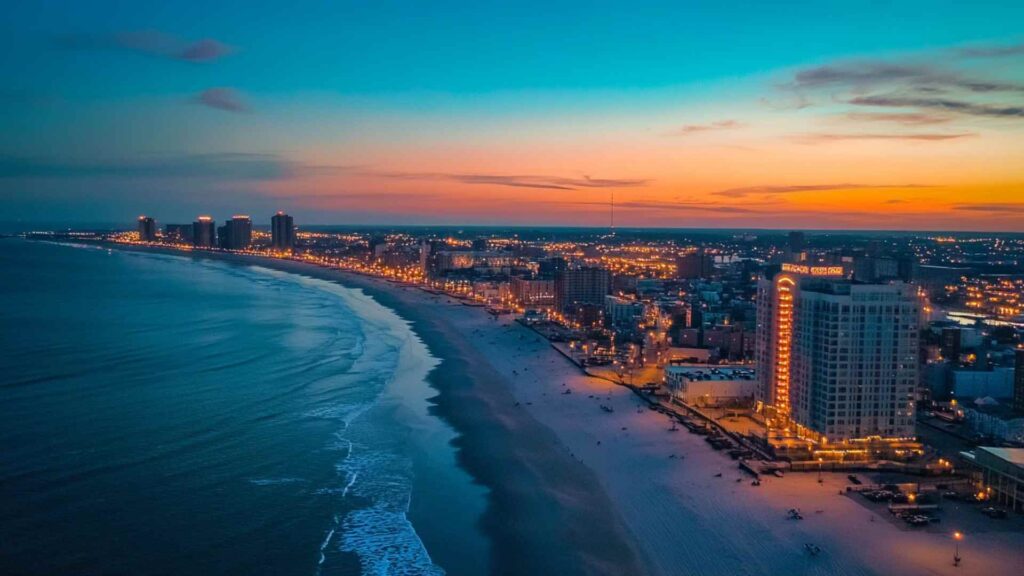
- New Jersey has about 210 km (130 mi) of Atlantic Ocean coastline known as the Jersey Shore.
- High Point near the New York border is the state’s highest elevation at 550 m (1,803 ft).
- The Delaware River forms much of New Jersey’s western boundary.
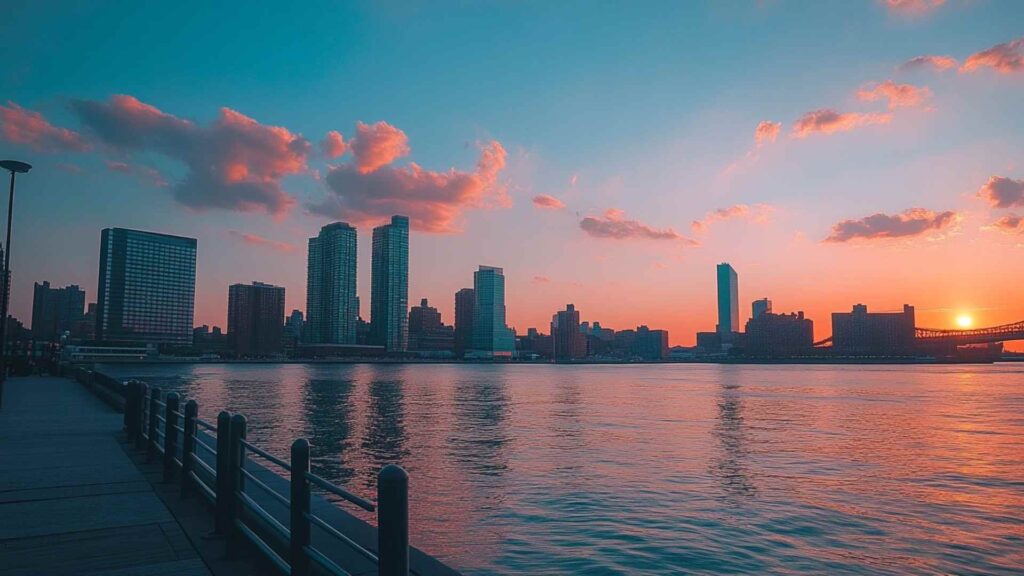
- The Hudson River and Upper New York Bay border the state to the northeast.
- The Kittatinny Mountains and the Appalachian Trail cross New Jersey’s northwest corner.
- The Palisades are dramatic basalt cliffs rising above the Hudson River for about 32 km (20 mi).
- The Pinelands National Reserve protects roughly 1.1 million acres of forests, bogs, and wetlands.
- The Raritan River is the longest river entirely within New Jersey at about 114 km (71 mi).
- New Jersey’s climate ranges from humid continental in the northwest to humid subtropical in the south.
- Sandy Hook forms a barrier spit that shelters Raritan Bay and hosts a historic lighthouse.
- Barnegat Bay is a shallow lagoon system separated from the ocean by long barrier islands.
- The state’s largest lake is Lake Hopatcong at about 10 km² (4 sq mi).
- The Delaware Water Gap cuts a scenic notch through the Kittatinny Ridge along the state line.
- The Passaic River’s Great Falls in Paterson drop about 23 m (77 ft) and powered early mills.
History & milestones
- Indigenous Lenape peoples lived across New Jersey for thousands of years before European settlement.
- The area was part of the Dutch and then English colonies in the 1600s.
- East Jersey and West Jersey were separate provinces until they were united as a royal colony in 1702.
- New Jersey was a key battleground during the American Revolution with more than 100 engagements.
- George Washington crossed the Delaware River on December 25–26, 1776 leading to the First Battle of Trenton.
- The Second Battle of Trenton and the Battle of Princeton followed in early January 1777.
- New Jersey was the first state to ratify the U.S. Bill of Rights on November 20, 1789.
- The first recorded organized baseball game was played in Hoboken on June 19, 1846.
- The nation’s first intercollegiate football game took place in New Brunswick on November 6, 1869.
- A near-complete dinosaur skeleton, Hadrosaurus foulkii, was unearthed in Haddonfield in 1858.
- The first drive-in movie theater opened in Camden County on June 6, 1933.
- The Hindenburg disaster occurred at Lakehurst on May 6, 1937.
- Atlantic City opened its first legal casino in 1978 after a statewide vote in 1976.
- New Jersey abolished the death penalty in 2007 and replaced it with life imprisonment.
People & demographics
- New Jersey has the highest population density of any U.S. state.
- The state’s population is about 9 million people, with diverse communities from around the world.
- New Jersey has one of the highest shares of foreign-born residents among U.S. states.
- Bergen County is the most populous county in New Jersey.
- Many residents commute to jobs in New York City or Philadelphia due to the state’s location.
- New Jersey communities speak dozens of languages, including large Spanish, Portuguese, Hindi, and Chinese speaking populations.
- Jersey City and Edison are among the fastest-growing major municipalities in recent decades.
- The phrase “down the Shore” is a local way of saying “to the beach.”
- Many towns ask beachgoers to buy seasonal badges for access during summer months.
- The long-running debate over whether to say “pork roll” or “Taylor ham” is a regional language quirk.
Government & civic
- New Jersey uses a strong home-rule tradition with many small municipalities and school districts.
- Voters approve many local school budgets directly in communities across the state.
- The state constitution gives residents initiative only in limited forms, with most referendums legislatively referred.
- Municipalities can choose different government structures under the Faulkner Act.
- New Jersey holds statewide elections in odd-numbered years for governor and legislature.
- The state’s congressional delegation represents 12 districts as of the current decade.
- Blue laws in parts of Bergen County restrict some retail sales on Sundays.
- Drivers cannot pump their own gasoline in New Jersey, where full-service fueling is required by law.
Economy & innovation
- New Jersey’s economy blends pharmaceuticals, finance, logistics, manufacturing, tourism, and agriculture.
- The state still honors its farming roots with major harvests of blueberries, cranberries, peppers, tomatoes, and peaches.
- Cultivated blueberries were first successfully domesticated in New Jersey in the early 1900s.
- Cranberry bogs in the Pinelands produce a large share of U.S. cranberries each fall.
- The Port Newark–Elizabeth complex is one of the busiest container terminals on the East Coast.
- Newark Liberty International Airport is among the nation’s earliest major airports, opening in 1928.
- Atlantic City’s casinos, shows, and conventions anchor a key tourism sector at the Shore.
- Many warehouses cluster along the New Jersey Turnpike corridor to serve the New York metropolitan market.
- The state has extensive research activity centered around universities and private labs.
- Thomas Edison ran one of the world’s first industrial research labs in Menlo Park in the 1870s.
- Scientists using a horn antenna in Holmdel detected the cosmic microwave background in 1964.
- Engineers at a New Jersey lab helped invent the transistor in 1947, transforming electronics.
- Paterson’s silk mills earned the city the nickname “Silk City” during the 19th century.
- Glassmaking has been a tradition in South Jersey since the 1700s.
- Oyster Creek Generating Station, once the nation’s oldest operating nuclear plant, retired in 2018.
- Offshore wind and solar projects are expanding as New Jersey pursues more renewable energy.

Transportation & infrastructure
- The New Jersey Turnpike opened in 1951 and remains a major north–south freight artery.
- The Garden State Parkway runs about 277 km (172 mi) from the New York line to Cape May.
- Many intersections use jughandles, which route left turns via right-hand ramps.
- PATH trains link Newark, Jersey City, and Hoboken with Manhattan through trans-Hudson tunnels.
- NJ Transit operates one of the largest statewide bus and rail systems in the United States.
- The George Washington Bridge opened in 1931 with the world’s longest main span at the time.
- The Holland Tunnel opened in 1927 as the first mechanically ventilated road tunnel for cars.
- The Lincoln Tunnel opened in 1937 and today carries traffic through three vehicular tubes.
- The Bayonne Bridge was the world’s longest steel arch bridge when it opened in 1931.
- The Outerbridge Crossing is named after a person, not a direction.
- The Pulaski Skyway, opened in 1932, carries traffic high above the Passaic and Hackensack Rivers.
- A year-round ferry connects Cape May, New Jersey with Lewes, Delaware across Delaware Bay.
Culture, food & sports
- New Jersey is often called the diner capital for its hundreds of chrome-and-neon eateries.
- Trenton-style tomato pie serves the sauce on top of the cheese for a tangy bite.
- Saltwater taffy became a boardwalk staple in Atlantic City in the late 1800s.
- Pork roll sandwiches with egg and cheese are a breakfast favorite across the state.
- Italian hot dogs served in split rolls with peppers, onions, and potatoes are a Newark specialty.
- The Shore’s summer culture includes mini-golf, arcades, and amusement piers on barrier islands.
- Many coastal towns hold weekly summer fireworks that draw families to the boardwalks.
- Cape May is famous for ornate Victorian houses preserved across entire streets.
- Doo Wop–style motels light up the Wildwoods with retro neon architecture.
- Music scenes in Asbury Park helped launch several celebrated rock careers.
- The state’s only major league team with a New Jersey name is the NHL’s Devils.
- Two NFL teams that play in East Rutherford carry New York names on their jerseys.
- The NBA’s Nets played in New Jersey for decades before moving to Brooklyn in 2012.
- College sports rivalries, especially between Rutgers and Princeton, date back to the 1800s.
- Street art and murals brighten neighborhoods from Jersey City to Asbury Park.
- Town fairs and food festivals celebrate blueberries, cranberries, peaches, and corn each summer.
- Sports wagering has been legal in New Jersey since 2018 after a major court decision.
- Many films and television series set stories in New Jersey’s suburbs, cities, and shore towns.
Education & colleges
- Princeton University was founded in 1746 and later moved to its current campus in 1756.
- Rutgers University, founded in 1766, is the state’s flagship public research university.
- Stevens Institute of Technology opened in Hoboken in 1870 with a focus on engineering.
- New Jersey Institute of Technology in Newark is a major polytechnic university.
- Community colleges serve every county with affordable two-year programs.
- A plasma physics laboratory in Princeton conducts research on fusion energy.
- Many public high schools offer magnet programs in science, technology, and the arts.
- Statewide preschool expansion has increased access to early childhood education.
- Vocational-technical schools teach trades from automotive repair to culinary arts.
- Libraries and historical societies across New Jersey preserve local archives and artifacts.
Parks, wildlife & environment
- Sandy Hook Lighthouse, built in 1764, is the oldest operating lighthouse in the United States.
- Absecon Lighthouse in Atlantic City stands 52 m (171 ft) tall with 228 steps.
- The state fish are the brook trout for fresh water and the striped bass for salt water.
- Liberty State Park in Jersey City offers sweeping views of the Statue of Liberty and Lower Manhattan.
- The state bird is the American goldfinch, a bright yellow finch seen in meadows and backyards.
- Delaware Bay beaches host one of the world’s largest horseshoe crab spawning events each spring.
- Cape May is a top North American bird migration hotspot in spring and fall.
- The state flower is the common blue violet, which blooms in spring lawns and forests.
- Black bears roam the forests of northwestern New Jersey, especially in the Kittatinny region.
- The state reptile is the bog turtle, a small and secretive wetland species.
- The state tree is the northern red oak, a tall hardwood with deeply lobed leaves.
- The state mammal is the horse, reflecting a long equestrian heritage.
Cities & places
- Newark’s downtown has a major performing arts center and busy rail hub.
- Jersey City’s waterfront skyline faces New York Harbor across the Hudson.
- Hoboken’s riverside parks line the former piers with views of Midtown Manhattan.
- Paterson is a National Historical Park for its Great Falls and industrial heritage.
- Elizabeth and Bayonne anchor key port facilities near Newark Bay.
- Trenton’s capitol complex includes a gold-domed State House dating to the 1790s.
- New Brunswick is a medical and university hub along the Raritan River.
- Princeton blends a historic town center with collegiate Gothic architecture.
- Camden’s waterfront features museums and the preserved battleship USS New Jersey.
- Cape May Point marks the southern tip of the state where the ocean meets the bay.
Names & etymology
- The state is named after the Isle of Jersey in the English Channel.
- Many place names such as Passaic, Hackensack, and Manasquan come from Lenape languages.
- The Statue of Liberty stands in waters off New Jersey even though it is commonly associated with New York.
- Most of Ellis Island’s acreage sits on New Jersey’s side due to 20th-century land expansion.
- Residents often describe locations by Turnpike or Parkway exit numbers as a handy shorthand.
For kids: quick comparisons
- New Jersey is roughly the size of Israel, so the whole state fits into a day’s drive.
- Driving from High Point to Cape May takes about four to five hours without heavy traffic.
- The Appalachian Trail runs about 116 km (72 mi) in New Jersey, which is like walking nearly three marathons.
- A trip from Newark to Atlantic City by car covers about 190 km (120 mi) mostly on toll highways.
- New Jersey’s 210 km coast is about the distance of five back-to-back marathons.
- The 1.1 million acre Pinelands would cover far more land than all of Delaware’s Sussex County.
Quick FAQ
Q: What is New Jersey’s capital and largest city?
A: Trenton is the capital, and Newark is the largest city.
Q: Why is it called the Garden State?
A: The nickname honors the state’s long history of farming and fresh produce.
Q: Does New Jersey really have the highest population density?
A: Yes, among U.S. states it has the most people per square kilometer.
Q: Can drivers pump their own gas in New Jersey?
A: No, state law requires full-service gasoline at stations.
Q: What makes the Jersey Shore special?
A: It stretches about 210 km with beaches, boardwalks, lighthouses, and lively summer towns.

Ellie is the owner and sole author of Fun Facts, combining her mechanical engineering background with years of research-driven writing to deliver facts you can trust. Every article is thoroughly fact-checked and routinely updated as new science and sources emerge to keep information accurate and current. Her mission is to make learning delightful while upholding high standards of reliability and transparency.