
Minnesota is a friendly, outdoorsy state packed with lakes, forests, and stories.
From the Mississippi’s tiny start to giant malls and music legends, there’s something here for every curious mind.
Dive into these quick, kid-safe facts to learn how the North Star State shines in nature, culture, and everyday life.
Origins & definitions
- Minnesota became the 32nd U.S. state on May 11, 1858.
- The state nickname is "Land of 10,000 Lakes," a nod to its many waters.
- The name Minnesota comes from a Dakota phrase meaning "sky-tinted water."
- The capital city is Saint Paul, located on the Mississippi River.
- The largest city is Minneapolis, and together they form the Twin Cities metro.
- The state motto is "L'Étoile du Nord," which means "The Star of the North."
- The state abbreviation is MN.
- Minnesota is entirely in the Central Time Zone.
- Minnesota has 87 counties.
- The state borders Canada’s provinces of Manitoba and Ontario to the north and northeast.
- Minnesota shares U.S. borders with North Dakota, South Dakota, Iowa, and Wisconsin.
- The Mississippi River begins in Minnesota at Lake Itasca.

Record-breakers & wow numbers
- Minnesota has about 11,800 lakes that are at least 4 hectares (10 acres) in size.
- The state covers roughly 225,000 square kilometers (86,900 square miles), making it the 12th largest state.
- The highest point is Eagle Mountain at 701 meters (2,301 feet).
- The lowest point is Lake Superior’s surface at about 183 meters (602 feet) above sea level.
- The Northwest Angle is the only part of the contiguous United States north of the 49th parallel.
- The Boundary Waters Canoe Area Wilderness protects about 4,400 square kilometers (1.1 million acres) of lakes and forest.
- Voyageurs National Park was established in 1975 as Minnesota’s only national park.
- The Mississippi River travels about 3,700 kilometers (2,320 miles) from its Minnesota headwaters to the Gulf of Mexico.
- Mall of America in Bloomington is the largest shopping mall in the United States by total retail space.
- Mall of America opened in 1992 and includes an indoor theme park.
- The Duluth–Superior harbor is one of the farthest inland seaports reached by ocean-going ships.
- The Minneapolis Skyway system links dozens of blocks with about 15 kilometers (9 miles) of enclosed walkways.
- The Minnesota State Fair draws millions of visitors each year in late August and early September.
- The state’s record high temperature is 46°C (115°F), set in 1917.
- The state’s record low temperature is −51°C (−60°F), set in 1996.
- Itasca State Park, created in 1891, is the oldest state park in Minnesota.
- The Aerial Lift Bridge in Duluth dates to 1905 and remains a landmark of the harbor.
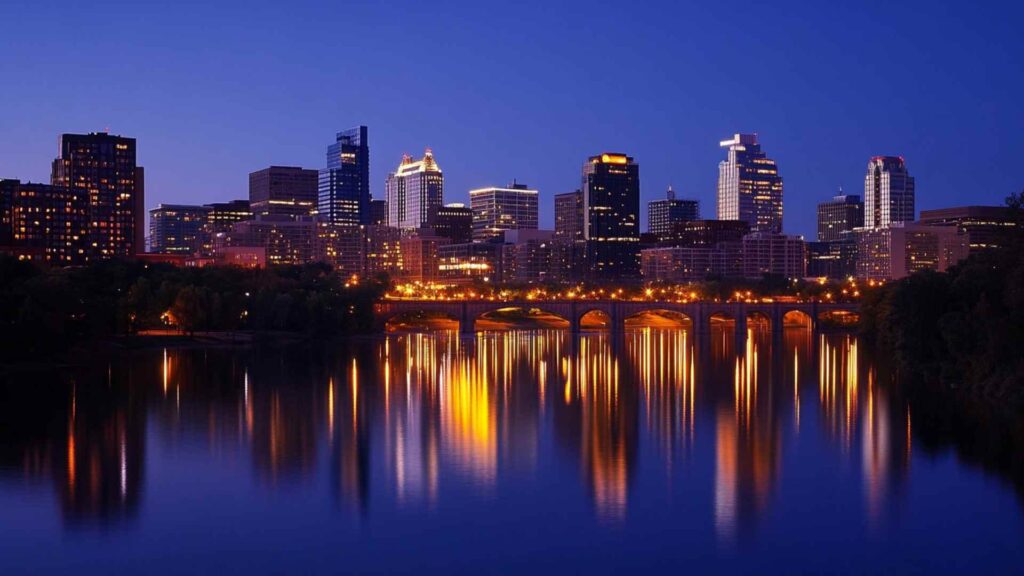
- The Stone Arch Bridge in Minneapolis has 23 arches spanning the Mississippi River.
- The Soudan Underground Mine plunges more than 700 meters (over 2,300 feet) below ground.
- High Falls on the Pigeon River is Minnesota’s tallest waterfall at about 36 meters (120 feet).

Science & nature
- Most of Minnesota’s lakes were carved by glaciers during the last Ice Age.
- Three major biomes meet in Minnesota: prairie grassland, deciduous forest, and boreal forest.
- The Red River of the North flows northward to Lake Winnipeg, which can worsen spring floods.
- Winters are long and cold, and many lakes freeze for several months each year.
- Northern Minnesota sometimes sees the aurora borealis on clear, dark nights.
- Trumpeter swans, once rare, now nest again on many Minnesota lakes.
- Bald eagles are commonly seen along rivers and lakes after decades of recovery.
- Gray wolves have a stable population in the state’s northeastern forests.
- Moose live mainly in the northeast, where cold bogs and forests suit them.
- Black bears roam much of the north woods and sometimes visit backyard bird feeders.
- The common loon is the state bird and is known for its haunting calls.
- The walleye is widely celebrated as the state fish and a favorite for anglers.
- Wild rice grows naturally in shallow lakes and is an important traditional food.
- The Lake Superior North Shore features pebble beaches, basalt cliffs, and cold water.
- The Saint Croix River at Interstate State Park showcases giant glacial potholes.
- Peat bogs and tamarack swamps cover large parts of the northern lowlands.
- Prairie remnants in the southwest hold big bluestem, switchgrass, and prairie flowers.
- Sax–Zim Bog is a winter birding hotspot famous for owls and boreal species.
- Many Minnesota towns track "ice-out" dates each spring when lakes finally thaw.
- Beaver lodges and dams are common features on northern streams and ponds.
- White-tailed deer are abundant and adapt well to farms, woods, and suburbs.
- Ticks and mosquitoes flourish in warm months, so hikers use repellent and long sleeves.
- Lake Superior’s cold water can create lake-effect snow along the North Shore.
- The Mississippi and Minnesota rivers meet at Fort Snelling, forming a major confluence.
- The Superior Hiking Trail runs for more than 480 kilometers (300 miles) along the North Shore.

History & culture
- Dakota and Ojibwe peoples have lived in the region for centuries before statehood.
- French fur traders and voyageurs paddled these waters in birchbark canoes.
- Fort Snelling was established in the 1820s at the rivers’ confluence to control trade.
- The 1851 treaties at Traverse des Sioux and Mendota opened much of the land to settlement.
- Logging boomed in the 1800s as white pine forests were cut and floated down rivers.
- By the late 1800s Minneapolis was known as the flour milling capital of the world.
- The Washburn A Mill explosion in 1878 led to stronger safety standards in milling.
- Immigrants from Norway, Sweden, Germany, and Finland left lasting cultural traditions.
- The Minnesota Democratic–Farmer–Labor Party formed in 1944 by merging two political parties.
- Hubert H. Humphrey of Minnesota served as U.S. vice president from 1965 to 1969.
- Walter Mondale of Minnesota served as U.S. vice president from 1977 to 1981.
- Jesse Ventura, a former professional wrestler, served as Minnesota governor from 1999 to 2003.
- The 1991 Halloween Blizzard dumped record snow on parts of the state.
- The Red River flood of 1997 forced major evacuations in the northwest.
- The I-35W bridge collapsed in Minneapolis in 2007 and was replaced in 2008.
- The Minnesota State Fair is nicknamed "The Great Minnesota Get-Together."
- Butter sculptures of "Princess Kay of the Milky Way" are carved each year at the fair.
- The Juicy Lucy, a cheese-stuffed burger, traces its roots to Minneapolis diners.
- Hotdish casseroles are classic comfort food at potlucks and church suppers.
- Many families enjoy lefse, krumkake, and other Scandinavian holiday treats.
- Lutefisk dinners remain a quirky winter tradition in some communities.
- "Minnesota Nice" describes a friendly, polite style of everyday manners.
- The phrase "Uff da" is a Norwegian-American exclamation still heard around the state.
- Garrison Keillor’s fictional Lake Wobegon put small-town Minnesota on the radio map.
- F. Scott Fitzgerald was born in Saint Paul in 1896.
- Bob Dylan was born in Duluth and grew up in Hibbing on the Iron Range.
- Charles M. Schulz, creator of Peanuts, spent his childhood in Saint Paul.
- Prince was born and raised in Minneapolis and recorded at Paisley Park in Chanhassen.
- First Avenue in Minneapolis is a famed music club with a wall of silver stars.
- The Coen brothers filmed parts of "Fargo" in Minnesota despite its North Dakota title.
Science & economy
- The Mesabi, Vermilion, and Cuyuna ranges supplied iron ore that fueled American industry.
- Today much of the iron shipped from Minnesota is processed as taconite pellets.
- Duluth’s giant ore docks load bulk carriers bound for steel mills on the Great Lakes.
- The Mayo Clinic in Rochester grew from a small practice founded in the 1880s.
- Medtronic began in a Minneapolis garage and helped create the first wearable pacemaker in 1957.
- 3M started in Two Harbors in 1902 and later pioneered many everyday products.
- General Mills in the Twin Cities helped popularize ready-to-eat breakfast cereals.
- Hormel Foods in Austin introduced SPAM in 1937.
- Cargill, based in Minnesota, is among the largest privately held companies in the United States.
- Best Buy is headquartered in Richfield and began as a small audio store.
- Target opened its first discount store in Roseville in 1962.
- Polaris started in Roseau and became known for snowmobiles and off-road vehicles.
- Agriculture focuses on corn, soybeans, sugar beets, and dairy across much of the state.
- Minnesota consistently ranks among the top U.S. producers of turkeys each year.
- The University of Minnesota released the Honeycrisp apple to growers in 1991.
- Wild rice is the official state grain and the only cereal grain native to North America.
- Renewable energy from wind and solar has grown quickly across the prairie and farm belt.
- The Duluth–Superior port moves millions of tons of cargo annually through the Great Lakes.
- Minneapolis–Saint Paul International Airport serves as a major Upper Midwest air hub.
- The state invests heavily in medical devices, software, and bioscience research.
Names & etymology
- Minneapolis combines a Dakota word for water with the Greek word for city.
- Saint Paul was named for the early log chapel of Saint Paul near the river bluffs.
- Hennepin County honors French explorer Louis Hennepin.
- Lake Superior is often called Gitchi-Gami from an Ojibwe term for "great sea."
- Bde Maka Ska is the restored Dakota name for the Minneapolis lake once called Lake Calhoun.
- The Minnesota River takes its name from the same "sky-tinted water" root as the state.
- The city of New Ulm reflects German settler heritage in its name and festivals.
- The town of New Prague shows the legacy of Czech immigrants on the prairie.
- The Iron Range name refers to long belts of iron-bearing rock in the north.
- The Boundary Waters name comes from the canoe routes that straddle the U.S.–Canada line.
For kids: quick comparisons
- Minnesota is slightly smaller than the United Kingdom by land area.
- Minnesota is bigger than Nebraska but smaller than Michigan.
- The Mississippi River at Lake Itasca is shallow enough that many people can wade across.
- Minnehaha Falls is about as tall as a five-story building.
- Summer daylight in northern Minnesota lasts about 16 hours around late June.
- Winter daylight in northern Minnesota can drop below 9 hours around late December.
- A moose in Minnesota can weigh as much as 600 kilograms (about 1,300 pounds).
- Gray wolves in Minnesota often live in packs of roughly 5 to 10 animals.
- Lake Superior is so large that it can create its own weather along the shore.
- The Boundary Waters has hundreds of portages where paddlers carry canoes between lakes.
- The state has more than one national park unit, including a full national park and several national monuments and riverways.
- Many Minnesotans mark May with a statewide fishing opener for walleye and northern pike.
Pop culture & fun extras
- The Minnesota Twins won the World Series in 1987 and 1991.
- The Minnesota Vikings have made four Super Bowl appearances but have not won the title.
- The Minnesota Lynx have won multiple WNBA championships in 2011, 2013, 2015, and 2017.
- The Minnesota Wild joined the National Hockey League in 2000.
- Minnesota United FC began Major League Soccer play in 2017.
- The Timberwolves reached the NBA Western Conference Finals in 2004 and 2024.
- U.S. Bank Stadium in Minneapolis hosted Super Bowl LII in 2018.
- The Metrodome’s inflatable roof famously collapsed after a heavy snowstorm in 2010.
- The "Spoonbridge and Cherry" sculpture is a playful icon of the Minneapolis Sculpture Garden.
- The Great Lakes Aquarium in Duluth focuses on freshwater ecosystems.
- Mystery Cave in southern Minnesota is the state’s longest known cave with more than 21 kilometers (13 miles) of passages.
- Pipestone National Monument preserves quarries of soft red stone used for ceremonial pipes.
- The Paul Bunyan and Babe the Blue Ox statues in Bemidji are classic roadside attractions.
- The Midtown Greenway offers a car-free cycling corridor through Minneapolis.
- The Saint Paul Winter Carnival celebrates ice and snow with parades, sculptures, and occasional ice palaces.
- The Northwest Angle’s tiny Angle Inlet village has the northernmost post office in the contiguous United States.
Quick FAQ
What is Minnesota best known for?
Minnesota is known for its lakes, the Mississippi headwaters, friendly culture, and four-season outdoor fun.
Where does the Mississippi River start in Minnesota?
The Mississippi River starts at Lake Itasca in Itasca State Park.
Why is it called the North Star State?
The motto "L’Étoile du Nord" or "The Star of the North" celebrates Minnesota’s northern location.
What is the state bird of Minnesota?
The state bird is the common loon.
What is a Juicy Lucy?
A Juicy Lucy is a cheese-stuffed burger that originated in Minneapolis.

Ellie is the owner and sole author of Fun Facts, combining her mechanical engineering background with years of research-driven writing to deliver facts you can trust. Every article is thoroughly fact-checked and routinely updated as new science and sources emerge to keep information accurate and current. Her mission is to make learning delightful while upholding high standards of reliability and transparency.