
The United States is big, busy, and full of surprises, from icy Alaska to sunny Florida and island Hawaii.
These quick facts cover geography, history, nature, culture, and wow numbers. Whether you’re planning a trip or just curious, this list makes learning about the USA easy and fun.
Origins & basics
- The United States is a federal republic of 50 states and a federal district.
- The country spans about 9.83 million km², making it the third-largest nation by area.
- U.S. states and D.C. cover six main time zones from UTC−4 to UTC−10.
- The capital city is Washington, D.C., which was established in 1790.
- The United States has no official federal language, though English is the most widely spoken.
- More than 41 million people speak Spanish at home in the United States.
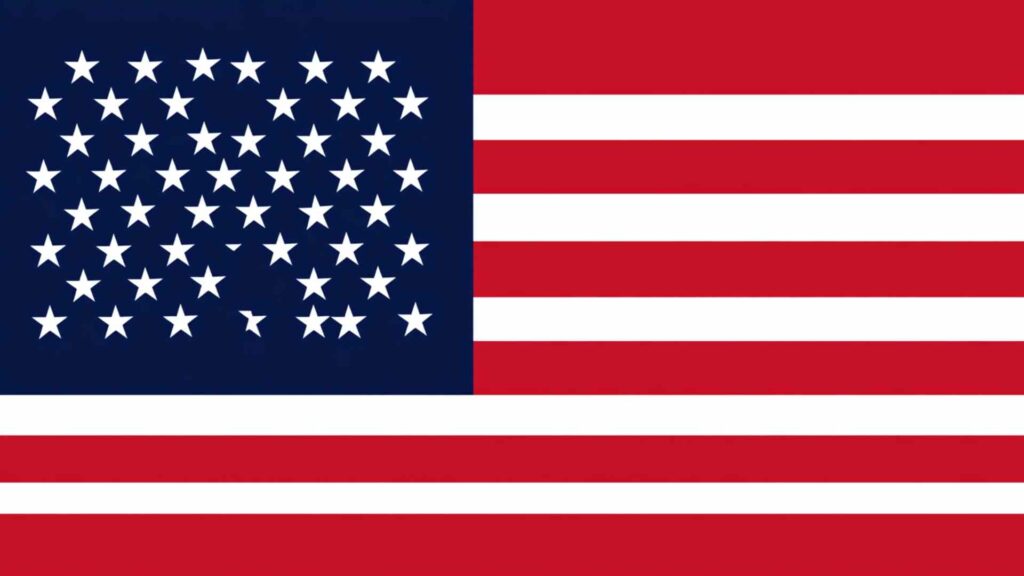
- The U.S. flag has 50 stars for the states and 13 stripes for the original colonies.
- “In God We Trust” became the national motto in 1956.
- Independence was declared on July 4, 1776.
- The U.S. Constitution took effect in 1789.
- “The Star-Spangled Banner” became the national anthem in 1931.
- The national currency is the U.S. dollar (USD), symbolized by $.
Geography & land
- The contiguous United States is bordered by Canada to the north and Mexico to the south.
- Alaska is the largest state by area at about 1.72 million km².
- Rhode Island is the smallest state at about 3,144 km².
- The highest point in the United States is Denali at 6,190 m (20,310 ft).
- The lowest point is Badwater Basin in Death Valley at −86 m (−282 ft).
- The Missouri River is the longest U.S. river at about 3,767 km.
- The Great Lakes hold roughly 20% of the world’s surface fresh water.
- The United States has coastlines on the Atlantic, Pacific, and Arctic Oceans and the Gulf of Mexico.
- Death Valley recorded an extreme air temperature of 56.7°C (134°F) in 1913.
- The U.S. shares the world’s longest international land border with Canada at about 8,891 km.
- U.S. territory stretches from about 18°N in the Caribbean to about 71°N in Alaska.
- The geographic center of the 50 states lies near Belle Fourche, South Dakota.
- The country contains ecosystems from arctic tundra to tropical rainforest.
- The Grand Canyon is about 446 km long (277 miles) and up to 1.8 km deep.
- Lake Michigan is the largest lake entirely within the United States.
- There are 63 national parks as of 2024.
States, territories & cities
- California is the most populous state with about 39 million people as of 2024.
- Wyoming is the least populous state with about 580,000 people as of 2024.
- New York City is the largest U.S. city with over 8 million residents.
- The New York metropolitan area includes about 20 million people as of 2024.
- Texas and Florida led net population growth among states in the early 2020s.
- Puerto Rico is a U.S. territory with its own constitution adopted in 1952.
- Other populated U.S. territories include Guam, American Samoa, the U.S. Virgin Islands, and the Northern Mariana Islands.
- Washington, D.C. covers about 177 km² and is not a state.
- Two states do not border any other U.S. state: Alaska and Hawaii.
- Colorado has the highest average elevation of any state at about 2,073 m.
- New Jersey is the most densely populated state with over 460 people per km².
- Hawaii is the youngest state by admission, joining the Union in 1959.
- The first 13 states were the original colonies along the Atlantic coast.
- Alaska has the longest state coastline at about 54,563 km.
- Texas has the most counties of any state with 254.
- Hawaii is the only state with a royal palace, called ʻIolani Palace.
History & government
- The United States first operated under the Articles of Confederation in 1781.
- The current Constitution was signed on September 17, 1787.
- The Bill of Rights, the first 10 amendments, was ratified in 1791.
- The federal government has three branches: legislative, executive, and judicial.
- Congress includes a 100-member Senate and a 435-member House of Representatives.
- Presidential elections occur every four years on the Tuesday after the first Monday in November.
- George Washington took office as the first president in 1789.
- The American Civil War lasted from 1861 to 1865.
- Slavery was abolished nationwide by the 13th Amendment in 1865.
- Women gained the right to vote nationwide in 1920 with the 19th Amendment.
- The 26th Amendment lowered the voting age to 18 in 1971.
- The United States entered World War I in 1917 and World War II in 1941.
- Alaska and Hawaii became the 49th and 50th states in 1959.
- The Supreme Court has nine Justices set by federal law.
- The presidential line of succession starts with the vice president, then the speaker of the House.
- Washington, D.C. received presidential electors with the 23rd Amendment in 1961.
- Independence Day is celebrated every year on July 4.
- Martin Luther King Jr. Day became a federal holiday in 1983.
- A national census is taken every 10 years as required by the Constitution.
- The U.S. flag has had 27 official designs, with the current 50-star version adopted in 1960.
- Most states have bicameral legislatures, with Nebraska as the single-chamber exception.
- Nebraska has a unicameral, officially nonpartisan legislature established in 1937.
- Congress created the first federal holidays, including New Year’s Day and Christmas, in 1870.
- The United States practices federalism, sharing power between the national and state governments.
Record-breakers & big numbers
- The United States has the world’s largest economy by nominal GDP as of 2024.
- The U.S. dollar is the most traded currency in global foreign exchange markets.
- Hartsfield–Jackson Atlanta International Airport handles over 100 million passengers in many years.
- As of the 2020s, the U.S. has the world’s longest road network at over 6.5 million km.
- The Interstate Highway System spans about 77,000 km (48,000 miles).
- One World Trade Center in New York City is the tallest U.S. building at 541 m (1,776 ft).
- Broadway’s theater district includes 41 professional theaters with 500 or more seats.
- The United States has over 35,000 museums nationwide.
- The postal system delivers mail to over 160 million addresses.
- The Ogallala Aquifer under the Great Plains covers roughly 450,000 km².
- The Yellowstone supervolcano is one of the largest active volcanic systems on Earth.
- The Library of Congress is the world’s largest library by shelf space and collection size.
- National Park Service lands encompass about 340,000 km² (over 84 million acres).
- The United States has won more Olympic medals than any other nation as of 2024.
- The United States produces more corn than any other country in most years.
- Crater Lake in Oregon is the deepest U.S. lake at 594 m.
- Mammoth Cave in Kentucky is the world’s longest known cave system with over 680 km of passages.
- Coast redwood trees in California can exceed 115 m in height.
Nature, parks & wildlife
- The United States spans climate zones from arctic in Alaska to tropical in Hawaii.
- Yellowstone, established in 1872, is widely regarded as the world’s first national park.
- The bald eagle has served as the national emblem since 1782.
- Grizzly bears live in parts of Alaska, Montana, Wyoming, and Idaho.
- The Everglades in Florida form the largest tropical wilderness in the continental United States.
- The Appalachian Mountains are among the oldest mountain ranges on Earth.
- Mount Whitney in California stands at 4,421 m, the highest in the contiguous states.
- The Colorado River carved the Grand Canyon over millions of years.
- Great Smoky Mountains National Park is the most visited U.S. national park as of 2024.
- Hawaii lies about 3,850 km from California, making it highly isolated in the Pacific.
- The Great Plains stretch north–south through the center of the country.
- Major bird migration routes include the Atlantic, Mississippi, Central, and Pacific Flyways.
- Redwood National and State Parks protect some of the tallest trees on Earth.
- The Chihuahuan Desert is the largest hot desert in North America.
- Lake Tahoe reaches a depth of about 501 m.
- Over 1,600 species are listed under federal endangered species protections.
- The Mississippi Flyway supports migrations of over 300 bird species.
- Utah’s Great Salt Lake is a large, shallow, and highly variable saline lake.
Culture, food & sports
- Baseball, basketball, and American football developed in the United States.
- The Super Bowl, the championship game of American football, was first played in 1967.
- The Super Bowl ranks among the most watched television events in the United States each year.
- Jazz, blues, country, hip-hop, and rock and roll all have roots in the United States.
- Thanksgiving has been celebrated on the fourth Thursday in November since 1941.
- Apple pie is a classic American dessert often served “à la mode” with ice cream.
- The hamburger rose to national popularity in the early 20th century.
- Route 66 was established in 1926 and became a symbol of American road travel.
- Hollywood in Los Angeles is a global center for film production.
- The United States has over 9,000 public library systems.
- Several college football stadiums seat more than 100,000 spectators.
- The United States plays a leading role in video game development and esports.
- National parks record over 300 million recreation visits annually in recent years.
- Jazz took shape in New Orleans in the early 1900s.
- The Statue of Liberty was dedicated in 1886 as a gift of friendship.
- Regional foods include Texas barbecue, New England clam chowder, and Chicago deep-dish pizza.
- The National Mall in Washington, D.C. hosts major public events and museums.
- The Olympic Games have been hosted in the United States eight times as of 2024.
Science, technology & innovation
- The U.S. electric system is organized into three major interconnections: Eastern, Western, and Texas.
- The first crewed Moon landing in 1969 launched from Florida and splashed down in the Pacific Ocean.
- Silicon Valley in California became a world hub for technology startups in the late 20th century.
- The core protocols of the modern internet were developed in the United States in the 1970s and 1980s.
- National laboratories across the country support research in energy, physics, and computing.
- The Human Genome Project announced a working draft in 2000 and completion in 2003.
- The United States has over 4,000 degree-granting colleges and universities.
- The first controlled, powered airplane flight took place in North Carolina in 1903.
- Major astronomical observatories operate at high-altitude sites in Arizona, Hawaii, and California.
- The United States ranks among the top countries in Nobel Prizes awarded to residents and institutions.
- The country hosts large particle physics facilities to study fundamental particles and forces.
- Nationwide weather forecasting uses networks of radars, buoys, and satellites to track storms.
Names, symbols & language
- The phrase “United States of America” appeared in print during the 1770s.
- “Uncle Sam” became a popular personification of the U.S. government in the 19th century.
- The national floral emblem is the rose, designated in 1986.
- The national tree is the oak, designated in 2004.
- The national mammal is the American bison, recognized in 2016.
- Each state sets its own official symbols like birds, flowers, and songs.
For kids: quick comparisons
- The United States is about the same size as China by total area.
- You could fit about 40 United Kingdoms inside the United States by land area.
- A typical coast-to-coast drive from New York to Los Angeles is about 4,500 km.
- Denali is over 1,700 m taller than Mount Whitney, the highest peak in the lower 48.
- Visiting one national park per month would take more than five years to see all 63 as of 2024.
Quick FAQ
Q: What is the capital of the United States?
A: The capital is Washington, D.C.
Q: How many states are in the United States?
A: There are 50 states.
Q: What is the population of the United States?
A: About 334 million people as of 2024.
Q: What currency does the United States use?
A: The U.S. dollar (USD).
Q: Which state is largest by area and which is most populous?
A: Alaska is largest by area, and California is most populous.

Ellie is the owner and sole author of Fun Facts, combining her mechanical engineering background with years of research-driven writing to deliver facts you can trust. Every article is thoroughly fact-checked and routinely updated as new science and sources emerge to keep information accurate and current. Her mission is to make learning delightful while upholding high standards of reliability and transparency.