
Bridges are everyday wonders that help people, animals, and even trains and bikes cross gaps safely.
From tiny footbridges to mega-projects over seas, these structures mix science, art, and smart planning.
Here are 145 bright, bite-size facts to make you look at every bridge with fresh eyes.
Origins & definitions
- A bridge is a structure built to carry people or vehicles over an obstacle such as water, a valley, a road, or railway.
- The simplest bridge type is a beam bridge, which is basically a stiff plank supported at each end.
- Arch bridges work by pushing forces into their curved shape and into the supports, called abutments.
- Suspension bridges hang the roadway from main cables draped over tall towers.
- Cable-stayed bridges support the deck with many straight cables connected directly to towers.
- Truss bridges use a framework of triangles to spread loads efficiently.
- A viaduct is a series of short spans that carries a road or railway across a long valley or plain.
- A causeway is a raised road across low or wet ground, sometimes considered a bridge when water flows beneath.
- A footbridge is designed primarily for pedestrians and often for cyclists.
- A flyover or overpass lets one road cross above another without an intersection.
- A deck is the part of a bridge you travel on, whether it’s concrete, steel, or timber.
- Piers are vertical supports in the middle of a span, while abutments sit at the ends.
- A span is the distance between two supports, measured center to center.
- Clearance is the space under a bridge, important for ships, trucks, and trains.
- A double-deck bridge has two levels of traffic, sometimes separating directions or modes.
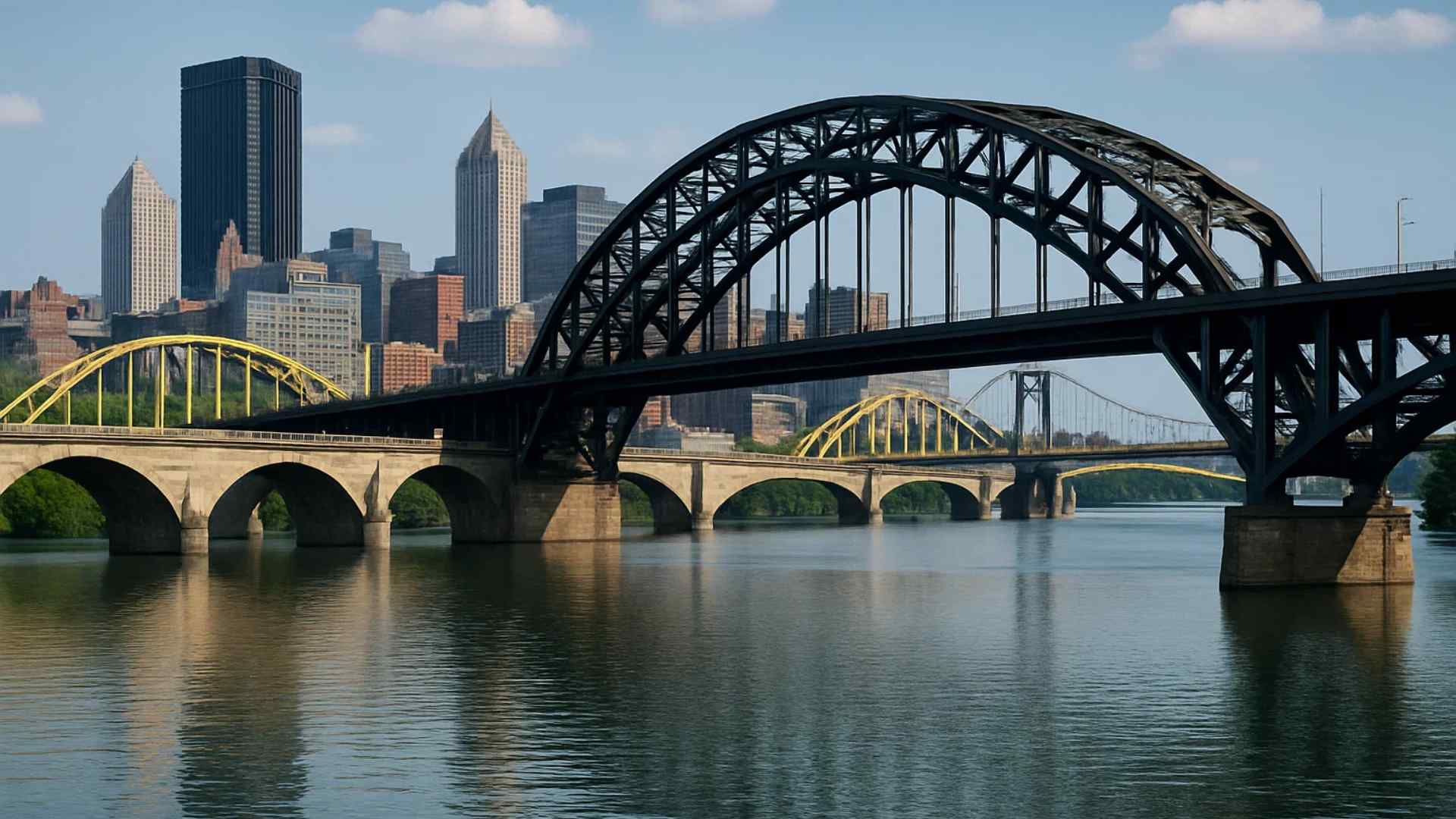
Record-breakers & wow numbers
- The world’s longest sea-crossing bridge-tunnel system stretches about 55 km and includes an undersea tunnel.
- The Danyang–Kunshan Grand Bridge in China runs roughly 165 km, making it one of the longest bridges on Earth.
- The Lake Pontchartrain Causeway in Louisiana is over 38 km long and runs almost entirely over water.
- The main span record for suspension bridges is 2,023 m, achieved by a Turkish bridge opened in 2022.
- The Akashi Kaikyō Bridge in Japan has a main span of 1,991 m and ranks among the longest suspension spans.
- A leading cable-stayed bridge has a main span of 1,104 m, showing how far straight-cable designs can reach.
- The Millau Viaduct in France peaks at 343 m from base to the top of its tallest pier.
- The Duge Bridge in China carries traffic about 565 m above the Beipan River valley floor.
- The Chenab Bridge in India has a deck about 359 m above the river, making it a very high railway bridge.
- The Sydney Harbour Bridge arch spans 503 m, forming a giant steel “coat hanger” shape.
- A modern long steel box-girder bridge can stretch single spans beyond 200 m with careful design.
- The Forth Bridge in Scotland opened in 1890 with cantilevers reaching 521 m between towers.
- The Brooklyn Bridge’s main span is 486 m, which was a world record when it opened in 1883.
- Some pedestrian suspension bridges exceed 700 m in length, offering dramatic walks across valleys.
- The Golden Gate Bridge total length is about 2,737 m with a 1,280 m main span.
- Some movable bridges lift roadways over 60 m to let tall ships pass.
- The longest masonry arch railway bridge by total length has dozens of stone arches lined in a graceful curve.
- The Russky Bridge in Russia uses a 1,104 m cable-stayed main span with very tall pylons.
- A modern extradosed bridge blends girder and cable-stayed ideas to span roughly 200–400 m efficiently.
- A long timber bridge can exceed 300 m when built as a series of covered spans.

Science & how it works
- Bridges balance loads and resistance, keeping forces in tension, compression, and sometimes torsion.
- In a beam, the top typically compresses while the bottom stretches in tension under bending.
- Arch bridges are mostly in compression, which stone and concrete handle very well.
- Suspension bridges put main cables in tension and towers in compression.
- Cable-stayed bridges carry forces from the deck straight into the towers through inclined cables.
- Trusses turn bending into small axial forces in many slender members.
- Shear forces try to slide layers of material past each other and must be resisted by web plates or diagonals.
- Bearings let the deck expand, contract, and rotate slightly as temperature and loads change.
- Expansion joints create gaps that open or close with temperature to prevent cracking.
- Live load includes traffic and pedestrians, while dead load is the bridge’s own weight.
- Impact factors account for bouncing from vehicles, wind gusts, or braking forces.
- Aerodynamic stability is vital, as wind can cause flutter or vortex shedding.
- Engineers often test bridge shapes in wind tunnels to tune rails, fairings, and grilles.
- Damping devices can reduce vibrations from wind, waves, or footsteps.
- Dynamic analysis checks how a bridge responds to moving loads and earthquakes.
- Redundancy means if one part fails, others can still carry load to prevent collapse.
- Fatigue happens when repeated stress cycles slowly grow tiny cracks in steel.
- Corrosion thins steel over time, so coatings and cathodic protection are common defenses.
- Prestressed concrete squeezes the concrete before loads act, improving strength and crack control.
- Post-tensioned tendons can be adjusted after concrete hardens to fine-tune performance.
- Box girders resist torsion well because their closed shape acts like a tube.
- Cable sag and temperature changes are carefully modeled to keep the deck level.
- Bearings can be elastomeric, pot, or spherical types, each suiting different movements.
- Scour is erosion around piers that can undermine foundations in fast-flowing water.
- Foundations may use deep piles driven or drilled into strong soil or rock.
- Soil-structure interaction matters because soft ground can move under seasonal changes.
- Seismic isolation bearings help decouple bridges from ground shaking.
- Load rating checks how much weight a bridge can safely carry after years of service.
- Structural health monitoring uses sensors to track strain, tilt, and vibration in real time.
- Finite element models simulate complex shapes so engineers can test thousands of scenarios.
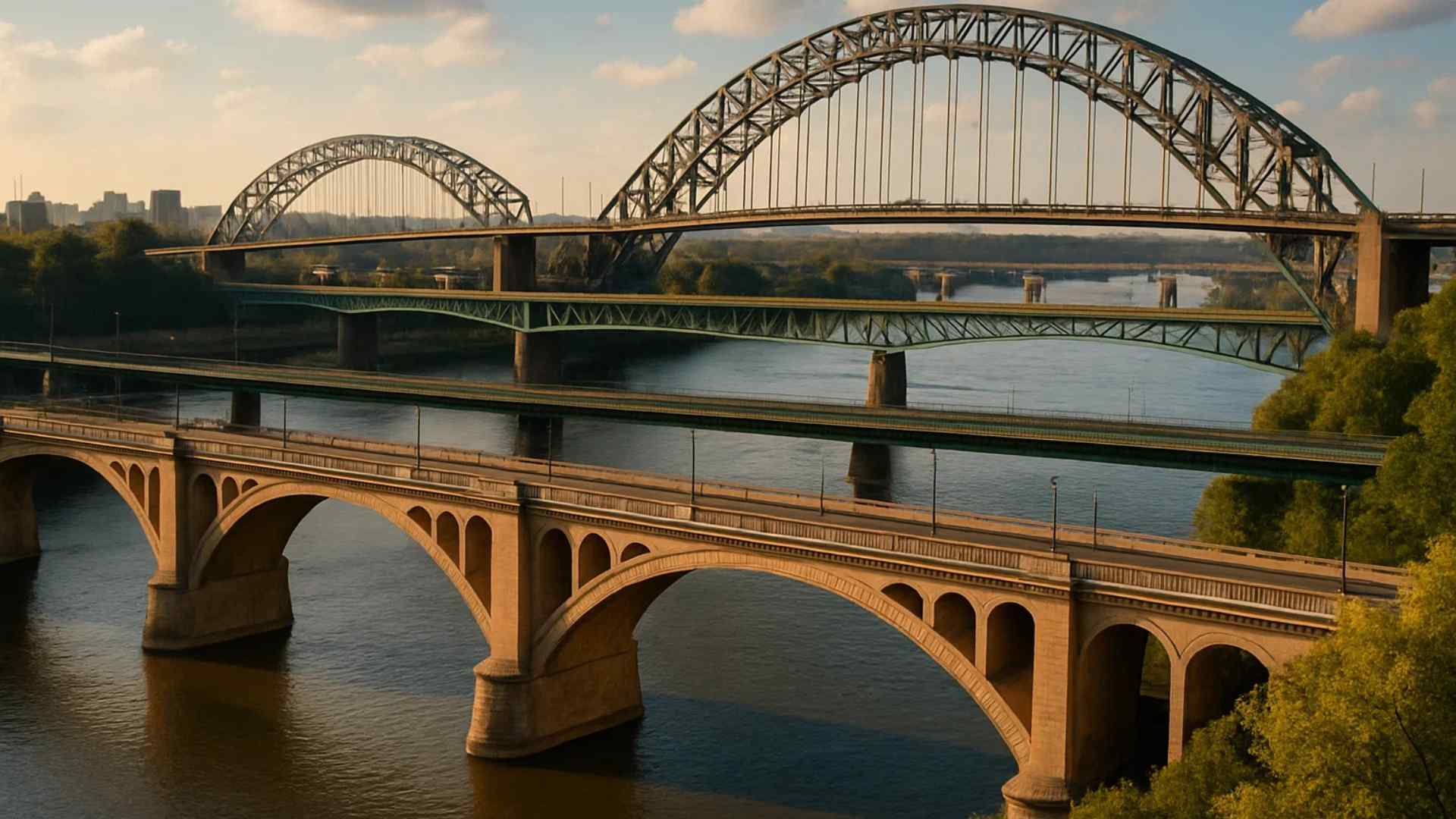
Materials & design types
- Stone and brick dominated early bridge building because they handled compression well.
- Timber bridges were common where wood was abundant and spans were short.
- Wrought iron allowed lighter, stronger bridges in the 1800s compared with stone alone.
- Steel became the go-to for long spans thanks to high strength and ductility.
- Reinforced concrete combines concrete’s compression strength with steel’s tension strength.
- Prestressed concrete enables slender decks and longer spans with fewer cracks.
- Aluminum has been used for lightweight pedestrian and special bridges.
- Fiber-reinforced polymer decks can reduce weight and resist corrosion.
- Beam bridges are economical for short spans and simple crossings.
- Arch bridges can be made from stone, concrete, steel, or a mix of materials.
- Suspension bridges suit very long spans over deep water where piers are difficult.
- Cable-stayed bridges are efficient for medium to long spans with fewer cables than suspension designs.
- Cantilever bridges extend arms from piers and connect in the middle.
- Truss types include Pratt, Howe, and Warren, each arranging diagonals differently.
- Tied-arch bridges hold the arch thrust with a tie beam, reducing abutment forces.
- Extradosed bridges use low pylons and short stays to assist a girder.
- Box-girder bridges use hollow boxes that are strong in bending and torsion.
- Segmental construction builds bridges from many short concrete pieces joined together.
- Movable bridges include bascule (drawbridge), vertical lift, and swing spans.
- Floating or pontoon bridges rest on boats or pontoons and are useful over deep lakes.
- Aqueduct bridges carry water across valleys for canals or cities.
- Wildlife bridges let animals safely cross highways and restore habitat connections.
- Green bridges may include soil and plants on top to blend into landscapes.
- Snow sheds and avalanche bridges protect roads in mountain corridors.
- Multi-modal bridges can carry cars, trains, bikes, and pedestrians on separate lanes.

Building & maintenance
- Surveying maps the route and geology to pick the best alignment and span arrangement.
- Environmental studies check impacts on rivers, fish, birds, and nearby communities.
- Temporary works like falsework and scaffolding support the bridge during construction.
- Cofferdams keep water out so workers can build piers and footings in rivers.
- Caissons allow deep underwater foundations by creating pressurized working spaces.
- Balanced cantilever methods cast segments outward from piers to keep forces even.
- Incremental launching pushes a finished deck out of a casting yard across supports.
- Stay cables are installed in carefully planned sequences to control deck geometry.
- Cable spinning on suspension bridges weaves thousands of wires into a single main cable.
- Orthotropic steel decks use stiffened plates to keep weight low and strength high.
- Quality control tests concrete strength with cylinders and monitors curing temperatures.
- Bearings and joints are inspected for wear, leaks, and misalignment.
- Drainage on decks stops water from pooling and reduces freeze-thaw damage.
- De-icing salts can accelerate corrosion, so protective overlays are often used.
- Painting steel protects against rust and can take years for very large bridges.
- Structural inspections commonly occur every two years, with extra checks after storms or quakes.
- Drone surveys and rope-access teams reach hard-to-see spots safely.
- Load testing with trucks or sensors confirms a bridge meets design expectations.
- Strengthening methods include adding plates, external cables, or fiber wraps.
- End-of-life decisions weigh repair versus replacement based on cost, safety, and history.
History & culture
- Ancient civilizations built stone arches that still carry traffic today.
- A famous iron bridge opened in 1779 and proved cast iron could span a river.
- The Brooklyn Bridge opened in 1883 and used steel wire cables in a pioneering way.
- A London bridge was relocated piece by piece to Arizona and rebuilt in the 1970s.
- A notable cantilever bridge in Scotland became a national symbol of industrial skill.
- The Golden Gate Bridge opened in 1937 and quickly became an icon of the American West.
- Tower Bridge in London opened in 1894 with two bascule leaves and twin Gothic-style towers.
- The Charles Bridge in Prague began construction in 1357 and is lined with statues.
- The Rialto Bridge in Venice opened in 1591 as a stone arch with bustling shops.
- The Ponte Vecchio in Florence is famous for goldsmith shops built along its span.
- The Tacoma Narrows Bridge collapsed in 1940 due to aeroelastic flutter under strong winds.
- The Millennium Bridge in London opened in 2000 and later added dampers to stop pedestrian-induced sway.
- Covered bridges protected timber decks from rain and snow to make them last longer.
- Many cities light bridges at night for safety, tourism, and special events.
- Some bridges charge tolls to fund construction, maintenance, or congestion control.
- Earthquakes have led to major bridge retrofits with isolators and ductile details.
- Historic metal trusses are often preserved as pedestrian crossings after road bypasses.
- Bridge openings can feature ship parades, fireworks, and community walks before traffic starts.
- The word “bridge” appears in many idioms, such as “bridge the gap” and “burning bridges.”
- Ice bridges form temporarily over frozen rivers and allow winter crossings in cold regions.
For kids: quick comparisons
- A beam bridge is like a ruler laid between two books.
- An arch bridge is like a rainbow that holds itself up by pushing into the ground.
- A suspension bridge is like a clothesline holding up a towel from above.
- A cable-stayed bridge is like a fan of strings holding a board to a tall pole.
- A truss bridge is like a triangle-filled fence that spreads weight everywhere.
- A movable bridge is like a drawbridge on a castle that lets boats through.
- A pontoon bridge is like standing on a sturdy row of floating barrels.
- Expansion joints are like tiny gaps in a sidewalk that let things grow and shrink.
- Bearings are like little pads that let the bridge slide and twist just a bit.
- Guardrails are like seatbelts for the edge of the road, keeping you safely on the deck.
Pop culture & fun extras
- Many famous bridges appear in movies because they instantly show where the story takes place.
- Bridge marathons and charity walks sometimes let people cross traffic-free before opening day.
- Some bridges play music when you drive at certain speeds over grooves in the pavement.
- Artists often use old bridge trusses as open-air galleries and light installations.
- Building a model bridge with sticks or spaghetti teaches the basics of load paths and stiffness.
Quick FAQ
What are the main types of bridges?
Beam, arch, suspension, cable-stayed, truss, cantilever, and box-girder are the main types used today.
Which bridge type spans the farthest?
Suspension bridges currently reach the longest main spans, measured in thousands of meters.
Why do bridges have gaps in the road?
Those are expansion joints that let the deck expand and contract with temperature changes.
How often are bridges inspected?
Routine inspections commonly occur every two years, with extra checks after major events.
What makes a bridge safe in wind?
Streamlined shapes, stiff decks, and damping devices help control vibrations and prevent flutter.

Ellie is the owner and sole author of Fun Facts, combining her mechanical engineering background with years of research-driven writing to deliver facts you can trust. Every article is thoroughly fact-checked and routinely updated as new science and sources emerge to keep information accurate and current. Her mission is to make learning delightful while upholding high standards of reliability and transparency.