
Tsunamis are not surf waves; they are long, powerful surges that can cross entire oceans.
In this mega list, we’ll explain how they form, wow records, and smart safety tips.
Read on for clear numbers, famous events, and easy comparisons that make big-wave science simple for curious minds.
Origins & definitions
- A tsunami is a series of long ocean waves caused by a sudden disturbance of the water.
- The most common trigger is a large undersea earthquake that shifts the seafloor.
- Volcanic eruptions, submarine landslides, or collapsing glaciers can also start tsunamis.
- Rarely, a meteor impact in the ocean can generate a tsunami.
- The word “tsunami” comes from Japanese and means “harbor wave.”
- In deep water, tsunami waves have very long wavelengths, often over 100 km.
- Because the energy spans the full depth, tsunamis are “shallow-water waves” in physics terms.
- In the open ocean, a tsunami’s surface height can be less than 1 m, making it hard to notice.
- Tsunamis travel as a train of waves separated by minutes to more than an hour.
- The first arriving wave is not always the largest in the series.
- A local tsunami can reach nearby coasts within minutes of the trigger.
- A distant, or tele-tsunami, can cross entire ocean basins.
- Tsunami “run-up” is the maximum height the water reaches above the normal sea level on land.
- “Inundation” is how far the water floods inland from the shoreline.
- A “tsunami warning” means a hazardous tsunami is expected or occurring.
- A “tsunami advisory” signals strong currents and dangerous waves are likely.
- Natural warning signs include a strong or long earthquake felt near the coast.
- Another natural warning is a sudden, unusual retreat of the sea that exposes the seafloor.

Record-breakers & wow numbers
- In 1958, a landslide in Lituya Bay, Alaska, produced a run-up of about 524 m (1,720 ft).
- Typical tsunami speeds in deep ocean reach 500–800 km/h (310–500 mph).
- A tsunami’s period is often 5–60 minutes, much longer than wind waves.
- In 4,000 m deep water, shallow-water wave speed is roughly 200 m/s (720 km/h).
- Some earthquake tsunamis have run-up heights exceeding 30 m (98 ft).
- Landslide-triggered waves have produced run-ups well over 100 m in steep fjords.
- The 2004 Indian Ocean tsunami caused over 200,000 deaths across the region.
- The 2011 tsunami along northeast Japan sent waves over 10 m onto parts of the coast.
- The 1883 island eruption in Indonesia generated deadly waves in the Sunda Strait.
- The 1700 Cascadia earthquake produced a Pacific-spanning tsunami that reached Japan about 10 hours later.
- Tsunami energy can circle an ocean basin multiple times as small oscillations lasting days.
- Harbor currents during a tsunami can exceed 5 m/s (about 10 knots).
- Some tsunamis have inundated more than 5 km inland on low-lying coasts.
- Wavelengths can exceed 200 km in deep water.
- A single tsunami can contain 5–10 major waves arriving over several hours.
- Recorded sea-level changes from a tsunami can continue for more than a day.
- Coastal uplift or subsidence during the quake can change shoreline elevation by meters.
- In narrow bays, wave heights can amplify several times due to funneling.
- Tsunami bores—steep, breaking walls of water—have been observed in some estuaries.
- The deadliest historical tsunamis have occurred along subduction zone coasts.
- Building codes and seawalls can reduce damage in some places but cannot stop large tsunamis.
- Evacuation drills have been shown to cut fatalities by moving people to high ground faster.
Science — how it works
- Tsunamis form when a large area of the seafloor moves up or down suddenly.
- The water column moves with the seafloor, creating a broad hump or dip.
- Gravity pulls the disturbance outward, spreading waves in all directions.
- In deep water, tsunami energy extends from the surface to the seafloor.
- Because the wavelength is so long, the wave behaves like a shallow-water wave.
- The speed of a shallow-water wave depends mainly on water depth, not on wave height.
- Wave speed is approximately the square root of the product of gravity and depth.
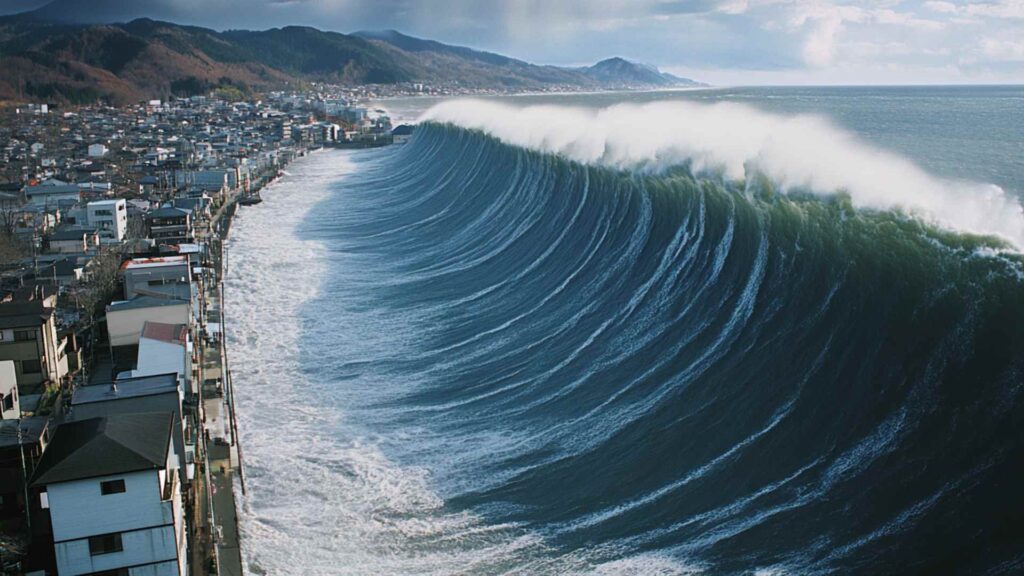
- As a tsunami enters shallow water, the front slows while the back keeps moving.
- This slowing compresses the wave, making it steeper and higher.
- Shoaling focuses energy and increases run-up near the shoreline.
- Bays and harbors can amplify waves through resonance when periods match basin size.
- Underwater ridges and headlands can refract and focus tsunami energy onto certain coasts.
- Interacting wave fronts can merge and create unusually high crests at “hot spots.”
- The first visible sign at the coast can be a rapid fall or rise in sea level.
- Extreme drawdown can expose reefs, rocks, and stranded fish before the surge returns.
- A loud roaring sound reported before some tsunamis comes from fast, turbulent flow.
- A tsunami bore is a fast-moving wall of water similar to a hydraulic jump.
- Floating debris carried by the flow increases drag and impact forces.
- Fast-moving water can erode roadbeds and building foundations within minutes.
- Sand transported by the waves settles inland as thin layers called tsunami deposits.
- Mapping these deposits helps estimate past wave heights and flood distances.
- Coral reefs can reduce some wave energy but often cannot stop tsunami flooding.
- Tide level at arrival can add or subtract several decimeters to meters from observed heights.
- Vertical evacuation to sturdy upper floors reduces risk when hills are far away.
- Earthquake tsunamis usually come from thrust faulting at subduction zones.
- Strike-slip earthquakes rarely make big tsunamis because vertical motion is small.
- Submarine landslides can create strong local tsunamis even without a large quake.
- Volcanic explosions or caldera collapses can displace water rapidly and launch waves.
- Air-pressure jumps from strong storms can drive “meteotsunamis” in enclosed seas.
- Small harbors can resonate with meteotsunamis and produce surges on otherwise calm days.

Habitat, history & human impact
- Most tsunami risk lies around the Pacific due to its many subduction zones.
- The “Ring of Fire” marks a belt of frequent earthquakes and tsunamis around the Pacific.
- The Indian Ocean also faces tsunami hazards from its subduction margins.
- The Atlantic has fewer large tsunamis but local landslides and volcanoes can pose risks.
- The Mediterranean has documented tsunamis from ancient times to the present.
- Coastal communities use warning sirens to urge people to evacuate to high ground.
- Local warnings often rely on strong shaking felt near the shore.
- Evacuation routes are marked with signs pointing inland or uphill.
- Schools in tsunami zones practice annual drills to speed evacuation.
- Vertical evacuation towers provide safe refuge where hills are distant or roads are limited.
- Historical records describe tsunamis reaching far inland along river valleys.
- Many cultures share flood legends that may describe past tsunamis.
- Stone markers in some countries advise people not to build below certain elevations.
- After a tsunami, stagnant pools and debris can create health hazards until cleaned.
- Ports may close for days due to dangerous currents even if no coastal flooding occurred.
- Fishing nets, docks, and small boats can be damaged by strong harbor surges.
- Rebuilding costs after a major tsunami can reach billions of dollars.
- Tourism can drop for months while communities repair homes, roads, and beaches.
- Coastal wetlands can trap debris and slow water, helping protect inland areas.
- Reconstruction plans often elevate buildings or set development back from the shore.
- Earthquakes on holidays or at night can change how people respond and evacuate.
- Local radio, text alerts, and loudspeakers help deliver instructions if power fails.
- Bridges and roads near rivers are vulnerable to scour and undercutting during fast flows.
- Boats already at sea are usually safer staying in deep water than returning to port.
- Harbor officials may order vessels to leave port before waves arrive.
- Aftershocks can trigger additional alerts while people remain evacuated.
- Community maps show safe zones above likely run-up heights.
- Visitor centers in tsunami regions teach geology, history, and safety skills.
- Studying past events improves hazard maps, models, and evacuation plans.
- Coastal planting projects sometimes include species that help anchor dunes against erosion.
Names & etymology
- “Tsunami” combines the Japanese words for “harbor” and “wave.”
- Before “tsunami” became common, many English speakers used “tidal wave” incorrectly.
- A tidal wave is driven by tides, while a tsunami is not.
- A “seiche” is a standing wave that can slosh in lakes, bays, or harbors.
- “Megatsunami” refers to extremely large run-ups usually caused by landslides.
- “Teletsunami” describes a distant tsunami that crosses an entire ocean basin.
- “Run-up” is the maximum vertical height above sea level that the water reaches on land.
- “Inundation distance” is how far inland the tsunami travels.
- “Drawdown” is the rapid drop in sea level that can precede the first wave.
- “Wave period” is the time between wave crests passing a fixed point.
For kids: quick comparisons
- A tsunami is not a surf wave you can ride on a board.
- A tsunami’s wavelength can be longer than a whole soccer field by thousands of times.
- In deep ocean a tsunami can race as fast as a jet airplane.
- Near shore the same wave slows to the speed of a car on a city street.
- Wind waves have periods of seconds, but tsunami periods last minutes.
- People cannot outrun a tsunami on flat ground once it is surging ashore.
- The ocean may first pull back like a giant low tide before rushing in.
- Pets can sense shaking and should be brought along during evacuation.
- If you feel a long or strong quake at the coast, the safest move is to go to high ground.
- A small first wave can hide a much bigger wave arriving only minutes later.
- Tall, reinforced buildings marked for evacuation can provide vertical shelters.
- Climbing just 10–20 m above sea level can mean the difference between danger and safety.
- Stairs, hills, and sturdy rooftops are faster options than trying to drive through traffic.
- Tsunami drills at school teach kids to move inland without waiting for instructions.
- A tsunami can carry logs, boats, and cars, turning floating objects into hazards.
Pop culture & fun extras
- Old coastal tales often describe the sea pulling back before a great wave.
- Traditional stories in many countries warn people to run to high ground after shaking.
- Tsunami stones along some coasts warn future generations where not to build.
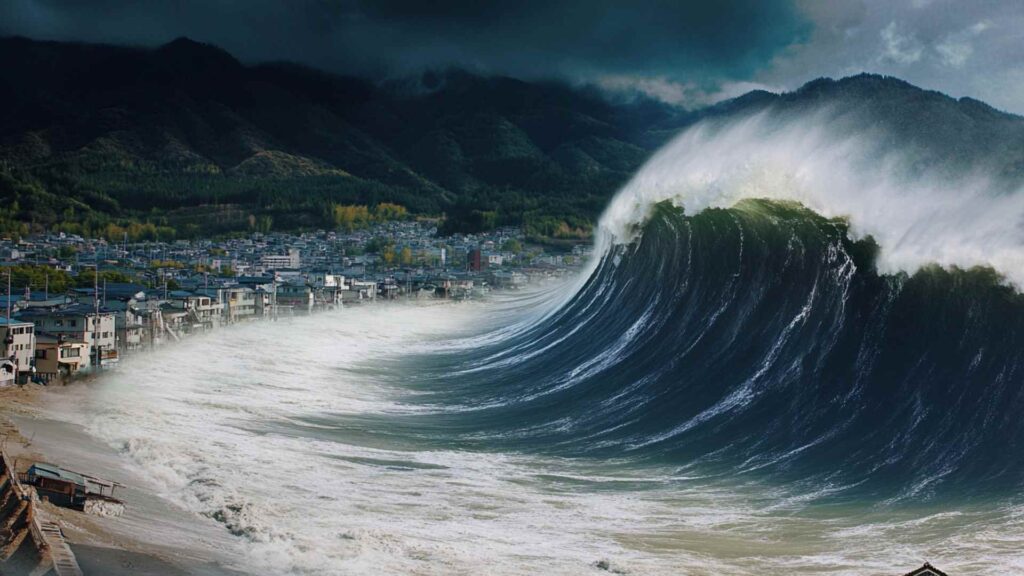
- Artists have painted dramatic views of breaking bores in bays and rivers.
- Modern video clips show that many tsunami waves look like fast, rising floods, not tall breakers.
- Science centers use wave tanks to demonstrate run-up and harbor resonance.
- Family emergency kits in coastal towns often include maps, headlamps, and whistles.
- Community fun runs sometimes trace official evacuation routes to teach the paths.
- Heritage trails mark high-water lines from historic tsunamis on buildings.
- Coastal festivals may include evacuation drills alongside food and music.
- Surf forecasts do not apply to tsunamis because their physics and scales are different.
- Popular books compare tsunami speeds to jet planes and bullet trains to help kids visualize.
- Educational board games teach the difference between a warning and an advisory.
- Classroom posters show three natural warning icons: shaking, ocean withdrawal, and a loud roar.
- Many beaches post signs that say “go to high ground” with arrows pointing inland.
- Computer models can simulate tsunami arrival times for different coasts.
- Hands-on activities let students measure wave periods using stopwatches and tubs.
- Community siren tests are often scheduled at the same time each month.
- Social media can spread evacuation messages quickly when roads are blocked.
- Rebuilding after a tsunami often includes memorials that mark the water’s height.
Quick FAQ
What causes most tsunamis?
Most tsunamis are caused by large undersea earthquakes that move the seafloor up or down.
How fast do tsunamis travel?
In deep ocean they can travel around 500–800 km/h, slowing down as they reach shallow water.
Is a tsunami the same as a tidal wave?
No, tides are caused by the Moon and Sun, while tsunamis are driven by sudden water displacement.
What are natural warning signs of a tsunami?
Strong or long ground shaking, unusual sea withdrawal, or a loud ocean roar are key warning signs.
What should I do if I’m near the coast and feel a long or strong quake?
Go to high ground or move inland immediately and stay there until officials say it is safe.

Ellie is the owner and sole author of Fun Facts, combining her mechanical engineering background with years of research-driven writing to deliver facts you can trust. Every article is thoroughly fact-checked and routinely updated as new science and sources emerge to keep information accurate and current. Her mission is to make learning delightful while upholding high standards of reliability and transparency.