
Capybaras are the world’s largest rodents, famous for chill vibes and a love of water.
This friendly, kid-safe guide packs quick facts you can trust, from size and speed to sounds and social life.
Dive in for numbers, neat comparisons, and pop-culture nuggets that make learning fun.
Origins & definitions
- The capybara is a semiaquatic rodent native to South America.
- Its scientific name is Hydrochoerus hydrochaeris.
- Capybaras belong to the cavy family, the same group as guinea pigs.
- The genus Hydrochoerus includes two species: the capybara and the lesser capybara.
- The capybara is the largest living rodent on Earth.
- Capybaras evolved to thrive in wetlands, rivers, and seasonally flooded savannas.
- They are herbivores that primarily eat grasses and aquatic plants.
- Capybaras are crepuscular, most active at dawn and dusk.
- They are social animals that typically live in groups.
- A typical group has one dominant male, several females, and subordinate males.
- Group sizes commonly range from 10 to 20 individuals.
- During the dry season, temporary aggregations can swell to dozens or more.
- Capybaras are excellent swimmers and divers.
- They mate in the water rather than on land.
- Capybaras are hindgut fermenters that digest fiber in an enlarged cecum.
- They practice cecotrophy by reingesting special droppings to absorb more nutrients.
- Capybaras communicate with barks, whistles, purrs, and clicks.
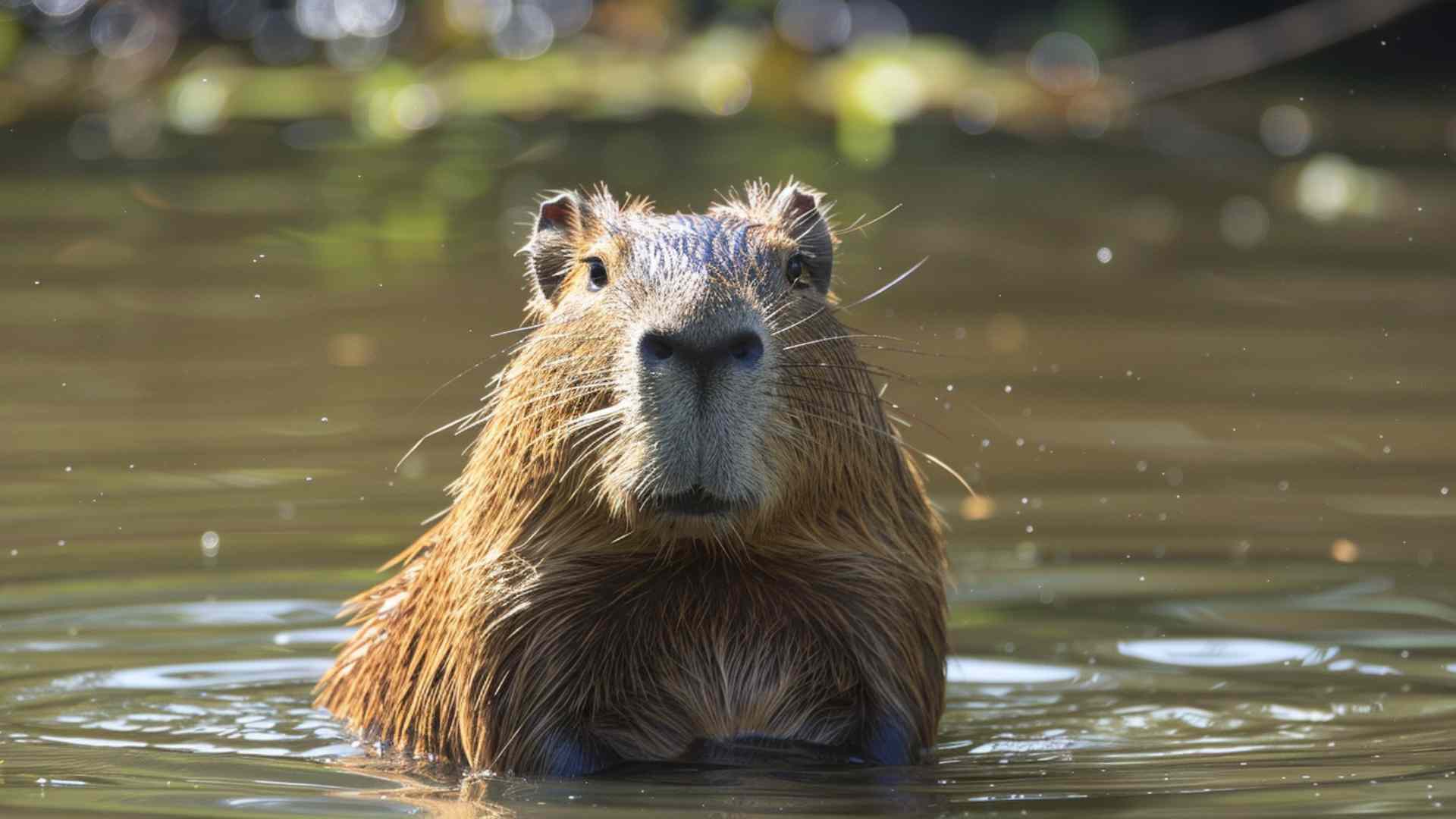
- Their eyes, ears, and nostrils sit high on the head to stay above water.
- Capybaras have partially webbed feet that aid swimming.
- They are native from Venezuela and Colombia south to Argentina and Uruguay.
Record-breakers & wow numbers
- Adult capybaras typically weigh 35–66 kg (77–146 lb).
- Large individuals can exceed 70 kg (154 lb).
- Adults measure about 106–134 cm long and 50–62 cm tall at the shoulder.
- Capybaras can run up to roughly 35 km/h on land.
- A dive can last about 5 minutes when avoiding predators.
- A litter usually contains 1–8 pups, with about 4 being common.
- Gestation lasts around 150 days.
- Pups start grazing within a week of birth.
- Capybara incisors grow continuously throughout life.
- Capybaras have a total of 20 teeth.
- Capybaras have four toes on the front feet and three on the hind feet.
- Newborn pups weigh around 1–2 kg at birth.
- Sexual maturity arrives at about 7–12 months for females.
- Males typically mature around 12–18 months of age.
- Wild capybaras usually live up to 8–10 years, while captive animals may reach about 12 years.

Biology & anatomy
- Capybara fur is coarse, sparse, and dries slowly after swimming.
- The coat color ranges from reddish brown to grayish brown.
- The skin has relatively few sweat glands, so capybaras cool off in water.
- Their barrel-shaped body helps conserve heat and buoyancy.
- A gap called a diastema separates incisors from cheek teeth.
- Capybaras rely on ever-growing incisors to crop tough grasses.
- The molars have ridged surfaces suited to grinding fibrous plants.
- The digestive system uses microbial fermentation in the cecum to process cellulose.
- Capybaras produce nutrient-rich cecotropes that are eaten directly from the anus.
- Their eyes, ears, and nostrils align in a horizontal row for surface swimming.
- The tail is vestigial and not externally visible.
- The skeletal structure supports strong hind limbs for quick sprints to water.
- Capybaras can close their nostrils and press their ears flat when submerged.
- Webbing between toes increases surface area for paddling.
- The heart and lungs are adapted for short, sustained dives.
- Males have a large, raised snout gland called the morrillo used for scent marking.
- Both sexes have anal scent glands that also mark territory.
- Capybaras perform social grooming by nibbling each other’s fur.
- Females usually have two pairs of mammary glands located laterally.
- Pups are precocial and are born with eyes open and a full coat.
- Pups can follow the group and swim soon after birth.
- All group females may nurse pups in a crèche behavior.
- Capybara hearing is sensitive to high-frequency alarm calls.
- Their vision is adapted for scanning while partially submerged.
- They do not undergo a dramatic seasonal molt.
- The thick skin helps resist minor bites from social squabbles.
- The liver and cecum occupy a large portion of the abdominal cavity.
- Capybara whiskers help sense obstacles when swimming at night.
- The dental enamel contains pigments that strengthen the incisors.
- Capybaras have a relatively low metabolic rate for their body size.

Habitat & behavior
- Capybaras prefer habitats with permanent water, grasses, and cover for hiding.
- They rest in dense vegetation during the hottest part of the day.
- Group members maintain contact using soft chirps and hums.
- A sharp bark serves as an alarm when danger approaches.
- Dominant males scent-mark trails and bushes by rubbing the morrillo.
- Subordinate males may mark less frequently and avoid challenging the dominant.
- Groups occupy overlapping home ranges centered on water.
- Capybaras defecate in water or at latrine sites that help mark space.
- They often follow well-worn trails between grazing areas and water.
- In human-dominated landscapes, capybaras shift more activity to nighttime.
- Capybaras are strong swimmers and can cross wide rivers.
- They can nap with only eyes and nostrils above the surface.
- Capybaras wallow in mud to deter parasites and cool the skin.
- They use water as a safe zone when chased by predators.
- Predators include jaguars, pumas, caimans, anacondas, and large eagles.
- Domestic dogs can also be a threat near farms and towns.
- Capybaras are selective grazers that track green regrowth after rains.
- During drought, they eat more reeds, sedges, and aquatic plants.
- Capybaras occasionally nibble tree bark or cultivated crops.
- They can travel several kilometers between feeding and resting sites.
- Group cohesion increases when resources are scarce.
- Females often remain with their natal groups while many males disperse.
- Mating occurs mostly in water where females can evade unwanted males.
- The dominant male guards receptive females but cannot monopolize all matings.
- Pups form play groups that strengthen social bonds.
- Juveniles practice mock chases that build sprinting skills.
- Capybaras often share basking sites with turtles and caimans.
- Birds like small herons sometimes forage near grazing capybaras.
- Capybara grazing helps keep wetland vegetation open for other species.
- Seeds pass through capybara guts and are dispersed in droppings.
- Seasonal flooding in places like the Pantanal shapes capybara movements.
- In the Llanos, group sizes can expand as water recedes during the dry season.
- Capybaras are important prey linking aquatic and terrestrial food webs.
- Human-altered ponds, canals, and rice fields can provide new habitat.
- Vehicle collisions pose risks where roads cross wetland corridors.

Names & etymology
- The word “capybara” likely comes from a Tupi phrase that means “grass eater.”
- Spanish speakers often call the animal “carpincho” or “chigüiro.”
- Portuguese speakers commonly use “capivara.”
- The genus name Hydrochoerus means “water pig” in Greek roots.
- The common nickname “water pig” refers to its barrel shape and aquatic habits.
- Despite nicknames, capybaras are rodents and not pigs.
- Capybaras are more closely related to guinea pigs than to beavers.
- The lesser capybara is slightly smaller and lives from Panama into northern South America.
- Different regions have many local names reflecting Indigenous languages.
- Some early travelers compared capybaras to sheep for their grazing groups.
Capybaras & people
- The species is listed as Least Concern on global conservation assessments.
- Hunting pressure varies by region and can increase near cities and ranches.
- Regulated harvests for meat and hides exist in some countries.
- Capybara meat is lean and has been used in traditional dishes.
- Rural communities sometimes keep semi-tame capybaras near ponds.
- Laws about keeping capybaras as pets vary widely by country and state.
- Capybaras require large outdoor space and deep water to stay healthy.
- Social needs mean solitary housing causes stress for capybaras.
- Zoo groups often live in mixed-species exhibits with birds and reptiles.
- Capybaras can carry ticks that affect people and livestock in some areas.
- Fencing, habitat management, and education help reduce human–capybara conflicts.
- Ecotourism in wetlands benefits when healthy capybara populations are present.
- Capybara dung enriches ponds and supports invertebrates and fish.
- Urban parks with lakes sometimes host capybaras where habitat is suitable.
- Public campaigns encourage drivers to slow down in capybara crossing zones.
For kids: quick comparisons
- A full-grown capybara is about as long as a golden retriever.
- A heavy capybara can weigh as much as a large fourth-grader.
- A capybara’s front teeth never stop growing like a pair of orange chisels.
- Capybaras have built-in flippers because their toes are slightly webbed.
- A capybara’s eyes, ears, and nose line up like three periscopes.
- Capybaras can sit quietly so birds feel safe hopping nearby.
- A capybara can hold its breath long enough to count to 300 slowly.
- A capybara family acts like a team with a leader and helpers.
- Capybaras eat mostly grass the way lawn mowers eat clippings.
- Capybaras love pools the way kids love splash parks on hot days.
Pop culture & fun extras
- Capybaras often appear in cheerful memes about relaxing with friends.
- Videos of capybaras enjoying warm baths delight viewers around the world.
- Winter citrus bath days at Japanese zoos have become a seasonal tradition.
- Capybara plush toys and cartoons spotlight their calm, rounded look.
- Photos sometimes show capybaras resting near caimans during sunny basking.
- Gentle spa scenes make capybaras popular ambassadors for wetlands.
- Artists frequently draw capybaras with tiny birds perched on their backs.
- Many aquariums and zoos host walk-through capybara encounters for visitors.
- Kids’ books often introduce capybaras as patient, friendly heroes.
- The capybara’s easygoing image inspires the motto “live slow, love grass.”
Quick FAQ
Q: Are capybaras rodents or pigs?
A: Capybaras are rodents, not pigs.
Q: Why do capybaras spend so much time in water?
A: Water helps them stay cool, avoid predators, and socialize.
Q: What do capybaras eat?
A: They mainly eat grasses and aquatic plants.
Q: Are capybaras friendly to people?
A: They are generally calm, but they are still wild animals and need space.
Q: Where do capybaras live?
A: They live near rivers, lakes, marshes, and flooded grasslands across much of South America.

Ellie is the owner and sole author of Fun Facts, combining her mechanical engineering background with years of research-driven writing to deliver facts you can trust. Every article is thoroughly fact-checked and routinely updated as new science and sources emerge to keep information accurate and current. Her mission is to make learning delightful while upholding high standards of reliability and transparency.