
Ready to explore the Sunflower State?
This kid-friendly guide packs 145 quick facts about Kansas, its prairies, weather, wildlife, and rich history.
From pioneer trails to space-age planes, you’ll find bite-size nuggets that are easy to read and fun to share. Let’s hit the trail across Kansas!
Origins & definitions
- Kansas is a U.S. state in the Midwest, bordered by Nebraska, Missouri, Oklahoma, and Colorado.
- It became the 34th state on January 29, 1861.
- The state’s nickname is the Sunflower State.
- The demonym for residents is Kansans.
- The capital city is Topeka.
- Wichita is the largest city by population.
- The state abbreviation is KS.
- Kansas spans roughly 660 km (410 mi) east to west.
- It stretches about 340 km (210 mi) north to south.
- The state motto is “Ad astra per aspera,” meaning “to the stars through difficulties.”
- The state bird is the Western meadowlark.
- The state flower is the wild sunflower.
- The state tree is the eastern cottonwood.
- Kansas has 105 counties.
- Four western counties observe Mountain Time while the rest use Central Time.

Record-breakers & wow numbers
- Mount Sunflower, the highest point, rises to about 1,231 m (4,039 ft) near the Colorado line.
- The lowest point is along the Verdigris River at roughly 207 m (679 ft) above sea level.
- A marker near Lebanon marks the geographic center of the contiguous United States.
- Kansas is widely known for powerful spring storms and experiences many tornadoes each year.
- The 2007 Greensburg tornado was rated EF5 and destroyed most of the town of Greensburg.
- The 1966 Topeka tornado was one of the costliest U.S. tornadoes of its time.
- July 1936 brought the state’s record high of 49.4°C (121°F) at Alton.
- February 1905 set the state’s record low of −40°C (−40°F) near Lebanon.
- The Kansas River, called the Kaw, forms where the Republican and Smoky Hill rivers meet at Junction City.
- The Arkansas River crosses the state from Colorado to Oklahoma and is a major Great Plains waterway.
- Kansas grows large amounts of winter wheat and often ranks among the top states for harvest size.
- Feedlots in western Kansas make the state a major beef producer.
- Wind farms across the plains provide a significant share of the state’s electricity generation.
- The state fair in Hutchinson draws hundreds of thousands of visitors each September.
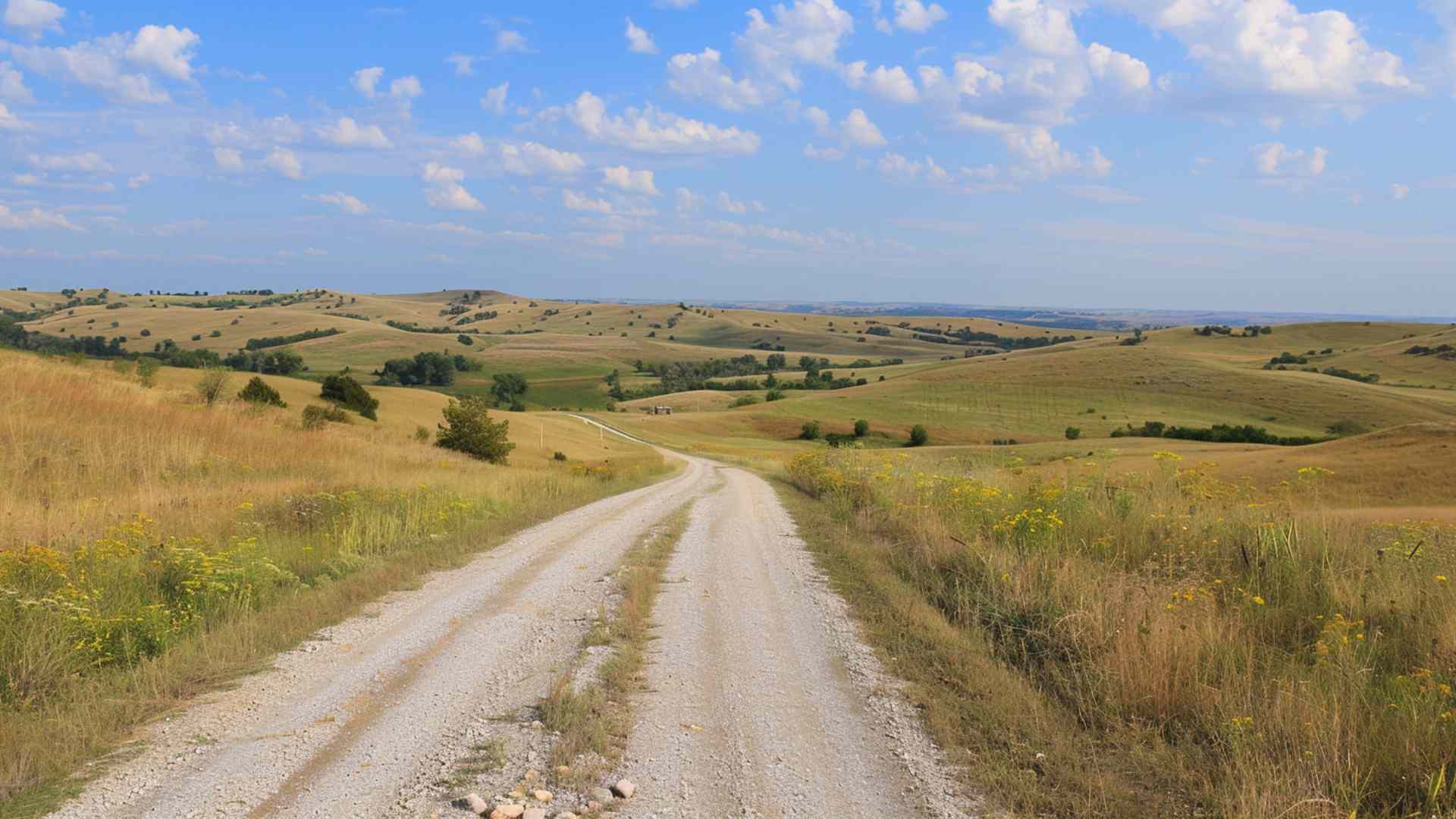
- Kansas has tens of thousands of kilometers of roads, including long straight stretches across open prairie.

Geography & nature
- Much of Kansas lies in the Great Plains, a broad region of grasslands and rolling hills.
- The Flint Hills hold some of the last large areas of tallgrass prairie in North America.
- Tallgrass Prairie National Preserve protects native grasses like big bluestem and Indian grass.
- Bison herds have been reintroduced to several Kansas preserves.
- Prairie chickens display in spring with booming dances on open leks.
- The Arikaree Breaks create badlands and steep gullies in the far northwest.
- Monument Rocks near Oakley are towering chalk formations from an ancient inland sea.
- Rock City near Minneapolis features huge spherical sandstone concretions.
- The Gypsum Hills near Medicine Lodge glow red with layered rock and buttes.
- Cheyenne Bottoms is one of the largest interior wetlands in the United States and a bird migration hotspot.
- Quivira National Wildlife Refuge mixes salt marshes and prairie around rare inland salt flats.
- The Cimarron National Grassland covers a large tract of shortgrass prairie in the southwest corner.
- Cottonwood trees line many Kansas rivers and creeks, offering shade and nesting sites.
- The Ogallala Aquifer under western Kansas stores groundwater used for farms and towns.
- Native sunflowers track the sun as they grow and brighten summer roadsides.
- White-tailed deer are common in woodlots and along river corridors.
- Pronghorn antelope live in open country in the high plains of western counties.
- Prairie rattlesnakes and bullsnakes are part of the state’s reptile community.
- Ornate box turtles are widespread in grasslands and sandy soils.
- The state recognizes Tylosaurus as the official marine fossil.
- The state recognizes Pteranodon as the official flying fossil.
- Western Kansas skies are famously clear and dark, great for stargazing on summer nights.
- Spring brings severe thunderstorms fueled by warm, moist air from the Gulf of Mexico.
- Autumn often offers long, mild days perfect for prairie hikes and harvest events.
- Many Kansas homes include basements or safe rooms as shelter during tornado season.
History & milestones
- The name Kansas comes from the Kansa or Kaw people, whose homelands included the region.
- The Kansas–Nebraska Act of 1854 opened the area to settlement and popular sovereignty.
- The violent 1850s struggle known as “Bleeding Kansas” pitted free-state and pro-slavery forces.
- Lawrence was a free-state stronghold attacked during the 1863 Lawrence Massacre.
- Kansas entered the Union as a free state at the start of the Civil War in 1861.
- Abolitionist John Brown fought in territorial Kansas before the war.
- The Santa Fe Trail crossed Kansas, linking Missouri river towns to New Mexico.
- Parts of the Oregon and California Trails passed through northeastern Kansas.
- The Pony Express ran through northeastern Kansas with a major station at Marysville.
- Cattle drives from Texas ended at railheads in Abilene and other Kansas towns in the 1860s and 1870s.
- Dodge City became a legendary Old West cattle town with famous lawmen and lively saloons.
- Fort Larned protected the Santa Fe Trail and is now a national historic site.
- Fort Scott guarded important frontier routes and later served during the Civil War.
- Nicodemus was founded by Black settlers after the Civil War and is preserved as a national historic site.
- In 1954, Brown v. Board of Education of Topeka ended legal school segregation in the United States.
- Haskell Indian Nations University in Lawrence began in the 19th century and continues today.
- The 1930s Dust Bowl battered western Kansas with drought and dust storms.
- The 1951 flood along the Kansas River inundated Topeka, Lawrence, and Kansas City areas.
- The Kansas Turnpike opened in 1956 and links Wichita, Emporia, Topeka, and Lawrence.
- Wichita’s aircraft factories built thousands of planes during World War II.
- The Big Well in Greensburg is a huge hand-dug well completed in 1888.
- Susanna M. Salter of Argonia was elected mayor in 1887, a first for U.S. women.
- Carry Nation led dramatic saloon-smashing temperance crusades in Kansas towns.
- Kansas kept statewide prohibition in its constitution from 1881 until mid-20th-century changes.
- Liquor by the drink in public establishments was not legalized statewide until 1986.
- Dwight D. Eisenhower grew up in Abilene and later became the 34th U.S. president.
- Amelia Earhart was born in Atchison and became a pioneering aviator.
- Langston Hughes spent part of his childhood in Lawrence and wrote about the region.
- The Atchison, Topeka and Santa Fe Railway shaped settlement and commerce across the plains.
- Harvey House restaurants along the rail line introduced standardized dining to travelers.

Culture & people
- Today’s Kansas includes communities with roots in German, Swedish, Czech, Mexican, and Vietnamese traditions.
- Lindsborg brands itself “Little Sweden” and hosts a biennial Svensk Hyllningsfest.
- Mennonite settlers brought hardy Turkey Red wheat to Kansas in the 1870s.
- Bierocks—yeast buns stuffed with beef and cabbage—are a popular old-world snack in Kansas.
- Many Kansans enjoy chili served with a cinnamon roll at fall school lunches.
- Barbecue is big in the Kansas City metro, with smoky burnt ends as a local favorite.
- Wichita’s food scene mixes farm-to-table cafes with classic diner fare.
- The Symphony in the Flint Hills stages outdoor concerts on summer prairie hills.
- The Keeper of the Plains, a tall sculpture at the rivers’ confluence in Wichita, is a city symbol.
- The Kansas State Fair features giant vegetables, 4-H exhibits, and midway rides every September.
- Garden City once touted a massive municipal swimming pool known simply as “The Big Pool.”
- Small-town Main Streets host autumn harvest festivals and winter light parades.
- College basketball fandom runs deep across the state.
- Kansas defines high school sports rivalries that pack gymnasiums on Friday nights.
- Local libraries and museums often double as community hubs in rural counties.
- Farmers’ markets pop up in warm months with sweet corn, melons, and sunflower bouquets.
- Many towns proudly paint water towers with mascots and slogans.
- Community volunteerism is strong during storm cleanups and harvest relief efforts.
- County fairs showcase prize livestock, quilts, and homemade pies.
- Family-owned wheat farms often work with custom harvest crews that travel north with the season.
Science, economy & industry
- Aircraft design and manufacturing earned Wichita the nickname “Air Capital of the World.”
- General aviation makers have produced countless small planes in south-central Kansas.
- Modern factories in the region also build major parts for commercial airliners.
- The Cosmosphere in Hutchinson displays historic spacecraft and hands-on STEM exhibits.
- The state hosts research on prairie ecology, soils, and water conservation.
- The Ogallala Aquifer’s declining levels drive innovation in efficient irrigation.
- Sun and wind resources position Kansas as a leader in renewable energy development.
- Grain elevators dot rail lines to move wheat, corn, and sorghum to global markets.
- Cattle feedlots and packing plants anchor the economy in several western counties.
- Oil and natural gas fields contribute to energy production in south-central Kansas.
- Helium extraction has a long history in the Hugoton natural gas area.
- Universities in Lawrence, Manhattan, and Wichita fuel research and startup activity.
- Advanced composites labs in the state support next-generation aircraft structures.
- Logistics hubs near interstates connect the central location to coast-to-coast shipping.
- Agricultural co-ops help small producers buy inputs and sell crops efficiently.
- Grain sorghum, often called milo, is drought-tolerant and widely grown in drier regions.
- Kansas dairies are expanding with new processing and cheese plants.
- Vineyards and wineries are emerging in river valleys and hill slopes.
- Tourism draws visitors to prairies, fossils, museums, and historic forts.
- Outdoor recreation brings spending through hunting seasons, birding, and prairie hikes.
Names & etymology
- The word Kansa is often translated as “people of the south wind.”
- The Kansas River’s nickname “the Kaw” echoes the Kansa name.
- Topeka is said to derive from a Kansa and Omaha phrase meaning “a good place to dig potatoes.”
- Wichita likely comes from a Native word related to “scattered lodges.”
- The Smoky Hill River was named for the haze from prairie fires along its course.
- The city of Liberal got its name from a settler known for giving travelers free water.
- Medicine Lodge took its name from a Native ceremonial site along the river.
- Dodge City took its name from nearby Fort Dodge.
- Abilene borrowed its name from a biblical word meaning “grassy meadow.”
- Manhattan got its name from investors promoting a “New Manhattan” on the Kansas River.
For kids: quick comparisons
- Kansas is bigger than Illinois but smaller than Colorado by total area.
- If you drive I-70 across Kansas at highway speeds, the trip takes most of a day.
- Mount Sunflower is a hill on a ranch, not a rocky peak with cliffs.
- A typical wheat field in June turns golden like a sea of grass in the wind.
- Tornado sirens are loud on purpose so people outdoors can hear warnings.
Pop culture & fun extras
- Dorothy’s line “We’re not in Kansas anymore” made the state famous in movie history.
- The city of Wamego hosts an Oz Museum celebrating characters from the classic story.
- Superman’s adoptive hometown of Smallville is set in Kansas in many versions of the tale.
- Cawker City proudly keeps adding twine to a community-built giant ball of sisal.
- Children’s Mercy Park in Kansas City, Kansas hosts top-tier soccer and loud supporter sections.
Quick FAQ
What is Kansas known for?
Kansas is known for tallgrass prairie, wide-open skies, trailblazing history, aviation manufacturing, and big wheat harvests.
What is the capital of Kansas?
The capital is Topeka, located on the Kansas River.
Does Kansas really get a lot of tornadoes?
Yes, Kansas sits in Tornado Alley and sees numerous spring and early-summer storms.
What is the highest point in Kansas?
Mount Sunflower is the high point at about 1,231 m (4,039 ft) near the Colorado border.
Where is the geographic center of the contiguous U.S.?
A marker near Lebanon, Kansas commemorates the center of the 48 states.

Ellie is the owner and sole author of Fun Facts, combining her mechanical engineering background with years of research-driven writing to deliver facts you can trust. Every article is thoroughly fact-checked and routinely updated as new science and sources emerge to keep information accurate and current. Her mission is to make learning delightful while upholding high standards of reliability and transparency.