
Soccer is the world’s favorite team game, mixing skill, speed, and strategy on a big green field.
This list packs quick, friendly facts that players and fans of any age can enjoy.
From how big the goal is to what a panenka means, you’ll learn the sport’s rules, history, and fun culture fast.
Origins & definitions
- Soccer is a team sport played between two sides of 11 players on a rectangular field with a goal at each end.
- The sport is officially called association football, which is where the word “soccer” originally came from.
- The modern Laws of the Game were first codified in England in 1863.
- A standard match lasts 90 minutes, split into two halves of 45 minutes each.
- Play is controlled by a referee on the field with two assistant referees on the touchlines.
- The objective is to score by getting the whole ball over the goal line between the posts and under the crossbar.
- Players use their feet, legs, torso, or head while only the goalkeeper may use hands inside the penalty area.
- The ball must be spherical with a circumference of 68–70 cm and a mass of 410–450 g at kickoff.
- The goal is 7.32 m wide and 2.44 m high.
- The penalty spot is 11 m from the center of the goal line.
- The center circle radius is 9.15 m to keep opponents the required distance at kick-off.
- Each corner of the field has a quarter-circle arc with a 1 m radius for corner kicks.
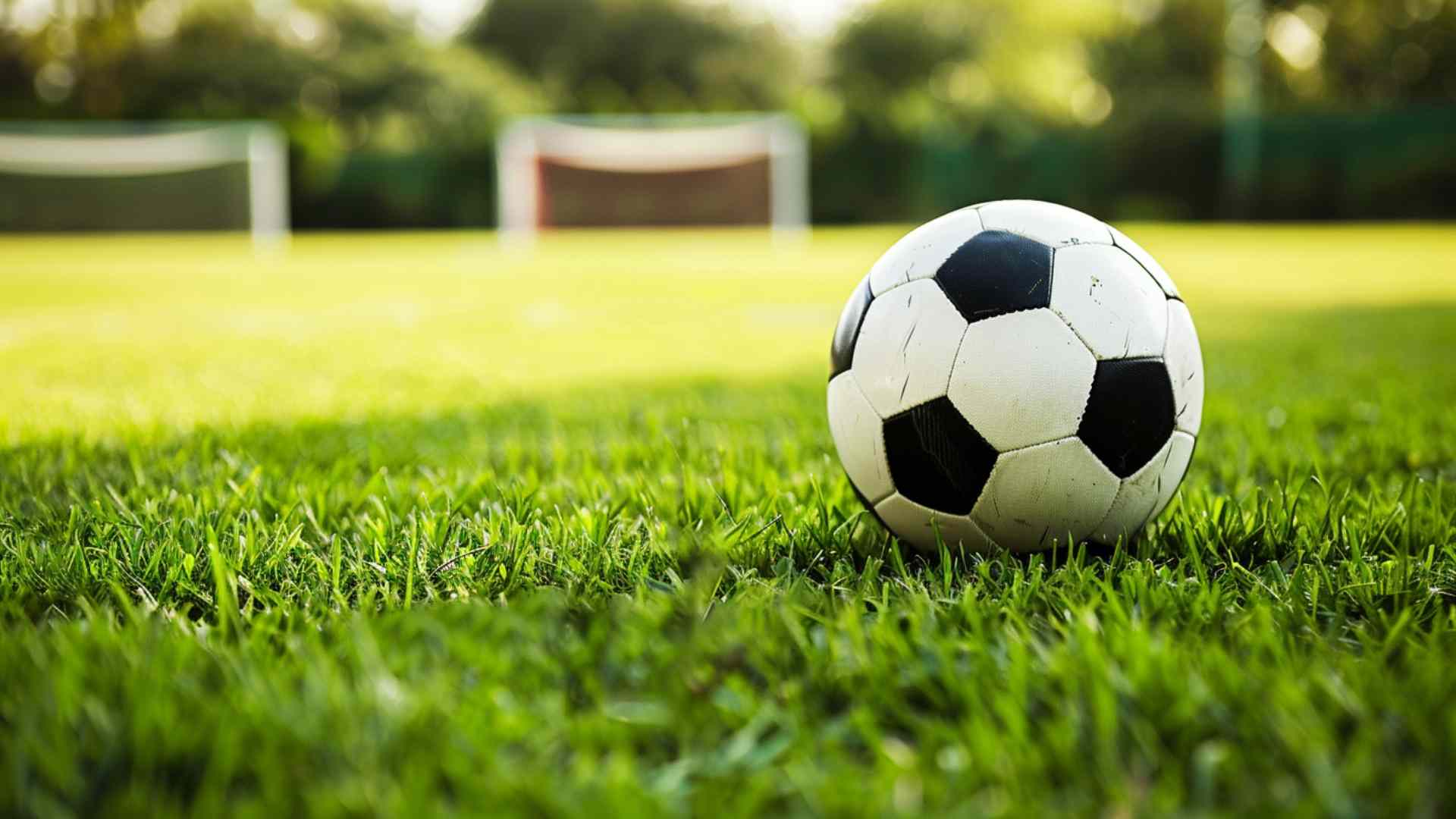
Field & equipment specs
- Adult fields are typically 100–110 m long and 64–75 m wide within competition limits.
- The penalty area extends 16.5 m from the goal line and is 40.3 m wide.
- The goal area, often called the six-yard box, extends 5.5 m from the goal line and is 18.3 m wide.
- Boundary lines are part of the areas they define, so the ball touching a line is still in that area.
- The ball is out only when it has wholly crossed a boundary line or when the referee stops play.
- Nets are optional under the Laws but are used in almost every organized match.
- Corner flags must be at least 1.5 m high and cannot have a pointed top.
- Players wear numbered shirts, shorts, socks, shin guards, and footwear called boots or cleats.
- Goalkeepers wear colors that distinguish them from outfield players and the match officials.
- Team jerseys must be clearly different from each other to avoid confusion.
- A coin toss before the game decides which team kicks off and which goal to attack first.
- Many competitions allow short cooling breaks in hot conditions for player safety.
- Pitches can be natural grass, approved artificial turf, or hybrid systems.
- Some stadiums use undersoil heating or grow lights to keep grass healthy in cold or low-light conditions.
- Recommended ball pressure is usually 0.6–1.1 bar at sea level for proper bounce.
- Modern match balls use thermally bonded synthetic panels for consistent flight.
- Referees carry a whistle, cards, a notebook, and often vanishing spray to mark free-kick spots.
- Electronic boards display substitutions and indicate minimum additional time at the end of each half.

Rules & gameplay
- Kick-offs can go in any direction and a goal may be scored directly against the opponent from a kick-off.
- A player is offside if nearer to the opponent’s goal line than both the ball and the second-last defender when the ball is played to them.
- There is no offside offense from a goal kick, a corner kick, or a throw-in.
- Simply being in an offside position is not an offense unless the player becomes involved in active play.
- Direct free kicks or penalty kicks punish fouls such as tripping, pushing, or handball by defenders in their area.
- Indirect free kicks are given for non-contact offenses like dangerous play or goalkeeper violations.
- Defenders must stay 9.15 m from a free kick until the ball is in play.
- Advantage lets play continue when stopping for a foul would benefit the team that committed it.
- A yellow card cautions a player for misconduct like unsporting behavior or persistent infringement.
- A red card sends a player off for serious foul play, violent conduct, or denying an obvious goal-scoring opportunity.
- Two yellow cards in one match equal a red card and dismissal.
- A penalty kick is taken from 11 m with all other players outside the penalty area and arc until the ball is in play.
- The goalkeeper must be on the goal line facing the kicker and may move laterally before the kick.
- Handball is penalized when a player deliberately handles the ball or makes the arm unnaturally bigger to block the ball.
- Slide tackles are legal if they are not dangerous and play the ball fairly.
- A throw-in restarts play when the ball crosses a touchline and must be taken with both hands from behind and over the head.
- At a throw-in, both feet must be on or behind the touchline when the ball is released.
- A corner kick is awarded when a defender last touches the ball before it crosses the goal line without a goal.
- A goal kick is awarded when an attacker last touches the ball before it crosses the goal line without a goal.
- Since 2019, goal kicks and defensive free kicks are in play once the ball is kicked and clearly moves.
- The back-pass rule forbids a goalkeeper from handling a deliberate kick from a teammate’s foot.
- A goalkeeper may hold the ball for up to six seconds before releasing it.
- A dropped ball restarts play when the referee stops the game for a reason not listed in the Laws.
- Most modern dropped balls are uncontested and given to one player of the team that last touched the ball.
- If advantage does not develop quickly, the referee can still stop play and sanction the original foul.
- Extra time consists of two periods of 15 minutes each when required by competition rules.
- If the score remains level after extra time, a penalty shootout may decide the winner.
- Teams name substitutes before kick-off and many competitions now allow up to five changes.
- A substituted player cannot return in most top-level competitions.
- Referees add time at the end of each half to make up for stoppages like injuries, substitutions, and reviews.
- Only the team in possession can take a quick free kick, accepting the risk of nearby defenders.
- The ball is in play when it rebounds from the goal frame, a corner flag, or the referee if still on the field.
- A goal cannot be scored directly from a team’s own throw-in, indirect free kick, or dropped ball.
- Video assistant referee technology can help correct clear and obvious errors in competitions that use it.
- Team officials in the technical area can be cautioned or sent off for irresponsible behavior.

Competitions & tournaments
- Soccer’s global body oversees international competitions and sets worldwide standards for the game.
- The Laws of the Game are maintained by a board representing national associations and the global body.
- The men’s World Cup began in 1930 and is held every four years except during World War II.
- Uruguay won the first men’s World Cup in 1930.
- The women’s World Cup began in 1991 and expanded to 32 teams in 2023.
- The United States has won the women’s World Cup four times.
- The men’s World Cup is scheduled to expand to 48 teams in 2026.
- Continental championships like Euro, Copa América, and the Africa Cup of Nations crown regional champions.
- Olympic soccer uses age limits for men with a set number of overage players allowed.
- Club soccer runs domestic leagues that determine champions over a season of home and away games.
- Many countries also run knockout domestic cup competitions alongside their leagues.
- Promotion and relegation move clubs between divisions based on final positions.
- The top European club tournament rebranded in 1992 and now features group and knockout stages.
- The away goals rule once broke ties in two-leg series but has been removed in several major events.
- Super cups often match a league winner against a cup winner to open a new season.
- Many associations stage community or charity shield matches as season curtain-raisers.
- International match windows are set periods when clubs must release players for national team duty.
- Elite referees and assistants pass fitness tests and assessments each season.
- Youth tournaments use shorter matches and smaller fields suitable for development.
- Futsal is a five-a-side indoor version with a smaller, less bouncy ball and a hard court.
- Beach soccer is played on sand with five players per team and unique restart rules.
- Walking football adapts the game by banning running to include older or recovering players.
- Small-sided formats like 7v7 and 5v5 are widely used for training and youth play.
- Many leagues schedule winter breaks to reduce fixture congestion and protect player welfare.

Positions & tactics
- Teams line up with one goalkeeper and ten outfield players in various formations.
- Common formations include 4-3-3, 4-2-3-1, 3-5-2, and 4-4-2.
- Full-backs defend wide areas and support attacks down the flanks.
- Center-backs protect the area in front of goal and often mark opposing strikers.
- A sweeper, or libero, plays behind the back line to clear danger in certain systems.
- Defensive midfielders screen the defense and break up opposition moves.
- Box-to-box midfielders contribute to both defending and attacking over long distances.
- Playmakers, often wearing number 10, create chances between the lines.
- Wingers stretch the field horizontally and deliver crosses into the penalty area.
- Center forwards lead the line and try to finish moves with shots on goal.
- A false nine drops into midfield to pull defenders out of position.
- Wing-backs provide width and stamina in back-three systems.
- Pressing is a coordinated effort to win the ball back quickly after losing it.
- Counterattacking tries to exploit space immediately after regaining possession.
- Zonal marking assigns defenders to guard spaces rather than specific opponents.
- Man-to-man marking assigns players to track specific opponents closely.
- The offside trap steps the defensive line up together to catch attackers offside.
- Set pieces include corners, free kicks, and throw-ins planned to create chances.
- Expected goals is a metric that estimates shot quality based on location and context.
- Load management and squad rotation help teams stay fresh during busy schedules.
History & milestones
- Early football existed for centuries, but modern rules grew from English school and club codes in the 1800s.
- The Cambridge and Sheffield rules strongly influenced the unified Laws of the Game.
- Uniform player numbers appeared in the early 20th century to help spectators identify players.
- Substitutions were added to elite competitions during the 1960s and expanded over time.
- Red and yellow cards were first used at a major international tournament in 1970.
- The back-pass rule arrived in 1992 to speed up play and reduce time wasting.
- Golden goal extra time ended matches immediately upon a goal in the 1990s and early 2000s.
- The silver goal variation briefly ended the first extra-time period if one team led at halftime of extra time.
- Goal-line technology uses cameras or sensors to confirm when the whole ball crosses the goal line.
- Vanishing spray became common in the 2010s to mark free-kick spots and defensive walls.
- Many leagues adopted three points for a win by the 1990s to reward attacking play.
- Women’s national team tournaments grew rapidly in the 1990s and 2000s.
- Youth academies formalized club player development pathways around the world.
- Modern sports science refined training with GPS tracking, nutrition planning, and recovery work.
- Video analysis tools help teams study patterns, set pieces, and opponent tendencies in detail.
- International match calendars were standardized to balance club and country commitments.
For kids: quick comparisons
- A typical adult soccer field is about the length of a city block and wider than an ice hockey rink.
- The goal is about as high as a doorway and more than three small cars wide.
- A soccer ball is a little smaller than a basketball and much larger than a baseball.
- Players often run 8–12 km in a match depending on position and style.
- There are 22 players on the field at once, which is more than in basketball or hockey.
- The free-kick distance of 9.15 m is about the length of a school bus.
- Each team has one goalkeeper who can use hands only inside the penalty area.
- A hat-trick means one player scored three goals in the same game.
- Extra time adds two 15-minute periods when a tournament game needs a winner.
- Penalty shootouts act like a tie-breaker with alternating kicks from the penalty spot.
Pop culture & fun extras
- A derby is a rivalry match between teams from the same city or region.
- Fans often create giant choreographed displays called tifos before kickoff.
- A nutmeg is when a player dribbles the ball through an opponent’s legs.
- An olympico is a rare goal scored directly from a corner kick.
- A panenka is a softly chipped penalty down the middle after the goalkeeper dives.
- A brace means a player scored two goals in one match.
- A clean sheet means a team allowed no goals in the game.
- An own goal is recorded when a defender accidentally puts the ball into their own net.
- The term “twelfth player” or “twelfth man” describes how loud fans feel like an extra teammate.
- Ball kids around the field speed up play by returning balls quickly for restarts.
Quick FAQ
Q: How long is a soccer game?
A: A standard game lasts 90 minutes plus added time, with two 45-minute halves and a halftime break.
Q: How big is a soccer goal?
A: A full-size goal is 7.32 m wide and 2.44 m high.
Q: What is offside in soccer?
A: Offside happens when a player is closer to the opponent’s goal than the ball and the second-last defender when the pass is made to them.
Q: How many players are on a soccer team?
A: Each team fields 11 players, including one goalkeeper.
Q: What does a yellow card mean?
A: A yellow card is a caution for misconduct, and two yellows equal a red card and dismissal.

Ellie is the owner and sole author of Fun Facts, combining her mechanical engineering background with years of research-driven writing to deliver facts you can trust. Every article is thoroughly fact-checked and routinely updated as new science and sources emerge to keep information accurate and current. Her mission is to make learning delightful while upholding high standards of reliability and transparency.