
Africa is huge, diverse, and full of surprises, from record-breaking rivers to ancient cities and unique wildlife.
This friendly list serves up quick, kid-safe nuggets about places, people, animals, and history across the continent.
Dip in anywhere, learn something new, and share a wow moment with a friend.
Origins & definitions
- Africa is the second-largest continent by area at about 30.37 million square kilometers.
- Africa is the second-most populous continent with about 1.46 billion people as of 2024.
- The continent is bounded by the Mediterranean Sea, Atlantic Ocean, Indian Ocean, and the Red Sea.
- The Isthmus of Suez in Egypt connects Africa to Asia by land.
- Geographers typically count 54 sovereign countries in Africa.
- Western Sahara is a disputed territory in North Africa.
- The African Union is a continental body founded in 2002 to promote cooperation.
- Africa includes large island nations such as Madagascar, Mauritius, and Seychelles.
- Madagascar is the world’s fourth-largest island.
- The equator crosses Africa through Gabon, Republic of the Congo, Democratic Republic of the Congo, Uganda, Kenya, Somalia, and São Tomé and Príncipe.
- Africa spans at least six standard time zones from UTC−1 to UTC+4.
- The Horn of Africa is a peninsula including Somalia, Ethiopia, Eritrea, and Djibouti.
- The Sahel is a semi-arid belt stretching across the continent south of the Sahara.
- The Maghreb refers to North African lands west of Egypt.
- Sub-Saharan Africa describes the regions located south of the Sahara Desert.
Record-breakers & wow numbers
- The Sahara is the world’s largest hot desert at about 9.2 million square kilometers.
- Mount Kilimanjaro in Tanzania is Africa’s highest peak at 5,895 meters.
- The Nile is Africa’s longest river at about 6,650 kilometers.
- Lake Victoria is Africa’s largest lake by area at about 68,800 square kilometers.
- Lake Tanganyika is Africa’s deepest lake at about 1,470 meters.
- Victoria Falls on the Zambezi is about 1,708 meters wide and up to 108 meters high.
- The Congo Rainforest is the world’s second-largest tropical rainforest.
- The Namib Desert is one of the world’s oldest deserts, with parts estimated to be tens of millions of years old.
- The Sahara can see summer daytime temperatures above 50°C (122°F).
- The Great Rift Valley extends for more than 6,000 kilometers.
- Africa has the world’s largest hot desert and also vast wetlands like the Okavango Delta.
- Ethiopia’s Danakil Depression drops to about 125 meters below sea level.
- Djibouti’s Lake Assal can be more than ten times saltier than typical seawater.
- Madagascar covers about 587,000 square kilometers.
- The Nile Delta spreads along roughly 240 kilometers of Mediterranean coastline.
- Algeria is Africa’s largest country by area at about 2.38 million square kilometers.
- Seychelles is Africa’s smallest country by area at about 459 square kilometers.
- Nigeria is Africa’s most populous country with over 220 million people as of 2024.
- Ethiopia is Africa’s most populous landlocked country.
- Cairo’s metropolitan area exceeds 20 million people as of 2024.
- Lagos ranks among the continent’s biggest metros with well over 15 million people as of 2024.
- Kinshasa is the world’s largest Francophone city by population as of 2024.
- Lake Malawi holds more fish species than any other lake on Earth.
- Africa’s coastline stretches roughly 30,500 kilometers.
- The Sahara covers about one-third of Africa’s land area.

Nature, wildlife & ecology
- The African elephant is the largest land animal on Earth.
- The common ostrich is the largest living bird.
- The cheetah is the fastest land animal, reaching speeds over 100 km/h.
- The Nile crocodile is among the largest freshwater predators in Africa.
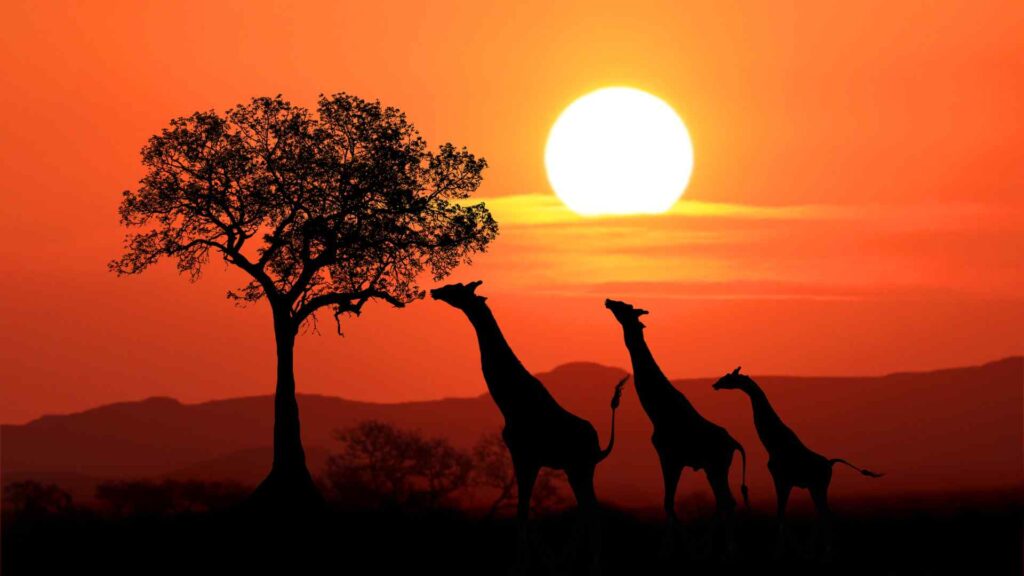
- The giraffe is the tallest land animal, with males often exceeding 5 meters.
- Black and white rhinoceroses are native to Africa.
- Hippopotamuses spend much of the day in water to keep cool.
- The “Big Five” refers to lion, leopard, elephant, buffalo, and rhinoceros.
- Africa hosts over 1,100 species of mammals.
- Africa is home to over 2,600 species of birds.
- Lemurs evolved in isolation and occur naturally only in Madagascar.
- The fossa is Madagascar’s largest native carnivorous mammal.
- Okapis live in the rainforests of the Democratic Republic of the Congo.
- Meerkats live in social groups called mobs or gangs in southern African deserts.
- The wildebeest migration in East Africa involves well over a million animals yearly.
- Baobab trees can store thousands of liters of water in their trunks.
- The Welwitschia plant in the Namib Desert can live for over a thousand years.
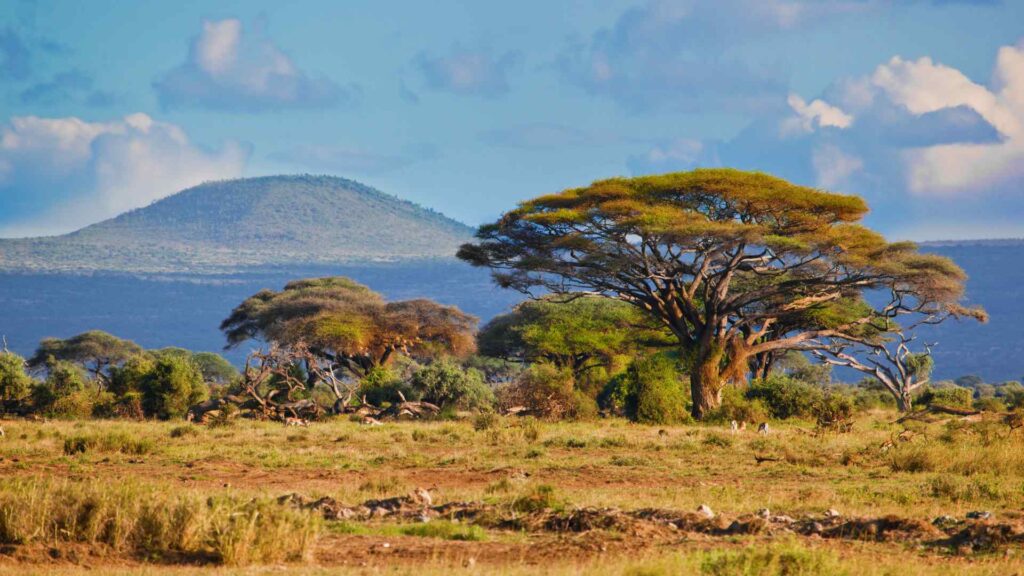
- Savannas are grasslands with scattered trees shaped by seasonal rains and fires.
- The Cape Floral Region holds an exceptional concentration of plant species.
- The Ethiopian Highlands are nicknamed the “Roof of Africa” for their elevations.
- The Serengeti ecosystem spans northern Tanzania and southwestern Kenya.
- The Sahara supports hardy species like the dromedary camel and fennec fox.
- Mangrove forests line warm African coasts and help protect shorelines from erosion.
- The Congo Basin stores vast amounts of carbon in peatlands and forests.
- The Okavango Delta in Botswana is a seasonal inland delta that floods annually.
- Kenya’s Lake Nakuru can host huge flocks of flamingos when conditions align.
- The Drakensberg mountains contain unique alpine and montane habitats.
- The African penguin lives along the coasts of South Africa and Namibia.
- Desert pavement forms in the Sahara where wind leaves behind gravel and stones.
- Many African climates are guided by the Intertropical Convergence Zone’s shifting rains.

People, languages & culture
- Africa has more than 2,000 languages across several major language families.
- Swahili serves as a widely used lingua franca in East Africa.
- Arabic is widely spoken in North Africa and parts of the Horn of Africa.
- Hausa is a major trade language across West Africa.
- Amharic uses a unique script descended from Geʽez.
- Zulu is one of the most widely spoken languages in southern Africa.
- Yoruba and Igbo are two of the largest languages in Nigeria.
- Berber languages are indigenous to North Africa.
- Afrikaans developed from Dutch and is spoken mainly in South Africa and Namibia.
- French and English are official languages in many African countries.
- Portuguese is an official language in six African countries.
- The median age in Africa is around 19 years as of 2024.
- Islam and Christianity are the two largest religions in Africa.
- Traditional belief systems remain important alongside major religions.
- Many African cuisines feature sorghum, millet, maize, and rice.
- Jollof rice is a beloved West African party dish with regional variations.
- Injera is a spongy sourdough flatbread central to Ethiopian and Eritrean meals.
- Couscous is a staple in many North African countries.
- Cassava is a key root crop in tropical Africa.
- Shea butter comes from nuts of a savanna tree.
- Kente cloth from Ghana is known for bright colors and symbolic patterns.
- Kangas and kitenges are popular patterned fabrics in East Africa.
- The djembe is a goblet drum widely played in West Africa.
- The kora is a 21-string harp-lute used across the western Sahel.
- Afrobeat, highlife, rai, soukous, kwaito, and amapiano are well-known music genres.
- Football is the most popular sport across the continent.
- The Africa Cup of Nations is the premier men’s football tournament in Africa.
- Distance runners from Kenya and Ethiopia often win major international marathons.
- Traditional wrestling remains popular in many West African communities.
- Many countries celebrate independence days gained mainly in the 1950s and 1960s.
History & heritage
- Human origins trace deep into Africa with very ancient fossils found across the continent.
- Ancient Egypt emerged along the Nile more than 5,000 years ago.
- The Pyramids of Giza are the only surviving Wonder of the Ancient World.
- Carthage was a powerful trading city in what is now Tunisia.
- The Kingdom of Kush thrived south of ancient Egypt along the Nile.
- Aksum in present-day Ethiopia was a major trading empire that minted coins.
- Great Zimbabwe raised striking dry-stone buildings between the 11th and 15th centuries.
- The Mali Empire prospered in West Africa between the 13th and 16th centuries.
- Timbuktu became a renowned center of learning in the medieval Sahel.
- Swahili Coast city-states flourished on Indian Ocean trade for centuries.
- Trans-Saharan trade linked West Africa with North Africa and the Mediterranean.
- The late-19th-century Scramble for Africa brought rapid European colonization.
- Liberia declared independence in 1847 and kept sovereignty through the colonial era.
- Ethiopia maintained sovereignty through most of that era aside from a brief occupation.
- Pan-Africanism promoted unity among people of African descent in the 20th century.
- South Sudan became the newest African country in 2011.
- Eswatini changed its official name from Swaziland in 2018.
- The African Union replaced the Organization of African Unity in 2002.
- Many African flags use Pan-African colors of red, green, yellow, and black.
- Historic rock art sites appear from the Sahara to South Africa.
Geography & places
- The Atlas Mountains rise across Morocco, Algeria, and Tunisia.
- The Drakensberg forms the highest mountain range in Southern Africa.
- The Mozambique Channel separates Madagascar from mainland Africa.
- The Gulf of Guinea lies on the Atlantic coast of West Africa.
- The Canary Islands sit off northwest Africa while belonging to Spain.
- The Cape of Good Hope marks a rocky headland near Africa’s southern tip.
- Lake Chad has fluctuated dramatically in size since the 1960s.
- The White Nile and Blue Nile meet at Khartoum in Sudan.
- The Niger River makes a great bend through Mali before reaching the Atlantic.
- The Limpopo River flows along borders of South Africa, Botswana, Zimbabwe, and Mozambique.
- Ghana’s Lake Volta is among the world’s largest reservoirs by surface area.
- Ethiopia’s Danakil region features colorful hydrothermal pools and salt flats.
- Namibia’s Skeleton Coast is famous for shipwrecks, dunes, and persistent fog.
- The Comoros archipelago lies between Madagascar and Mozambique in the Indian Ocean.
- Lesotho is an enclave country entirely surrounded by South Africa.
For kids: quick comparisons
- Africa is bigger than the United States, China, India, and Japan combined.
- You could fit about three United States into Africa’s land area.
- The Nile is about the distance from London to New Delhi in a straight line.
- Mount Kilimanjaro is over seven times taller than the world’s tallest building.
- Lake Victoria is roughly the size of West Virginia.
Pop culture & fun extras
- Many popular films and documentaries feature Africa’s savannas, deserts, and rainforests.
- Safari is a Swahili word meaning journey.
- Traditional storytelling and proverbs remain a cherished art across the continent.
- Drumming circles and dance festivals are common features of community celebrations.
- Colorful markets in many African cities buzz with traders selling spices, textiles, and fresh produce.
Quick FAQ
What is the largest country in Africa by area?
Algeria is the largest by area.
What is the highest mountain in Africa?
Mount Kilimanjaro is the highest at 5,895 meters.
How many countries are in Africa?
There are typically counted as 54 sovereign countries.
What is the longest river in Africa?
The Nile is the longest at about 6,650 kilometers.
Which animal is the largest land animal in Africa?
The African elephant is the largest land animal.

Ellie is the owner and sole author of Fun Facts, combining her mechanical engineering background with years of research-driven writing to deliver facts you can trust. Every article is thoroughly fact-checked and routinely updated as new science and sources emerge to keep information accurate and current. Her mission is to make learning delightful while upholding high standards of reliability and transparency.