
Koalas are one of the world’s most loved animals, and there’s a lot more to them than sleepy cuddles.
This kid-friendly guide packs in bite-size facts about their bodies, habits, food, and the forests they call home.
Get ready to meet the jellybean joey, the eucalyptus expert, and the champion tree-hugger!
Origins & definitions
- Koalas are marsupials, not bears.
- Marsupials carry and nurse their young in a pouch.
- The scientific name of the koala is Phascolarctos cinereus.
- Phascolarctos combines Greek words meaning “pouch” and “bear,” even though koalas are not bears.
- Cinereus means “ash-colored,” describing the koala’s gray fur.
- Koalas are the only living members of the family Phascolarctidae.
- Their closest living relatives are wombats.
- Koalas live naturally only in Australia.
- Fossils show koala relatives appeared in Australia about 25 million years ago.
- A baby koala is called a joey, like other marsupial young.
- Koalas are arboreal mammals that spend most of their time in trees.
- Koalas are folivores, which means they mainly eat leaves.
- The word “koala” is widely believed to come from an Aboriginal word meaning “no water.”
- Early European settlers called them “native bears,” which started the wrong nickname “koala bear.”
- Koalas are generally solitary animals with overlapping home ranges.
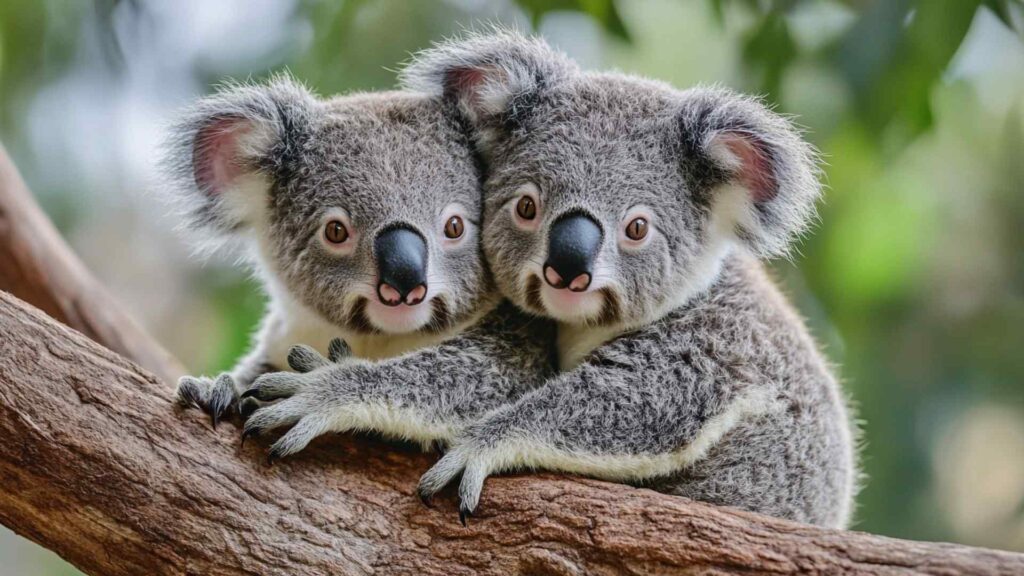
Record-breakers & wow numbers
- Adult koalas typically measure 60–85 cm from head to rump.
- Southern koalas tend to be heavier than northern koalas.
- Adult koalas usually weigh between 4 and 15 kg depending on sex and region.
- Koalas sleep or rest for around 18–20 hours each day.
- A joey stays inside the pouch for about six months.
- Koalas usually have one joey per year in good conditions.
- Gestation for a koala lasts roughly 33–35 days.
- Wild koalas often live 10–12 years, with some reaching about 15 years.
- Koalas in human care can live longer than those in the wild.
- A male koala’s bellow can carry across over a kilometer of woodland.
- Koalas feed from many eucalypt species but prefer a small set that varies by region.
- Koalas have one of the longest ceca relative to body size among mammals.
- A newborn joey is only about 2 cm long.
- A newborn joey weighs under 1 gram.
- Koalas can lower heat stress by hugging cooler tree trunks on hot days.

Biology & anatomy
- Koalas have thick, woolly fur that insulates them from heat and cold.
- Their fur is water-resistant, helping rain roll off.
- Koalas have a large, leathery nose packed with scent receptors.
- Their ears are fluffy and sensitive, aiding hearing and temperature control.
- Koalas have fingerprints that look almost identical to human fingerprints.
- The front paws have five digits with two opposable “thumbs” for gripping.
- The hind paws have an opposable big toe that lacks a claw.
- The second and third toes on the hind paws are fused, forming a grooming “comb.”
- Koalas have long, sharp claws that help them climb rough bark.
- A tough cartilage pad on the rump lets them sit comfortably in tree forks.
- Koala eyes are adapted for low light but they rely more on hearing and smell.
- Males are usually larger than females.
- Adult males develop a visible scent gland on the chest.
- The chest gland produces an oily scent used for marking trees.
- Koalas possess a relatively small, smooth brain compared with many mammals.
- Their vocal tract includes special structures that help produce deep bellows.
- Koalas have strong jaw muscles for grinding tough leaves.
- They have sharp incisors to clip leaves and molars to shred them.
- A gap called a diastema lies between the incisors and molars.
- Koala molars wear down over time and do not regrow.
- The tongue and cheeks help move leafy mash to the molars for grinding.
- Koalas have a long cecum, a pouch in the intestine that aids fermentation.
- Their digestive system hosts microbes that break down leaf toxins.
- The liver helps process natural chemicals found in eucalyptus leaves.
- A koala’s pouch opens toward the rear, helping keep dirt out while climbing.
- Joeys latch to a teat inside the pouch and drink milk for months.
- The mother’s milk changes composition as the joey grows.
- Koalas have strong shoulder girdles for climbing and holding onto trunks.
- Their curved spine helps them balance while perching in trees.
- The coat color ranges from light gray to brown with a pale chest.
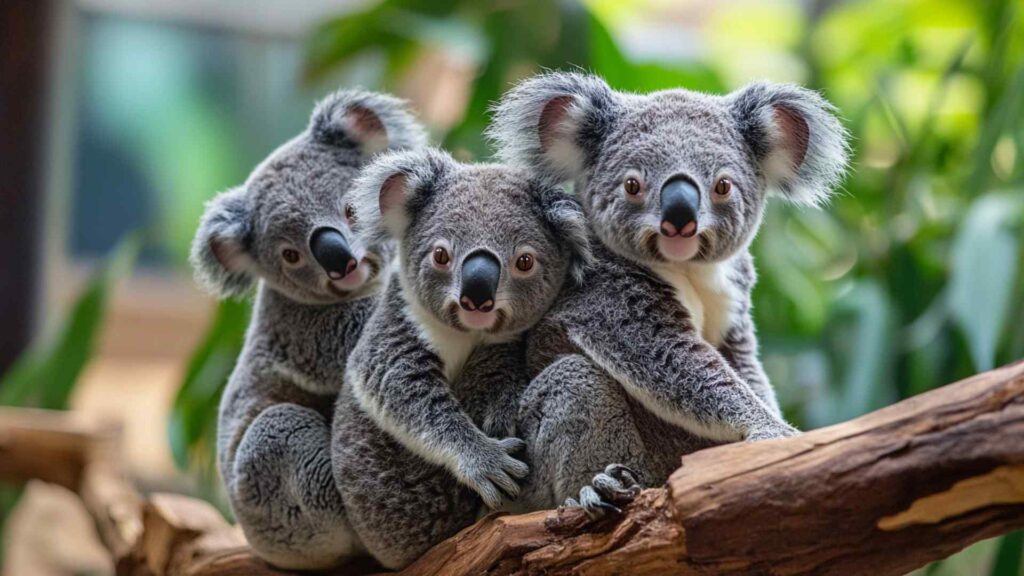
Diet & digestion
- Koalas mainly eat eucalyptus leaves.
- Eucalyptus leaves are low in protein and high in tough fibers.
- Many eucalypt leaves contain natural oils and tannins that can be toxic.
- Koalas rely on gut microbes to handle these leaf chemicals.
- They prefer younger leaves, which are usually softer and slightly richer.
- Koalas are picky eaters and may sample a tree before committing to it.
- They often feed at night when it is cooler and safer.
- Koalas pluck leaves with their incisors and chew them into a paste.
- The long cecum allows microbes to ferment the leafy mash.
- Fermentation helps release energy from tough plant fibers.
- Koalas get most of their water from the moisture in leaves.
- They will drink free water during heatwaves or droughts.
- Koalas tend to select trees with the chemical profiles they tolerate best.
- They may lick rainwater flowing down trunks during storms.
- Mothers feed joeys a special soft feces called pap to seed gut microbes.
- Pap is offered when the joey is transitioning from milk to leaves.
- Koalas produce many small pellet droppings each day.
- Old koalas with worn teeth can struggle to chew enough leaves.
- Koalas sometimes change feeding trees within their home range across seasons.
- Natural leaf oils give koalas a mild eucalyptus scent.
Behavior & life cycle
- Koalas are mostly nocturnal and crepuscular.
- They spend daytime resting high in tree forks.
- Koalas do not build nests; they sit in natural branches and saddles.
- Adult koalas keep loose territories called home ranges.
- Male home ranges are usually larger than female home ranges.
- Koalas mark trees with chest gland scent to signal presence.
- Deep bellows help males advertise and avoid fights.
- Females vocalize with grunts and squeaks, especially with joeys.
- Visual body language includes postures, climbing moves, and stillness.
- Koalas climb down to the ground mainly to reach another tree.
- On the ground, they move with a rolling, awkward walk.
- Koalas can climb quickly when alarmed.
- Koalas can swim if necessary but avoid water when they can.
- Breeding season generally peaks from spring through summer.
- Courtship may include scent marking, calling, and careful approaches.
- Females usually give birth to one joey at a time.
- The tiny joey crawls from the birth canal to the pouch using its forelimbs.
- Joeys stay in the pouch until they are well furred.
- After leaving the pouch, joeys ride on their mother’s back or belly.
- Weaning typically completes around 12 months of age.
- Young koalas learn preferred trees by traveling with their mothers.
- Dispersing juveniles search for their own home ranges.
- Grooming with the fused toes helps keep fur clean and parasite-free.
- Koalas reduce movement in hot weather to save energy and water.
- Koalas often choose shadier or lower branches during heatwaves.
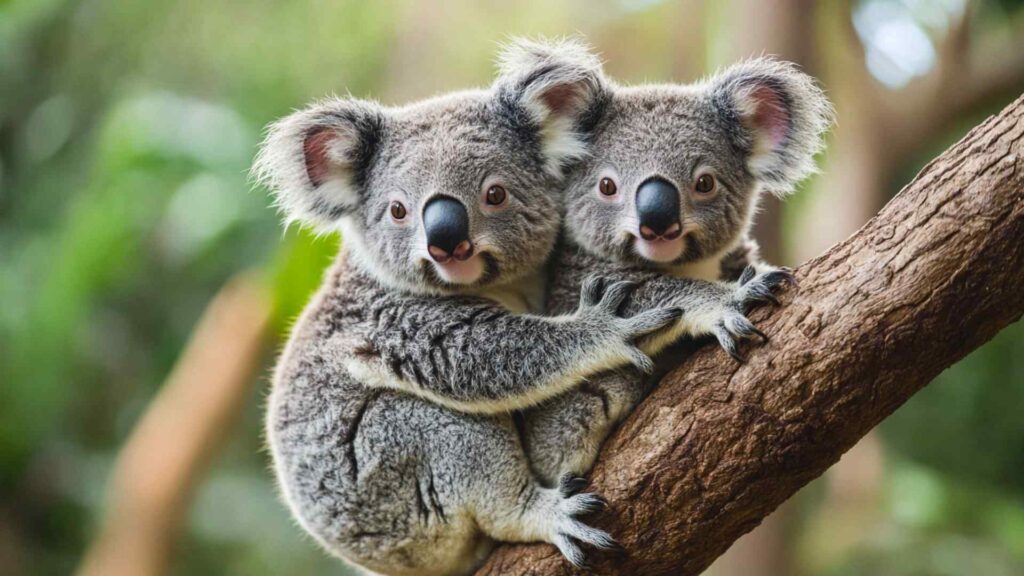
Habitat, range & conservation
- Koalas live in eucalypt woodlands and forests of eastern and southeastern Australia.
- Their range forms a patchwork that follows suitable trees and soils.
- Koalas are not native to Tasmania.
- Coastal and riverine forests can provide key habitat for koalas.
- Tree species composition strongly influences koala density.
- Habitat fragmentation makes it hard for koalas to move safely.
- Roads and fences can block koala dispersal.
- Vehicle strikes are a major cause of koala injuries.
- Dog attacks also harm koalas, especially in urban edges.
- Drought reduces leaf moisture and food quality for koalas.
- Heatwaves can cause dehydration and heat stress in koalas.
- Bushfires can remove large areas of koala habitat quickly.
- After fire, surviving koalas may face food shortages.
- Planting corridors of native trees helps koalas move between habitats.
- Rope bridges and underpasses can guide wildlife safely across roads.
- Wildlife carers rehabilitate injured and orphaned koalas.
- Disease, including chlamydia, threatens many koala populations.
- Chlamydia can cause eye disease and infertility in koalas.
- Research is exploring vaccines and treatments for koala health.
- Protecting old trees helps preserve high-quality koala feeding sites.
- Communities can help by keeping dogs restrained near koala habitat.
- People can report sightings to local groups to guide protection work.
- Legal protections limit harm to koalas and their habitats.
- Koalas are widely classified as threatened in parts of their range as of 2024.
- Long-term survival depends on habitat conservation and safer wildlife travel paths.
Pop culture & fun extras
- Koalas are a global symbol of Australian wildlife.
- Koalas appear on many stamps, posters, and children’s books.
- Plush koalas are popular souvenirs for visitors to Australia.
- Koala stories feature in First Nations teachings and artworks.
- Wildlife parks let people see koalas up close under trained care.
- Some regions allow supervised photos while others do not.
- Koala images are often used to promote forest conservation.
- The gentle look of koalas helps inspire donations for habitat projects.
- Koalas are frequent stars of science lessons about herbivores.
- Koalas remind people that iconic animals can be vulnerable to change.
For kids: quick comparisons
- A newborn koala is smaller than a jellybean.
- A grown koala is about as long as a skateboard.
- Koalas snooze longer each day than lions or sloths in many studies.
- A koala’s two thumbs on each front paw work like mini grabbers.
- Koalas hug trees to cool down the way we hug ice packs on hot days.
Quick FAQ
Are koalas bears?
No, koalas are marsupials, which carry their young in a pouch.
What do koalas eat?
Koalas mainly eat eucalyptus leaves, especially the softer young leaves.
Why do koalas sleep so much?
They rest for long hours to save energy because eucalyptus leaves are low in energy.
Where do koalas live?
Koalas live in eucalypt woodlands and forests across eastern and southeastern Australia.
Can I keep a koala as a pet?
No, koalas are protected wild animals and are not kept as pets.

Ellie is the owner and sole author of Fun Facts, combining her mechanical engineering background with years of research-driven writing to deliver facts you can trust. Every article is thoroughly fact-checked and routinely updated as new science and sources emerge to keep information accurate and current. Her mission is to make learning delightful while upholding high standards of reliability and transparency.