
Foxes are clever, fluffy-tailed members of the dog family that thrive from icy tundra to busy cities.
This kid-friendly guide packs quick, cool facts about how foxes live, hunt, raise families, and adapt to wild places and neighborhoods alike.
Ready to pounce into fox knowledge? Let’s go!
Origins & definitions
- Foxes are mammals in the dog family, Canidae.
- Scientists use the word “vulpine” to describe fox-like traits.
- “True foxes” belong to the genus Vulpes with about 12 species.
- The red fox (Vulpes vulpes) is the most widespread fox species.
- The gray fox (Urocyon cinereoargenteus) is a close relative but not a “true” Vulpes fox.
- The island fox (Urocyon littoralis) is the gray fox’s island cousin.
- The bat-eared fox (Otocyon megalotis) is a fox-like canid with very large ears.
- The word “fox” comes from Old English and ancient Germanic roots.
- A male fox is called a dog or tod, and a female is a vixen.
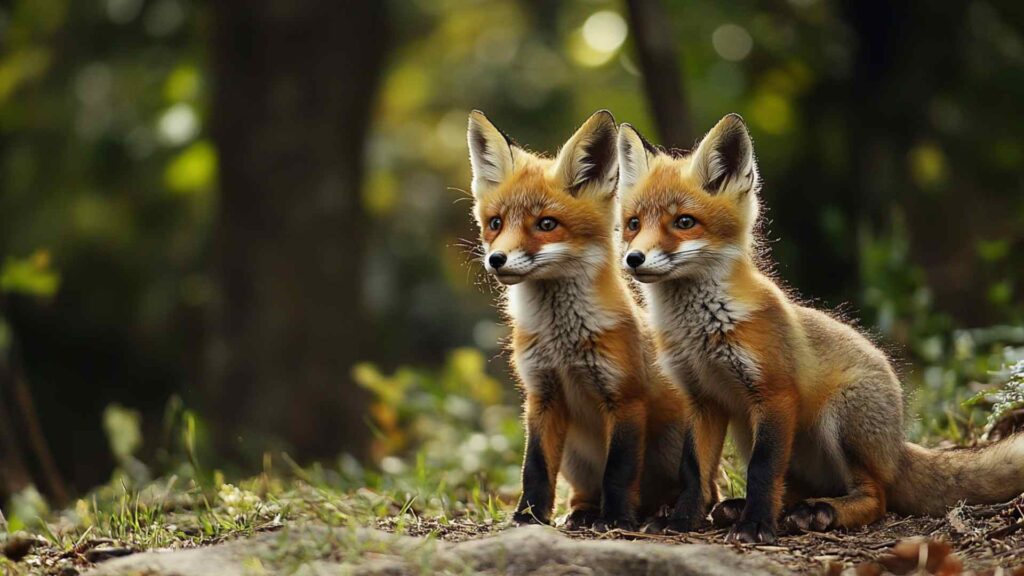
- A young fox is called a kit, pup, or cub.
- A group of foxes can be called a skulk, leash, or earth.
- A fox den is also called an “earth” in some regions.

Record-breakers & wow numbers
- The red fox naturally ranges across North America, Europe, and Asia and has also been introduced to Australia.
- A fennec fox usually weighs 0.7–1.6 kg (1.5–3.5 lb).
- A red fox can sprint up to about 50 km/h (31 mph).
- Many foxes can clear fences up to about 2 m high (6.5 ft).
- Arctic foxes survive winter temperatures as low as −50°C.
- Arctic fox coats change seasonally, turning white in snowy winters.
- A fennec fox’s ears can reach about 15 cm long (6 in).
- Gray foxes can climb trees and may rest on branches.
- A red fox’s bushy tail, or “brush,” often measures 30–55 cm.
- Red fox litters commonly have 4–6 kits.
- Some dens have more than 10 entrances for quick escapes.
- Urban fox home ranges can be under 1 km², while rural ranges can exceed 10 km².

Science & anatomy
- Adult foxes have 42 teeth for slicing meat and crunching small bones.
- Many foxes have vertically slit pupils that help control light in dim conditions.
- Foxes have long whiskers on the face and short whiskers on the wrists to sense nearby objects.
- A fox’s thick tail helps with balance and works like a warm blanket in cold weather.
- Ear muscles let foxes rotate their ears to pinpoint faint sounds.
- A reflective eye layer called the tapetum lucidum improves night vision.
- Foxes walk on their toes, a posture called digitigrade.
- A scent gland near the base of the tail helps with marking.
- Arctic fox paw pads are covered in fur for insulation on ice.
- Fennec fox feet are furred underneath to protect from hot sand.
- Gray foxes have strongly curved claws that grip bark during climbs.
- Bat-eared foxes have extra-tall molars suited to chewing insects.
- Fox hearing detects the squeaks of small rodents under snow or grass.
- Light, flexible skeletons help foxes twist quickly while running.
- Foxes shed winter coats in spring and grow fresh fur for summer.
- Tail-tip colors help tell species apart: red fox usually white-tipped, gray fox black-tipped.
Habitat & behavior
- Most foxes are crepuscular, most active at dawn and dusk.
- Foxes are opportunistic omnivores that eat animals and plants.
- Red foxes often live alone but may share territories with mates or family.
- Dens provide shelter for kits and protection from storms or heat.
- Foxes cache extra food by burying it for later meals.
- Territorial boundaries are marked with scent and urine.
- Red foxes adapt well to farms, towns, and big cities.
- Urban foxes travel along hedges, fences, and walls like safe highways.
- Foxes commonly reuse or enlarge old burrows dug by other animals.
- A high, arching pounce helps pin prey under snow or tall grass.
- In winter, foxes curl up and use their tails to cover their noses.
- Arctic foxes often follow larger predators to scavenge leftovers.
- Foxes can swim when they need to cross rivers or ponds.
- In hot climates, foxes rest underground during the day to stay cool.
- Foxes do not hibernate and stay active year-round.
- Body language like ear angle and tail height helps foxes communicate.
- Many fox species form monogamous pairs during the breeding season.
- Family members may share food and guard the den together.
- Foxes learn and remember paths, dens, and safe shortcuts across their range.
- Habitat color and local climate influence the shades of a fox’s coat.

Diet & hunting
- Voles, mice, and rabbits are staple foods for many foxes.
- Foxes also eat insects such as beetles, grasshoppers, and crickets.
- Fruits like berries and apples become important in late summer and autumn.
- Earthworms are eaten on rainy nights and in damp lawns.
- Many foxes hide food in many small caches to reduce theft by competitors.
- Bat-eared foxes focus heavily on termites and other small insects.
- Arctic foxes eat lemmings, fish, seabirds, and their eggs.
- When prey is scarce, foxes will scavenge carrion.
- Keen hearing lets foxes strike prey hidden under snow or leaf litter.
- A fox often freezes to listen before making its signature pounce.
- Red foxes hunt field edges where prey trails and cover meet.
- Spilled birdseed can draw rodents, and foxes may hunt beneath feeders.
- Sharp carnassial teeth let foxes slice flesh and crack small bones.
- Seasonal shifts in plants and prey shape a fox’s diet across the year.
Reproduction & life cycle
- Most fox species breed once per year.
- In temperate zones, red foxes usually mate in winter.
- Red fox gestation lasts about 52 days.
- Newborn kits are blind and open their eyes at about 10 days.
- Kits start exploring outside the den at 4–5 weeks.
- Mothers nurse while fathers or partners bring food to the den.
- Older siblings sometimes act as helpers at the den.
- Kits are weaned at roughly 6–8 weeks old.
- Play-fighting teaches hunting and social skills.
- Young foxes usually disperse in autumn to find territories.
- Wild foxes often live 3–6 years, while some in care can exceed 10 years.
- Litter sizes change with food supply and species, ranging from one to a dozen.
- Female foxes have multiple nipples, often 6–8, to feed the litter.
- Most foxes reach adult size within their first year.
Communication & senses
- Foxes use more than a dozen distinct calls.
- Short barks help mates or family members keep in contact.
- A loud winter scream from a vixen can carry far through the night.
- Kits produce a rapid chattering sound called “geckering” during play or squabbles.
- Scent marks share information about identity, sex, and status.
- Tail posture can signal fear, confidence, or excitement.
- Ears swivel without moving the body to keep listening while hidden.
- Strong noses help track faint odor trails and locate cached food.
- Head tilts and crouches fine-tune the angle of a hunting pounce.
- Foxes often face into the wind before leaping to catch scent and sound.
- Young foxes learn call meanings by listening to adults.
- Scent posts are revisited on regular travel routes.
- Foxes use feces at prominent spots as territorial signposts.
- Hearing alone can guide a fox to prey moving under snow or grass.
Species & subspecies
- The red fox has many regional forms with different sizes and shades.
- The silver fox is a dark, melanistic color morph of the red fox.
- The cross fox shows a dark stripe along the back and shoulders.
- The arctic fox has white and blue color morphs tied to habitat and season.
- The fennec fox lives in the Sahara and nearby deserts of North Africa.
- The kit fox ranges through the deserts of the southwestern United States and northern Mexico.
- The swift fox lives on the Great Plains of North America.
- The corsac fox inhabits the open steppes of Central Asia.
- The Tibetan sand fox lives on high plateaus in and around Tibet.
- Rüppell’s fox occupies arid lands of North Africa and the Middle East.
- The pale fox is native to the Sahel belt of Africa.
- The Cape fox lives in southern Africa’s open country.
- The Bengal fox is found across the Indian subcontinent.
- Blanford’s fox is an agile climber in rocky Middle Eastern deserts.
- The gray fox and island fox form an ancient canid branch separate from Vulpes.
- The island fox evolved on California’s Channel Islands and is smaller than the gray fox.
Names & etymology & folklore
- The word “vixen” specifically means a female fox.
- “Vulpine” comes from Latin and means fox-like.
- Many languages use “fox” to describe clever or tricky behavior.
- “Reynard” became a classic fox name through medieval storytelling.
- In Japanese folklore, a kitsune is a magical, shape-shifting fox.
- European fables often show foxes winning by wit rather than strength.
- Many Native American stories feature foxes as helpers or tricksters.
- The phrase “sly as a fox” reflects long-held views of fox intelligence.
- Artists often draw red foxes with a bright white tail tip.
- Fox masks and tails are popular costume pieces at autumn and winter festivals.
For kids: quick comparisons
- A fennec fox weighs about as much as a one-liter bottle of water.
- A red fox is roughly the length of a skateboard, tail included.
- A gray fox climbs trees like a cat but belongs to the dog family.
- An arctic fox’s winter coat acts like a thick parka against wind and snow.
- A kit fox’s big ears cool it like tiny built-in radiators.
- A fox’s pounce can be as high as a typical kitchen counter.
- A fox’s 42 teeth are more than a human’s 32 teeth.
- A trotting fox moves about as fast as a person jogging.
Pop culture & fun extras
- The joyful fox leap into deep snow is a favorite moment in wildlife videos.
- “Reynard” is still a common fox name in books and cartoons.
- Fox tracks in snow often look neat and nearly straight in a line.
- Foxes sometimes sit with tails wrapped around them like a fluffy scarf.
- Wildlife-friendly yards can help foxes by providing water and wild corners.
- City foxes may carry food in their mouths to feed hidden kits.
- People often mistake eerie fox calls at night for strange screams.
Conservation & human interactions
- Red foxes are common in many places, while some island or desert foxes have smaller, more fragile populations.
- Good waste storage and secure small-animal housing reduce conflicts between people and foxes.
Quick FAQ
Are foxes dogs or cats?
Foxes are canids, so they are part of the dog family, not the cat family.
Where do foxes live?
Foxes live in forests, grasslands, deserts, mountains, tundra, and many cities across the Northern Hemisphere.
What do foxes eat?
They eat small mammals, birds, insects, fruit, earthworms, and sometimes carrion.
Do foxes hibernate?
No, foxes stay active all year and adjust behavior to weather and food.
Are foxes dangerous to people?
Foxes avoid people and are not usually dangerous, but pets and poultry should be protected and food waste secured.

Ellie is the owner and sole author of Fun Facts, combining her mechanical engineering background with years of research-driven writing to deliver facts you can trust. Every article is thoroughly fact-checked and routinely updated as new science and sources emerge to keep information accurate and current. Her mission is to make learning delightful while upholding high standards of reliability and transparency.