
Whales are the ocean’s gentle giants, from speedy fin whales to mysterious beaked whales.
This kid-friendly roundup packs bite-size facts about sizes, songs, diets, and epic journeys.
Whether you’re a curious student or a nature fan, dive in and discover what makes these marine mammals so extraordinary.
Origins & Definitions
- Whales are fully aquatic mammals belonging to the order Cetacea.
- Cetacea includes whales, dolphins, and porpoises.
- Whales are divided into baleen whales (Mysticeti) and toothed whales (Odontoceti).
- Baleen whales use flexible plates called baleen to filter food from seawater.
- Toothed whales have teeth and typically hunt individual prey.
- The term “whale” often includes large oceanic dolphins like orcas in everyday language.
- Whales breathe air through blowholes located on top of their heads.
- Baleen whales have two blowholes while toothed whales have one.
- Whales are warm-blooded and nurse their young with milk.
- The word “cetacean” comes from a Greek term meaning “sea monster.”
- Whales evolved from hoofed land mammals more than 50 million years ago.
- Early whale relatives such as Pakicetus had legs and lived near rivers.
- Modern whales retain tiny vestigial pelvic bones inside their bodies.
- The closest living land relatives of whales are hippopotamuses.
- Whales lack external hind limbs but keep internal remnants of those bones.
Record-Breakers & Wow Numbers
- The blue whale is the largest animal known to have ever lived.
- Adult blue whales can reach about 30 meters long and over 150 tonnes.
- A blue whale’s heart can weigh around 180 kilograms.
- A newborn blue whale can be roughly 7 meters long at birth.
- The sperm whale is the largest toothed predator on Earth.
- Sperm whales can dive beyond 1,000 meters to hunt deep-sea prey.
- The longest known whale migration stretches more than 16,000 kilometers.
- Humpback whales produce long, complex songs that can last for hours.
- The fin whale can sprint at roughly 40 km/h in short bursts.
- The pygmy right whale is the smallest baleen whale at about 6 meters.
- The dwarf sperm whale is among the smallest toothed whales at about 2.7 meters.
- Orcas are the largest members of the dolphin family.
- Bowhead whales can live for more than two centuries.
- Gray whales complete one of the longest mammal migrations each year.
- Sperm whale clicks are among the loudest biological sounds recorded underwater.
- Cuvier’s beaked whales have made dives deeper than 2,900 meters.
Biology & Anatomy
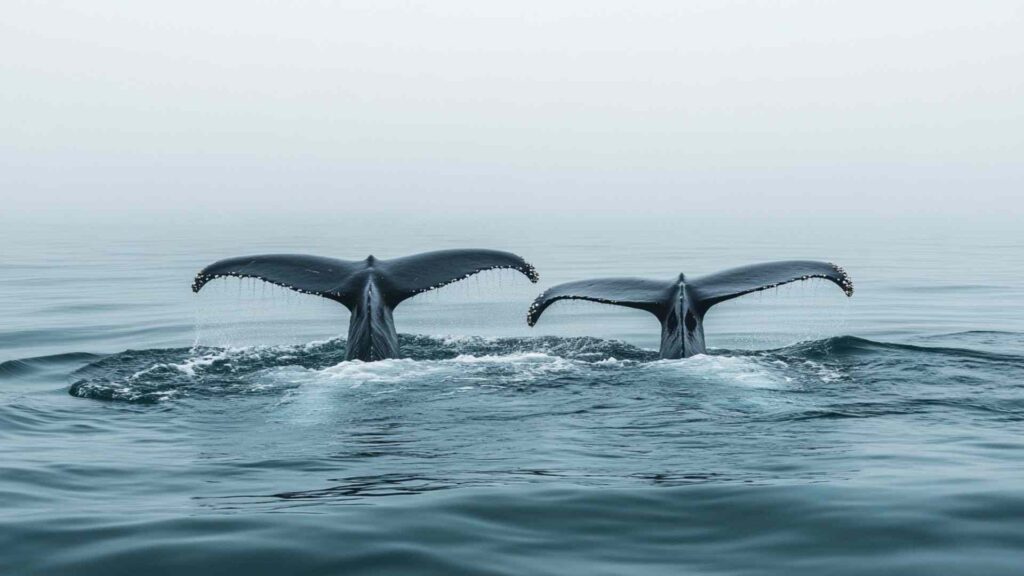
- Whale flukes are horizontal, powering swimming with up-and-down strokes.
- Whale forelimbs are modified into flippers with bones arranged like a human hand.
- Most whales have a thick layer of blubber for insulation and energy storage.
- Whales lack external ears but hear through specialized structures in the head.
- Toothed whales use echolocation to navigate and find prey.
- Baleen whales generally do not use echolocation like toothed whales.
- The shape of a whale’s dorsal fin can help identify species and individuals.
- Baleen is made of keratin, the same protein found in human hair and nails.
- A blue whale’s tongue can weigh around 3 tonnes (about 6,600 lb).
- Rorquals have expandable throat pleats that allow huge gulps of water.
- Whale vertebrae are linked by flexible joints that enable powerful tail strokes.
- Many whales are countershaded, darker on top and lighter underneath.
- Toothed whales have some of the highest brain-to-body ratios among mammals.
- Sperm whales have a massive spermaceti organ filling much of the head.
- The “melon” in toothed whales focuses sound for echolocation.
- Baleen plates hang from the upper jaw and form a filtering fringe.
- Whale eyes are adapted to low-light conditions at depth.
- Some whales slough outer skin layers and may rub on rocks to help exfoliate.
- High levels of myoglobin in muscles help whales store oxygen for long dives.

Feeding & Ecology
- Blue whales mainly eat tiny shrimp-like animals called krill.
- Humpbacks use bubble-net feeding to trap schools of fish.
- Gray whales scoop amphipods and other crustaceans from muddy seafloors.
- Sperm whales hunt deep-sea squid and fish.
- Orcas hunt cooperatively in pods using coordinated tactics.
- Bryde’s whales often target small fish in warm and subtropical waters.
- Sei whales skim for copepods and small fish near the surface.
- Minke whales feed on krill and small schooling fish.
- Right whales filter dense patches of zooplankton by steady skimming.
- Fin whales are swift lunge feeders that engulf prey with huge mouthfuls.
- Baleen whales can filter thousands of liters of seawater in a single gulp.
- Toothed whales usually swallow prey whole rather than chewing.
- Many whales fast during long migrations by living off stored blubber.
- Whales help cycle ocean nutrients through the “whale pump” effect.
- Whale fecal plumes fertilize surface waters and boost plankton growth.
- When whales die and sink, they create deep-sea “whale fall” habitats.
- Whale falls can support unique communities for decades.
- Natural predators of whales include orcas and large sharks, especially for calves.
- Bowhead whales feed along sea-ice edges in Arctic waters.
- Bubble-net techniques appear to spread socially among humpback groups.
Behavior & Communication
- Whales show surface behaviors like breaching, tail-slapping, and spyhopping.
- Breaching may help with communication, parasite removal, or play.
- Humpback songs shift gradually over seasons within the same population.
- Low-frequency calls from large whales can travel hundreds of kilometers.
- Some species form long-term social bonds in stable groups.
- Sperm whales live in matrilineal groups centered on adult females.
- Male humpbacks compete for mates using songs and displays.
- Orcas have distinct dialects and cultural traditions in different ecotypes.
- Calves ride beside mothers in an energy-saving echelon position.
- Resting whales may float at the surface for long periods, called logging.
- Toothed whales can sleep with one brain hemisphere at a time.
- Many baleen whales migrate annually between feeding and breeding grounds.
- Some whales rub on pebbly beaches or rocks during social or molting behavior.
- Whales sometimes carry kelp on their backs in playful “kelping.”
- Some species can recognize individuals by signature calls or unique markings.

Reproduction & Life Cycle
- Most whales give birth to a single calf after a long gestation.
- Gestation in large whales ranges from about 10 to 17 months.
- Whale milk is very rich in fat to fuel rapid calf growth.
- Calves can gain tens of kilograms per day while nursing.
- Many whales reach sexual maturity between roughly 5 and 15 years.
- Male sperm whales grow much larger than females, showing strong dimorphism.
- Gray whales commonly calve in warm lagoons along Baja California.
- Humpback calves are typically born in tropical waters during winter.
- Mothers and calves maintain close contact using touch and sound.
- Some whales sometimes allonurse calves within social groups.
- Bowhead whales grow slowly and mature later than many mammals.
- Baleen whales often breed every two to three years.
- Calving intervals can lengthen when prey is scarce.
- Whale lifespans vary widely across species and environments.
Migration & Habitat
- Gray whales travel between Arctic feeding grounds and Mexican nurseries.
- Southern right whales breed in sheltered bays in the Southern Hemisphere.
- Blue whales occur in all major oceans and are rare in the Arctic.
- Belugas favor cold Arctic and sub-Arctic seas and estuaries.
- Narwhals inhabit deep fjords and pack-ice regions of the Arctic.
- Sperm whales roam deep offshore waters in temperate and tropical seas.
- Fin whales use both coastal and offshore routes during migrations.
- Minke whales are among the most widely distributed baleen whales.
- Pilot whales favor deep waters along continental slopes.
- River dolphins are fellow cetaceans that live in rivers rather than the sea.
Species Spotlights
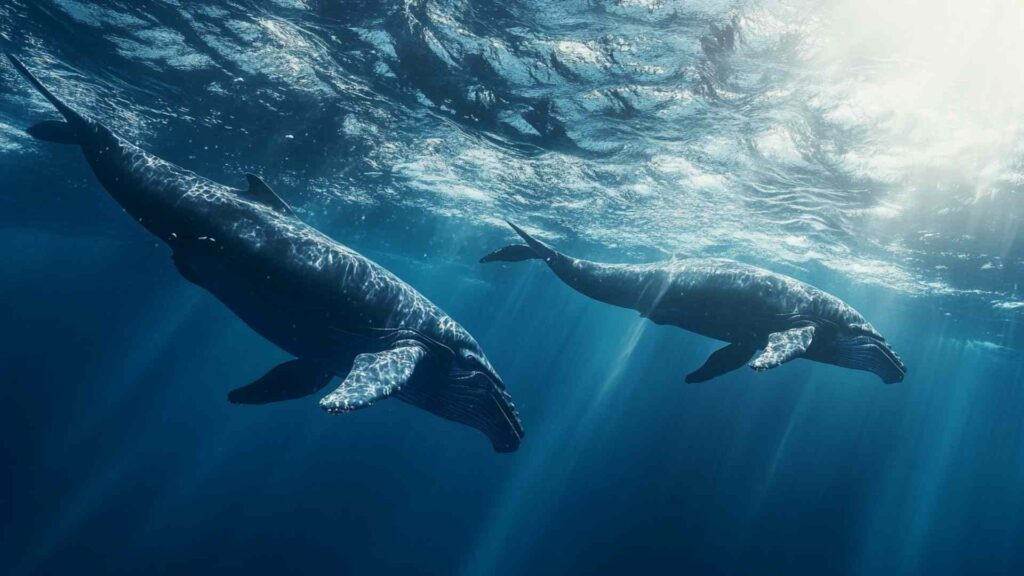
- Humpback whales have very long pectoral fins up to one-third of body length.
- Bowhead whales have the thickest blubber of any whale.
- Right whales carry rough skin patches called callosities on their heads.
- Gray whales lack a tall dorsal fin and show knuckles along the back.
- Fin whales have a white right lower jaw and a darker left side.
- Sei whales show a single ridge along the top of the head.
- A blue whale’s blow can shoot more than 9 meters into the air.
- Minke whales arch steeply before diving, showing their pointed snouts.
- Bryde’s whales often show three ridges on the front of the head.
- The pygmy right whale is elusive and rarely observed at sea.
- Dwarf sperm whales can release a dark cloud of fluid when threatened.
- Beaked whales are deep divers with small dorsal fins and slender jaws.
- Male narwhals usually grow a single long tusk from a canine tooth.
- Beluga whales are white and highly vocal, earning the nickname “sea canary.”
- Orcas have bold black-and-white patterns and towering dorsal fins.
- Pilot whales have bulbous foreheads and extremely strong social bonds.
History & Culture
- People have depicted whales in art and stories for thousands of years.
- Commercial whaling expanded rapidly during the 1700s and 1800s.
- Many great whale populations were severely reduced by past whaling.
- A global moratorium on commercial whaling began in 1986.
- Whale watching has become a major ecotourism activity worldwide.
- Some Indigenous communities practice limited subsistence whaling under quotas.
- Collisions with ships remain a serious threat to some whale populations.
- Entanglement in fishing gear can injure or kill whales.
- Underwater noise can disrupt whale communication and navigation.
- Climate change is shifting sea ice and prey patterns that whales depend on.
Conservation & Science
- Several whale species have shown recovery where strong protections exist.
- Speed limits for ships in key habitats can reduce fatal strikes.
- Passive acoustic listening helps scientists detect whales over vast areas.
- Photo-ID catalogs track individuals using unique fluke or fin patterns.
- Satellite tags reveal migration routes and feeding hotspots.
- Marine protected areas can safeguard critical whale habitats.
- Responsible wildlife viewing guidelines help minimize disturbance.
- Cutting plastic waste and ghost gear reduces entanglement risks.
- Community science projects collect valuable whale sighting data.
- International cooperation is essential to protect whales that cross borders.
Quick FAQ
What is the biggest whale?
The blue whale is the biggest, reaching about 30 meters and more than 150 tonnes.
How do whales sleep without drowning?
They rest at the surface or use unihemispheric sleep so one brain half stays alert to breathe.
Do whales drink seawater?
They get most of their water from their food and produce fresh metabolic water while limiting salt intake.
How long can whales hold their breath?
Many can hold breath for 20 to 60 minutes, and some beaked whales can exceed two hours.
Is an orca a whale or a dolphin?
An orca is a dolphin by family but is commonly called a whale because of its size and lifestyle.

Ellie is the owner and sole author of Fun Facts, combining her mechanical engineering background with years of research-driven writing to deliver facts you can trust. Every article is thoroughly fact-checked and routinely updated as new science and sources emerge to keep information accurate and current. Her mission is to make learning delightful while upholding high standards of reliability and transparency.