
Saturn is the show-stopper of our Solar System, famous for its bright rings and mysterious moons.
This friendly guide packs bite-size facts about what Saturn is made of, how its rings work, and why its moons are so special.
Ready to tour the ringed giant and wow your brain? Let’s go!
Origins & definitions
- Saturn is the sixth planet from the Sun.
- Saturn orbits at a mean distance of about 1.43 billion kilometers (9.5 AU).
- A year on Saturn lasts about 29.5 Earth years.
- A day on Saturn is roughly 10.5 Earth hours long.
- Saturn is a gas giant made mostly of hydrogen and helium.
- Saturn is the second-largest planet in the Solar System after Jupiter.
- Saturn’s equatorial diameter is about 120,500 kilometers.
- Saturn’s average density is about 0.69 g/cm³, less than water.
- Gravity at Saturn’s cloud tops is about 10.4 meters per second squared.
- Saturn’s axial tilt is about 26.7 degrees, giving it seasons like Earth’s.
- Saturn’s pale yellow color comes from ammonia ice clouds.
- Saturn is visibly flattened at the poles because it spins so fast.
- Saturn is the flattest planet in the Solar System.
- Saturn radiates more energy than it receives from the Sun.
- Saturn’s atmosphere shows bands like Jupiter but with softer contrast.
- The name Saturn comes from the Roman god of agriculture.
- The day Saturday is named after Saturn.
- Saturn has been observed by humans since ancient times with the naked eye.
- Saturn’s average orbital speed is about 9.7 kilometers per second.
- Saturn is roughly 95 times more massive than Earth.

Record-breakers & wow numbers
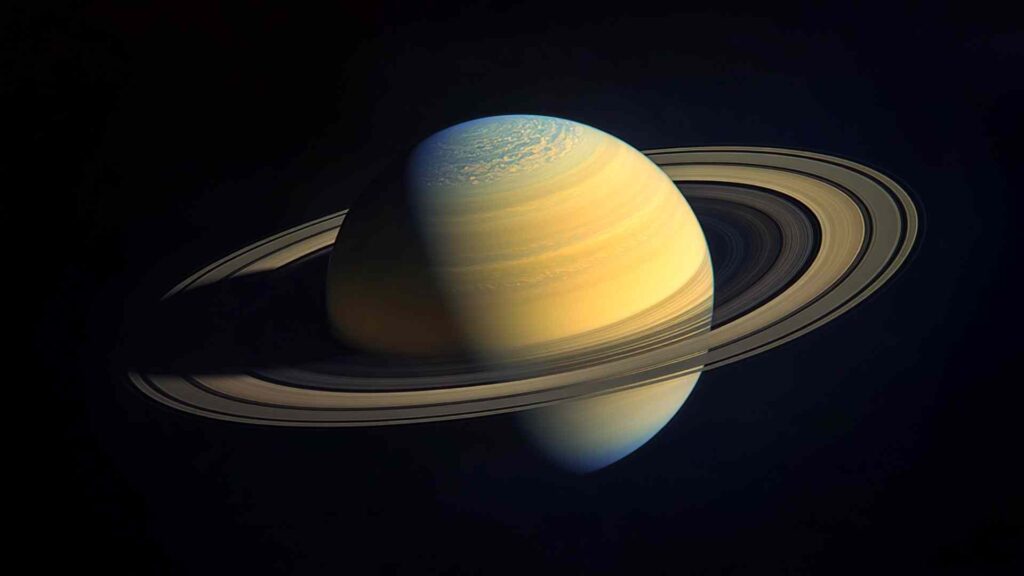
- Saturn’s ring system is the largest and brightest of any planet.
- The main rings span about 280,000 kilometers from end to end.
- Despite their size, the rings are usually only tens of meters thick.
- Saturn’s winds can reach around 1,800 kilometers per hour at the equator.
- The hexagon at Saturn’s north pole is about 30,000 kilometers across.
- The Great White Spot is a planet-encircling storm that erupts roughly every few decades.
- Saturn’s magnetic field envelops a magnetosphere millions of kilometers wide.
- As of 2025, Saturn has over 140 confirmed moons.
- Titan, Saturn’s largest moon, is bigger than the planet Mercury.
- Saturn’s second-largest moon, Rhea, is about 1,528 kilometers across.
- The E ring is Saturn’s widest ring, stretching hundreds of thousands of kilometers.
- The Cassini Division between the A and B rings is about 4,800 kilometers wide.
- Saturn’s escape velocity is about 36 kilometers per second.
- Saturn’s average effective temperature is around 95 Kelvin (−178 °C).
- The F ring is among the narrowest major rings, only a few hundred kilometers across.
- The G ring is faint and lies beyond the bright main rings.
- The D ring is the innermost and also very faint.
- Titan’s thick atmosphere is denser at the surface than Earth’s atmosphere.
- Enceladus ejects plumes that shoot hundreds of kilometers into space.
- Saturn’s ring particles range from dust-size grains to boulders meters across.
Science: how Saturn works
- Saturn’s interior likely has a core of rock and ice surrounded by metallic hydrogen.
- Pressure inside Saturn turns hydrogen into a liquid and then a metallic form.
- Saturn’s extra heat comes from slow gravitational contraction and helium rain.
- Helium droplets likely sink inside Saturn and release heat as they fall.
- Saturn’s atmosphere is mostly hydrogen with a smaller amount of helium.
- Trace gases like methane and ammonia shape Saturn’s cloud colors.
- Saturn’s rotation varies by latitude, a behavior called differential rotation.
- Measuring Saturn’s exact day length is hard because its radio signals drift.
- Saturn’s magnetic field is generated by motions in its metallic hydrogen layer.
- Saturn’s magnetosphere traps charged particles and creates radiation belts.
- Auroras dance near Saturn’s poles when the solar wind shakes its magnetosphere.
- Tiny grains from the rings fall into the atmosphere in a process nicknamed ring rain.
- The Roche limit helps explain why ring particles do not easily clump into a moon.
- Micrometeoroid impacts slowly darken and pollute the icy rings.
- Ring spokes are transient, radial features linked to dust and magnetic effects.
- Saturn’s storms often appear as bright white spots in small telescopes.
- Saturn produces powerful lightning that can be detected by radio from far away.
- Ammonia ice forms the upper clouds, with deeper clouds of ammonium hydrosulfide and water.
- Seasonal sunlight changes Saturn’s hemispheres over its long year.
- Wind patterns and waves in the rings reveal the planet’s internal oscillations.
Rings: structure & mysteries
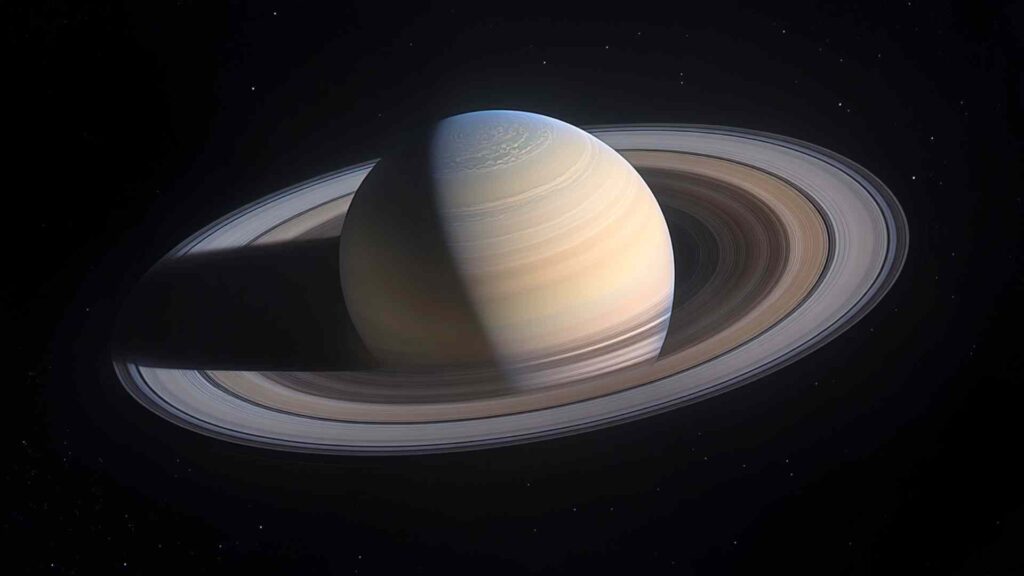
- The main rings are labeled D, C, B, A from the planet outward.
- The Cassini Division separates the bright B ring from the A ring.
- The Encke Gap is a narrow clearing within the A ring.
- The Keeler Gap lies near the edge of the A ring and is carved by the moon Daphnis.
- The F ring sits just outside the A ring and is shaped by shepherd moons.
- The G ring and E ring lie still farther out and are much fainter.
- The rings are composed mostly of water ice with a small amount of dust.
- Some ring particles are as small as smoke, while others are house-sized.
- The rings are thought to be relatively young on cosmic timescales.
- Estimates for ring ages range from tens to hundreds of millions of years.
- The rings may have formed from a shattered moon or a captured comet.
- Collisions among ring particles keep the rings thin and flat.
- Spiral density waves ripple through the rings due to moon resonances.
- Edges of some rings are razor-sharp because of gravitational shepherding.
- Ring thickness varies, but the brightest parts are extremely thin compared with their width.
- The A ring shows propeller-shaped gaps caused by hidden moonlets.
- Daphnis produces wave patterns along the edges of the Keeler Gap.
- Pan and Atlas have ridge-like equators from scooping up ring material.
- The F ring looks braided because clumps get stretched and re-shaped.
- The E ring is centered on Enceladus’s orbit and is brightest there.
- The rings brighten strongly when the Sun is directly behind the observer.
- During ring-plane crossings, the rings can nearly vanish from our view.
- Ultraviolet sunlight slowly erodes ring particles by sputtering.
- The rings likely contain enough mass to make a small icy moon.
- Ring observations help scientists measure Saturn’s gravity and interior structure.
Moons: Titan, Enceladus & friends
- Titan is Saturn’s largest moon and the second-largest in the Solar System.
- Titan’s atmosphere is mostly nitrogen with methane clouds and haze.
- Rivers of liquid methane and ethane carve valleys on Titan.
- Titan has lakes and seas near its poles, including the vast Kraken Mare.
- Rainstorms on Titan can darken the surface as methane falls from the sky.
- Titan’s surface temperature is around 94 Kelvin (−179 °C).
- Titan’s surface pressure is about 1.5 times Earth’s sea-level pressure.
- Huygens became the first probe to land on a moon in the outer Solar System when it touched Titan in 2005.
- Dunes made of organic sand stretch across Titan’s equatorial regions.
- A rotorcraft mission is planned for Titan exploration in the 2030s.
- Enceladus is a small icy moon only about 504 kilometers wide.
- Enceladus hides a global subsurface ocean beneath its ice crust.
- Jets from Enceladus spray water vapor, ice grains, and organic molecules.
- Salts in Enceladus’s plumes point to rock-water interactions at the seafloor.
- Enceladus’s geysers feed Saturn’s E ring with fresh material.
- Mimas is cratered and resembles a famous sci-fi battle station in pictures.
- Tethys hosts a vast impact crater named Odysseus that dominates one hemisphere.
- Dione shows bright wispy canyons formed by fractures and icy cliffs.
- Rhea is heavily cratered and is Saturn’s second-largest regular moon.
- Iapetus has a striking light-and-dark two-tone surface.
- Iapetus also sports a tall equatorial ridge that circles much of the moon.
- Hyperion looks spongy because of its porous, chaotic shape.
- Phoebe orbits backward compared with most moons, a hint of capture.
- Janus and Epimetheus are co-orbital moons that swap positions roughly every four years.
- Tethys has a 2,000-kilometer-long canyon called Ithaca Chasma.
- Dione’s bright wisps are icy cliffs formed by ancient fractures.
- Rhea hosts a wispy exosphere made mostly of oxygen and carbon dioxide.
- Iapetus’s dark hemisphere is likely coated by dust from outer moons.
- Helene, Telesto, and Calypso share orbits as Trojan companions of larger moons.
- Many small outer moons follow distant, tilted, and often backward paths.
- These irregular moons cluster into orbital families with similar tilts and distances.
- Mimas may hide a subsurface ocean suggested by its measured wobble.
- Enceladus’s geysers vary in strength with tidal stretching along its orbit.
- Titan’s methane cycle mirrors Earth’s water cycle with evaporation, clouds, rain, rivers, and seas.
- Titan’s lakes cluster near the north pole where climate and terrain favor basins.
Discovery & exploration
- In 1610, Galileo saw Saturn through a telescope and thought the rings were “ears.”
- In 1655, Christiaan Huygens discovered Titan and proposed that Saturn is encircled by a ring.
- In the 1670s, Giovanni Cassini identified more moons and recognized structure in the rings.
- The wide gap between the A and B rings is called the Cassini Division in his honor.
- Pioneer 11 flew past Saturn in 1979 and returned the first close-up photos.
- Voyager 1 and Voyager 2 revealed complex ring waves and dozens of small moons in 1980–1981.
- The Cassini orbiter studied Saturn from 2004 to 2017 with hundreds of close moon flybys.
- The Huygens probe landed on Titan on January 14, 2005 and transmitted data from the surface.
- Cassini’s Grand Finale in 2017 included 22 dives between the rings and the cloud tops.
- The Dragonfly rotorcraft is planned to explore multiple sites on Titan in the 2030s.
- Future mission concepts aim to sample Enceladus’s plumes for possible biosignatures.

Observation & viewing from Earth
- Saturn is easily seen by eye as a steady, yellowish “star” when it is above the horizon.
- A small backyard telescope can show the ring system and sometimes a dark gap near the edge.
- The rings appear more open or closed from Earth as Saturn moves through its 29.5-year cycle.
- Ring-plane crossings every 13–15 years make the rings appear thinnest and hardest to spot.
- The brightest ring views happen when the rings are widely tilted toward Earth.
For kids: quick comparisons
- Because Saturn’s average density is less than water, it would float in a huge bathtub.
- At 9.5 times farther from the Sun than Earth, sunlight at Saturn is about 1⁄90 as bright.
- Flying around Saturn’s equator at 900 km/h would take about 17.5 days.
- Saturn’s volume is big enough to hold roughly 760 Earths.
- A 45-kilogram person on Earth would feel like about 48 kilograms at Saturn’s cloud tops.
Names & etymology
- The rings are labeled by discovery order, not by their distance from the planet.
- Many of Saturn’s moons are named after Titans, giants, and mythic figures from several cultures.
Pop culture & fun extras
- The north polar hexagon is a long-lived jet stream that has persisted for decades and rotates with the planet.
Quick FAQ
What is Saturn made of?
Saturn is mostly hydrogen and helium with clouds of ammonia ice and deeper layers of water and other compounds.
Can you see Saturn’s rings without a telescope?
You can see Saturn as a bright point by eye, but you need a small telescope to resolve the rings.
How many moons does Saturn have?
Saturn has over 140 confirmed moons as of 2025, with new small moons occasionally added.
Is there life on Titan or Enceladus?
No confirmed life is known, but Titan and Enceladus are prime targets because they hold key ingredients and active environments.
How long is a day on Saturn?
A day on Saturn is about 10.5 Earth hours, which makes the planet noticeably flattened at the poles.

Ellie is the owner and sole author of Fun Facts, combining her mechanical engineering background with years of research-driven writing to deliver facts you can trust. Every article is thoroughly fact-checked and routinely updated as new science and sources emerge to keep information accurate and current. Her mission is to make learning delightful while upholding high standards of reliability and transparency.