
Rainforests are warm, wet, and bursting with life, from tiny glowing fungi to sky-high trees and swooping eagles.
This giant list breaks down how rainforests work, where to find them, and why they matter.
Dive in for fast, friendly facts that kids and adults can enjoy together.
Origins & definitions
- A rainforest is a forest that receives high yearly rainfall, usually more than 1,500–2,000 mm.
- Tropical rainforests grow near the equator between the Tropics of Cancer and Capricorn.
- Temperate rainforests occur in cooler coastal zones with heavy rain and mild temperatures.
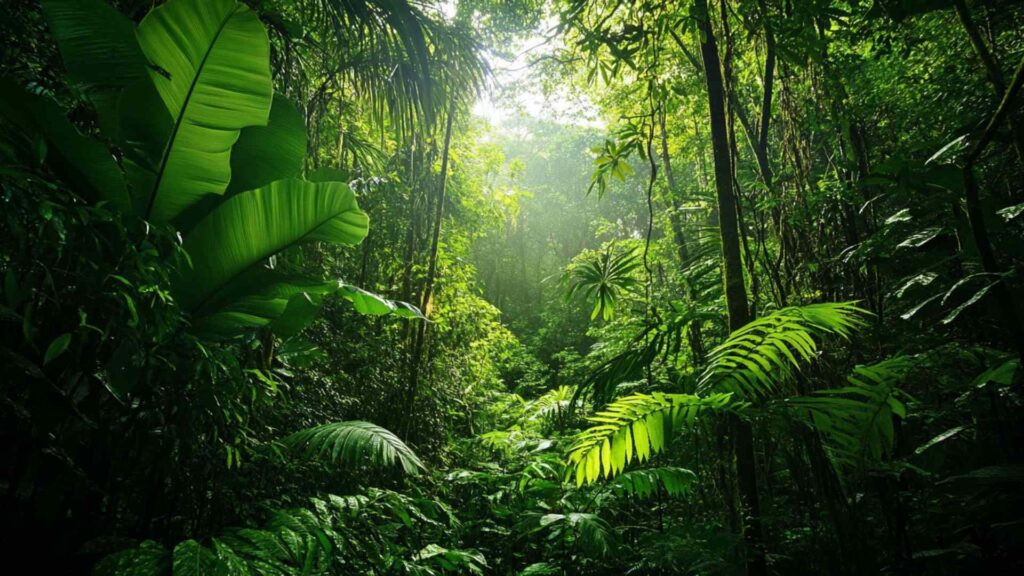
- Most rainforests have four main layers: emergent, canopy, understory, and forest floor.
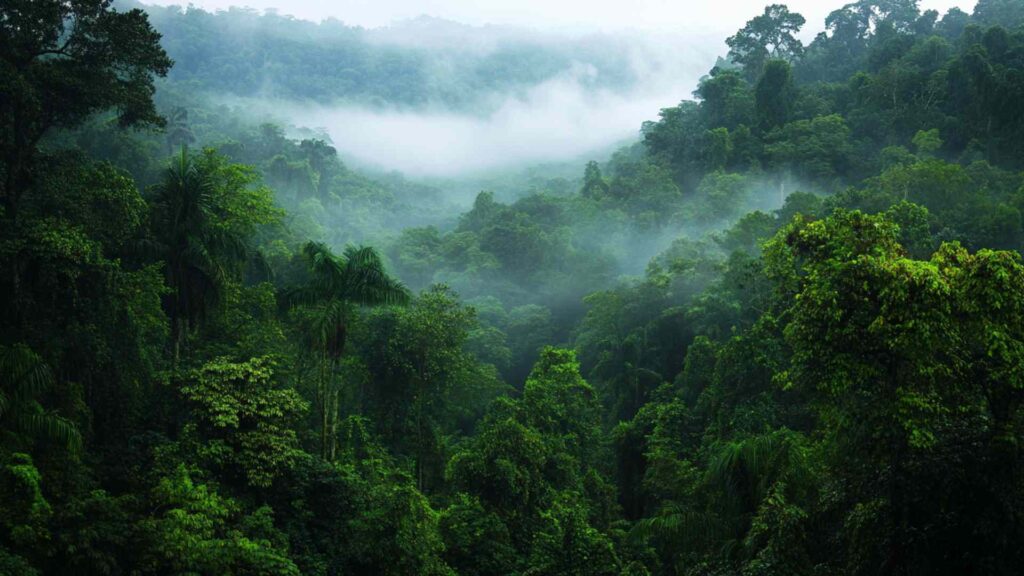
- The canopy is a leafy roof formed where tree crowns overlap tightly.
- The understory is a dim, humid zone of young trees, shrubs, and lianas.
- The forest floor is mostly shade, leaf litter, fungi, and decomposers.
- Cloud forests are high-elevation rainforests often wrapped in mist.
- Mangrove rainforests grow along tropical coasts where trees tolerate salty water.
- Monsoon forests are seasonal rainforests with a marked dry period each year.
Record-breakers & wow numbers
- Tropical rainforests cover about 6–7% of Earth’s land but hold a huge share of species.
- Some rainforest areas receive over 7,000 mm of rain per year.
- Daylength near the equator stays close to 12 hours all year.
- As of 2024 the Amazon is the largest tropical rainforest at roughly 5.5 million km².
- The Congo Basin is the second largest tropical rainforest at about 1.8 million km².
- New Guinea holds the third largest tropical rainforest in a single island.
- In some Amazon plots one hectare can host more than 250 tree species.
- Tropical canopy heights commonly reach 30–45 m with emergent trees taller.
- The tallest known tropical tree measured just over 100 m in Borneo as of 2024.
- Only about 1–5% of sunlight reaches many rainforest floors at midday.
- Relative humidity inside many rainforests often stays above 75%.
- Leaf litter can decompose in weeks because heat and moisture speed decay.
- A single bromeliad can hold over a liter of rainwater as a tiny pond.
- Large buttress roots on some trees can stand taller than a person.
- Some rainforest rivers rise by several meters between dry and wet seasons.
Science & how it works
- Drip tips on leaves help water run off fast to prevent fungus and rot.
- Buttress roots spread wide to support tall trees in shallow soils.
- Many rainforest soils are nutrient-poor because heavy rains leach minerals.
- Most nutrients are locked in living plants rather than in the soil.
- Fungi and bacteria recycle nutrients quickly back into roots.
- Mycorrhizal fungi link roots and help trees absorb water and phosphorus.
- Epiphytes grow on other plants for light but do not take their sap.
- Lianas are woody vines that climb trees to reach the sun.
- Some trees show cauliflory, growing flowers and fruit directly from trunks.
- Strangler figs start life high on a host and later encase it with roots.
- Many rainforest plants make strong chemical defenses to deter herbivores.
- Animals disperse seeds by swallowing fruits and dropping them later.
- Bats pollinate many night-blooming rainforest flowers.
- Rainforests pump huge amounts of water vapor into the air through evapotranspiration.
- Recycled moisture can fall again as local rain, creating “flying rivers.”
- Canopy leaves often have thick waxy cuticles to handle intense sun and rain.
- Understory plants usually have large, thin leaves to catch scarce light.
- Lianas often increase after disturbance because extra light favors vines.
- Gaps from fallen trees let sun-loving seedlings race upward.
- Over long timescales tropical forests are close to oxygen-neutral because respiration uses most oxygen they produce.
Wildlife & adaptations
- Jaguars are strong swimmers and often hunt along rainforest rivers.
- Harpy eagles have wingspans around 2 m and snatch prey from the canopy.
- Sloths move slowly to save energy and host green algae in their fur.
- Poison dart frogs warn predators with bright colors called aposematism.
- Leafcutter ants farm a special fungus using fresh leaves as compost.
- Army ants form living bridges with their linked bodies.
- Many tree frogs have toe pads that stick to leaves using tiny wet films.
- Toucans and hornbills help shed excess body heat through their large bills.
- Orangutans are the world’s biggest tree-dwelling mammals.
- Gibbons brachiate using long arms to swing quickly under branches.
- Pygmy marmosets weigh as little as about 100–160 g.
- Pangolins in Asian and African rainforests are covered in protective scales.
- Okapi live in the Congo rainforest and are relatives of giraffes.
- Tapirs roam rainforest undergrowth and are excellent swimmers.
- Sun bears in Southeast Asian forests have long tongues for licking honey.
- Cassowaries in New Guinea and northeastern Australia disperse large seeds.
- Electric eels from Amazonian forests can deliver strong electric shocks.
- Arapaima are giant Amazon fish that can exceed 3 m in length.
- Many butterflies gather at muddy spots to sip minerals in a behavior called puddling.
- Birdwing butterflies include some of the largest butterflies on Earth.
- Goliath birdeater spiders can reach leg spans near 28 cm.
- Many orchids grow as epiphytes high in the canopy.
- Bromeliads create mini-ponds that shelter insects, tadpoles, and crabs.
- Fruit bats spread seeds widely by flying long distances after feeding.
- Mixed-species flocks of small birds move together to spot predators and find food.

Geography & places
- The Amazon Basin drains an area larger than the entire European Union.
- Flooded Amazon forests called várzea are nourished by muddy whitewater rivers.
- Blackwater forests called igapó flood with dark, nutrient-poor rivers.
- The Chocó region along the Pacific coast of Colombia and Ecuador is among the rainiest on Earth.
- Borneo hosts vast dipterocarp rainforests with many emergent giants.
- Sumatra’s lowland rainforests include plants with some of the largest flowers.
- Madagascar’s rainforests hold many species found nowhere else on Earth.
- The Congo River loops through dense central African rainforests.
- New Guinea’s mountains support cool, mossy cloud forests above hot lowlands.
- India’s Western Ghats contain lush monsoon rainforests with many endemics.
- Australia’s Daintree is one of the oldest surviving tropical rainforest areas.
- Central America’s Caribbean slope carries continuous bands of wet forest.
- Sri Lanka’s southwestern hills harbor compact, humid rainforests.
- The Pacific Northwest holds temperate rainforests rich in ferns and conifers.
- Southern Chile and Argentina contain cool temperate rainforests with ancient trees.
- New Zealand’s West Coast rainforests mix podocarps, beeches, and tree ferns.
- Japan’s Yakushima Island supports warm-temperate rainforests with giant cedars.
- Parts of Norway’s coast host small patches of temperate rainforest with heavy mist.
- Tropical montane rainforests often sit between about 1,000 and 3,000 m elevation.
- Many island rainforests change rapidly with altitude over short horizontal distances.
People, history & culture
- Millions of Indigenous people live in and around rainforests with deep ecological knowledge.
- Some rainforest groups practice shifting cultivation with long fallow periods.
- Blowpipes, bows, and spears have long been traditional rainforest hunting tools.
- Canoes remain vital for travel on many rainforest rivers.
- Natural latex from rainforest trees fueled a global rubber boom in the late 1800s.
- Forest foods include palm hearts, fruits, nuts, fish, and wild game.
- Many rainforest plants have been used in traditional medicine for centuries.
- House stilt designs keep homes above floods and damp ground.
- Woven baskets and mats often use rainforest vines and palm fibers.
- Many languages in rainforest regions face decline as young speakers move to cities.
- Ecotourism brings visitors to canopy walkways and wildlife lodges.
- Hand-carved wooden canoes are still crafted in many rainforest communities.
- Seasonal festivals often align with rains, fruiting peaks, or fish migrations.
- River traders move goods between remote forest villages and towns.
- Storytelling in rainforest cultures often features animals with human-like powers.

Conservation & challenges
- Deforestation fragments habitats and reduces populations of large animals.
- Road building often opens remote forest to logging, mining, and settlement.
- Illegal wildlife trade threatens many rainforest birds, reptiles, and mammals.
- Climate change is altering rainfall patterns and raising heat stress in many forests.
- Extreme drought years can increase tree mortality and fire risk.
- Edge effects near clearings dry out forest fringes and favor hardy species.
- Selective logging removes big trees and can damage surrounding vegetation.
- Forest regrowth can recover canopy cover but may lose old-growth specialists.
- Protected areas slow habitat loss when they are well funded and enforced.
- Community-managed forests often perform well at keeping trees standing.
- Shade-grown cacao and coffee farms support more wildlife than sun-grown fields.
- Agroforestry mixes trees with crops to keep soil covered and boost biodiversity.
- Reforestation projects plant native species to reconnect broken habitats.
- Assisted natural regeneration protects sprouts so forests recover on their own.
- Wildlife corridors link small forest patches so animals can move safely.
- Acoustic monitoring uses sound recorders to track birds, frogs, and chainsaws.
- Camera traps reveal shy animals and help estimate their numbers.
- Carbon credit programs pay for keeping forests intact to store carbon.
- Buying products certified for sustainable practices can reduce pressure on forests.
- Urban consumers can help by choosing less wasteful packaging and reducing food loss.
Names & etymology
- The word “jungle” entered English through South Asia and originally meant wild or uncultivated land.
- In common use “jungle” often refers to very dense vegetation at forest edges and riverbanks.
- The modern term “rainforest” was popularized in the late 1800s to describe forests shaped by heavy rain.
- Cloud forest is named for the frequent low clouds that brush the canopy.
- The term “canopy” comes from a word for a cloth covering, likening leaves to a roof.
For kids: quick comparisons
- A big emergent tree can be as tall as a 25–30 story building.
- Some rainforest leaves are as long as your arm to catch more light.
- A sloth’s top speed on the ground is slower than most people walk.
- A harpy eagle’s talons are about as long as a grizzly bear’s claws.
- A goliath birdeater spider is wider than a dinner plate when fully spread.
- A bromeliad pond can hold more water than a large soda bottle.
- A jaguar’s bite can crush turtle shells like a nutcracker.
- The Amazon River carries more water than the next several big rivers combined.
- The canopy can feel like a sunny park while the forest floor feels like a dim basement.
- Some rainforest valleys get more rain in a month than deserts get in a whole year.
Pop culture & fun extras
- Many adventure stories set their mysteries in vine-draped rainforest ruins.
- Boardwalks and canopy towers let visitors feel like birds high above the trees.
- Wildlife sounds at night can blend into a steady chorus called the rainforest soundtrack.
- Scientists sometimes reach treetops using hot-air balloons or cranes for canopy research.
- Some rainforest lodges offer night walks where glowing fungi and fireflies steal the show.
Quick FAQ
What defines a rainforest?
A rainforest is a forest with consistently high rainfall, humid air, and dense, multilayered vegetation.
Where are most rainforests located?
Most tropical rainforests lie near the equator in South America, Africa, Southeast Asia, and Oceania, while temperate rainforests sit in cool, rainy coastal zones.
Do rainforests really make most of our oxygen?
Rainforests produce huge amounts of oxygen, but decomposition uses most of it, making them roughly oxygen-neutral over long periods.
How many layers does a rainforest have?
Most have four main layers: emergent, canopy, understory, and forest floor.
How can I help protect rainforests?
Choose products made with sustainable practices, reduce waste, support conservation groups, and learn more about biodiversity and forests.

Ellie is the owner and sole author of Fun Facts, combining her mechanical engineering background with years of research-driven writing to deliver facts you can trust. Every article is thoroughly fact-checked and routinely updated as new science and sources emerge to keep information accurate and current. Her mission is to make learning delightful while upholding high standards of reliability and transparency.