
South Africa is a country of mountains, deserts, forests, and two oceans, packed with wildlife and friendly people.
These quick, kid-safe facts will take you from the tip of the continent to famous parks and lively cities.
Ready to learn about languages, foods, and big adventures? Let’s go!
Origins & definitions
- South Africa sits at the southern tip of the African continent.
- It borders Namibia, Botswana, Zimbabwe, Mozambique, and Eswatini, and it completely surrounds Lesotho.
- It faces the Atlantic Ocean to the west and the Indian Ocean to the east.
- Cape Agulhas is the country’s southernmost point.
- The country uses South African Standard Time, which is UTC+2 year-round.
- People in South Africa drive on the left side of the road.
- The nation has three capital cities: Pretoria, Cape Town, and Bloemfontein.
- Pretoria is the administrative (executive) capital.
- Cape Town is the legislative capital where Parliament sits.
- Bloemfontein is the judicial capital.
- The Union of South Africa was created on 31 May 1910 from four British colonies.
- The country became a republic on 31 May 1961.
Record-breakers & wow numbers
- South Africa covers about 1,221,037 square kilometers.
- The coastline stretches roughly 3,000 kilometers along two oceans.
- The Drakensberg mountain range reaches its highest point at Mafadi at about 3,450 meters.
- Tugela Falls in the Drakensberg is among the tallest waterfalls on Earth at about 948 meters.
- The Vredefort Dome is one of the largest known impact structures on the planet.
- Mponeng is among the deepest mines on Earth, reaching more than 4 kilometers below ground.
- The constitution recognizes 11 official languages.
- The national flag adopted on 27 April 1994 features six colors in a bold Y-shaped design.
- South Africa has nine provinces governing its regions.
- The Garden Route spans about 300 kilometers of scenic southern coastline.
- The N1 highway runs roughly 1,900 kilometers from Cape Town to the Zimbabwe border.
- The Orange River runs more than 2,000 kilometers from the Drakensberg toward the Atlantic.
- As of 2024, South Africa has a population of about 60 million people.
- The country holds some of the world’s richest reserves of platinum group metals.
- South Africa has won the men’s Rugby World Cup four times in 1995, 2007, 2019, and 2023.

Geography & nature
- The Atlantic side of South Africa is cooled by the Benguela Current.
- The Indian Ocean side is warmed by the fast-moving Agulhas Current.
- Cape Point lies within Table Mountain National Park near the Cape Peninsula’s tip.
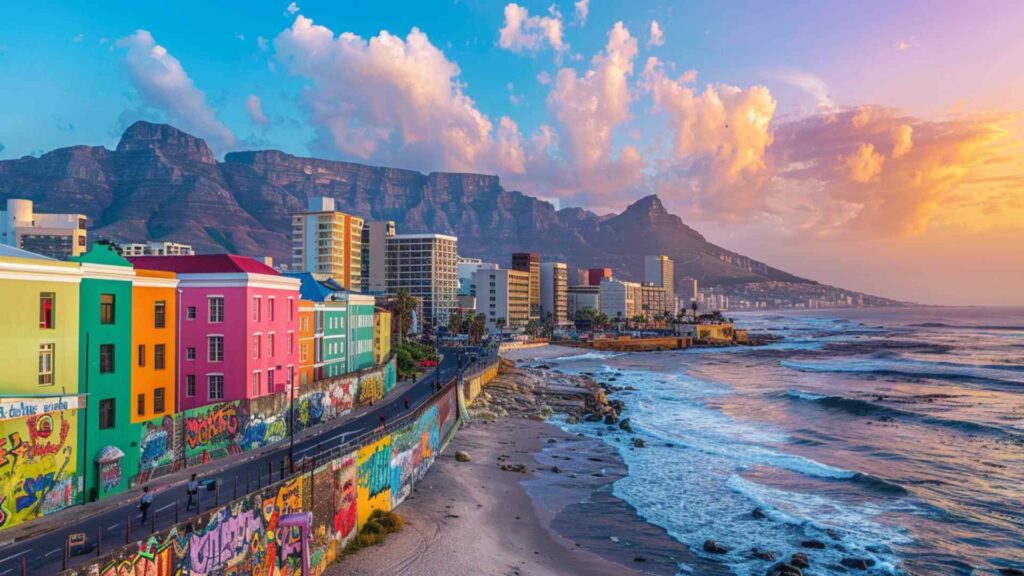
- Cape Town sits below Table Mountain, a flat-topped sandstone massif.
- The Cape Floristic Region is a global biodiversity hotspot packed with endemic plants.
- Fynbos shrubland dominates much of the Western Cape’s natural vegetation.
- Namaqualand bursts into colorful wildflower displays after late winter rains.
- The Karoo is a vast semi-desert covering much of the interior plateau.
- The Drakensberg forms a towering escarpment along the country’s eastern rim.
- Blyde River Canyon is famed for lush cliffs and the Three Rondavels viewpoint.
- The Great Escarpment separates the highveld plateau from the coastal lowlands.
- The highveld sits at 1,200–1,800 meters and enjoys cooler, drier air.
- The lowveld slopes toward the Indian Ocean with warmer, more humid conditions.
- The Western Cape has a Mediterranean climate with winter rain and dry summers.
- KwaZulu-Natal’s coast is subtropical with warm seas year-round.
- Snow can fall on high Drakensberg peaks in winter months.
- The Kalahari’s red sands reach into the Kgalagadi Transfrontier Park in the far northwest.
- The Orange River forms much of the border with Namibia before reaching the Atlantic.
- The Limpopo River marks part of the northern boundary with Botswana and Zimbabwe.
- South Africa’s largest dam by capacity is the Gariep Dam on the Orange River.
- The Vaal River is the main Orange tributary and a key water source for Gauteng.
- The Lesotho Highlands rise sharply beside the Free State’s rolling farmlands.
- The Garden Route runs through indigenous forests, lagoons, and coastal cliffs.
- The Wild Coast in the Eastern Cape is famous for rugged headlands and remote beaches.
- The Cederberg mountains north of Cape Town hold ancient rock art and dramatic sandstone formations.

Wildlife & conservation
- South Africa is home to the celebrated “Big Five” of lion, leopard, elephant, rhino, and buffalo.
- Kruger National Park is one of Africa’s largest and oldest game reserves.
- Addo Elephant National Park protects elephants and unique coastal habitats.
- Kgalagadi Transfrontier Park spans South Africa and Botswana for desert wildlife.
- iSimangaliso Wetland Park safeguards lakes, estuaries, and coral reefs along the east coast.
- African penguins nest at Boulders Beach near Simon’s Town.
- Southern right whales migrate past the Western Cape to calve in winter.
- Great white sharks are part of the marine ecosystem off the Cape coasts.
- Meerkats live in arid regions of the Northern Cape and the Karoo.
- The blue crane is South Africa’s national bird.
- The springbok is South Africa’s national animal.
- The king protea is the national flower.
- The real yellowwood is the national tree.
- The galjoen is the national fish.
- Private and public reserves work with national parks to protect key habitats.
- Wildlife corridors help animals move between protected areas.
- Anti-poaching units operate in several parks to protect threatened species.
- Many reserves promote eco-tourism as a way to fund conservation.
- The Cape mountain zebra is a distinct subspecies recovered from low numbers.
- Bontebok National Park was established to save the bontebok antelope.
- The Sardine Run brings huge shoals and predators along the KwaZulu-Natal coast most winters.
- Vultures like the Cape vulture soar on thermals above the cliffs of the Drakensberg.
- The country hosts significant populations of both black and white rhinoceroses.
People, language & culture
- South Africa is often nicknamed the “Rainbow Nation” to celebrate its diversity.
- isiZulu is the most widely spoken home language.
- English is widely used in business, media, and government.
- Afrikaans developed from Dutch and local influences over centuries.
- Many South African languages use click consonants, especially in isiXhosa and isiZulu.
- The country’s motto “!ke e: Ɂxarra Ɂke” comes from a /Xam phrase meaning “diverse people unite.”
- A typical South African barbecue is called a braai.
- Heritage Day on 24 September is often celebrated as a national day of braai.
- The South African national anthem blends multiple languages into one song.
- A “bakkie” is a pickup truck in South African English.
- A “robot” is a traffic light in local slang.
- Bunny chow is a hollowed-out loaf filled with curry, popular in Durban.
- Bobotie is a baked curried mince dish topped with an egg custard.
- Biltong is air-dried seasoned meat enjoyed as a snack.
- Chakalaka is a spicy vegetable relish often served with pap.
- Pap is a stiff maize porridge eaten with stews and braai meats.
- Koeksisters are twisted syrup-soaked pastries enjoyed as sweets.
- Melktert is a creamy milk tart with cinnamon.
- Boerewors is a coiled sausage traditionally cooked over coals.
- Potjiekos is a slow-cooked stew made in a small cast-iron pot.
- Rooibos tea comes from a plant native to the Cederberg mountains.
- South Africa produces acclaimed wines from regions like Stellenbosch and the Cape Winelands.
- Chenin Blanc and Pinotage are signature grape varieties grown widely.
- Gumboot dancing started among miners and became a popular performance style.
- Amapiano is a dance music style that surged from townships into global playlists.
- Kwaito reshaped urban youth culture in the 1990s.
- Gqom is a hard-hitting electronic sound linked with Durban.
- Rugby, cricket, and football are three of the most followed sports.
- The national cricket team is popularly known as the Proteas.
- The men’s national football team is popularly called Bafana Bafana.

History & milestones
- Khoisan peoples were among the earliest inhabitants of southern Africa.
- Bantu-speaking communities spread into the region more than 1,000 years ago.
- Portuguese explorers sailed past the Cape in the late 1400s.
- A Dutch refreshment station was founded at the Cape in 1652.
- British rule expanded at the Cape in the early 1800s.
- Diamonds were discovered near Kimberley in the late 1860s.
- Gold was discovered on the Witwatersrand in 1886, transforming Johannesburg.
- The South African War, also called the Anglo-Boer War, ended in 1902.
- The Union of South Africa joined World War I in 1914 and World War II in 1939.
- The apartheid policy became formal state policy in 1948.
- The Sharpeville protest in 1960 marked a turning point in resistance politics.
- The Soweto uprising began on 16 June 1976 after student protests.
- The country’s first democratic elections were held on 27 April 1994.
- 27 April is celebrated annually as Freedom Day.
- A new constitution took effect in 1996 with a strong Bill of Rights.
- The Truth and Reconciliation process addressed past human rights abuses in the late 1990s.
- South Africa rejoined the Commonwealth in 1994.
- The national flag and anthem were both updated in the 1990s.
- The first human-to-human heart transplant took place in Cape Town in 1967.
- The country legalized same-sex marriage in 2006, the first in Africa to do so.
Cities, travel & landmarks
- Johannesburg is the largest city and major economic hub.
- Pretoria is part of the City of Tshwane metropolitan area.
- Cape Town is known for its mountain, beaches, and heritage architecture.
- Durban on the east coast is famous for warm waters and surf culture.
- Bloemfontein is a central city known as the “City of Roses.”
- Gqeberha is the new official name for the city long known as Port Elizabeth.
- Makhanda is the new name for the city formerly called Grahamstown.
- Polokwane was historically known as Pietersburg before a 2005 name change.
- The Big Hole in Kimberley is a striking open-pit diamond mine and museum site.
- Robben Island in Table Bay is a museum and UNESCO World Heritage Site.
Economy, science & innovation
- The rand is the national currency and is abbreviated as R.
- South Africa is a leading producer of platinum, manganese, and chromium ores.
- The automotive industry assembles vehicles for both local use and export.
- The country generates most of its electricity from coal, with growing wind and solar capacity.
- A major optical telescope operates near Sutherland in the Northern Cape’s clear skies.
- South Africa hosts part of the Square Kilometre Array radio telescope project in the Karoo.
- Johannesburg’s economy grew from gold mining and has diversified into finance, services, and technology.
For kids: quick comparisons
- South Africa is about twice the size of France and five times the size of the United Kingdom.
- Johannesburg is one of the world’s highest big cities at roughly 1,700 meters above sea level.
- The distance from Cape Town to Durban by road is about 1,600 kilometers along the coast.
Quick FAQ
What are South Africa’s three capitals?
Pretoria is the executive capital, Cape Town is the legislative capital, and Bloemfontein is the judicial capital.
How many official languages does South Africa have?
South Africa recognizes 11 official languages.
What currency does South Africa use?
The national currency is the rand, written with the symbol R.
When did South Africa hold its first democratic elections?
The first democratic elections took place on 27 April 1994.
What are the Big Five animals?
The Big Five are lion, leopard, elephant, rhino, and buffalo.

Ellie is the owner and sole author of Fun Facts, combining her mechanical engineering background with years of research-driven writing to deliver facts you can trust. Every article is thoroughly fact-checked and routinely updated as new science and sources emerge to keep information accurate and current. Her mission is to make learning delightful while upholding high standards of reliability and transparency.