
Portugal packs castles, cliffs, and cozy cafés into a small Atlantic nation with a huge story.
From daring sailors to sweet custard tarts, every corner has a tale.
Dive into these quick facts to learn how Portugal’s history, language, nature, and food all come together in one friendly place.
Origins & history
- Portugal became a kingdom in 1139 under Afonso I.
- Portugal’s independence was recognized in the Treaty of Zamora in 1143.
- The country’s borders stayed largely stable after the Treaty of Alcañices in 1297.
- The Anglo-Portuguese Alliance of 1373 is one of the world’s oldest active treaties.
- Portuguese sailors launched the Age of Discoveries in the 1400s with agile caravels.
- In 1415, Portugal captured Ceuta in North Africa, starting a global empire.
- Pedro Álvares Cabral reached Brazil in 1500 and claimed it for the Portuguese crown.
- Vasco da Gama sailed to India in 1498, opening a sea route around Africa.
- The 1494 Treaty of Tordesillas split new lands outside Europe between Portugal and Spain.
- The Iberian Union joined Portugal and Spain under one crown from 1580 to 1640.
- A massive earthquake and tsunami struck Lisbon on November 1, 1755.
- Rebuilding after 1755 introduced early anti-seismic “gaiola” wooden frame designs.
- Portugal became a republic on October 5, 1910.
- Portugal stayed neutral in World War II while serving as an escape route for refugees.
- The Estado Novo authoritarian regime lasted from 1933 to 1974.
- The Carnation Revolution on April 25, 1974 ended the dictatorship with minimal bloodshed.
- Several African territories gained independence in 1975 after the revolution.
- Macau returned to Chinese administration in 1999 after centuries of Portuguese rule.
- Portugal joined the European Economic Community in 1986.
- The euro replaced the escudo for cash purchases in 2002.
Geography & nature
- Portugal includes mainland territory plus the Azores and Madeira archipelagos.
- Mount Pico on Pico Island reaches 2,351 m, the highest point in Portugal.
- Torre in Serra da Estrela rises to 1,993 m, the highest point on the mainland.
- Cabo da Roca marks the westernmost point of mainland Europe.
- Cabo de São Vicente forms the southwestern tip of mainland Europe.
- The Azores include nine volcanic islands spread across the mid-Atlantic.
- Madeira Island is famous for steep green mountains and a mild climate.
- The Tagus River is the Iberian Peninsula’s longest river and crosses Lisbon.
- The Mondego is the longest river that flows entirely within Portugal.
- Portugal’s long Atlantic coastline shapes its weather, food, and traditions.
- A deep undersea canyon at Nazaré helps create giant surfable waves.
- Cork oak forests called montado shelter wildlife and support rural life.
- The cork oak became Portugal’s national tree in 2011.
- Ria Formosa in the Algarve is a protected lagoon rich in birdlife.
- The Berlengas islands near Peniche are a marine reserve with clear waters.
- Bottlenose dolphins live year-round in the Sado Estuary near Setúbal.
- Madeira’s Laurisilva forest preserves a rare subtropical laurel ecosystem.
- The Azores rank among Europe’s best places for whale watching.
- Portugal has a Mediterranean climate with strong Atlantic influence.
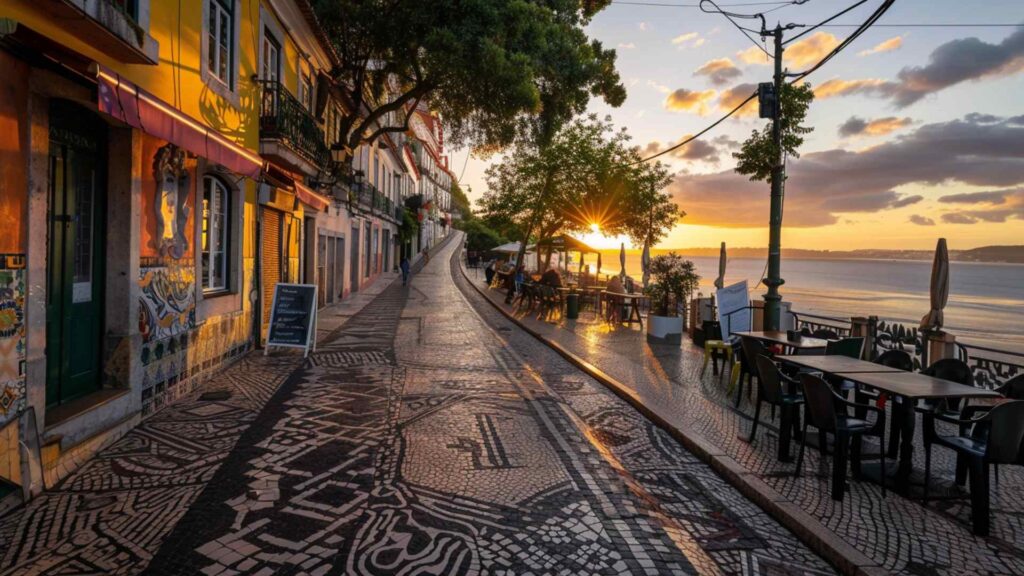
- Cities often feature black-and-white wave mosaics called calçada portuguesa.
- Serra da Arrábida packs limestone cliffs, beaches, and wildflowers into a compact park.
- At times the national grid runs on 100% renewable electricity for days.
- Europe’s overall westernmost point sits at Monchique Islet off Flores in the Azores.
- The Douro Valley terraces show centuries of careful hillside farming.
- Portugal covers about 92,090 km², slightly smaller than the U.S. state of Indiana.

Cities & landmarks
- Lisbon is Portugal’s capital and largest city.
- Tram 28 trundles through Lisbon’s steep historic neighborhoods.
- The 25 de Abril Bridge spans the Tagus between Lisbon and Almada.
- The Vasco da Gama Bridge stretches about 12.3 km across the Tagus estuary.
- Jerónimos Monastery in Belém shines with richly carved Manueline stonework.
- The Tower of Belém once guarded Lisbon’s harbor entrance.
- The iron Santa Justa Lift has connected downtown levels since 1902.
- Porto’s Dom Luís I Bridge was designed by engineer Théophile Seyrig.
- Porto’s Ribeira quarter lines the Douro with tall, colorful houses.
- Port wine cellars cluster in Vila Nova de Gaia across from Porto.
- The University of Coimbra was founded in 1290 and still teaches today.
- Bats in Coimbra’s Baroque library help protect precious books from insects.
- Sintra’s Pena Palace mixes bright colors and Romantic architecture on a hilltop.
- Évora displays a first-century Roman temple in its historic center.
- Tomar’s Convent of Christ preserves a round Templar church called the Charola.
- Elvas forms a star-shaped fortress complex near the Spanish border.
- The Douro railway hugs the river with tunnels, bridges, and grand views.
- Óbidos is a walled town where cherry liqueur is served in chocolate cups.
- Arouca 516 is a 516 m pedestrian suspension bridge over a deep gorge.
- The Sete Cidades caldera holds striking twin lakes colored blue and green.
Language & words
- Portuguese is the official language of Portugal and dominates South America because of Brazil.
- Portuguese is a Romance language that developed from Latin.
- Portuguese is an official language in nine countries on four continents.
- A community of Portuguese-speaking countries promotes cultural and language ties.
- Many Portuguese people use two surnames, often one from each parent.
- The letters K, W, and Y became officially accepted in the alphabet in 2009.
- Mirandese has regional co-official status in northeastern Portugal.
- Saudade is a famous Portuguese word for deep, nostalgic longing.
- The English word baroque comes from Portuguese barroco, meaning irregular pearl.
- The English word caste comes from Portuguese casta, meaning lineage.
- The English word fetish comes from Portuguese feitiço, meaning charm.
- The English word marmalade comes from Portuguese marmelada, a quince jam.
- The English word albino entered English through Portuguese and Spanish.
- The English word cobra likely shortened from Portuguese cobra de capelo.
- A spelling agreement aims to harmonize Portuguese across different countries.
Food & drink
- Portugal leads the world in cork production used for wine stoppers and more.
- The Douro Valley is the birthplace of port, a fortified wine style.
- Vinho Verde is a young, crisp wine from the rainy northwest.
- Madeira wine is heat-aged and famous for long-lasting flavors.
- The Douro was officially demarcated as a wine region in 1756.
- Pastéis de nata are creamy custard tarts topped with cinnamon.
- Bacalhau means dried salted cod cooked in countless home recipes.
- Charcoal-grilled sardines are a classic taste of summer festivals.
- Caldo verde soup blends thin-sliced greens, potatoes, and sausage.
- Francesinha layers meats and cheese under a rich, spicy sauce.
- Cataplana stews from the Algarve cook in a clamshell copper pot.
- Piri-piri chilies, brought by trade, add heat to many dishes.
- Serra da Estrela cheese is a soft sheep’s milk specialty.
- Ginjinha is a sweet sour-cherry liqueur served in tiny cups.
- Bolo-rei is a ring-shaped holiday bread with dried fruit.
- In the Azores, cozido das Furnas slow-cooks underground with volcanic heat.
- Broa is hearty cornbread that pairs perfectly with soups.
- Bolo do caco from Madeira is flat bread often served with garlic butter.
- Olive oil from Alentejo groves is a kitchen staple.
- Neighborhood pastelarias offer strong coffee and trays of fresh pastries.
Culture & traditions
- Fado is a soulful song tradition recognized as an intangible cultural treasure.
- The tear-drop Portuguese guitar has 12 strings and a bright ring.
- Coimbra’s fado style links to student life and black academic capes.
- The Galo de Barcelos rooster is a colorful good-luck symbol.
- Ceramic swallows called andorinhas symbolize home and safe returns.
- June street festivals called Santos Populares fill cities with music and sardines.
- Lisbon honors Santo António with parades and balcony decorations.
- Porto’s São João festival features bonfires and playful plastic hammers.
- Tomar’s Festa dos Tabuleiros every four years showcases towering bread crowns.
- Queima das Fitas celebrates the end of the academic year in several cities.
- Blue-and-white azulejo tiles often tell local history on public walls.
- Portuguese filigree jewelry twists fine gold wires into lace-like art.
- Calçada sidewalks are hand-set stone mosaics found in many town squares.
- The Barcelos weekly market has traded farm goods and crafts for generations.
- The Sanctuary of Fátima attracts millions of pilgrims each year.

Science, economy & innovation
- Portuguese shipyards built nimble caravels that transformed early ocean travel.
- Trade routes helped spread crops and flavors like chilies, pepper, and tea.
- Portugal consistently ranks among top exporters of cork and cork products.
- Northern regions remain strong in textiles and footwear manufacturing.
- Artistic ceramics from Caldas da Rainha and Barcelos are popular exports.
- Wind, hydro, and solar power expand across hills, rivers, and plains.
- Northern Portugal holds lithium-bearing ores important for batteries.
- Major ports like Sines and Leixões connect Europe with Atlantic trade.
- Arouca Geopark protects notable rock formations and fossils.
- Lisbon hosted Expo ’98 with a huge ocean-themed exhibition site.
Sports & pop culture
- Football is the country’s most popular sport.
- Portugal won the UEFA European Championship in 2016.
- Portugal won the inaugural UEFA Nations League in 2019.
- Big-wave surfers flock to Nazaré to ride towering winter swells.
- Portugal has earned many roller hockey world and European titles.
- The Lisbon Marathon takes place each autumn along scenic roads.
- The Estoril Coast hosts international surfing and sailing events.
- The Portuguese Water Dog once helped fishermen retrieve gear at sea.
- The Lusitano horse breed shines in classical riding and dressage.
- Porto’s São Bento Station displays huge azulejo panels of history and daily life.
Travel & quick comparisons
- Portugal’s population is about 10 million people as of 2024.
- The country drives on the right and uses the metric system.
- Mainland Portugal matches London time in winter and moves one hour ahead in summer.
- The Azores are usually one hour behind the mainland.
- Trains and buses link major cities, with scenic rides along coasts and rivers.
- Short distances make it easy to visit beaches, mountains, and cities in one trip.
- Lisbon’s airport sits only a few kilometers from the historic center.
- Portugal has 17 UNESCO World Heritage Sites as of 2024.
- Cabo da Roca is roughly a 40-minute drive from central Lisbon on a quiet day.
- In one holiday you can swim in Algarve waters and hike Azores volcano craters.
Quick FAQ
What is Portugal famous for?
Portugal is famous for seafaring explorers, fado music, azulejo tiles, cork, and scenic Atlantic coasts.
When is the best time to visit Portugal?
Late spring and early autumn offer warm weather, fewer crowds, and great outdoor conditions.
Which islands belong to Portugal?
Portugal includes the Azores and Madeira, both in the Atlantic Ocean.
What language do people speak in Portugal?
People speak Portuguese, a Romance language also used in several countries worldwide.
Is Portugal expensive to visit?
Portugal is generally more affordable than many Western European countries, especially outside peak summer.

Ellie is the owner and sole author of Fun Facts, combining her mechanical engineering background with years of research-driven writing to deliver facts you can trust. Every article is thoroughly fact-checked and routinely updated as new science and sources emerge to keep information accurate and current. Her mission is to make learning delightful while upholding high standards of reliability and transparency.