
Pluto is small, cold, and incredibly interesting, with icy mountains, a famous heart, and a moon almost half its size.
Dive into these fast, friendly facts to learn how Pluto moves, what covers its surface, and why it still captures imaginations.
Ready for a chilly space adventure? Let’s go!
Origins & definitions
- Pluto is a dwarf planet in the Kuiper Belt.
- Its official minor planet designation is 134340 Pluto.
- Pluto was discovered in 1930 by Clyde Tombaugh.
- Pluto was counted as the ninth planet for much of the 20th century.
- It is called a dwarf planet because it has not cleared its orbital neighborhood.
- Pluto orbits the Sun beyond Neptune.
- Pluto shares a 3:2 orbital resonance with Neptune.
- Its orbital plane is tilted about 17 degrees relative to Earth’s.
- Pluto’s orbit is quite stretched, with an eccentricity of about 0.25.
- One Pluto year lasts about 248 Earth years.
- One Pluto day lasts 6.387 Earth days.
- Pluto spins in retrograde, so the Sun appears to rise in the west there.
- Pluto’s axial tilt is about 120 degrees, giving extreme seasons.
- Pluto orbits at an average distance of about 39.5 astronomical units.
- At perihelion Pluto is about 29.7 astronomical units from the Sun.
- At aphelion Pluto is about 49.3 astronomical units from the Sun.
- Pluto is a trans-Neptunian object.
- Objects in the same 3:2 resonance are called plutinos.
- Pluto’s astronomical symbol is the monogram ♇.
- The initials in the symbol also honor Percival Lowell.
Record-breakers & wow numbers
- Pluto is about 2,376 kilometers wide.
- Its mean radius is about 1,188 kilometers.
- Pluto’s mass is about 1.303 × 10^22 kilograms.
- Pluto’s density is about 1.86 grams per cubic centimeter.
- Surface gravity on Pluto is about 0.62 meters per second squared.
- A 100 kilogram person would weigh about 6 kilograms on Pluto.
- Pluto’s escape velocity is about 1.21 kilometers per second.
- Average surface temperature is near 44 Kelvin.
- Sunlight at Pluto is roughly 1⁄1,600 as bright as on Earth.
- The Sun would look about 1⁄40 as wide as it appears from Earth.
- Light needs more than five hours to go from the Sun to Pluto.
- Pluto’s equatorial circumference is about 7,500 kilometers.
- A jet circling Pluto would take about eight hours at cruise speed.
- From 1979 to 1999 Pluto was closer to the Sun than Neptune.
- Pluto completes two orbits for every three of Neptune’s.
- Pluto’s last perihelion occurred in 1989.
- One Pluto season can last longer than 20 Earth years.
- Surface pressure is measured in tiny microbars.
- Pluto’s sky shows many stacked haze layers.
- The heart-shaped region is roughly 1,500 kilometers across.
- Mountains on Pluto reach about 3 to 6 kilometers high.
- A dark equatorial band stretches nearly 3,000 kilometers.
- Pluto is the largest known Kuiper Belt object by volume as of 2025.
- Eris is more massive than Pluto even though Pluto is slightly larger in diameter.
- Pluto has five known moons as of 2025.
Science & how it works: geology, ice, and air
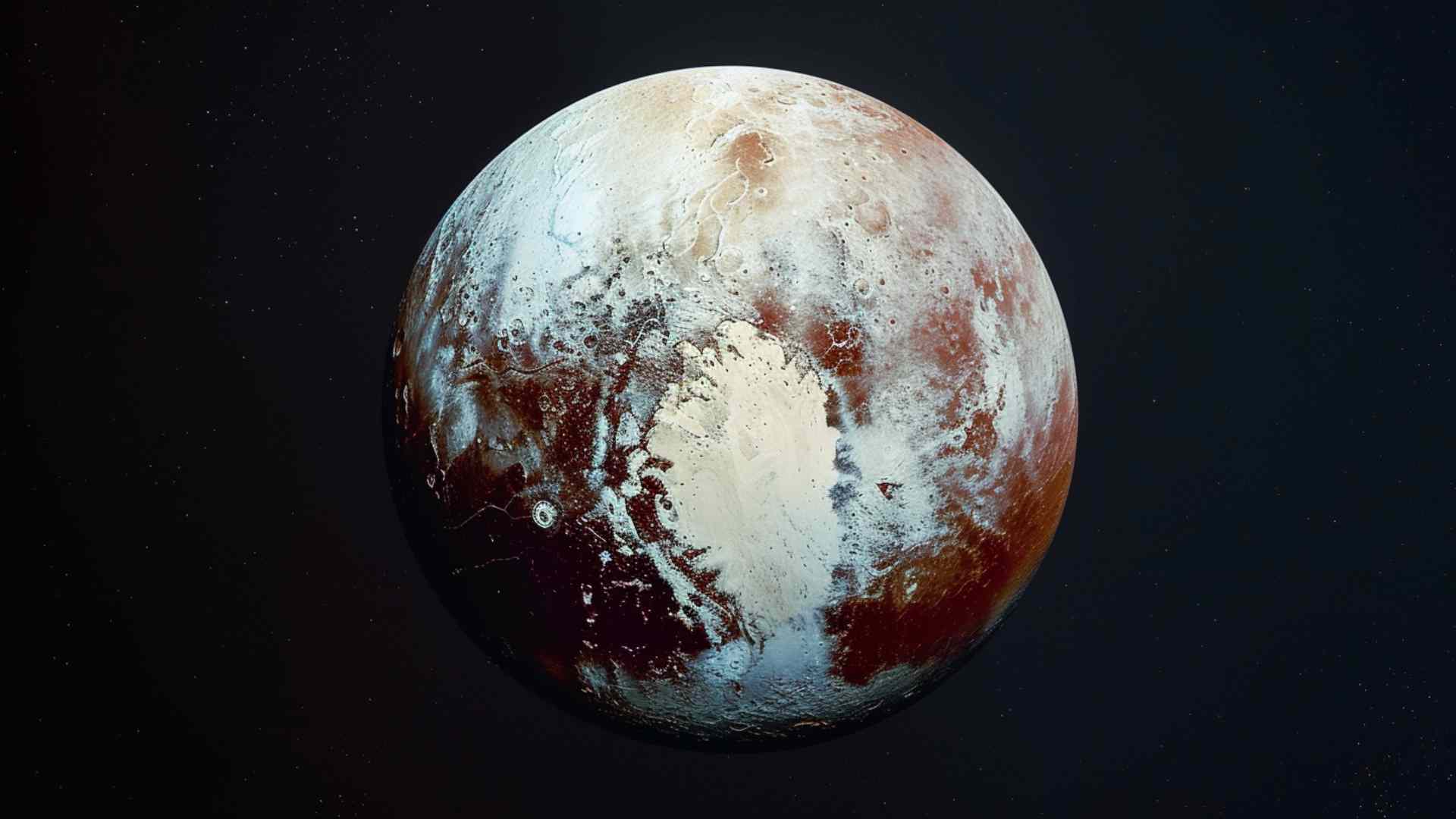
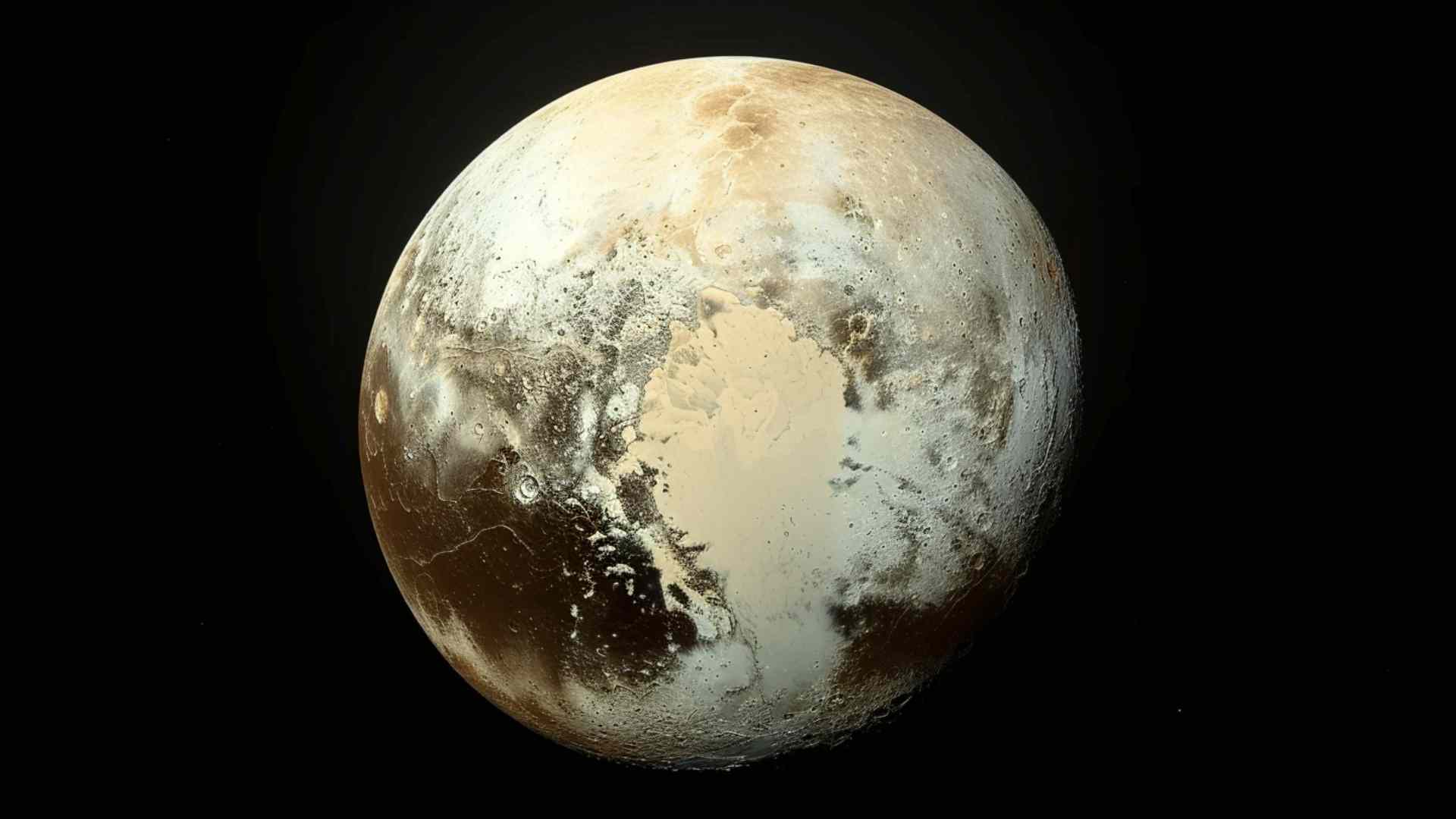
- Pluto’s bright heart is called Tombaugh Regio.
- The heart’s left lobe is a vast nitrogen-ice plain named Sputnik Planitia.
- Polygon patterns on Sputnik Planitia come from slow ice convection cells.
- Nitrogen glaciers stream from Sputnik Planitia into nearby valleys.
- Water ice forms Pluto’s strong bedrock at frigid temperatures.
- Norgay Montes and Hillary Montes rise near the heart’s edge.
- Wright Mons and Piccard Mons are possible ice volcanoes several kilometers high.
- Regions with few craters show geologically young surfaces.
- A huge dark equatorial area called Cthulhu Macula is heavily cratered.
- Tall, bladed methane-ice ridges called penitentes line some highlands.
- Pitted textures suggest surface ice is slowly evaporating into space.
- Long fractures and scarps hint at global tectonic stresses.
- Pluto likely reoriented through true polar wander to place Sputnik Planitia near the equator.
- Reddish colors come from complex organic solids known as tholins.
- Pluto’s atmosphere is mainly nitrogen with a little methane and carbon monoxide.
- Methane absorbs sunlight and helps warm the upper air slightly.
- Haze particles settle onto the ground and tint the surface.
- The atmosphere swells near perihelion and thins as Pluto recedes.
- Recent measurements show the surface pressure has been declining.
- Gentle winds can move methane grains to build dunes.
- Curving dunes fringe the western margin of Sputnik Planitia.
- Glacier lobes push around hills and leave scoured margins.
- Some valley glaciers appear to surge from stepped cliffs.
- The Sputnik Planitia basin likely holds kilometers of nitrogen ice.
- A large ancient impact may have created the basin.
- The heavy basin can drive reorientation by shifting mass on the globe.
- A buried ocean mixed with antifreeze may survive under Pluto’s crust.
- Patterns of fractures support the idea of a subsurface ocean.
- No global magnetic field has been detected around Pluto.
- Escaping gas creates a long tail shaped by the solar wind.
- Seasonal frosts migrate as sunlight shifts over the long year.
- Bright methane frost whitens some peaks and crater rims.
- Pluto’s sky looks blue because tiny haze particles scatter sunlight.
- Twilight on Pluto lasts a long time due to haze scattering.
- No rings or arcs have been found around Pluto as of 2025.

Moons & the Pluto–Charon system
- Charon is about half as wide as Pluto.
- Charon measures roughly 1,212 kilometers across.
- Charon orbits about 19,600 kilometers from Pluto’s center.
- Pluto and Charon keep the same faces toward each other.
- The system’s center of mass sits outside Pluto’s surface.
- Charon’s orbital period matches Pluto’s day at 6.387 Earth days.
- Charon’s surface is dominated by water ice and appears gray.
- A dark reddish cap stains Charon’s north pole.
- Escaping gases from Pluto likely help darken Charon’s polar cap.
- Charon hosts canyon systems more than 1,000 kilometers long.
- Smooth plains on Charon suggest icy resurfacing.
- Charon shows no clear signs of a present atmosphere.
- Pluto’s four small outer moons are Styx, Nix, Kerberos, and Hydra.
- All four small moons orbit beyond Charon on near-circular paths.
- Styx circles Pluto in about 20 days.
- Nix circles Pluto in about 25 days.
- Kerberos circles Pluto in about 32 days.
- Hydra circles Pluto in about 38 days.
- The small moons are irregularly shaped and rotate unpredictably.
- Their chaotic spins are driven by the pulls of Pluto and Charon.
- Names for Pluto’s moons follow an underworld theme.
- Charon was discovered in 1978 by noticing changes in Pluto’s brightness.
- Nix and Hydra were found in the mid-2000s with sharp imaging.
- Kerberos and Styx were added in the early 2010s.
- No moons beyond these five have been confirmed as of 2025.
History, discovery & exploration
- Clyde Tombaugh spotted Pluto on February 18, 1930.
- He used a blink comparator to find a moving point between sky photos.
- Pluto’s mass was long overestimated before better measurements arrived.
- The hunt for a distant “Planet X” motivated the search that found Pluto.
- For decades Pluto appeared in schoolbooks as the ninth planet.
- In 2006 astronomers defined a new dwarf planet category.
- Pluto received the number 134340 in the minor planet catalog in 2006.
- The New Horizons spacecraft launched on January 19, 2006.
- It used a 2007 Jupiter flyby to speed toward Pluto.
- New Horizons made closest approach on July 14, 2015.
- It passed about 12,500 kilometers above Pluto’s surface.
- The flyby delivered the first close-up maps of Pluto and its moons.
- Transmitting all the flyby data took more than a year.
- The flyby revealed haze layers reaching hundreds of kilometers high.
- It confirmed active glaciers and young plains on Pluto.
- The spacecraft later flew past the Kuiper Belt object Arrokoth in 2019.
- Images showed sharp water-ice peaks rising like jagged mountains.
- Data confirmed the heart is a deep basin filled with nitrogen ice.
- Before 2015, stellar occultations revealed Pluto’s thin atmosphere.
- Continued occultations since then have tracked changing pressure.
Names, etymology, and pop culture
- The name Pluto was suggested by 11-year-old Venetia Burney.
- The initials P and L in the symbol also honor Percival Lowell.
- The moons’ names come from mythic figures of the underworld.
- Many Pluto features are named for explorers and adventurers.
- Some Charon features are named for fictional voyagers and locales.
- The heart image turned Pluto into a pop-culture star overnight.
- The playful verb “to pluto” briefly meant to demote or downgrade.
- A famous cartoon dog named Pluto debuted in the early 1930s.
- Fans celebrate Pluto Day each year in February.
- Kids love that Pluto is tiny yet packed with surprises.
For kids: quick comparisons
- Pluto is smaller than Earth’s Moon.
- If Earth were a basketball, Pluto would be about a ping-pong ball.
- Driving around Pluto’s equator by car would take more than 100 hours.
- You would jump about 16 times higher on Pluto than on Earth.
- One Pluto day is longer than a school week.
- A single Pluto winter can last longer than a human lifetime.
- The Sun would look like a tiny bright dot from Pluto.
- Snow on Pluto is mainly nitrogen or methane frost, not water snow.
- You need a medium-sized backyard telescope to spot Pluto.
- Despite being small, Pluto has mountains, glaciers, dunes, and a blue sky.
Quick FAQ
Is Pluto a planet or a dwarf planet?
Pluto is officially classified as a dwarf planet.
How many moons does Pluto have?
Pluto has five known moons.
How long is a day on Pluto?
A Pluto day lasts about 6.387 Earth days.
How long is a year on Pluto?
A Pluto year is about 248 Earth years.
What is the heart on Pluto?
The heart is Tombaugh Regio, a bright area with a giant nitrogen-ice plain called Sputnik Planitia.

Ellie is the owner and sole author of Fun Facts, combining her mechanical engineering background with years of research-driven writing to deliver facts you can trust. Every article is thoroughly fact-checked and routinely updated as new science and sources emerge to keep information accurate and current. Her mission is to make learning delightful while upholding high standards of reliability and transparency.