
Jamaica is a colorful island full of mountains, music, and amazing wildlife.
This friendly guide breaks the country into quick, snackable facts, perfect for kids and curious grown-ups.
From history and language to food and sports, you’ll find something “irie” to learn on every line.
Origins & definitions
- Jamaica is an island country in the Caribbean Sea south of Cuba and west of Hispaniola.
- The name “Jamaica” comes from the Taíno word “Xaymaca,” often translated as “land of wood and water.”
- Jamaica’s capital and largest city is Kingston.
- Jamaica’s official language is English, and Jamaican Patois is widely spoken.
- Jamaica is the third-largest island in the Caribbean by area after Cuba and Hispaniola.
- Jamaica became an independent nation on 6 August 1962.
- Jamaica is a parliamentary constitutional monarchy.
- The island is divided into 14 parishes grouped into the historic counties of Cornwall, Middlesex, and Surrey.
- The country’s currency is the Jamaican dollar, abbreviated as JMD or J$.
- The national motto is “Out of Many, One People.”
Record-breakers & wow numbers
- Jamaica covers about 10,991 square kilometers (4,244 square miles).
- Blue Mountain Peak is the island’s highest point at 2,256 meters (7,402 feet).
- The island’s coastline stretches roughly 1,022 kilometers (635 miles).
- Jamaica lies about 145 kilometers (90 miles) south of Cuba at the closest point.
- Jamaica’s population is about 2.8 million people as of 2024.
- Jamaica shares the North American country calling code and uses area codes 876 and 658.
- Jamaica drives on the left side of the road.
- The Blue and John Crow Mountains National Park covers about 495 square kilometers (191 square miles).
- Dunn’s River Falls is about 55 meters (180 feet) tall and 183 meters (600 feet) long.
- The Black River flows through extensive mangrove wetlands known as the Great Morass.
- The average annual temperature near sea level is about 27°C (81°F).
- Hurricane season runs from June to November each year.
- Jamaica’s exclusive economic zone extends 200 nautical miles from its coast under international law.
- Usain Bolt set the men’s 100 m world record at 9.58 seconds in 2009.
- Jamaica’s national flag is one of only a few national flags without red, white, or blue.

Geography & nature
- Jamaica sits near complex plate boundaries that give the island notable geological fault lines.
- The island’s interior features dramatic limestone karst known as Cockpit Country.
- The Blue Mountains form the rugged eastern spine of the island.
- The longest river in Jamaica is the Rio Minho in Clarendon.
- The Martha Brae River is famous for bamboo rafting tours near Falmouth.
- Kingston Harbour is one of the largest natural harbors in the Caribbean.
- Jamaica has several offshore cays, including the Morant and Pedro Cays.
- The Hellshire Hills in St. Catherine protect rare dry limestone forest.
- The Buff Bay and Rio Grande rivers drain the lush northeastern slopes.
- The Yallahs River helps supply water to the Kingston Metropolitan Area.
- The south coast is generally drier than the wetter, greener north coast.
- Microclimates range from hot coastal plains to cool, misty mountain forests.
- The Blue and John Crow Mountains are a UNESCO World Heritage Site inscribed in 2015.
- The Homerus swallowtail butterfly, the largest in the Western Hemisphere, is native to Jamaica.
- The red-billed streamertail hummingbird, called the Doctor Bird, is Jamaica’s national bird.
- The national flower is the Lignum vitae, known for its tough wood and blue blossoms.
- The national tree is the Blue mahoe, valued for beautifully colored timber.
- Wild American crocodiles live in Jamaican wetlands and river mouths.
- The Jamaican iguana was rediscovered in 1990 after being thought extinct.
- Endemic birds include the Jamaican tody, Jamaican lizard cuckoo, and Jamaican owl.
- Coral reefs and seagrass beds around the island support important fisheries.
- A bioluminescent lagoon near Falmouth glows at night due to tiny dinoflagellates.
- Negril is famous for its long sandy beach and dramatic sea cliffs.
- The Runaway Bay and Ocho Rios coasts contain many limestone caves and sinkholes.
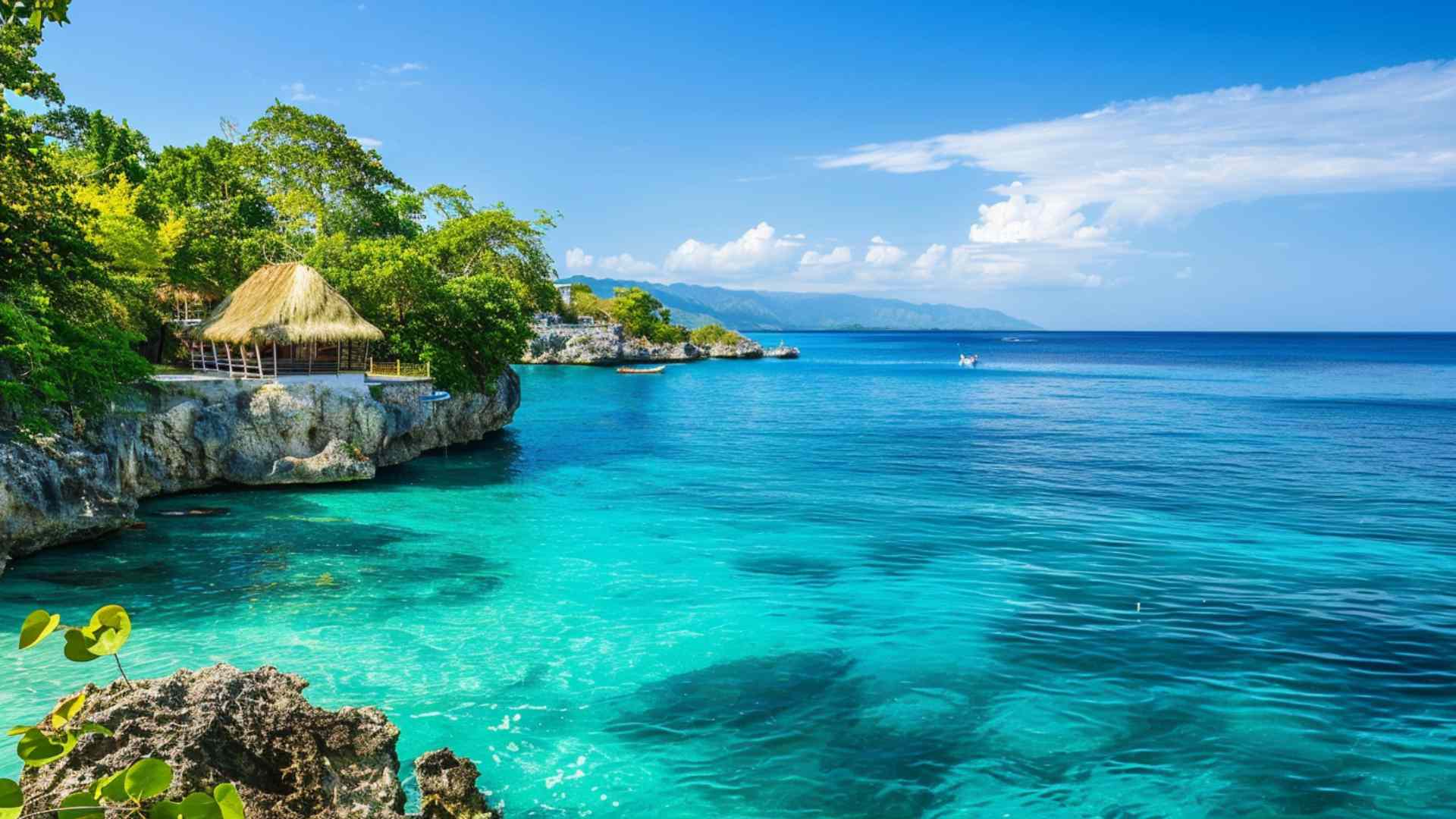
- The Blue Lagoon near Port Antonio is a deep, spring-fed inlet with striking blue-green water.
History & milestones
- Indigenous Taíno people lived in Jamaica long before European arrival.
- Christopher Columbus landed on Jamaica during his second voyage in 1494.
- Spain colonized the island in the early 1500s.
- The English captured Jamaica from Spain in 1655.
- Port Royal became a major center for trade and privateering in the late 1600s.
- A powerful earthquake in 1692 devastated Port Royal, submerging parts of the town.
- Another major earthquake struck Kingston in 1907 and caused widespread damage.
- Enslaved Africans were brought to Jamaica to work on sugar plantations during the colonial era.
- Maroon communities of formerly enslaved people formed in Jamaica’s interior.
- The First Maroon War ended with treaties in 1738 and 1739 recognizing Maroon autonomy.
- The Baptist War, also called the Christmas Rebellion, took place in 1831–1832.
- Slavery was abolished in the British Empire in the 1830s, with full emancipation in Jamaica by 1838.
- The apprenticeship system ended early in 1838, granting full freedom to former apprentices.
- Spanish Town served as the capital under Spain and later Britain until 1872.
- Kingston became the official capital in 1872.
- The banana trade expanded in the late 19th century alongside sugar production.
- Jamaica introduced universal adult suffrage in 1944.
- The colony moved to internal self-government in 1959.
- Jamaica joined and then withdrew from the West Indies Federation by 1962.
- The national anthem “Jamaica, Land We Love” was adopted in 1962.
- The black, green, and gold flag was first raised on Independence Day in 1962.
- The Jamaican dollar replaced the Jamaican pound in 1969.
- Kingston hosted the 1966 Commonwealth Games at the National Stadium.
- The Blue and John Crow Mountains National Park was declared in 1993.
- Reggae music rose to worldwide fame from the late 1960s onward.

People, culture & society
- Christianity is the largest religion in Jamaica.
- Rastafari emerged in Jamaica in the 1930s as a cultural and spiritual movement.
- The national motto highlights unity among people of diverse origins.
- Jamaicans celebrate Emancipation Day on 1 August each year.
- Independence Day is celebrated on 6 August each year.
- The Jamaican diaspora forms large communities in cities such as London, New York, and Toronto.
- Many Jamaican households maintain ties through remittances sent by relatives overseas.
- Schooling in Jamaica is compulsory for children roughly between ages 6 and 16.
- Cricket has deep historical roots in Jamaica and across the Caribbean.
- Football (soccer) is widely played and followed across the island.
- Track and field is Jamaica’s most celebrated sport internationally.
- A major annual music festival known as Reggae Sumfest is held in Montego Bay.
- Jamaica Carnival season brings colorful road parades and lively soca music.
- Traditional folk costumes often feature bandanas and madras fabric.
- Jamaican arts include woodcarving, pottery, and vibrant mural painting.
- Many homes use verandas and louvered windows to catch sea breezes.
- Local markets sell produce like callaloo, breadfruit, and Scotch bonnet peppers.
- Sunday dinner commonly includes rice and peas with chicken or fish.
- Sound system parties have been a cornerstone of community music culture since the mid-20th century.
- Dancehall emerged in the late 1970s and 1980s as a distinct Jamaican genre.
- Most Jamaican schools require uniforms in distinctive colors and styles.
- National Heroes Day is observed on the third Monday in October.
- Public holidays include Christmas Day and Boxing Day in December.
- Jamaica’s coat of arms features a crocodile atop a log and two Taíno figures.
- National Heroes include Nanny of the Maroons, Marcus Garvey, George William Gordon, Paul Bogle, Samuel Sharpe, Norman Manley, and Alexander Bustamante.
Language & etymology
- Jamaican Patois is an English-based creole with strong West African grammar influences.
- The phrase “Wah gwaan?” informally means “What’s going on?”
- In local speech, “mi deh yah” means “I’m here” or “I’m doing fine.”
- The word “nyam” means to eat in Jamaican usage.
- “Bredren” and “sistren” are kinship-style terms for friends or community members.
- “Likkle” is a common word meaning small or little.
- “Pickney” refers to a child in Jamaican Patois.
- The word “yaad” often means home or homeland.
- Many Jamaican place names keep Spanish-era forms such as Spanish Town and Ocho Rios.
- The county names Cornwall, Middlesex, and Surrey echo historic English counties.
- Taíno influence survives in local words for foods like cassava and cooking methods like barbacoa.
- Standard English is the main language of government and formal schooling.
- Many Jamaicans code-switch between English and Patois depending on the situation.
- Spelling in Patois varies, though standardized writing systems have been developed.
- The national anthem is written in Standard English.

Food & daily life
- Ackee and saltfish is Jamaica’s national dish.
- Jerk cooking traditionally uses pimento wood and allspice with fiery Scotch bonnet peppers.
- Rice and peas typically pairs rice with coconut milk and kidney beans or gungo peas.
- Bammy is a flatbread made from grated, pressed, and cooked cassava.
- Festival is a slightly sweet fried cornmeal dough often served with fish.
- Callaloo is a leafy green cooked as a side or breakfast dish.
- Patties are flaky pastries filled with spiced meat or vegetables.
- Soursop, mango, and guava are popular fresh fruits across the island.
- Ginger beer is a beloved nonalcoholic drink with a spicy kick.
- Blue Mountain Coffee is grown at high elevations and prized for its mild flavor.
- Sugarcane has been a major crop in Jamaica since the colonial era.
- Breadfruit, introduced in the 18th century, is now a common staple food.
- Rastafarian ital cuisine emphasizes natural, plant-based ingredients.
- Market days bustle with vendors selling produce, spices, and handmade goods.
- Visitors often enjoy bamboo rafting trips that include local food and music along the riverbanks.
Music, sports & pop culture
- Ska music emerged in Jamaica in the late 1950s.
- Rocksteady followed ska in the mid-1960s with slower rhythms and soulful vocals.
- Reggae developed in the late 1960s and became Jamaica’s signature sound.
- Dub pioneered studio remix techniques and heavy bass emphasis in the 1970s.
- Dancehall rose to prominence from the late 1970s and 1980s onward.
- Sound systems are mobile DJ setups that power street dances and neighborhood parties.
- Jamaican toasting over rhythms helped shape early hip-hop culture in New York.
- Jamaica’s greatest sporting successes center on sprinting events in track and field.
- Usain Bolt set the 200 m world record at 19.19 seconds in 2009.
- Shelly-Ann Fraser-Pryce is one of the most decorated female sprinters in history.
- Jamaica’s men’s national football team, the Reggae Boyz, reached the 1998 FIFA World Cup.
- Jamaica’s women’s national team, the Reggae Girlz, qualified for the Women’s World Cup in 2019 and 2023.
- Jamaica fielded its first Olympic bobsleigh team in 1988.
- The 1993 film “Cool Runnings” popularized the island’s bobsleigh story worldwide.
- Kingston’s National Stadium hosts major athletics meets, including the annual Boys and Girls Championships.
Quick FAQ
What is Jamaica best known for?
Jamaica is best known for reggae music, world-class sprinters, jerk cuisine, beautiful beaches, and the Blue Mountains.
What language do people speak in Jamaica?
English is the official language, and Jamaican Patois is widely spoken in everyday life.
When did Jamaica gain independence?
Jamaica became an independent nation on 6 August 1962.
What is the capital of Jamaica?
The capital and largest city is Kingston.
What is the national dish of Jamaica?
The national dish is ackee and saltfish.

Ellie is the owner and sole author of Fun Facts, combining her mechanical engineering background with years of research-driven writing to deliver facts you can trust. Every article is thoroughly fact-checked and routinely updated as new science and sources emerge to keep information accurate and current. Her mission is to make learning delightful while upholding high standards of reliability and transparency.