
The Moon is our nearest neighbor in space and an amazing way to learn science.
From tides to eclipses, it shapes life on Earth more than you might think.
Dive into these short, kid-friendly fun facts to explore how the Moon formed, how it moves, what it’s made of, and why it matters.
Origins & definitions
- The Moon is Earth’s only natural satellite.
- It formed about 4.5 billion years ago, likely after a giant impact between early Earth and a Mars-sized body.
- The Moon’s mean diameter is about 3,474 km.
- Its average distance from Earth is about 384,400 km.
- The Moon’s mass is about 1/81 of Earth’s mass.
- Surface gravity on the Moon is about 1.62 m/s², roughly one-sixth of Earth’s.
- The Moon has no breathable atmosphere, only a very thin exosphere.
- The lunar day from sunrise to sunrise lasts about 29.5 Earth days.
- The Moon rotates once on its axis in the same time it orbits Earth, a state called synchronous rotation.
- Because of synchronous rotation, the same lunar hemisphere faces Earth most of the time.
- Gentle rocking called libration lets us see about 59% of the lunar surface over time.
- The study of the Moon is called selenology or selenography.
Record-breakers & wow numbers
- The Moon’s surface area is about 38 million km², similar to Africa’s area.
- The Moon’s average albedo is about 0.12, so it reflects about 12% of the sunlight that hits it.
- A full Moon has an apparent magnitude around −12.7, making it the brightest object in the night sky.
- Light takes about 1.3 seconds to travel one way from Earth to the Moon.
- The Moon’s escape velocity is about 2.38 km/s.
- The Moon’s orbital speed around Earth averages about 1.02 km/s.
- The orbit’s eccentricity is about 0.055, making perigee noticeably closer than apogee.
- At perigee the Moon can be about 363,300 km away, and at apogee about 405,500 km away.
- A perigee full Moon appears up to about 14% larger and 30% brighter than an apogee full Moon.
- The highest known point on the Moon rises about 10.7 km above the mean surface.
- The lowest regions in the South Pole–Aitken basin sink more than 8 km below the mean radius.
- Mons Huygens is a prominent lunar mountain about 5.5 km tall.
- The largest lunar mare, Oceanus Procellarum, sprawls over roughly 2,500 km across.
- The biggest confirmed impact structure on the Moon is the South Pole–Aitken basin, about 2,500 km wide.
- The Tycho crater shows bright rays that stretch more than 1,500 km across the near side.
- The Moon’s mean density is about 3.34 g/cm³.
- The Moon is drifting away from Earth by roughly 3.8 cm per year.
- Earth’s day lengthens by about 1.7 milliseconds per century because of lunar tides.
Orbit & phases
- The Moon completes one orbit relative to the stars in about 27.3 days, called the sidereal month.
- The phase cycle from new Moon to new Moon averages about 29.53 days, called the synodic month.
- The Moon’s orbital plane is tilted about 5.1° to Earth’s orbital plane around the Sun.
- Because of this tilt, eclipses do not happen every month.
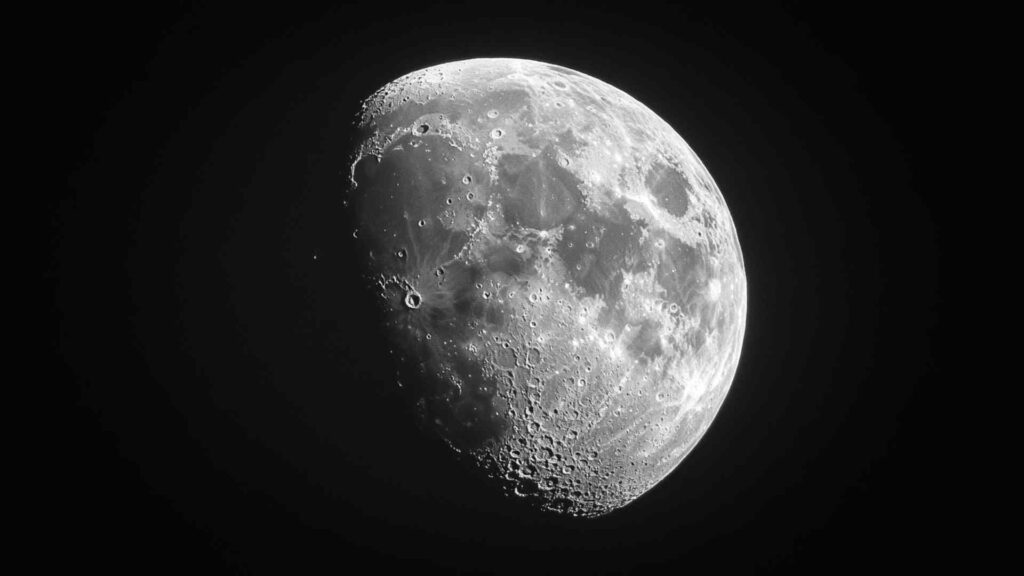
- The line separating day and night on the Moon is called the terminator.
- Phases occur because we see different portions of the Sun-lit half of the Moon from Earth.
- The main phases are new, first quarter, full, and last quarter.
- The crescent and gibbous phases are the in-between steps of the cycle.
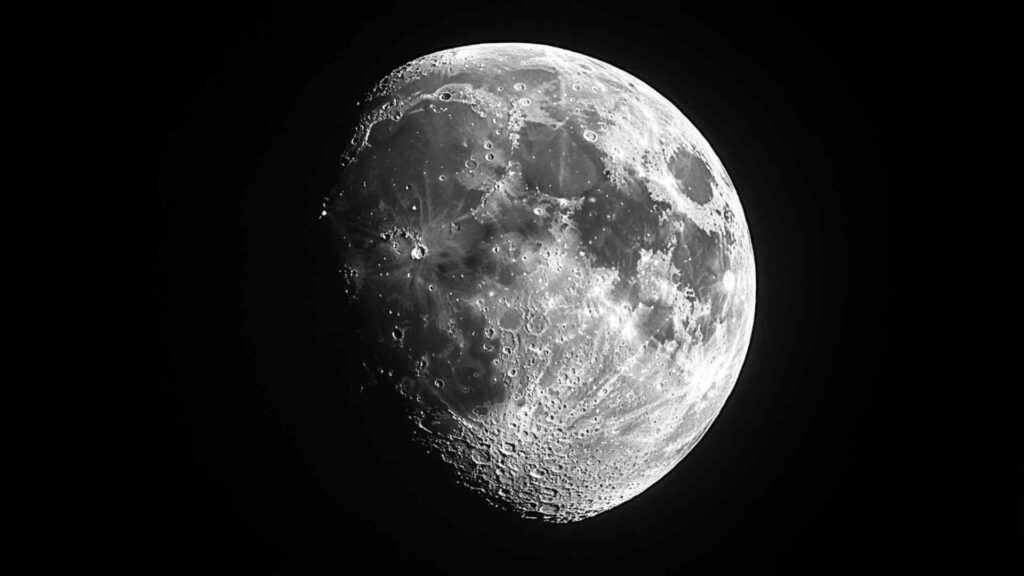
- “Gibbous” means more than half illuminated but not full.
- The Moon rises about 50 minutes later each day on average.
- In the Northern Hemisphere a waxing crescent is lit on the right, while in the Southern Hemisphere it is lit on the left.
- The Moon moves eastward about 13° per day against the background stars.
- The same phase returns on the same date about every 19 years due to a cycle called the Metonic cycle.
- Eclipses repeat in a pattern about every 18 years and 11 days called the Saros cycle.
- Solar eclipses occur only at new Moon when the Moon crosses near a node.
- Lunar eclipses occur only at full Moon when the Moon crosses near a node.
- Total lunar eclipse totality can last up to about 1 hour 40 minutes.
- Total solar eclipse totality can last up to about 7 minutes 32 seconds.
- Annular solar eclipses happen when the Moon is too far to cover the Sun completely.
- During a lunar eclipse the Moon can turn red because Earth’s atmosphere filters blue light.
Surface & geology
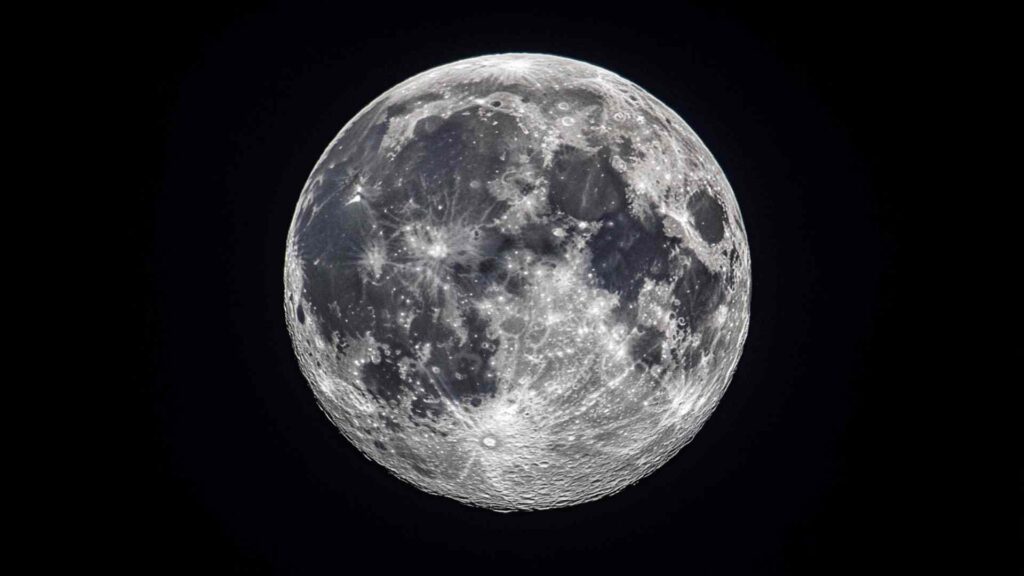
- The Moon’s dark plains, called maria, are vast basaltic lava flows.
- The bright highlands are mostly anorthosite, rich in plagioclase feldspar.
- The lunar crust is thicker on the far side than on the near side.
- Impact craters cover the surface because there is no weather to erase them.
- Fresh lunar craters show bright rays of ejected material radiating outward.
- Regolith, a layer of broken rock and dust, blankets the Moon to depths of several meters.
- Micrometeoroids constantly garden the regolith, breaking and churning grains.
- Some lunar dust becomes electrically charged and may loft above the surface near sunrise and sunset.
- Sinuous rilles are ancient lava channels that snake across the maria.
- Dome-shaped volcanic hills show that thick, slow lava once welled up in places.
- Most mare eruptions happened between about 3.9 and 3.1 billion years ago.
- A few younger lava flows are dated to less than 1.2 billion years old.
- The South Pole–Aitken basin exposes deep crust and mantle materials at the surface.
- Swirly bright markings like Reiner Gamma are linked to local magnetic anomalies.
- The Moon has no plate tectonics, so its crust does not recycle like Earth’s.
- Slow cooling and tidal stresses create small cliffs called lobate scarps.
- These scarps show that the Moon is still shrinking slightly today.
- Many craters have central peaks formed by rebounding rock after impact.
- The far side shows few maria because its thicker crust was harder to flood with lava.
- Dark basalt in the maria contains small beads of volcanic glass formed in fire-fountain eruptions.
- Boulders on crater slopes sometimes roll and leave long tracks in the dust.
- The Moon’s core is small and iron-rich compared with Earth’s core.
- Ancient magnetic fields once existed, leaving remanent magnetization in some rocks.
- Permanently shadowed craters near the poles can trap water ice and other volatiles.
- Some polar ridges receive sunlight for most of the lunar year and are called peaks of near-eternal light.
Earth effects: tides, time, and life
- The Moon’s gravity pulls Earth’s oceans into two tidal bulges, causing most coastal tides.
- Spring tides with higher ranges happen near new and full Moon.
- Neap tides with lower ranges happen near first and last quarter.
- The 18.6-year nodal cycle slightly changes tide heights over long periods.
- The Moon’s pull very slightly reduces your weight when it is overhead.
- The slowing of Earth’s rotation from tides gradually lengthens the day.
- Long ago the Moon was closer to Earth, and tides were stronger.
- The Moon helps stabilize Earth’s axial tilt over geologic timescales.
- Many animals use lunar cues for spawning, nesting, and migration.
- Farmers once timed planting and harvest by the monthly lunar cycle.
- Earthshine makes the dark side of a crescent Moon faintly glow.
- Earth’s outer atmosphere extends beyond the Moon’s orbit as a very tenuous cloud.
Observation & viewing
- You can often see the Moon during the day when it is far from the Sun in the sky.
- Binoculars reveal craters, maria, and bright rays even from a city.
- The best time for crater detail is near the terminator when shadows are long.
- A full Moon looks flat because sunlight hits it straight on and casts few shadows.
- The Moon appears orange or yellow near the horizon because Earth’s atmosphere scatters blue light.
- A 22° halo around the Moon forms when moonlight passes through high icy clouds.
- The Moon illusion makes the low Moon look larger even though its angular size hardly changes.
- The Moon is above the horizon for about half of each 24-hour day on average.
- The Moon moves its own width across the sky in roughly one hour.
- Star occultations occur when the Moon passes in front of a star and briefly hides it.
- Small meteoroid flashes on the Moon can be recorded by sensitive cameras during meteor showers.
- With no atmosphere, the lunar sky is black even at local noon.

Exploration history
- The first soft landing on the Moon happened in 1966.
- The first close-up photos from the surface also came in 1966.
- The first crewed landing on the Moon occurred in 1969.
- Twelve people walked on the Moon between 1969 and 1972.
- No one has walked on the Moon since 1972.
- A total of 24 people traveled to the vicinity of the Moon during that era.
- The first sample return from the Moon came in 1970 by an uncrewed mission.
- Crewed explorers drove a battery-powered rover on the Moon in 1971 and 1972.
- Seismometers left on the Moon detected deep and shallow moonquakes.
- Some shallow moonquakes reached around magnitude 5 and lasted much longer than typical quakes on Earth.
- Retroreflectors left on the surface still allow precise Earth–Moon distance measurements by laser.
- Orbiters in the 1990s mapped the Moon in detail with modern instruments.
- Later missions confirmed hints of water ice in permanently shadowed polar craters.
- An uncrewed capsule orbited the Moon and returned safely to Earth in 2022 as a systems test.
- Robotic landers have recently targeted the Moon’s south polar region.
- Several nations and private teams now operate or plan lunar orbiters and landers.
- Commercial efforts aim to deliver instruments to the surface on small landers.
- New maps reveal the Moon’s gravity field with fine detail, including strong mascons.
- Future crewed missions plan to use the Moon as a stepping-stone for deeper space travel.
- Scientists continue to study lunar samples with new tools decades after collection.
- Fresh impact craters have been spotted forming on the Moon by comparing before-and-after images.
- International interest in the Moon has grown as technology makes access more affordable.
Future & tech
- Plans for sustained lunar research focus on the south pole where sunlight and ice may be found together.
- Engineers study ways to make rocket fuel from water by splitting it into hydrogen and oxygen.
- Solar power works well on the Moon because skies are always clear.
- 3D printing with local regolith is being tested for building pads, roads, and shelters.
- Protective berms of soil can help shield habitats from radiation and micrometeoroids.
- Radio telescopes on the far side could listen to very low frequencies blocked on Earth.
- A small orbiting station could support repeated crew trips to the lunar surface.
- Using local resources would reduce the mass launched from Earth for long missions.
Names & etymology
- The word “Moon” comes from old words related to month and measuring time.
- Many languages use names like Luna, Selene, or Chandra for the Moon.
- The word “month” originally meant a period based on the Moon’s phases.
- Mare is Latin for “sea,” so maria were once thought to be oceans.
- The weekday Monday is named for the Moon in many languages.
- The term “lunation” means one full cycle of lunar phases.
Pop culture, myths & fun extras
- Stories about a “man in the Moon” come from patterns seen in the dark maria.
- Werewolf tales link full Moons with change, but there is no scientific evidence for behavior shifts.
- A “blue Moon” usually means the second full Moon in one calendar month.
- Another definition of a “blue Moon” is the third full Moon in a season that has four full Moons.
- The Moon is not made of cheese, even if cartoons say so.
For kids: quick comparisons
- The Moon is about one-quarter as wide as Earth.
- If Earth were the size of a basketball, the Moon would be about the size of a tennis ball.
- Gravity on the Moon is about 16% of Earth’s, so you could jump about six times higher.
- The Moon orbits at a distance of about 30 Earth diameters from us.
- Earth would look about 3.7 times wider in the lunar sky than the Moon looks from Earth.
Quick FAQ
Q: How long does it take for the Moon to go through all its phases?
A: One full cycle of phases takes about 29.5 days.
Q: Why do we always see the same side of the Moon?
A: The Moon is tidally locked, so it rotates once per orbit and keeps one face toward Earth.
Q: What causes ocean tides on Earth?
A: The Moon’s gravity pulls on Earth’s oceans, creating two tidal bulges that move as Earth rotates.
Q: Can the Moon make people act differently?
A: There is no good scientific evidence that the full Moon changes human behavior.
Q: Why does the Moon look red during a lunar eclipse?
A: Earth’s atmosphere bends and reddens sunlight into the Moon’s shadow, tinting the surface.

Ellie is the owner and sole author of Fun Facts, combining her mechanical engineering background with years of research-driven writing to deliver facts you can trust. Every article is thoroughly fact-checked and routinely updated as new science and sources emerge to keep information accurate and current. Her mission is to make learning delightful while upholding high standards of reliability and transparency.