
Black holes are some of the most extreme objects in the universe, and they follow the same rules of physics we use every day just turned up to the max.
This friendly guide packs bite-size facts about how black holes form, grow, bend light, stretch time, and light up the skies with powerful jets and flares.
Origins & definitions
- A black hole is a region of space where gravity is so strong that nothing, not even light, can escape once it gets close enough.
- The point of no return around a black hole is called the event horizon.
- Escape velocity at the event horizon is greater than the speed of light, which is about 299,792 km/s.
- The radius of a non-spinning black hole is called the Schwarzschild radius.
- The Schwarzschild radius is given by 2GM/c², which links gravity, mass, and the speed of light.
- A black hole’s “size” usually means the size of its event horizon, not a solid surface.
- Inside the event horizon, all paths lead inward, so even light cannot go back out.
- The center of a classical black hole is called a singularity, a place where our current math breaks down.
- Black holes are predicted by general relativity, which describes gravity as the curvature of spacetime.
- A black hole does not “suck” like a vacuum cleaner; it attracts objects with gravity like any mass.
- If the Sun magically became a black hole with the same mass, Earth would keep almost the same orbit but the planet would be dark and cold.
- Black holes can be described by just a few properties: mass, spin, and electric charge.
Anatomy & parts
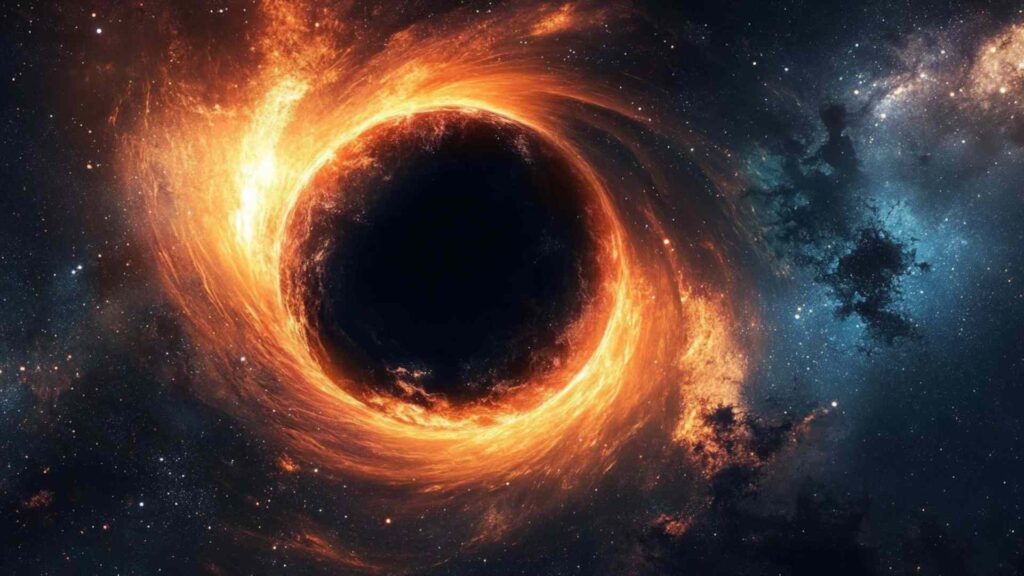
- The event horizon is a boundary, not a solid surface.
- The region outside a spinning black hole where spacetime is dragged around is called the ergosphere.
- Frame dragging near a spinning black hole twists the paths of nearby matter and light.
- The photon sphere is the distance where light can orbit a black hole in unstable circles.
- The shadow of a black hole looks larger than the event horizon because light is bent strongly.
- For a non-spinning black hole, the shadow diameter is about 5.2 times the event horizon radius.
- The innermost stable circular orbit, or ISCO, marks the closest steady orbit for matter in a disk.
- For a non-spinning black hole, the ISCO is at three times the event horizon radius.
- The faster a black hole spins, the closer the ISCO moves to the horizon.
- Spinning black holes are called Kerr black holes, while non-spinning ones are Schwarzschild black holes.
- The ergosphere allows energy extraction from a spinning black hole through certain processes.
- The “no-hair” idea says an isolated black hole’s outside story is told only by mass, spin, and charge.
Types & sizes
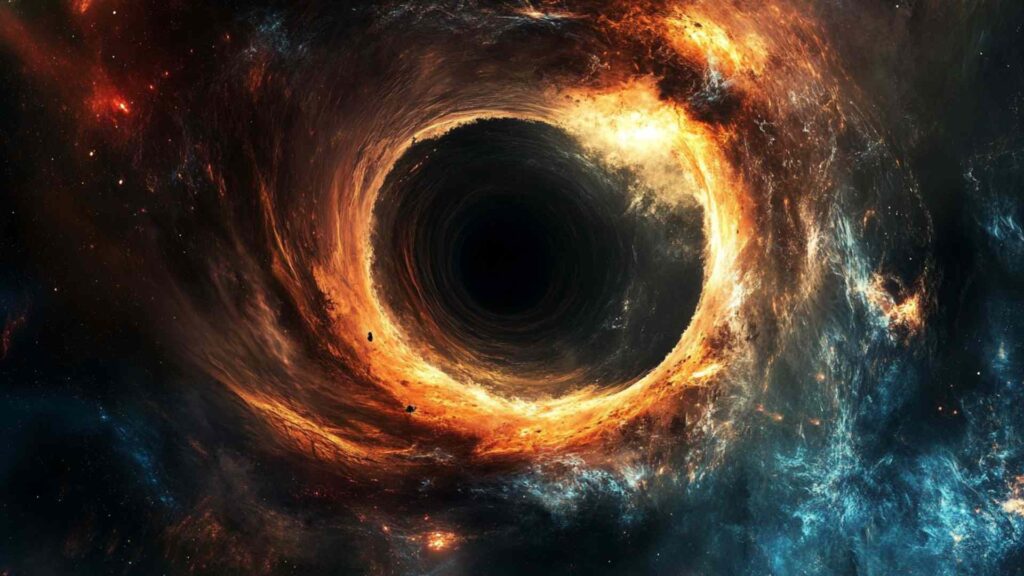
- Stellar-mass black holes form from the collapse of massive stars, often weighing about 5–100 times the Sun.
- Intermediate-mass black holes are thought to weigh hundreds to hundreds of thousands of Suns.
- Supermassive black holes sit in the centers of many galaxies and weigh millions to billions of Suns.
- Ultralight hypothetical black holes, called primordial black holes, may have formed in the early universe.
- No confirmed primordial black holes have been found so far.
- A black hole with the mass of Earth would have a radius of only about 9 mm.
- A black hole with the mass of the Sun would have a radius of about 3 km.
- The supermassive black hole at the center of our galaxy weighs about four million Suns.
- Some galaxies host central black holes that weigh several billion Suns.
- The smallest known stellar black holes are only a few Suns in mass.
- The heaviest stellar black holes found in pairs can exceed 50 Suns each.
- Black hole spins can range from near zero up to values very close to the maximum allowed by physics.
- Spinning close to the limit lets a black hole convert infalling mass into light with very high efficiency.
- A black hole’s growth history is recorded in its mass and spin.
- Black holes can exist alone or in pairs and, in rare cases, possibly in triples.
Formation & growth
- Many stellar black holes form when a massive star runs out of fuel and its core collapses.
- Some stellar black holes may form through direct collapse without a visible supernova.
- Two neutron stars can merge and leave behind a black hole.
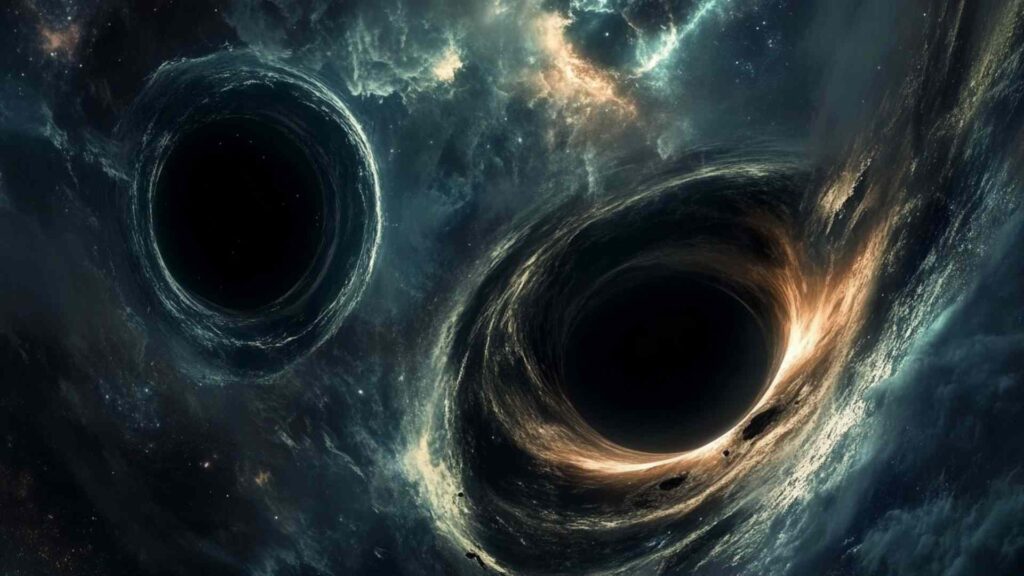
- Two black holes can spiral together and merge into a heavier black hole.
- Gas falling onto a black hole forms a hot, bright disk that feeds the hole.
- Black holes grow by swallowing gas, dust, stars, and sometimes entire stellar clusters.
- Star clusters can drive black holes to the center of a galaxy where they merge with the central giant.
- Runaway growth in the early universe may explain the quick rise of supermassive black holes.
- At very high feeding rates, radiation pressure can push back and slow the inflow of gas.
- The Eddington limit sets a balance point where radiation pushes outward as strongly as gravity pulls inward.
- At the Eddington rate, black hole mass can multiply by e in about 45 million years.
- Giant black holes can also grow by merging with other giant black holes during galaxy collisions.
- Dense star clusters can assemble heavy stellar black holes through many small mergers.
- Some black holes wander through space after getting a kick from an uneven merger.
Spacetime & relativity
- Time runs slower near a strong gravitational field, a phenomenon called gravitational time dilation.
- A clock near a black hole ticks more slowly than a clock far away.
- Light climbing out of a deep gravitational well loses energy and becomes redder, called gravitational redshift.
- The shortest route through spacetime near a black hole is a curved path, not a straight line.
- Tidal forces stretch objects along the direction of gravity and squeeze them sideways.
- Falling feet-first into a small black hole could produce “spaghettification,” a strong tidal stretch.
- Near a supermassive black hole, tidal forces at the horizon can be mild enough to be survivable for a moment.
- The equivalence principle says free fall feels like weightlessness, even near a black hole.
- Inside the event horizon, moving “forward in time” also means moving inward toward the center.
- Light can orbit a black hole at the photon sphere but those orbits are unstable.
- The area of a classical black hole’s event horizon tends to increase when it swallows matter or merges.
- Black holes have enormous entropy that scales with the area of the horizon, not its volume.
- The information paradox asks how information about what fell in might be preserved.
Accretion, disks & jets
- Matter falling toward a black hole forms an accretion disk that heats to millions of degrees.
- Friction and magnetic fields in the disk turn gravitational energy into light.
- Disks can glow in X-rays, ultraviolet, and visible light depending on temperature and size.
- Some black holes launch narrow jets that shoot particles at near light speed.
- Jets are guided and powered by magnetic fields threading the spinning black hole and its disk.
- Jets can extend for thousands to millions of light-years from a galaxy’s center.
- Accretion disks can flicker because the supply of gas changes over time.
- Hot gas near the black hole can form a corona that scatters light into X-rays.
- Iron emission lines in the disk can look skewed because gravity shifts and broadens their light.
- When a star wanders too close, tidal forces can rip it apart in a bright flare called a tidal disruption event.
- Accretion can switch between bright outbursts and dim states in some systems.
- Accretion onto a fast-spinning black hole can convert up to about 40% of mass into energy.
- Powerful winds from the disk can blow gas out of the black hole’s neighborhood.
Observations & detection
- Black holes are invisible directly but their effects on nearby matter and light can be observed.
- The first direct image of a black hole’s shadow was shared in 2019.
- In 2022, astronomers unveiled the first image of the black hole at the center of our galaxy.
- Stars orbiting our galactic center trace out paths that reveal a compact, massive object.
- Rapid X-ray flickering can signal matter skimming near the innermost stable orbit.
- Gravitational lensing by a black hole can bend and magnify background stars.
- Astronomers can spot isolated black holes by the way they lens the light of background stars.
- Many stellar black holes are found in binary systems by measuring the wobble of the companion star.
- Radio telescopes can map jets from supermassive black holes in distant galaxies.
- Variations in quasar brightness can track changes in accretion close to the horizon.
- Gravitational waves from merging black holes were first detected in 2015.
- After a merger, the new black hole “rings” in gravitational waves as it settles down.
- The pitch and decay of that ringdown reveal the mass and spin of the final black hole.
- Networks of detectors listen for the tiny ripples that mergers send across the universe.
- Timing of pulsars across the sky has found evidence for a background of low-frequency gravitational waves.
- Computer simulations help decode disk turbulence and jet structure around black holes.
Black holes in the Milky Way
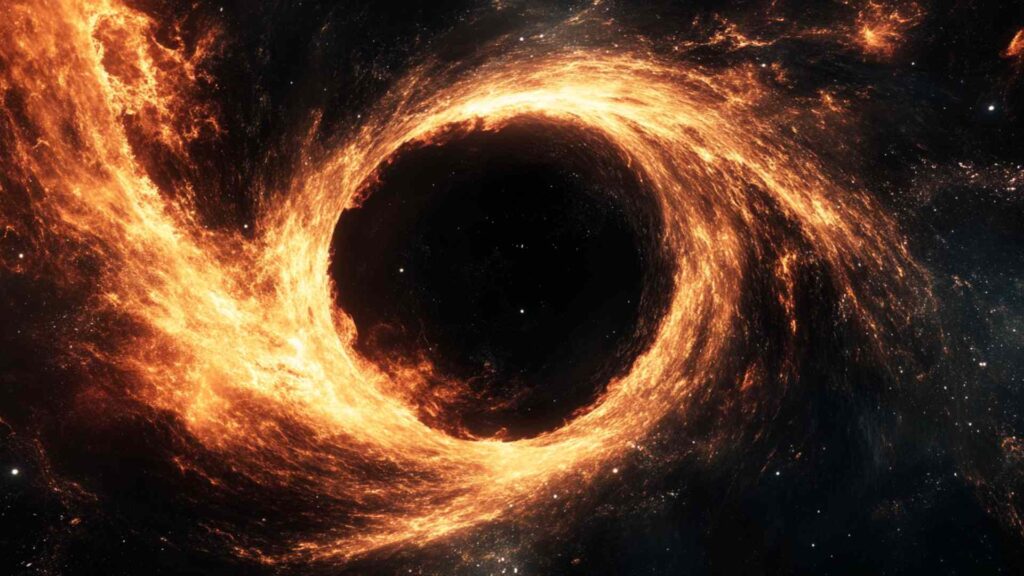
- Our galaxy hosts a supermassive black hole near its center about 26,000 light-years away.
- Dense star clusters near the center help feed gas and stars toward the giant black hole.
- A star near the center completes a very stretched orbit in roughly 16 years.
- Gas around the central black hole brightens and dims on timescales of minutes to hours.
- The central black hole’s event horizon would fit well inside Mercury’s orbit if placed in our Solar System.
- The Milky Way likely holds tens of millions of stellar-mass black holes.
- Some black holes in our galaxy drift alone without a companion star.
- Isolated black hole candidates have been detected through microlensing events.
- X-ray binaries in the Milky Way reveal black holes feeding from their companion stars.
- Some nearby stellar black holes are a few thousand light-years from Earth.
- The gravitational pull of the central giant helps shape the orbits of stars in the inner parsec.
- Gas clouds passing close to the center can get stretched and heated by tidal forces.
Black holes across the universe & cosmology
- Most large galaxies are thought to have a supermassive black hole in the center.
- Quasars are extremely bright galactic centers powered by supermassive black holes feeding fast.
- Quasars can outshine their entire host galaxies.
- Galaxy mergers can trigger bursts of feeding that light up central black holes.
- Two supermassive black holes can form a close pair after their host galaxies collide.
- Pairs of giants are expected to radiate very low-frequency gravitational waves as they spiral inward.
- Feedback from active black holes can heat and push gas, slowing star formation in galaxies.
- Giant radio lobes far outside galaxies trace energy carried by black hole jets.
- In clusters of galaxies, black hole outbursts can carve bubbles in hot gas.
- Early in cosmic history, some black holes grew very fast to become bright quasars.
- The number of bright quasars peaks when the universe is a few billion years old.
- Black holes help set the pace of galaxy growth through heating and winds.
- Ultra-massive black holes may sit in the centers of the largest galaxies in dense clusters.
Names & etymology
- The term “black hole” describes an object that lets nothing escape, so it looks black against space.
- The “event horizon” name means events inside cannot affect what happens outside.
- The “ergosphere” name refers to the region where energy extraction is possible.
- The “photon sphere” labels the zone where light can orbit in unstable loops.
- “Spaghettification” is a playful name for the tidal stretching of objects.
- “Quasar” is short for a “quasi-stellar radio source,” a bright galactic core seen far away.
- “Tidal disruption event” names the ripping apart of a star by gravity.
- “Ringdown” describes the fading gravitational wave tones after a merger.
For kids: quick comparisons
- A black hole with the Sun’s mass would be about the size of a small town at only 3 km across.
- A supermassive black hole can be as wide as our entire Solar System or even larger.
- If you replaced the Sun with an equal-mass black hole, Earth’s year would stay about 365 days.
- Near a black hole, one hour for you could be many hours for someone far away.
- Falling into a small black hole would stretch you more than falling into a giant one.
- Black holes can bend light like a funhouse mirror in space.
- Jets from black holes can be longer than a galaxy.
- Two black holes merging make ripples in spacetime like waves spreading on a pond.
- You can safely study black holes from Earth because the nearest big ones are very far away.
Pop culture & fun extras
- Black holes appear in many movies and books as portals, but in real life they are not shortcuts we can travel through.
- Some stories imagine time travel near black holes because time really does slow down there.
- Sci-fi often shows people seeing inside a black hole, but once across the horizon no signals can get back out.
- Artists draw glowing rings around black holes to show the hot disk of gas and the dark shadow.
- A fast-spinning black hole could, in theory, power a jet that shines brighter than trillions of Suns.
- Black holes can give merged remnants a “kick” of hundreds to thousands of km/s.
- Hawking radiation predicts that black holes very slowly leak energy and shrink over huge times.
- A black hole the mass of the Sun would take about 10⁶⁷ years to evaporate through Hawking radiation.
Quick FAQ
What is a black hole in simple terms?
A black hole is a place in space where gravity is so strong that nothing can escape once it gets too close.
How big are black holes?
They range from a few kilometers across for stellar black holes to sizes larger than the Solar System for supermassive ones.
Can a black hole eat the Earth?
There is no known black hole anywhere near close enough to threaten Earth.
Do black holes last forever?
They very slowly lose energy through Hawking radiation, but large ones would take far longer than the age of the universe to evaporate.
Can we see a black hole?
We see their effects, such as hot glowing disks and bending of light, and we can even image the dark shadow against the bright surroundings.

Ellie is the owner and sole author of Fun Facts, combining her mechanical engineering background with years of research-driven writing to deliver facts you can trust. Every article is thoroughly fact-checked and routinely updated as new science and sources emerge to keep information accurate and current. Her mission is to make learning delightful while upholding high standards of reliability and transparency.