
Frogs are small, jumpy wonders with big stories to tell.
From see-through bellies to record-breaking leaps, these amphibians show off amazing science in every swamp and stream.
Dive into this friendly guide and hop through their world of life cycles, habitats, cool adaptations, and fun surprises.
Frog Fun Facts
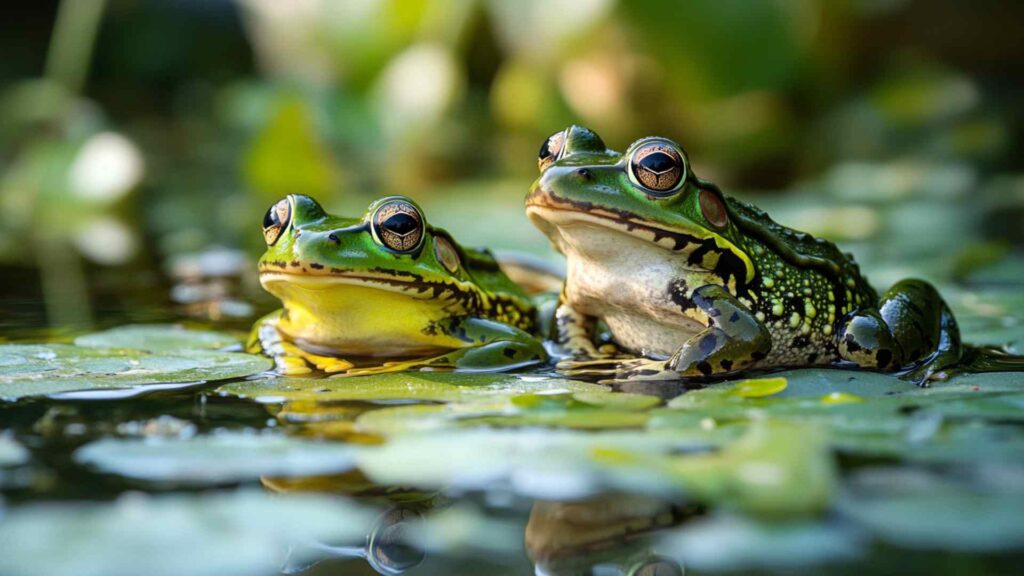
- Frogs are amphibians in the order Anura, which means “without tail.”
- Scientists have described over 7,000 frog species as of 2024.
- Frogs live on every continent except Antarctica.
- Most frogs begin life as eggs in water that hatch into gilled tadpoles.
- Tadpoles grow legs, absorb their tails, and turn into air-breathing froglets.
- Adult frogs breathe with lungs and through their skin, a process called cutaneous respiration.
- Frog skin is thin and must stay moist to work well for gas exchange.
- Many frogs absorb water through a “drinking patch” on their belly instead of sipping.
- Frogs are ectotherms, so their body temperature follows the environment.
- The Goliath frog can grow longer than 30 cm and weigh over 3 kg (about 6.6 lb).
- One of the tiniest frogs, Paedophryne amauensis, measures around 7–8 mm long.
- Tree frogs use toe pads with microscopic structures to stick to leaves and glass.
- A frog’s tongue is attached at the front of the mouth and flips out like a catapult.
- Some frogs can snap their tongue to a bug in less than 0.1 second.
- Frogs usually have four fingers on the front feet and five toes on the back feet.
- Webbed hind feet help many frogs swim powerfully.
- Frogs do not have ribs, which helps them make big body movements for breathing.
- A frog’s backbone ends in a stiff rod called the urostyle for strong jumping.
- The eyes of many frogs bulge and help push food down when they swallow.
- Frogs have a third eyelid, the nictitating membrane, to protect and moisten the eye.
- Most frogs hear with a round eardrum called the tympanum just behind the eye.
- Male frogs often have larger tympana than females of the same species.
- A group of frogs is commonly called an army.
- Many frog calls are made by inflating one or two vocal sacs as sound balloons.
- Each frog species has its own call pattern, like a sonic name tag.
- Some frogs call only after rain when ponds quickly appear.
- The American bullfrog’s deep call can carry across a large pond.
- Frogs communicate with visual signals too, like foot-flagging in noisy streams.
- Frogs use chemical cues to find mates and avoid predators.
- Some frogs survive dry seasons by sleeping underground in a state called aestivation.
- In cold regions, some frogs hibernate in mud at the bottom of ponds.
- Wood frogs can survive being partly frozen by making natural antifreeze in their bodies.
- Many frogs change color using cells called chromatophores.
- Bright colors in some frogs warn predators that they are toxic, a sign called aposematism.
- Some harmless frogs mimic toxic species to gain protection.
- Poison frog toxins often come from their diet of ants, mites, or beetles.
- The golden poison frog is among the most toxic land animals known.
- Glass frogs have see-through bellies where you can glimpse organs and eggs.
- Wallace’s flying frog glides between trees using large webbed feet and skin flaps.
- Desert frogs can form a cocoon from shed skin to lock in moisture.
- Many frogs shed their skin and eat it for nutrients.
- Frog hearts have three chambers: two atria and one ventricle.
- Tadpoles usually breathe with gills, while adults mainly use lungs and skin.
- Tadpoles often eat algae and detritus, scraping surfaces with tiny mouthparts.
- Some tadpoles are carnivorous and may eat insects or even other tadpoles.
- Most frogs have teeth on the upper jaw for gripping, not chewing.
- Frogs swallow by pulling their eyes down to help push food toward the throat.
- Frogs pump air into their lungs using throat movements called buccal pumping.
- Frogs can jump many times their body length thanks to springy leg tendons.
- Some small frogs leap more than 20 times their body length.
- Many frogs are nocturnal and hunt at night for insects and other small prey.
- Frogs help control insect populations, including mosquitoes.
- Herons, snakes, fish, mammals, and even larger frogs often prey on frogs.
- Camouflage patterns help frogs blend into leaves, bark, or mud.
- Some frogs flash bright thigh colors to startle predators when they jump.
- When grabbed, many frogs give a distress call that sounds like a squeal.
- Most frogs use external fertilization where the male clasps the female in amplexus.
- Amplexus positions vary, including axillary and inguinal holds.
- Female frogs lay jelly-coated eggs that dry out quickly if not kept moist.
- Clutch size ranges from a few eggs to several thousand, depending on species.
- Some frogs build foam nests that float on water or hang from branches.
- Poison frog parents may carry tadpoles on their backs to tiny pools.
- Darwin’s frog males brood their young in their vocal sac until they emerge.
- The extinct gastric-brooding frogs once raised young inside the stomach.
- A few frogs give birth to live tadpoles instead of laying eggs.
- Direct-developing frogs hatch from eggs as tiny froglets without a tadpole stage.
- In explosive breeding, huge numbers of frogs gather and mate over a few days.
- In prolonged breeding, calling and mating spread over months.
- Rainfall and temperature often trigger breeding migrations to ponds.
- Many species return to the same breeding site year after year.
- Tadpole growth speed depends on water temperature and food supply.
- Drying ponds can speed up metamorphosis in some tadpoles.
- Some frogs guard egg clutches from predators and fungus.
- Frogs can navigate using smell, stars, or the Earth’s magnetic field cues.
- Many frogs bask briefly to raise body temperature for faster activity.
- Some frogs dig backward using special spade-like structures on their feet.
- Burrowing frogs hide from heat and emerge after storms to feed and breed.
- Stream frogs often have slimmer bodies and longer limbs for clinging to rocks.
- Aquatic frogs tend to have smoother skin and stronger webbing for swimming.
- Terrestrial frogs may have rougher skin that resists drying.
- Island frogs sometimes evolve unique calls or body sizes due to isolation.
- The American bullfrog has become invasive in parts of Europe, Asia, and the West.
- Invasive frogs can outcompete local species for food and space.
- Frogs are key bioindicators because their permeable skin reacts to pollution.
- Chytridiomycosis is a fungal disease that has harmed many frog populations.
- Habitat loss from draining wetlands reduces breeding sites for frogs.
- Pesticides can affect frog hormones and development.
- Road traffic during migrations causes heavy frog mortality in some areas.
- Wildlife tunnels and seasonal road closures can help frogs cross safely.
- Protecting wetlands and riparian zones supports healthy frog communities.
- Citizen science programs often track frog calls to monitor populations.
- Frogs help cycle nutrients by moving energy from aquatic to land food webs.
- Some frogs co-exist with ants, wasps, or spiders around shared shelters.
- Frogs can learn simple routes and remember hiding spots.
- Many frogs show site fidelity to daytime shelters.
- Frog skin contains antimicrobial peptides that help fight infections.
- Scientists study frog skin compounds for potential medical uses.
- Frogs can regulate water loss by changing posture and skin secretions.
- Some species tolerate salty or brackish water better than others.
- High-altitude frogs may be active at cooler temperatures than lowland species.
- The term “ranid” refers to true frogs in the family Ranidae.
- The word “frog” in English traces back to Old English “frogga.”
- “Anuran” is the adjective for members of the order Anura.
- “Tadpole” likely comes from words meaning “toad head,” referring to its shape.
- Male frogs are often smaller than females in many species.
- In some species, males have rough thumb pads for gripping during amplexus.
- Frogs can estimate distance to prey using stereo vision and motion cues.
- A frog’s brain is small but highly tuned for sound and movement.
- Many frogs can regenerate small injuries to skin and toes.
- Frogs often line up their bodies with the sun to warm evenly.
- Some frogs use burrows of other animals as ready-made shelters.
- Frogs may share calling sites, forming nighttime chorus groups.
- Calling loudly uses a lot of energy for small male frogs.
- Females often choose mates based on call pitch, speed, or stamina.
- Some species engage in satellite behavior where silent males wait near callers.
- Frogs sometimes adjust call timing to avoid overlapping with neighbors.
- In noisy streams, some frogs switch to visual signals like leg waving.
- Frogs can detect vibrations through their forelimbs on the ground.
- The lateral line system in tadpoles senses water movement.
- Tadpoles often school together for safety in numbers.
- Many tadpoles scrape algae with tiny keratinized mouthparts called beaks.
- As legs grow, tadpoles reorganize their guts to switch to a carnivorous diet.
- Metamorphosis is controlled by thyroid hormones that reshape the body.
- During metamorphosis, gills disappear and lungs become more effective.
- Newly transformed froglets are especially vulnerable to drying and predators.
- Some frogs breed in tree holes filled with rainwater called phytotelmata.
- Poison frog parents sometimes feed unfertilized eggs to developing tadpoles.
- Rainforest frogs can call from bromeliad cups high above the ground.
- In savannas, many frogs wait underground for seasonal rains to return.
- Urban frogs may use garden ponds and drainage ditches as breeding sites.
- Frogs often hunt by sitting and waiting for prey to come close.
- Larger frogs may eat small fish, mice, or even other frogs.
- Frogs locate prey mainly by movement rather than smell.
- The fastest part of a frog’s jump happens at takeoff when leg tendons recoil.
- Some frogs walk instead of hop, especially on narrow branches.
- A few species can climb smooth leaves by spreading mucus under toe pads.
- Many frogs are most active at dusk and dawn, a pattern called crepuscular.
- Frogs often return to water to rehydrate even if they live on land.
- Frog lifespan varies widely, from a few years to over a decade in some kinds.
- In cold, oxygen-rich water, hibernating frogs can absorb enough oxygen through skin.
- Frogs appear in myths as symbols of rain, luck, or change.
- A famous fairy tale, “The Frog Prince,” features a frog transformed by kindness.
- A well-known puppet frog helped make frogs pop-culture stars worldwide.
- The frog emoji and frog memes keep these animals popular online.
- Learning about frogs encourages people to protect wetlands and clean water.

Quick FAQ
What makes a frog an amphibian?
An amphibian lives part of its life in water and part on land, usually with moist skin and a life cycle that includes metamorphosis.
How do frogs breathe?
Frogs breathe with lungs and also through their thin, moist skin, which lets gases pass in and out.
Why are some frogs brightly colored?
Bright colors often warn predators that the frog is toxic or bad-tasting.
Do all frogs live in water?
No, many frogs live mostly on land or in trees, but most still need water or moisture to reproduce.
What do tadpoles eat?
Most tadpoles eat algae and plant matter, though some are omnivores or predators.
Are frogs important to ecosystems?
Yes, frogs control insects, feed many other animals, and signal the health of wetlands and streams.


Ellie is the owner and sole author of Fun Facts, combining her mechanical engineering background with years of research-driven writing to deliver facts you can trust. Every article is thoroughly fact-checked and routinely updated as new science and sources emerge to keep information accurate and current. Her mission is to make learning delightful while upholding high standards of reliability and transparency.