
Chile is long, skinny, and full of surprises, from sand-dry deserts to icy fjords.
Meet penguins, volcanoes, ancient statues, and sky-high observatories in one amazing country.
These quick, kid-friendly facts make it easy to learn fast and share with friends. Ready to explore from north to south? Let’s go!
Origins & definitions
- Chile is a long, narrow country on South America’s Pacific coast.
- The country stretches from about 17°S to 56°S in latitude.
- Its average width is roughly 180 km from the Andes to the sea.
- The name “Chile” likely comes from a Mapuche word meaning “where the land ends.”
- Santiago is the capital and largest city.
- Spanish is the most widely spoken language nationwide.
- The currency is the Chilean peso.
- Chile is a republic with a presidential system.
- The national holiday Fiestas Patrias is celebrated on 18–19 September.
- Chile’s coat of arms features an Andean condor and a huemul.
- The national flower is the copihue, a red bell-shaped vine.
- The national dance is the cueca, performed with handkerchiefs.

Record-breakers & wow numbers
- Chile spans about 4,300 km north to south.
- Its coastline runs for over 6,000 km along the Pacific Ocean.
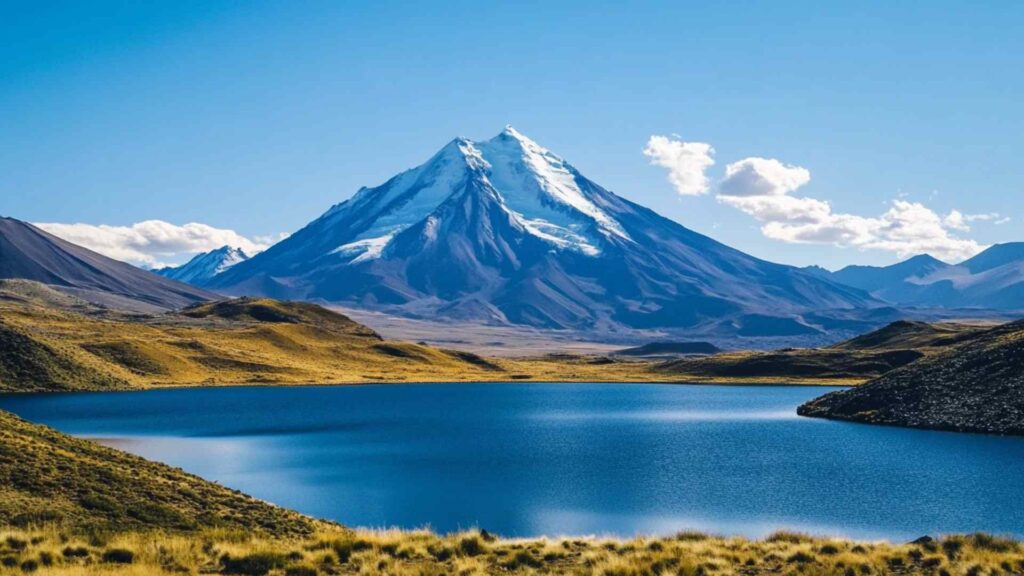
- Ojos del Salado on the Chile–Argentina border is the highest active volcano on Earth at 6,893 m.
- A small crater lake near Ojos del Salado is among the highest lakes on Earth.
- The Atacama Desert is one of the driest places on the planet.
- Some Atacama weather stations have recorded years with zero measurable rain.
- Chile sits on the Pacific Ring of Fire, making earthquakes common.
- The 1960 Valdivia earthquake reached magnitude 9.5, the largest instrumentally recorded.
- Chile claims a sector of Antarctica under the Antarctic Treaty system.
- Cape Horn marks the southern tip of the country’s island territories.
- Puerto Williams is Chile’s southernmost city.
- The Strait of Magellan provides a natural sea passage between the Atlantic and Pacific.
- The Pan-American Highway runs the length of Chile as Route 5.
- The Atacama Large Millimeter/submillimeter Array operates high in northern Chile.
- The Very Large Telescope stands on Cerro Paranal in the Atacama.
- Chile is the world’s leading copper producer by volume.
- Chile is also a major global producer of lithium from salt flats.
- Torres del Paine National Park showcases towering granite spires in Patagonia.
- The Humboldt Current cools Chile’s long coast and shapes its marine life.
- The country’s wine industry ranks among the world’s largest exporters.
Nature & science
- Chile packs climates from the Atacama Desert to Mediterranean valleys and subpolar fjords.
- Coastal fog called camanchaca brings moisture to parts of the Atacama.
- Rare rains can trigger a desert bloom that carpets valleys with wildflowers.
- The Valdivian temperate rainforest shelters ancient alerce trees.
- Some alerce trees live for over 3,000 years.
- The Andean condor can reach a wingspan of about 3.3 m.
- The pudú is one of the world’s smallest deer and lives in southern Chile.
- The endangered huemul is a shy Andean deer on Chile’s coat of arms.
- Pumas roam the Patagonian steppe and forest edges.
- Guanacos graze windswept plains in the south.
- Vicuñas live on high Andean plateaus in the far north.
- The kodkod, or güiña, is a tiny wildcat native to Chile’s forests.
- Darwin’s fox survives on Chiloé Island and a few mainland parks.
- Humboldt penguins nest along central and northern coasts.
- Magellanic penguins breed in colonies in southern Chile.
- Blue whales feed seasonally off the Chiloé archipelago.
- The Atacama Sun is strong because of altitude, clear skies, and dry air.
- Chile’s northern salt flats host flamingos that filter-feed on brine shrimp.
- Lauca National Park protects high-altitude wetlands called bofedales.
- Lakes in the Lake District were carved by ancient glaciers.
- The Araucaria, or monkey puzzle tree, is native to southern Chile.
- The Llaima and Villarrica volcanoes are among Chile’s most active.
- Many Chilean volcanoes lie along the Andean volcanic belt.
- The Elqui Valley is famed for exceptionally dark skies.
- Chile captures strong solar energy potential in the Atacama.
- Kelp forests along the coast shelter marine otters and fish.
- The Chilean flamingo is a pale pink wader found in saline lagoons.
- The Chucao tapaculo is a loud songbird of the southern understory.
History & culture
- The Mapuche are one of Chile’s largest Indigenous peoples.
- Aymara and Quechua communities live in the country’s far north.
- Rapa Nui people are Polynesian and live on Easter Island.
- The earliest artificial mummies, made by the Chinchorro culture, were created in northern Chile.
- Spanish conquistador Pedro de Valdivia founded Santiago in 1541.
- Chile’s independence process began on 18 September 1810.
- Chile declared full independence on 12 February 1818.
- Bernardo O’Higgins became a key leader of the independence era.
- The War of the Pacific (1879–1883) expanded Chile’s northern territory.
- The nitrate boom transformed northern port cities in the late 1800s.
- Many German immigrants settled around Valdivia, Osorno, and Puerto Varas in the 19th century.
- The 1906 Valparaíso earthquake was one of the city’s worst disasters.
- A military regime governed Chile from 1973 to 1990.
- Chile returned to democracy in 1990.
- Gabriela Mistral won the Nobel Prize in Literature in 1945.
- Pablo Neruda won the Nobel Prize in Literature in 1971.
- Isabel Allende is one of Chile’s most widely read novelists.
- The cueca, with twirling handkerchiefs, is danced at September fiestas.
- Rodeo is officially recognized as a national sport in Chile.
- Football is the country’s most popular spectator sport.
- Chile’s national team won the Copa América in 2015.
- Chile defended the title at the Copa América Centenario in 2016.
- Valparaíso is known for steep hills, funiculars, and street art.
- The Historic Quarter of Valparaíso is a UNESCO World Heritage Site.
- Rapa Nui National Park is a UNESCO World Heritage Site for its moai.
- The Humberstone and Santa Laura Saltpeter Works are UNESCO-listed industrial sites.
- Sewell Mining Town in central Chile is also a UNESCO World Heritage Site.
- Chiloé’s wooden churches are UNESCO-recognized for unique carpentry.
- The Viña del Mar International Song Festival is a famous music event.
- Chile’s national motto is “Por la razón o la fuerza.”

Places & travel
- San Pedro de Atacama is a desert town that anchors tours to salt flats and lagoons.
- Valle de la Luna near San Pedro has wind-carved dunes and moonlike ridges.
- Geysers del Tatio spout steam at over 4,000 m before sunrise.
- The Mano del Desierto is a giant desert hand sculpture near Antofagasta.
- La Serena and the Elqui Valley mix beaches, observatories, and starry nights.
- Isla Damas in the Humboldt Penguin Reserve offers boat trips to see seabirds.
- Valparaíso’s funiculars climb colorful cerros above the port.
- Santiago’s Cerro San Cristóbal overlooks the city from a big hilltop park.
- Cajón del Maipo brings Andean canyons and hot springs close to the capital.
- Casablanca Valley is known for cool-climate whites like Sauvignon Blanc.
- Colchagua Valley is celebrated for rich red wines.
- Pucón markets itself as Chile’s adventure capital.
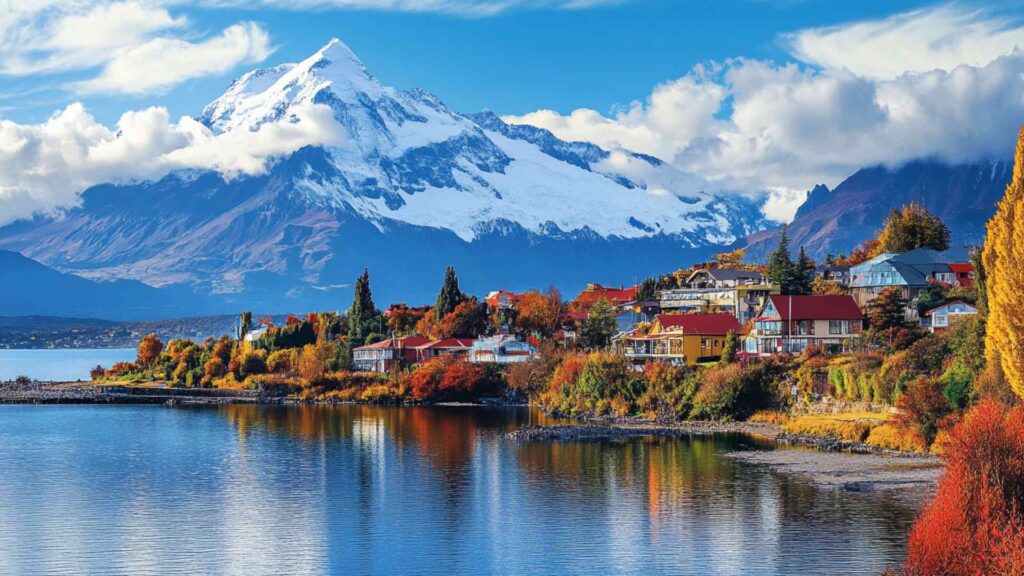
- Lake Villarrica sits beneath a snowcapped active volcano.
- The Carretera Austral is a scenic road stretching over 1,200 km through Patagonia.
- Marble caves shimmer on the turquoise waters of Lake General Carrera.
- Chiloé Island features stilt houses called palafitos.
- A traditional Chiloé curanto cooks seafood and meats in a pit with hot stones.
- Punta Arenas faces the Strait of Magellan at the far south.
- Isla Magdalena hosts a large colony of Magellanic penguins in summer.
- Torres del Paine’s W Trek links valleys to towering granite horns.
- Cape Horn is a windswept headland in the Drake Passage.
- Puerto Williams serves as a gateway to the Dientes de Navarino trek.
- Robinson Crusoe Island in the Juan Fernández archipelago has rugged volcanic scenery.
- On Easter Island, Ahu Tongariki showcases 15 restored moai facing the sea.
- Orongo village on Easter Island preserves petroglyphs tied to the birdman ritual.
Language, names & symbols
- Chilean Spanish often adds the filler word “po” at the end of phrases.
- The expression “¿cachai?” informally asks “do you get it?”.
- Most Chileans use “ustedes” instead of “vosotros” for “you all.”
- Many speakers aspirate or drop the final “s” in casual speech.
- People commonly go by two surnames, one from each parent.
- Chile’s flag shows a single white star on blue with white and red bands.
- The flag is nicknamed “La Estrella Solitaria,” or the Lone Star.
- The coat of arms carries a crest of three feathers in blue, white, and red.
- Santiago’s full name is Santiago de Chile.
- The country is affectionately called “largo y flaco,” meaning long and skinny.
- Mapudungun words such as “copihue” and “cultrún” appear in Chilean culture.
- Rapa Nui terms like “moai,” “ahu,” and “pukao” are widely used.
- The national anthem includes a rousing chorus known by most schoolchildren.
- Chile is often nicknamed “the country of poets.”
- The huaso’s wide-brimmed chupalla hat is a symbol of rural tradition.
For kids: quick comparisons
- Chile is longer than the straight-line distance from New York to Los Angeles.
- Chile is about the length of Europe from Norway to Sicily.
- Much of Chile is under 200 km wide from mountains to sea.
- Chile’s area is roughly three quarters the size of Egypt.
- Ojos del Salado is over 2 km taller than Japan’s Mount Fuji.
- The Atacama Desert gets less rain than the Sahara’s central core.
- Penguins in Chile live on beaches where summer days can be warm.
- In winter, ski resorts near Santiago operate within a couple of hours’ drive.
- Chile’s southern fjords look a lot like those in Norway.
- Chile’s Pacific coast faces the same ocean as California and Hawaii.
Pop culture & fun extras
- Empanadas de pino are classic pastries filled with beef, onion, egg, and olives.
- A “completo” is a Chilean hot dog piled with avocado, tomato, and mayonnaise.
- Mote con huesillo is a sweet summertime drink of wheat and dried peaches.
- Many Chileans enjoy a holiday drink called cola de mono made with coffee and spirits.
- The national football team is nicknamed “La Roja” for its red jersey.
Quick FAQ
Q: What is Chile famous for?
A: Chile is famous for the Atacama Desert, Patagonia landscapes, world-class observatories, moai statues, copper mining, and award-winning wines.
Q: Is Easter Island part of Chile?
A: Yes, Easter Island (Rapa Nui) is a Chilean territory in the southeastern Pacific Ocean.
Q: Why is the Atacama Desert so dry?
A: Cold ocean currents, high mountains, and stable air combine to block moisture and create extreme dryness.
Q: When is the best time to visit Chile?
A: Visit the north year-round, central valleys in spring or fall, and Patagonia from late spring to early autumn.
Q: What language do people speak in Chile?
A: Spanish is the main language, with Indigenous languages such as Mapudungun, Aymara, and Rapa Nui also spoken.

Ellie is the owner and sole author of Fun Facts, combining her mechanical engineering background with years of research-driven writing to deliver facts you can trust. Every article is thoroughly fact-checked and routinely updated as new science and sources emerge to keep information accurate and current. Her mission is to make learning delightful while upholding high standards of reliability and transparency.