
Earthquakes shake the ground when rocks deep below us suddenly slip.
This mega list breaks down the basics, jaw-dropping records, how the science works, what to do to stay safe, and some fun comparisons kids will love.
Ready to feel the earth move under your feet on paper?
Origins & definitions
- An earthquake is the shaking of the ground caused by a sudden release of energy inside Earth.
- The spot inside Earth where a quake starts is called the focus or hypocenter.
- The point on the surface directly above the focus is the epicenter.
- Most earthquakes happen along the edges of moving tectonic plates.
- Earth has seven major plates and many smaller ones that creep a few centimeters per year.
- Shallow earthquakes are 0–70 km deep, intermediate ones are 70–300 km, and deep ones are 300–700 km.
- Earthquakes can occur under continents, beneath oceans, and even under ice.
- A fault is a fracture in rock where blocks move past each other during a quake.
- Strike-slip faults move sideways, normal faults drop one side down, and reverse faults push one side up.
- Transform plate boundaries mostly host strike-slip earthquakes.
- Convergent plate boundaries often produce powerful thrust and megathrust earthquakes.
- Divergent boundaries create frequent small quakes along mid-ocean ridges.
- Intraplate earthquakes occur far from plate edges within a single plate.
- The study of earthquakes is called seismology.
- Instruments that record shaking are called seismographs, and their records are seismograms.
- Seismic waves are the energy waves that travel through and along Earth after a rupture.
- P waves are compressional waves that arrive first and shake the ground back and forth.
- S waves are shear waves that arrive second and shake the ground side to side.

Record-breakers & wow numbers
- The largest instrumentally recorded earthquake was magnitude 9.5 in 1960 in southern Chile.
- The second largest was magnitude 9.2 in Alaska in 1964.
- The 2004 Indian Ocean earthquake reached magnitude about 9.1 to 9.3.
- The 2011 Tōhoku earthquake in Japan was magnitude 9.0.
- The 2004 rupture stretched roughly 1,300 km along the seafloor.
- A magnitude 9 earthquake releases about 32 times more energy than a magnitude 8.
- Each whole step in magnitude means about 10 times more shaking amplitude on a seismogram.
- Very large subduction earthquakes can produce several minutes of strong shaking.
- The 2004 Sumatra rupture shook for about 8 to 10 minutes.
- Some tsunami runups from great earthquakes have exceeded 40 m onshore.
- A landslide triggered by an earthquake in 1958 produced a bay runup of about 524 m.
- Surface fault offsets in major earthquakes can shift the ground several meters in seconds.
- About 90% of the world’s earthquakes occur around the Pacific Ring of Fire.
- Deep-focus earthquakes can occur as deep as about 700 km within sinking slabs.
- Some ruptures go supershear, briefly outrunning shear-wave speed.
- The deadliest earthquake event often cited is the 1556 Shaanxi disaster with hundreds of thousands of deaths.
- Earthquakes have been recorded on every continent, including Antarctica.
- As of 2024, millions of people can receive early alerts seconds before strong shaking.
- The 2011 Tōhoku disaster ranks among the costliest natural catastrophes in history.
- Some cities have experienced intensity levels of XI or XII on the Modified Mercalli scale.

Science: how it works
- P waves typically travel about 5 to 8 km per second in the Earth’s crust.
- S waves usually move at roughly 3 to 4 km per second in the crust.
- S waves do not pass through the liquid outer core, helping map Earth’s interior.
- Surface waves called Love and Rayleigh waves roll along the ground and can be very damaging.
- The time gap between P and S waves helps estimate distance to the epicenter.
- At least three seismic stations are needed to locate an epicenter by triangulation.
- Magnitude measures the energy released at the earthquake source.
- Intensity describes how strongly the earthquake is felt and what it does at a specific place.
- The Modified Mercalli scale ranks intensity from I to XII using observed effects.
- Modern global magnitudes use the moment magnitude scale, written as Mw.
- Moment magnitude depends on fault area, slip amount, and rock stiffness.
- The older local magnitude, often called the Richter scale, works best for small nearby quakes.
- Some magnitude types saturate for large events, so Mw is preferred for great earthquakes.
- Magnitude scales are logarithmic, so energy grows very fast with each step.
- Elastic rebound explains quakes as rocks snapping back after years of slow strain.
- Plate motion loads faults at millimeters to centimeters per year until failure.
- In subduction zones, a sinking plate locks against an overriding plate until it suddenly slips.
- Megathrust earthquakes occur on the shallow, gently dipping subduction interface.
- Normal fault earthquakes are common where the crust is stretched and thinned.
- Reverse and thrust fault earthquakes dominate where the crust is squeezed.
- Strike-slip earthquakes involve sideways motion and can produce long ground cracks.
- Aftershocks are smaller earthquakes that follow the mainshock near the same fault.
- Aftershock rates usually decay with time in a pattern described by Omori’s law.
- A foreshock is an earthquake that comes before a larger mainshock on the same area.
- Foreshocks cannot be confirmed until after the mainshock happens.
- Earthquake swarms are clusters without one standout mainshock.
- Slow slip events release strain over days to months and may go unfelt.
- Dynamic stresses from one quake can sometimes trigger distant earthquakes.
- Fluids in faults can weaken rock and help faults slip more easily.
- Aseismic creep lets some faults move slowly without felt earthquakes.
- Liquefaction occurs when water-saturated sandy soils temporarily lose strength during shaking.
- Lateral spreading is a liquefaction effect that makes ground slide toward open spaces.
- Seiches are sloshing waves in lakes, pools, or bays triggered by shaking.
- Tsunamis form when large volumes of water are displaced by seafloor movement or landslides.
- In deep ocean a tsunami can travel around 200 m/s, racing like an airplane.
- As tsunamis reach shallower water they slow down and grow much taller.
- Peak ground acceleration is a common measure of how hard the ground shakes at one site.
- Buildings respond to shaking based on height, stiffness, and natural frequency.
- Engineers use shear walls, braced frames, and moment frames to resist lateral forces.
- Base isolation systems allow a building to rock gently and cut the forces reaching it.

Hazards & impacts
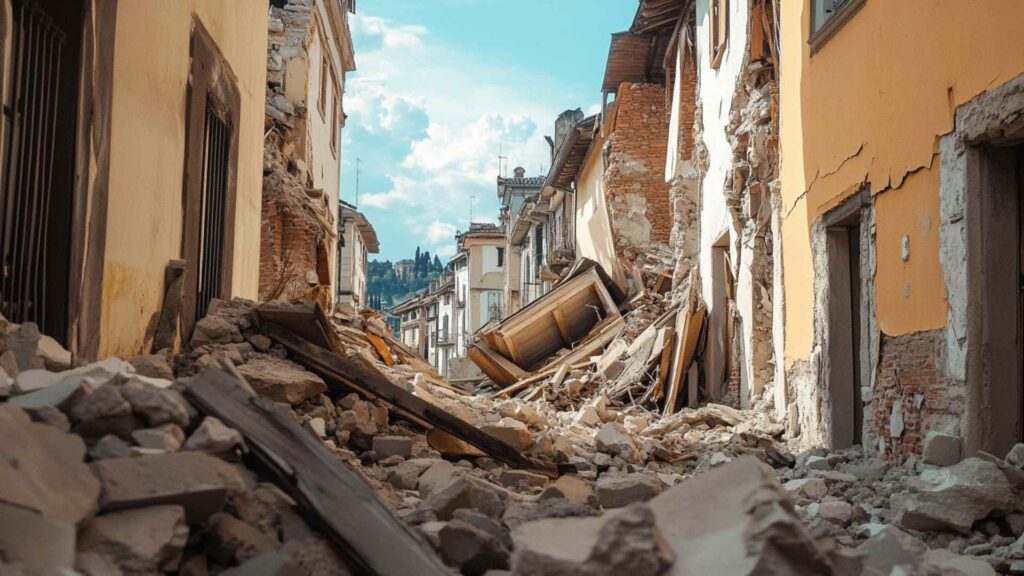
- Most earthquake injuries come from collapsing buildings and falling objects, not the ground opening.
- Unreinforced masonry walls are especially vulnerable to shaking.
- Soft-story buildings with weak ground floors can fail unless strengthened.
- Nonstructural items like bookcases and ceiling lights can cause injuries if they fall.
- Earthquakes can ignite fires by damaging gas lines and electrical systems.
- Landslides triggered by shaking can bury roads and communities in steep terrain.
- Dams and levees can be harmed by cracking, settlement, or sloshing overtops.
- Bridges can lose spans if bearings or restrainers fail during strong shaking.
- Ports may sink or tilt due to liquefaction in sandy or filled ground.
- Pipelines and water mains can break at fault crossings or where ground spreads.
- Hospitals and schools need special checks because they must function after earthquakes.
- Ocean-floor earthquakes can generate tsunamis that arrive minutes to hours later.
- Tsunami travel time depends on distance from the source and average ocean depth.
- A strong or long earthquake at the coast is a natural tsunami warning to head uphill.
- Tsunami waves often arrive in several surges, and the first wave may not be the largest.
- Coastal wetlands, dunes, and reefs can help reduce tsunami runup locally.
- Large earthquakes can permanently raise or lower land by meters.
- Great earthquakes can slightly change Earth’s rotation and shift the axis by centimeters.
- Moderate earthquakes can cause heavy losses if they strike near dense cities.
- Older buildings built before modern codes are usually at higher risk.
- Earthquake insurance often has a high deductible and varies by region.
- Early warning can automatically slow trains and open critical doors to reduce damage.
- Phone networks can clog during disasters, so text messages may work better than calls.
- Tsunamis can carry cars and boats inland and sweep debris back out to sea.
- River mouths and bays can focus tsunami energy and increase local wave heights.
- Tall buildings far from the epicenter can sway for minutes due to long-period waves.
Preparedness & safety
- A safe action during shaking is to drop, cover, and hold on under a sturdy table.
- If no table is close, cover your head and neck next to an interior wall.
- If you are in bed, staying put and covering your head with a pillow can reduce injury.
- Doorways are not safer in modern buildings and may expose you to swinging doors.
- Do not run outside during shaking because falling glass and debris are dangerous.
- After the shaking stops, check for injuries and hazards like gas leaks and fires.
- Keep a home kit with water, food, a flashlight, a radio, and first-aid supplies for several days.
- Secure tall furniture and store heavy items low to prevent tipping.
- Strap water heaters and tall shelves to reduce damage.
- Practice earthquake drills so everyone knows what to do when shaking starts.
- Know at least two ways out of every room in case one path is blocked.
- Near the coast, a long or strong quake is your cue to go to high ground right away.
- If you are driving, slow down and stop in a safe place away from bridges and power lines.
- Aftershocks can continue for days to months, so be ready to protect yourself again.
History & culture
- Written earthquake records go back thousands of years in many cultures.
- Before modern science, people often blamed quakes on mythical creatures or gods.
- Early seismoscopes showing shaking direction were invented in ancient China.
- The idea that weather causes earthquakes is a myth not supported by science.
- Many languages name earthquakes with words meaning “earth shaking” or “ground moving.”
- Cities often adopt new building codes after major earthquakes to reduce future losses.
- Museums in many regions feature safe shake tables for learning about earthquakes.
- Memorials in many cities honor lives lost and lessons learned from past earthquakes.
- Coastal evacuation signs guide people to high ground in tsunami zones.
- Schools in earthquake country commonly hold annual drills to teach safe actions.
- Community science programs let the public share shaking reports that help map intensity.
For kids: quick comparisons
- Think of P waves like a slinky pushed and pulled, and S waves like a rope wiggled side to side.
- If P waves are like lightning, the stronger shaking that follows is like the thunder.
- A magnitude 6 quake releases about 32 times more energy than a magnitude 5.
- A magnitude 7 quake releases about 1,000 times more energy than a magnitude 5.
- A two-story house sways slower than a short one, like a tall tree moving in the wind.
- Soft, muddy ground can shake like jelly compared to solid rock.
- Sand that liquefies can act like quicksand until the shaking stops.
- Tsunami waves out at sea are low and fast like rolling swells, not steep surfable walls.
- Earth’s plates creep along about as fast as fingernails grow.
- A rupture front can outrun a cheetah by thousands of times because it moves at kilometers per second.
- If a beach suddenly pulls the water far out, that can be a tsunami clue to run uphill.
Pop culture & fun extras
- People sometimes report hearing a low rumble just before nearby strong shaking.
- Pets may react to early shaking, but animals are not reliable earthquake predictors.
- Small earthquakes happen somewhere on Earth every minute on average.
- Scientists also study moonquakes and marsquakes to learn about other worlds.
- You can lower earthquake risk at home today by securing furniture and planning a family drill.
Quick FAQ
What causes earthquakes?
Earthquakes happen when stress builds up in rocks and a fault suddenly slips, sending waves through the ground.
Can we predict earthquakes?
Exact prediction with a date and place is not possible, but scientists estimate long-term probabilities and issue early warnings after a rupture starts.
What is the difference between magnitude and intensity?
Magnitude measures the energy released at the source, while intensity describes the shaking and damage at a specific location.
What should I do during an earthquake?
Drop to the ground, cover your head and neck under a sturdy table if possible, and hold on until the shaking stops.
What is the biggest earthquake ever recorded?
The largest instrumentally recorded earthquake was magnitude 9.5 in 1960 in southern Chile.

Ellie is the owner and sole author of Fun Facts, combining her mechanical engineering background with years of research-driven writing to deliver facts you can trust. Every article is thoroughly fact-checked and routinely updated as new science and sources emerge to keep information accurate and current. Her mission is to make learning delightful while upholding high standards of reliability and transparency.