
Comets are icy visitors that write glowing streaks across our sky and whisper secrets from the solar system’s beginning.
This big list keeps things friendly and simple, with quick facts anyone can enjoy.
Ready to learn what they’re made of, where they come from, and how to spot one? Let’s go!
Origins & definitions
- A comet is a small solar system body made mainly of ices, dust, and rock.
- The solid core of a comet is called the nucleus.
- When a comet warms near the Sun, its ices sublimate and create a glowing coma.
- The word "comet" comes from a Greek term meaning "long-haired."
- Most comets formed about 4.6 billion years ago during the birth of the solar system.
- Astronomers often describe comets as "dirty snowballs" or "icy dustballs."
- Comets are distinct from asteroids because comets show a coma or tail when heated.
- A comet’s activity begins when volatile ices like carbon dioxide start to sublimate.
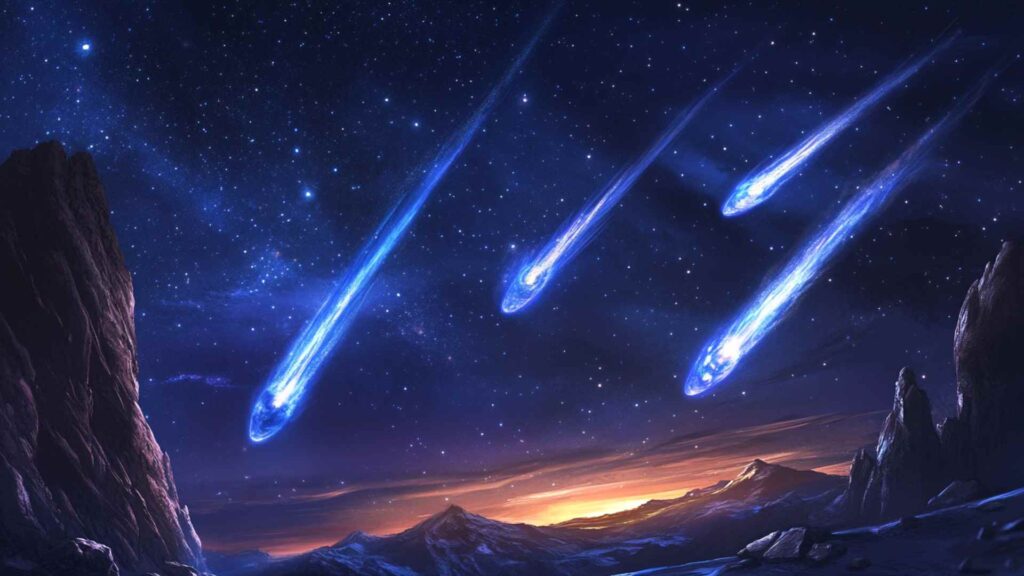
- The visible tail forms because sunlight and the solar wind push gas and dust away from the Sun.
- Comets are natural time capsules preserving primitive materials from the early solar nebula.
Record-breakers & wow numbers
- Typical comet nuclei measure a few kilometers across, but some reach tens of kilometers.
- Comet 1P/Halley completes one orbit around the Sun roughly every 75 to 76 years.
- The coma of a bright comet can grow larger than the Sun in diameter.
- Comet tails can stretch over 100 million kilometers in space.
- The darkest comet surfaces reflect only a few percent of incoming sunlight.
- Some comets shed tons of material every second near perihelion.
- A small comet may lose meters of surface thickness during a single close passage to the Sun.
- A long-period comet can take more than a million years to complete one orbit.
- Short-period comets often return in less than 20 years.
- The fastest comets whip through the inner solar system at tens of kilometers per second.
- The faintest comets known are discovered only with powerful telescopes.
- A sungrazer can skim within a few hundred thousand kilometers of the solar photosphere.
What comets are made of
- Cometary ices commonly include water, carbon dioxide, carbon monoxide, and traces of other gases.
- Dust in comets contains silicate minerals such as olivine and pyroxene.
- Many cometary molecules break apart in sunlight, creating daughter species that glow.
- Some comets show a green glow near the nucleus from carbon molecules excited by sunlight.
- An ion tail is made of charged particles carried away by the solar wind.
- A dust tail consists of tiny grains pushed back by sunlight pressure.
- The nucleus of many comets is darker than charcoal because of complex carbon compounds.
- Comet nuclei are porous and have very low bulk densities compared to solid rock.
- Jets erupt from vents when subsurface ices heat and gas escapes through cracks.
- Comet surfaces often develop a dusty crust as lighter ices escape first.
- The gas coma is mostly water vapor close to the Sun, with other gases mixed in.
- Sodium atoms can create a faint separate tail in some bright comets.
- X-rays from comets arise when fast solar wind ions interact with neutral gas in the coma.
- The strength of a comet nucleus is low, so pieces can break off under stress.
- Some comet nuclei are contact binaries made of two lobes gently stuck together.

Orbits & families
- Short-period comets mainly come from the Kuiper Belt and related regions beyond Neptune.
- Long-period comets likely originate from the distant Oort Cloud surrounding the solar system.
- Jupiter-family comets have orbital periods under 20 years and are influenced by Jupiter’s gravity.
- Halley-type comets have periods between 20 and 200 years.
- Long-period comets have periods longer than 200 years or even thousands of years.
- A comet’s path is described by its orbital elements such as eccentricity and inclination.
- Many comets follow highly elongated ellipses that bring them close to the Sun and then far away.
- Some comets have retrograde orbits that run opposite the planets’ direction.
- The Tisserand parameter helps classify comets by their relationship to Jupiter’s orbit.
- Gravitational nudges from planets can change a comet’s period and tilt.
- Passing stars and the galactic tide can dislodge Oort Cloud comets into the inner solar system.
- A hyperbolic comet has enough energy to escape the Sun and never return.
- Resonances with Jupiter can trap or scatter comets over time.
- Non-gravitational forces from jets can subtly alter a comet’s trajectory.
- Some comets become dormant when surface dust seals in their ices.
Tails, comas & jets
- A comet’s tails always point roughly away from the Sun, not necessarily behind its direction of travel.
- The dust tail curves because particles keep their orbital momentum as they drift.
- The ion tail is usually straighter because charged particles follow the solar wind.
- An anti-tail can appear briefly when Earth crosses the comet’s orbital plane.
- The coma can span hundreds of thousands of kilometers even for modest comets.
- The inner coma is densest near the nucleus and thins rapidly with distance.
- Sunlight breaks water into hydrogen and hydroxyl, creating a large hydrogen envelope.
- Jets can rotate with the nucleus, making fans and spirals in long-exposure images.
- Outbursts happen when trapped gas suddenly vents and lifts dust into space.
- Backlit dust can make a comet appear brighter at small phase angles.
- The position angle of the tail on the sky changes as Earth and the comet move.
- Radiation pressure sorts dust by size, with finer grains pushed farther.
- Bright comets sometimes show streamers and striations within their dust tails.
- Plasma interactions can bend the ion tail during solar wind gusts.
- Magnetic fields in the solar wind can drape around the coma and tail.
- Collisions between dust grains within the coma are rare because the gas is extremely tenuous.
- Sublimation usually begins for water ice when a comet gets inside a few astronomical units.
- Carbon monoxide and carbon dioxide can drive activity much farther from the Sun.

Meteor showers & Earth
- Many annual meteor showers come from comet dust streams intersecting Earth’s orbit.
- The Perseid meteor shower comes from debris shed by Comet Swift–Tuttle.
- The Leonid meteor shower originates from dust released by Comet Tempel–Tuttle.
- The Orionids and Eta Aquariids are produced by dust from Halley’s Comet.
- Meteor showers recur because Earth crosses the same comet trails each year.
- Fresh, narrow trails from recent passages can cause short-lived meteor outbursts.
- The speed of meteors depends on the angle at which Earth meets the dust stream.
- Most meteors from comets burn up high in the atmosphere and do not reach the ground.
- A meteor shower’s radiant is the point in the sky from which the meteors seem to come.
- The thickness of a dust trail can vary, making some years stronger than others.
- Radar can detect faint meteors from comet dust that are invisible to the eye.
- Cometary dust contributes a portion of the fine material that slowly settles through Earth’s atmosphere.
Spacecraft & discoveries
- The first close images of a comet nucleus were captured in the 1980s.
- A probe successfully flew past Halley’s Comet and revealed a dark, active surface.
- A dedicated impactor once struck a comet to study the plume of ejected material.
- Another mission collected dust from a comet’s coma and returned samples to Earth.
- A spacecraft achieved the first orbit around a comet and escorted it for many months.
- The same mission delivered a small lander that touched down and bounced before coming to rest.
- Close-up images revealed cliffs, pits, boulders, and smooth plains on a comet’s surface.
- Measurements showed that some comet nuclei are less dense than water.
- Instruments detected complex organic molecules in the gas coma of an active comet.
- The rotation period of a comet can change as jets act like tiny rocket thrusters.
- High-speed dust grains pepper spacecraft during close comet flybys.
- Thermal maps showed very low thermal inertia on comet surfaces.
- Jets were seen switching on and off with sunlight as the comet rotated.
- Spacecraft have observed both dust tails and ion tails from up close.
- One mission revisited a comet years after an impact to view the changed surface.
- Detailed spectra from space showed water, carbon compounds, and many minor species.
- Missions found that comet dust contains minerals that formed at high temperatures.
- Spacecraft observations proved that many comets are far from uniform inside.

History & culture
- Records of comets span many cultures over thousands of years.
- In 1705, a mathematician predicted that a recurring comet would return, pioneering orbital prediction.
- A bright comet in 1066 was famously depicted on a medieval tapestry.
- Some ancient observers saw comets as omens because they appeared suddenly and unpredictably.
- Systematic telescopic discovery of comets began after the invention of the telescope in the 1600s.
- The modern system of naming comets after their discoverers started in the nineteenth century.
- The rise of digital sky surveys greatly increased the rate of comet discoveries.
- Bright comets in the 1990s renewed public interest with spectacular tails.
- City lights make faint comets harder to see compared to dark-sky sites.
- Binoculars often reveal a comet’s fuzzy head better than unaided eyes.
- Star charts help observers track a comet’s changing position from night to night.
- Amateur astronomers still discover comets, especially using wide-field imaging.
Names & etymology
- Comets receive a letter prefix indicating type, such as C for non-periodic and P for periodic.
- A number before the P, like 1P, marks the order in which periodic comets were confirmed.
- The year and half-month of discovery appear in a comet’s designation.
- The discoverer’s name or survey name follows the official designation.
- A comet that disintegrates gets a D prefix in later references.
- An object first classified as an asteroid but later showing a coma gets an A prefix at discovery.
- Multiple independent discoverers can be joined with hyphens in the comet’s name.
- A comet observed only briefly and with uncertain orbit may be labeled with an X prefix.
Oddballs & breakups
- Some comets split into multiple fragments when thermal stresses crack the nucleus.
- Tidal forces near planets or the Sun can tear weak comets apart.
- Outgassing can spin a nucleus faster until it sheds pieces.
- Sungrazer families include many tiny members that vaporize near the Sun.
- A comet once broke into pieces before striking Jupiter in the 1990s.
- Main-belt comets show comet-like activity while orbiting within the asteroid belt.
- Some active asteroids likely expose buried ice after small impacts.
- Dormant comets can masquerade as dark asteroids until they heat up again.
- A few comets follow orbits that bring them very close to Earth’s orbit but still miss our planet.
- Interactions with Jupiter can eject comets from the solar system entirely.
For kids: quick comparisons
- A typical comet nucleus is about the size of a city, while Earth is the size of a marble compared to the Sun.
- The fluffiest comet ice is less dense than liquid water, so it would float if it were a solid block.
- A comet’s tail can be longer than the distance from the Earth to the Sun divided by ten.
- If your car drove at highway speed toward a comet tail, you could travel for days and still be inside it.
- The black surface of many comets is darker than fresh asphalt.
- A snowball in your freezer sublimates slowly like a comet does in space, just without the tail.
- A comet’s visit is like a boomerang trip that can take years or centuries.
- The dust from a comet becomes shooting stars when Earth runs into it.
- A comet’s coma would feel emptier than a vacuum chamber on Earth even though it looks bright.
- The Sun warms a comet the way a campfire melts a snowball brought too close.
Pop culture & fun extras
- A truly bright "great comet" is rare enough that many people see only a few in a lifetime.
- Some comets become visible in twilight near the horizon shortly before sunrise or after sunset.
- Photographers often use short telephoto lenses to capture a comet’s tail and the landscape together.
- A small telescope can reveal the starlike nucleus hidden inside the fuzzy head.
- Keeping notes of a comet’s changing shape and brightness turns a sky sighting into a personal science project.
Quick FAQ
What is a comet?
A comet is a small icy body that heats up near the Sun, forming a coma and tail.
Why do some comets look green?
Certain carbon molecules glow green when sunlight excites them in the coma.
How often does Halley’s Comet return?
Halley’s Comet returns roughly every 75 to 76 years.
Do comets hit Earth?
Impacts are rare on human timescales, and most comet material burns up as meteors.
Where do comets come from?
Short-period comets mostly come from the Kuiper Belt, while long-period comets come from the distant Oort Cloud.

Ellie is the owner and sole author of Fun Facts, combining her mechanical engineering background with years of research-driven writing to deliver facts you can trust. Every article is thoroughly fact-checked and routinely updated as new science and sources emerge to keep information accurate and current. Her mission is to make learning delightful while upholding high standards of reliability and transparency.