
Yellowstone is a land of boiling rivers, rainbow pools, and roaming bison, and it’s packed with surprises for curious minds.
This friendly guide shares quick, kid-safe facts about the park’s wild history, animals, geysers, and volcano science.
Get ready to explore safely, learn a ton, and plan an unforgettable adventure.
Origins & definitions
- Yellowstone National Park was established on March 1, 1872.
- It is widely recognized as the world’s first national park.
- The park spans about 8,983 km² across Wyoming, Montana, and Idaho.
- Most of the park lies in Wyoming.
- The park protects the Yellowstone Caldera, a large volcanic system.
- The name “Yellowstone” comes from the yellow-hued canyon walls of the Yellowstone River.
- The park contains over half of the world’s active geysers.
- People have lived and traveled in the Yellowstone region for at least 11,000 years.
- The park is part of the Greater Yellowstone Ecosystem, one of Earth’s largest nearly intact temperate ecosystems.
- Yellowstone’s elevations range from about 1,610 m to 3,462 m.
- The park has five vehicle entrances: north, northeast, west, south, and east.
- The main sightseeing route is a figure-8 highway called the Grand Loop Road.
Record-breakers & wow numbers
- Yellowstone preserves over 10,000 hydrothermal features.
- More than 500 of those features are geysers.
- The Grand Prismatic Spring is the largest hot spring in the United States.
- Grand Prismatic Spring ranks among the world’s three largest hot springs by area.
- Steamboat Geyser is the tallest active geyser on Earth when it erupts.
- The Lower Falls of the Yellowstone River drops about 94 m.
- Yellowstone Lake covers roughly 350 km² at an elevation over 2,300 m.
- The Grand Canyon of the Yellowstone is up to about 300 m deep.
- The Yellowstone River is the longest undammed river in the contiguous United States.
- The park hosts hundreds to thousands of small earthquakes every year.
- The Grand Loop Road is about 230 km long.
- The 1988 fires burned roughly 3,200 km² of the park landscape.
Geology & the supervolcano
- Yellowstone sits atop a hotspot where hot mantle material rises toward the surface.
- Three giant eruptions occurred about 2.1 million, 1.3 million, and 640,000 years ago.
- The most recent caldera-forming blast created the current Yellowstone Caldera.
- Many smaller lava flows continued after the last giant eruption.
- The most recent lava flow in the park is roughly 70,000 years old.
- The caldera measures roughly 55 by 72 km.
- A shallow magma reservoir lies a few kilometers beneath the surface.
- A deeper magma body sits further down in the crust.
- Most of the magma beneath Yellowstone is partially solid crystalline mush.
- Heat from the magmatic system powers the park’s hot springs and geysers.
- Rain and snowmelt percolate deep, get heated, and rise back up as hot water.
- Silica-rich fluids deposit sinter that builds geyser cones and terraces.
- The caldera floor rises and falls by centimeters over years to decades.
- Underground water at Yellowstone can be hotter than the surface boiling point.
- At Yellowstone’s elevation, pure water boils near 93°C (199°F).
- Pressure at depth lets hydrothermal water reach well above 100°C.
- Fumaroles vent steam and gases such as carbon dioxide and hydrogen sulfide.
- Mudpots form where acidic hot water dissolves rock into clay.
- Travertine terraces at Mammoth form from calcium-carbonate deposits.
- The risk of a giant eruption in any given year is considered extremely low.

Hydrothermal wonders
- Old Faithful is famous for erupting regularly, though intervals naturally vary.
- Old Faithful’s typical eruption lasts a few minutes and sends water tens of meters high.
- The Upper Geyser Basin holds the world’s densest concentration of geysers.
- The Midway Geyser Basin includes the colorful Grand Prismatic Spring.
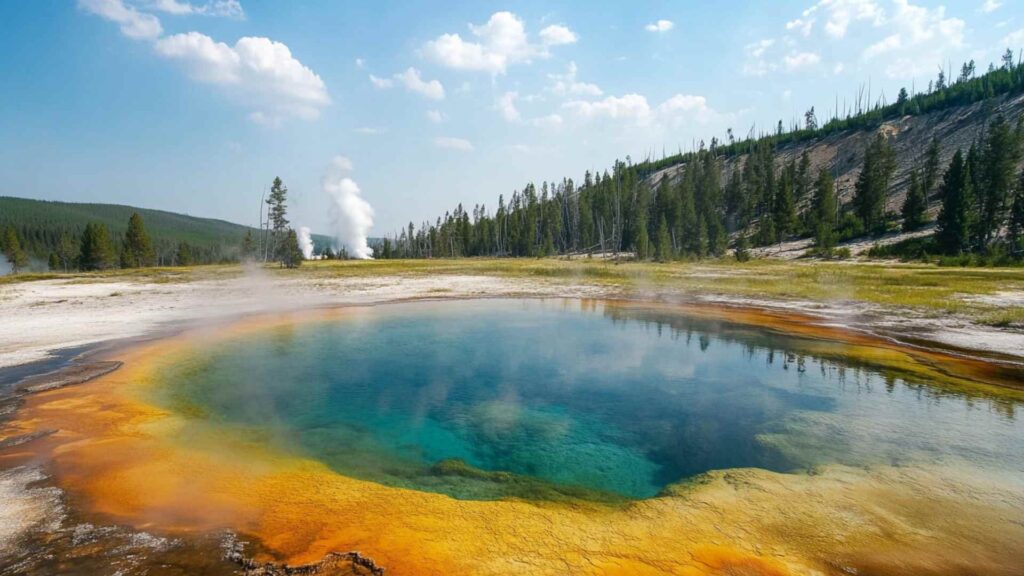
- The vivid colors of some hot springs come from heat-loving microbes called thermophiles.
- Different colors often match different temperature zones around a spring.
- Norris Geyser Basin is the hottest and most changeable geyser basin in the park.
- Steamboat Geyser’s rare major eruptions can shoot spray above 90 m.
- Geysers erupt when superheated water flashes to steam in underground chambers.
- Geyserite is the hard silica rock that lines geyser vents and pools.
- Morning Glory Pool has changed color over time as conditions shifted.
- The Firehole River carries warm water from several geyser basins.
- The Gibbon River flows past the Beryl Spring and Gibbon Falls area.
- Riverside Geyser often erupts in a graceful arch over the Firehole River.
- Castle Geyser features a massive, crenellated cone built from geyserite.
- Grand Geyser is among the tallest predictable geysers in the world.
- Great Fountain Geyser erupts from a broad terraced pool on the Firehole Lake Drive.
- Mud Volcano area showcases acid features like roiling mud and hissing vents.
- Roaring Mountain is known for numerous steam vents across its slope.
- West Thumb Geyser Basin sits on the shore of Yellowstone Lake.
- Some hot springs and geysers continue beneath the waters of Yellowstone Lake.
- Black Growler Steam Vent has produced loud roars during active periods.
- Siliceous sinter can create delicate “geyser eggs” that look like pearls.
- Hydrothermal features can shift or go dormant as underground plumbing changes.
- Thin crust near hot springs can break and cause severe burns.
- Boardwalks protect visitors and fragile thermal ground from damage.
- Unnatural objects tossed into hot springs can clog vents and alter colors.
- Some pools are acidic enough to dissolve bone and plant matter.
- New vents or small thermal explosions occasionally open in active areas.
- Winter steam from hot springs can frost nearby trees into ghostly shapes.

Water, canyons & waterfalls
- The Yellowstone River flows north through the park to Montana.
- The river drops over the 33 m Upper Falls before the Lower Falls.
- The Grand Canyon of the Yellowstone showcases bands of yellow, red, and orange rock.
- Canyon colors come from hot water altering iron-rich volcanic rock.
- The canyon stretches for more than 30 km through the central park.
- Artist Point offers one of the most photographed views of the Lower Falls.
- Tower Fall plunges about 40 m near a set of slender rock spires.
- Gibbon Falls drops roughly 26 m along the Gibbon River.
- Kepler Cascades tumbles down a series of drops near the Firehole River.
- Yellowstone Lake usually remains ice-covered into late spring.
- The lake’s maximum depth is about 120 m.
- Cold water and sudden winds can make boating on the lake hazardous.
- The Continental Divide crosses the park and splits river drainages.
- Fairy Falls is a tall waterfall reachable by a popular trail near Grand Prismatic.
- The Firehole and Gibbon Rivers join to form the Madison River at Madison Junction.
Wildlife
- Yellowstone shelters North America’s largest free-ranging bison herd.
- Adult male bison can weigh over 900 kg (2,000 lb).
- Bison calves are nicknamed “red dogs” for their reddish coats.
- Bison bellow and clash horns during the midsummer rut.
- Both grizzly bears and black bears live in the park.
- Grizzly bears have a prominent shoulder hump of muscle for digging.
- Gray wolves were restored to the park in the mid-1990s.
- Wolf numbers in the park fluctuate with prey and territory.
- Elk are the most numerous large mammals in the park.
- Male elk grow and shed antlers every year.
- Pronghorn are North America’s fastest land mammals over long distances.
- Moose favor marshy areas with willows and cold streams.
- Bighorn sheep cling to steep cliffs to avoid predators.
- Mountain goats live just north of the park but occasionally wander in.
- Coyotes often hunt rodents in open meadows.
- River otters play and fish in cold streams and lakes.
- Beavers reshape creeks with dams and lodges.
- Trumpeter swans, bald eagles, and ospreys nest around lakes and rivers.
- Sandhill cranes dance in wetlands during spring courtship.
- Over 280 bird species have been recorded in the park.
- Amphibians are few because high elevations bring long, cold winters.
- Native Yellowstone cutthroat trout support many predators.
- Non-native lake trout in Yellowstone Lake are actively controlled to help cutthroat.
- American bison are not true buffalo, which live in Africa and Asia.
- Safe wildlife viewing distances are at least 23 m for bison and elk and 91 m for bears and wolves.

Weather, seasons & safety
- Summer days can be warm while nights remain cool at high elevations.
- Afternoon thunderstorms are common in July and August.
- Winter temperatures can drop below −30°C (−22°F).
- Snow can fall in any month at Yellowstone’s higher passes.
- Many park roads close to regular cars from early November to late April.
- In winter, over-snow travel uses snow coaches and limited snowmobiles on certain routes.
- Hypothermia is a risk year-round in cold rivers and lakes.
- Sunburn is possible even on cool days because high elevation means thinner air.
- Lightning is a serious hazard on open ridges and near tall isolated trees.
- Cell service is spotty, so paper maps and backup plans are wise.
- Staying on boardwalks prevents falls through thin thermal crust.
- Carrying bear spray and knowing how to use it is recommended in bear country.
History & culture
- Many Indigenous nations maintain deep cultural connections to the Yellowstone region.
- Early photographs and surveys helped convince leaders to protect the area.
- The park was set aside for the benefit and enjoyment of the people in 1872.
- Fort Yellowstone at Mammoth Hot Springs once served as the park’s administrative center.
- The rustic Old Faithful Inn opened to visitors in the early 1900s.
- The park’s iconic hand-built stone and log architecture is called “parkitecture.”
- A severe flood in June 2022 damaged roads and prompted major repairs.
- Scientists have studied Yellowstone’s geology and biology for more than a century.
- A heat-stable enzyme first found in a Yellowstone hot spring helped revolutionize DNA testing.
- Obsidian Cliff provided prized stone for tools that traveled widely in ancient trade.
Visiting tips & fun extras
- Wildlife often graze along roads, causing “bison jams” and “bear jams” that slow traffic.
- Dawn and dusk are the best times to spot many animals.
- Drinking untreated hot spring water is dangerous and strictly forbidden.
- Fishing inside the park requires a park-specific permit.
- Campers can choose from multiple campgrounds and many backcountry sites with permits.
- Stargazing is excellent here thanks to big skies and low light pollution.
- The park sees around four to five million visits per year as of 2024.
- Many places remain snow-covered into May or even June at higher elevations.
- The figure-8 road lets visitors plan two logical loops for day trips or longer tours.
Quick FAQ
Is Yellowstone a supervolcano?
Yes, Yellowstone sits over a large volcanic system with a giant caldera, but a major eruption is very unlikely in any given year.
Where is Yellowstone located?
Yellowstone stretches across northwest Wyoming with small parts in southern Montana and eastern Idaho.
When was Yellowstone founded?
It became a national park on March 1, 1872.
What is the most famous geyser in Yellowstone?
Old Faithful is the most famous geyser, known for its frequent, dramatic eruptions.
Can you swim in hot springs at Yellowstone?
No, hot springs are extremely dangerous and off-limits, but a few designated river spots outside thermal features may be seasonally allowed.

Ellie is the owner and sole author of Fun Facts, combining her mechanical engineering background with years of research-driven writing to deliver facts you can trust. Every article is thoroughly fact-checked and routinely updated as new science and sources emerge to keep information accurate and current. Her mission is to make learning delightful while upholding high standards of reliability and transparency.