
Wisconsin is a friendly Midwestern state filled with shimmering lakes, tall forests, and cheese galore.
This list packs quick, fun nuggets kids and adults can enjoy.
You’ll learn how glaciers shaped the land, why it’s called the Badger State, and where to find unique foods and outdoor adventures.
Origins & definitions
- Wisconsin is a U.S. state in the Midwest and Great Lakes region.
- It became the 30th state on May 29, 1848.
- The state capital is Madison.
- The largest city is Milwaukee.
- The state nickname is the Badger State.
- The official motto is “Forward.”
- The postal abbreviation for Wisconsin is WI.
- Residents of the state are called Wisconsinites.
- Wisconsin is divided into 72 counties.
- The state flag features the coat of arms on a blue field with the year 1848.

Record-breakers & wow numbers
- Wisconsin has over 15,000 lakes when smaller water bodies are counted.
- The highest natural point is Timms Hill at 595 m (1,951 ft).
- The Wisconsin River is the longest river entirely within the state at about 692 km (430 miles).
- The Mississippi River forms much of Wisconsin’s western border.
- The state covers roughly 169,640 km² (65,498 sq mi).
- Apostle Islands National Lakeshore protects 21 islands and about 19 km (12 miles) of mainland shoreline.
- Wisconsin has more than 10,000 miles of streams and rivers.
- Lake Winnebago is the largest inland lake entirely in Wisconsin at about 557 km² (215 sq mi).
- Madeline Island is the largest island in Wisconsin.
- The coldest temperature recorded in Wisconsin was about −48°C (−55°F) at Couderay in 1996.
- The hottest temperature recorded was about 46°C (114°F) at Wisconsin Dells in 1936.
- The 2004 state quarter became famous for a mint error variety showing an extra leaf on the corn.
Geography & nature
- Wisconsin straddles the divide between the Mississippi River basin and the Great Lakes basin.
- The Driftless Area in the southwest escaped the last glaciers and features steep ridges and coulees.
- Glacial action carved many of Wisconsin’s lakes during the last Ice Age.
- Door County is a long peninsula reaching into Lake Michigan.
- The Kettle Moraine is a ridge of glacial deposits running through southeastern Wisconsin.
- The Baraboo Range is an ancient quartzite range in south-central Wisconsin.
- Devil’s Lake is ringed by purple quartzite bluffs rising over 150 m (500 ft).
- The state’s lowest natural point is Lake Michigan at about 176 m (579 ft) above sea level.
- Central Wisconsin features rolling plains well suited to dairy farming.
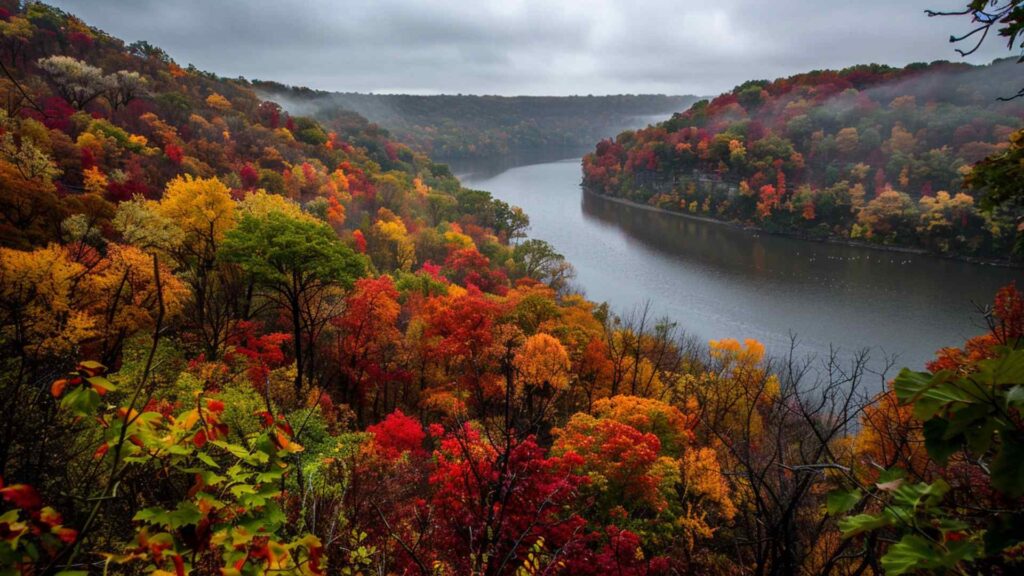
- Northern Wisconsin is heavily forested with conifers and hardwoods.
- Chequamegon-Nicolet National Forest covers about 1.5 million acres.
- The Apostle Islands sandstone sea caves can freeze into dramatic ice formations in cold winters.
- Rib Mountain near Wausau is over a billion years old.
- The Niagara Escarpment arcs through eastern Wisconsin and forms cliffs along Green Bay.
- The Dells of the Wisconsin River showcase carved sandstone canyons and towers.
- Wisconsin experiences four distinct seasons with snowy winters and warm summers.

Lakes & rivers
- The Wisconsin River begins at Lac Vieux Desert on the Michigan border.
- The Menominee River forms part of the boundary with Michigan’s Upper Peninsula.
- The St. Croix River marks part of the border with Minnesota.
- The Fox River connects Lake Winnebago to Green Bay.
- Lake Superior touches Wisconsin at the cities of Superior and Ashland.
- Lake Michigan borders Wisconsin from Kenosha north to Door County.
- The Chippewa River drains much of northwestern Wisconsin.
- The Namekagon River is a protected waterway popular for paddling.
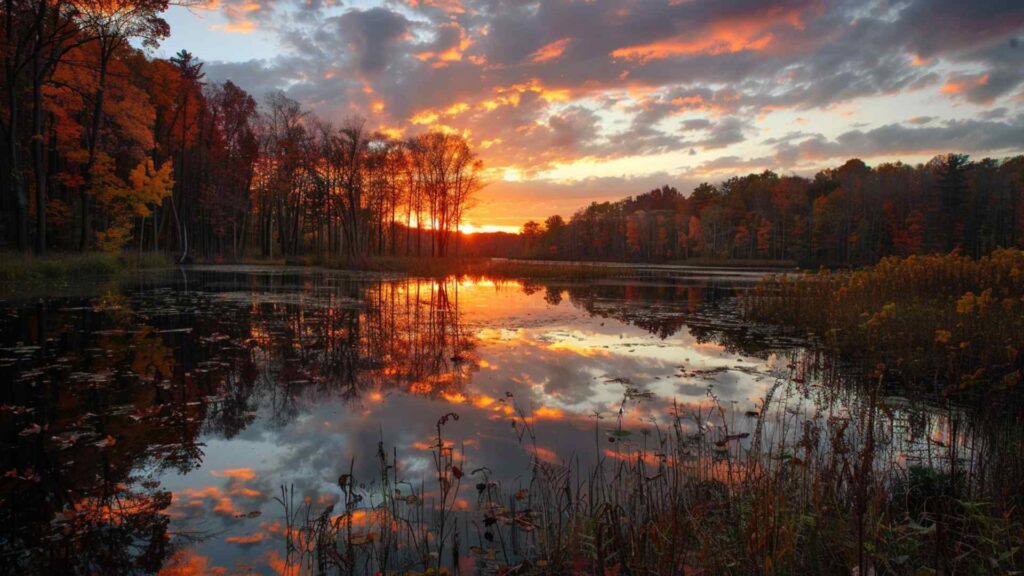
- Many lakes in Wisconsin are kettle lakes with clear, deep water.
- Lake Mendota in Madison reaches a maximum depth of about 25 m (83 ft).
- Green Lake is the deepest natural inland lake in Wisconsin at about 72 m (236 ft).
- The Wolf River is known for whitewater rafting in the northeast.
- The Root River in Racine hosts seasonal salmon and trout runs.
- The Yahara River chain links several lakes around Madison.
Wildlife & ecology
- White-tailed deer are abundant across the state.
- Black bears live mainly in northern forests.
- Gray wolves recolonized northern Wisconsin in the late 20th century.
- Common loons nest on clear northern lakes each summer.
- Bald eagles have rebounded and are now seen year-round near open water.
- Sandhill cranes migrate through Wisconsin each spring and fall.
- The state bird is the American robin.
- The state flower is the wood violet.
- The state tree is the sugar maple.
- The state fish is the muskellunge.
History & people
- Native peoples built effigy mounds shaped like animals between about 700 and 1100 CE.
- The Ho-Chunk Nation has deep ancestral ties to southern Wisconsin.
- The Menominee Nation maintains a reservation in northeastern Wisconsin.
- French explorers visited the region in the 1600s seeking trade routes.
- Fur trading posts grew at river confluences in the 1700s.
- After the American Revolution the area became part of the United States.
- The Wisconsin Territory was created in 1836.
- The first state constitution was adopted in 1848 after an earlier draft was rejected.
- Large numbers of German immigrants settled in Wisconsin in the 19th century.
- Scandinavian settlers established many farming communities in the north.
- Milwaukee became a major manufacturing center by the late 1800s.
- Wisconsin played a notable role in Progressive Era reforms in the early 1900s.
- Dairy cooperatives expanded rapidly in the early 20th century.
- Wisconsin regiments served in major U.S. conflicts from the Civil War onward.
- Fair housing marches in Milwaukee in the 1960s drew national attention.
- Tribal treaty rights cases shaped state policy in the late 20th century.
- The Wisconsin State Capitol building was completed in 1917.
- The Capitol dome rises about 85 m (284 ft) and is clad in granite.
Economy & industry
- Dairy farming is a major industry in Wisconsin.
- Wisconsin ranks first in U.S. cheese production as of 2024.
- Cheddar, mozzarella, and specialty cheeses are produced in hundreds of plants statewide.
- Cranberries are the official state fruit and a leading cash crop.
- Wisconsin produces the majority of U.S. cranberries as of 2024.
- Marathon County is known for high-quality ginseng farms.
- Paper and pulp mills have long operated along the Fox River corridor.
- Machine tools, engines, and fabricated metals are key manufactured products.
- The Port of Milwaukee links lake shipping to rail and highway networks.
- Tourism contributes billions of dollars annually to the state economy.
- Large farm shows and county fairs run across Wisconsin each summer.
- Wind, solar, and biomass projects are expanding in the state’s energy mix.
- Maple syrup is produced each spring from sugar maple stands.
- Tech startups and research spinouts are growing in the Madison area.
Science & education
- Wisconsin operates a public university system with campuses around the state.
- The flagship campus in Madison is known for research in biotechnology and engineering.
- The university in Madison became a land-grant institution in 1866.
- The “Wisconsin Idea” encourages sharing university expertise to benefit the whole state.
- Milwaukee hosts colleges focused on health sciences, business, and the arts.
- Technical colleges provide hands-on training for skilled trades statewide.
- Public schools are organized into local districts with elected boards.
- Rural communities are served by public libraries and bookmobiles.
- Science museums in Madison and Milwaukee offer interactive exhibits for kids.
- Astronomy clubs host dark-sky viewing nights in northern counties each summer.
Food & traditions
- The state pastry is the kringle, officially recognized in 2013.
- Friday night fish fries are a beloved tradition year-round.
- Frozen custard stands are popular in many cities.
- Bratwurst is a favorite at backyard cookouts and festivals.
- Cheese curds squeak when fresh and are often served fried.
- Booyah is a long-simmered community stew in northeastern Wisconsin.
- Door County is famous for dramatic fish boils cooked in big kettles.
- Butter burgers pair seared patties with buttered buns.
- Wild rice dishes reflect Native food traditions in the north.
- Maple candy and maple cream are classic spring treats.
- Many supper clubs serve relish trays and brandy old-fashioned cocktails.
Sports & recreation
- The Green Bay Packers are the only publicly owned major professional sports team in the United States.
- The Packers have won multiple league championships including four Super Bowls.
- The Milwaukee Bucks won the NBA championship in 1971 and 2021.
- The Milwaukee Brewers play Major League Baseball in a retractable-roof stadium.
- Curling leagues flourish in northern towns each winter.
- Snowmobile trails span thousands of kilometers across rural counties.
- Cross-country ski areas offer groomed trails in many state parks.
- Door County and the Apostle Islands are top summer destinations for sea kayaking.
- Anglers target muskellunge, walleye, and trout in lakes and rivers.
- The American Birkebeiner is a major cross-country ski race held each February.
Cities & places
- Madison sits on a narrow isthmus between Lakes Mendota and Monona.
- Milwaukee grew at the confluence of the Milwaukee, Menomonee, and Kinnickinnic Rivers.
- Green Bay lies at the head of Green Bay, an arm of Lake Michigan.
- La Crosse overlooks the Mississippi River and the bluffs of the Driftless Area.
- Eau Claire stands where the Eau Claire River meets the Chippewa River.
- Oshkosh sits on the western shore of Lake Winnebago.
- Wausau is a regional hub near Rib Mountain.
- Superior anchors Wisconsin’s far northwest on Lake Superior.
- Kenosha and Racine line the Lake Michigan shoreline south of Milwaukee.
- Appleton and the Fox Cities cluster along the Fox River.
Names & etymology
- The name “Wisconsin” is derived from an Algonquian term that originally referred to a river.
- Early French records spelled the name as “Ouisconsin.”
- The demonym “Wisconsinite” is widely used in modern English.
- The state is commonly nicknamed “America’s Dairyland.”
- The Badger nickname traces to early lead miners who lived in hillside dugouts.
For kids: quick comparisons
- Wisconsin is roughly 500 km (310 miles) from north to south.
- Texas is about four times larger than Wisconsin by area.
- The average July high in Madison is around 28°C (82°F).
- The average January high in Madison is around −3°C (27°F).
- A free ferry crosses the Wisconsin River at Merrimac during the warm season.
Quick FAQ
What is the capital of Wisconsin?
Madison is the state capital.
What is Wisconsin known for?
Wisconsin is known for dairy farming, thousands of lakes, and outdoor recreation.
When did Wisconsin become a state?
Wisconsin became the 30th state on May 29, 1848.
What is the largest city in Wisconsin?
Milwaukee is the largest city.
What is the state nickname?
Wisconsin is called the Badger State.

Ellie is the owner and sole author of Fun Facts, combining her mechanical engineering background with years of research-driven writing to deliver facts you can trust. Every article is thoroughly fact-checked and routinely updated as new science and sources emerge to keep information accurate and current. Her mission is to make learning delightful while upholding high standards of reliability and transparency.