
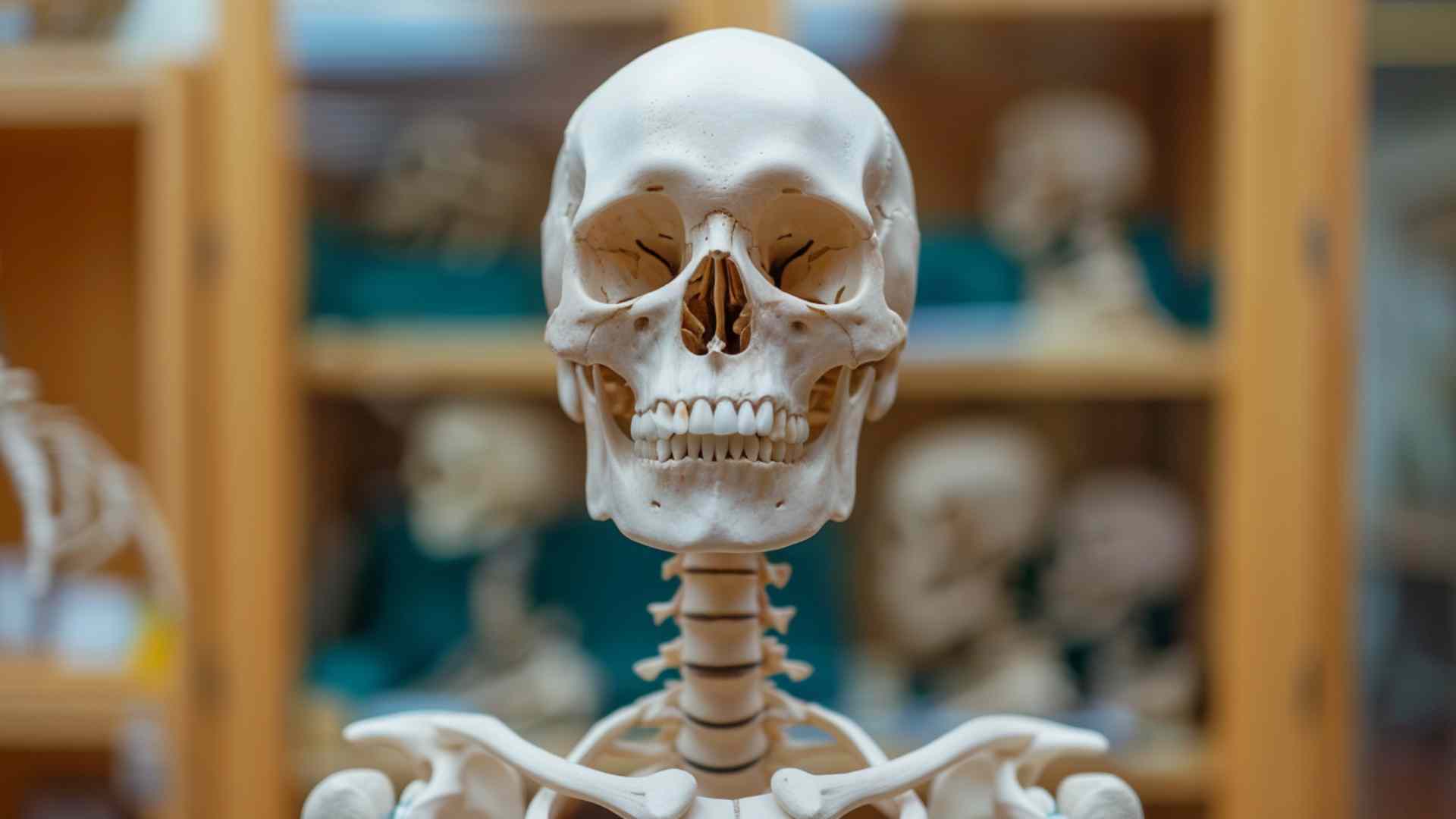
Meet your body’s built-in scaffold: the skeletal system. It holds you up, protects organs, and teams with muscles so you can run, jump, and hug.
In this big list we’ll tour bones, joints, and marrow, peek at growth plates, and compare creatures, all in friendly, bite-size facts you can trust and share.
Skeletal System Fun Facts

- The skeletal system is the framework of bones, cartilage, and ligaments that supports the body.
- Adult humans typically have 206 bones.
- A newborn has about 270 bones that fuse as they grow.
- The skeleton is divided into the axial skeleton and the appendicular skeleton.
- The axial skeleton has 80 bones including the skull, spine, and rib cage.
- The appendicular skeleton has 126 bones in the limbs and girdles.
- Bones protect vital organs like the brain, heart, and lungs.
- The skeletal system anchors muscles to enable movement.
- Bones store minerals such as calcium and phosphorus for later use.
- Bone marrow inside certain bones produces blood cells.
- The skeleton helps maintain body shape and posture.
- Some bones act as levers to amplify muscle force.
- Bone tissue is about one third organic collagen and two thirds mineral crystals by weight.
- The mineral in bone is mainly hydroxyapatite, a calcium phosphate compound.
- Compact bone forms the dense outer layer of bones.
- Spongy bone, also called cancellous bone, fills bone ends and contains trabeculae.
- Osteoblasts are cells that build new bone matrix.
- Osteoclasts are cells that break down bone tissue.
- Osteocytes are mature bone cells that sense stress and coordinate remodeling.
- Bone is covered by a tough membrane called the periosteum.
- Blood vessels and nerves run through Haversian canals in compact bone.
- The inner surface of bone is lined by the endosteum.
- Yellow marrow stores fat inside the shafts of long bones.
- Red marrow makes red blood cells, white blood cells, and platelets.
- Collagen gives bone flexibility while mineral crystals give bone hardness.
- Bones are living tissues that constantly remodel in response to stress.
- Most bones form through endochondral ossification replacing cartilage templates.
- Flat bones like the skull and clavicles can form by intramembranous ossification.
- Growth plates, or epiphyseal plates, allow long bones to lengthen during childhood.
- Growth plates usually close during the late teens.
- Vitamin D helps the intestines absorb calcium for bone growth.
- Without enough vitamin D, children can develop rickets with soft bones.
- Parathyroid hormone helps regulate blood calcium by signaling bones to release calcium.
- Calcitonin helps lower blood calcium by affecting bone activity.
- Bones grow in thickness by adding layers under the periosteum.
- Wolff’s law states bone grows stronger when it is regularly loaded.
- Astronauts lose bone density in microgravity without countermeasures.
- Adolescents can have temporary growth plate injuries called Salter–Harris fractures.
- The adult skull contains 22 bones excluding the tiny ear bones.
- Eight cranial bones form the cranium that protects the brain.
- Fourteen facial bones shape the face and jaw.
- The mandible is the largest and only freely movable bone of the skull.
- The hyoid bone in the neck does not articulate directly with any other bone.
- The smallest bones in the body are the three auditory ossicles in each middle ear.
- The frontal bone forms the forehead and roofs of the eye sockets.
- The occipital bone forms the back of the skull and contains the foramen magnum.
- The temporal bones house the structures of hearing and balance.
- The zygomatic bones form the cheekbones.
- The maxillae hold the upper teeth and form part of the hard palate.
- Sutures are immovable joints that knit skull bones together.
- Infants have soft spots called fontanelles that later close into sutures.
- The nasal septum is partly bone and partly cartilage.
- The vertebral column typically has 33 vertebrae in early life.
- Adults usually have 24 individual vertebrae plus the sacrum and coccyx.
- There are 7 cervical, 12 thoracic, and 5 lumbar vertebrae.
- The sacrum forms from five fused vertebrae.
- The coccyx forms from three to five small fused vertebrae.
- Intervertebral discs act as cushions between vertebral bodies.
- Normal spine curves include cervical and lumbar lordosis and thoracic kyphosis.
- The atlas is the first cervical vertebra that supports the skull.
- The axis is the second cervical vertebra that allows head rotation.
- The spinal canal protects the spinal cord within the vertebrae.
- The rib cage includes the ribs, sternum, and thoracic vertebrae.
- Most adults have 12 pairs of ribs.
- Ribs 1 through 7 attach directly to the sternum and are called true ribs.
- Ribs 8 through 10 attach to the sternum indirectly and are called false ribs.
- Ribs 11 and 12 do not attach to the sternum and are called floating ribs.
- The sternum consists of the manubrium, body, and xiphoid process.
- The clavicle is among the most commonly fractured bones.
- The scapula provides a broad surface for shoulder muscle attachment.
- The rib cage protects the heart and lungs while expanding for breathing.
- Costal cartilage allows the chest wall to move during respiration.
- Each upper limb has 30 bones.
- The humerus is the long bone of the upper arm.
- The radius lies on the thumb side of the forearm.
- The ulna lies on the little finger side of the forearm.
- The elbow is a hinge joint between the humerus, radius, and ulna.
- The wrist contains eight small carpal bones.
- The hand has five metacarpal bones forming the palm.
- Fingers contain phalanges with three in each finger and two in each thumb.
- The rotator cuff muscles stabilize the shoulder joint on the scapula and humerus.
- The acromioclavicular joint connects the clavicle to the scapula.
- The glenoid cavity on the scapula forms the shoulder socket.
- The olecranon is the bony tip of the elbow on the ulna.
- Each lower limb has 30 bones.
- The femur is the longest and strongest bone in the human body.
- The patella is a sesamoid bone embedded in the quadriceps tendon.
- The tibia bears most of the lower leg weight.
- The fibula provides lateral ankle stability and muscle attachment.
- The ankle joint involves the tibia, fibula, and talus.
- The foot contains seven tarsal bones including the calcaneus and talus.
- The calcaneus forms the heel and helps absorb impact.
- The metatarsals form the midfoot arches with five long bones.
- Toes contain phalanges with two in each big toe and three in the others.
- The pelvis includes two hip bones plus the sacrum.
- Each hip bone forms from the fused ilium, ischium, and pubis.
- A joint is where two or more bones meet.
- Joints can be fibrous, cartilaginous, or synovial based on structure.
- Synovial joints are the most movable type of joint.
- Synovial fluid lubricates moving joints to reduce friction.
- Articular cartilage covers the ends of bones in synovial joints.
- Ligaments connect bone to bone across joints.
- Tendons connect muscle to bone to move joints.
- Ball-and-socket joints like the hip allow movement in many directions.
- Hinge joints like the knee mainly allow bending and straightening.
- Pivot joints like the atlas and axis enable rotation.
- Condyloid joints allow movement without rotation as seen in the wrist.
- Saddle joints like the thumb carpometacarpal joint permit grasping motions.
- Plane joints let bones glide over each other as in some carpals.
- Menisci are crescent pads of fibrocartilage in the knee that improve fit.
- Bursae are small fluid-filled sacs that cushion tendons near joints.
- The temporomandibular joint is the sliding hinge joint of the jaw.
- Articular cartilage has no blood vessels and heals slowly.
- Hyaline cartilage is the most common cartilage type in joints.
- Elastic cartilage provides flexible support in structures like the ear.
- Fibrocartilage is tough and resists compression in discs and menisci.
- After a fracture, bleeding forms a clot called a fracture hematoma.
- A soft callus of cartilage bridges the break during early healing.
- A hard callus of new bone replaces the soft callus as healing progresses.
- Remodeling reshapes the healed bone to restore its original structure.
- Osteoblasts and osteoclasts balance each other to maintain bone mass.
- Microdamage from daily use stimulates targeted bone remodeling.
- Weight-bearing activity signals bones to add strength over time.
- Immobilization leads to measurable bone loss within weeks.
- Smoking slows bone healing by reducing blood flow and cell activity.
- Calcium and protein are key nutrients for building strong bones.
- Vitamin K helps enzymes that bind calcium in the bone matrix.
- Magnesium supports bone mineral formation.
- Peak bone mass is usually reached in the late teens to twenties.
- Bone density typically declines with age, especially after menopause.
- Osteoporosis is a disease where bones become less dense and more fragile.
- A bone mineral density scan can help estimate fracture risk.
- High-impact and resistance exercise help preserve bone density.
- Excessive alcohol intake can reduce bone formation.
- Some medicines can affect bone turnover and fracture risk.
- Good posture reduces uneven stress on the spine and hips.
- Protective gear like helmets and pads helps prevent bone injuries.
- The basic plan of a vertebrate skeleton is shared across mammals, birds, reptiles, amphibians, and fish.
- Birds have many bones fused to lighten the body for flight.
- A giraffe has seven neck vertebrae, the same number as humans.
- Sharks have skeletons made mostly of cartilage rather than bone.
- The earliest bony skeletons in fossils are hundreds of millions of years old.
- Whales have finger bones hidden inside their flippers that resemble a hand.
- Your femur is roughly as long as the distance from your hip to your knee.
- The stapes in the ear is about the size of a grain of rice and helps transmit sound.
Quick FAQ
What are the main functions of the skeletal system?
Support, movement, protection, blood cell production, mineral storage, and hormone signaling.
How many bones are in the human body?
Most adults have 206 bones.
What is bone marrow?
Bone marrow is soft tissue inside bones that makes blood cells or stores fat.
What keeps joints moving smoothly?
Synovial fluid and articular cartilage reduce friction at many joints.
Which is the strongest bone?
The femur is the longest and strongest bone in the human body.

Ellie is the owner and sole author of Fun Facts, combining her mechanical engineering background with years of research-driven writing to deliver facts you can trust. Every article is thoroughly fact-checked and routinely updated as new science and sources emerge to keep information accurate and current. Her mission is to make learning delightful while upholding high standards of reliability and transparency.