
The northern lights are not sunlight bouncing off polar ice, and cold weather does not create them. They begin with charged particles from the Sun, interact with Earth’s magnetic field, collide with atoms high in the atmosphere, and produce glowing curtains that can shift from green to red, purple, blue, or pink. These 145 northern-lights facts explore aurora physics, solar storms, colors, altitude, magnetic fields, space weather, photography, forecasting, myths, sounds, planets, satellites, and why a spectacular display can suddenly appear hundreds of kilometers farther south than usual.
Northern lights basics
- The northern lights are also called the aurora borealis.
- They are glowing emissions in Earth’s upper atmosphere.
- Auroras occur most frequently around high-latitude regions.
- The southern counterpart is called the aurora australis.
- Both phenomena have the same basic physical cause.
- Charged particles from space interact with Earth’s magnetic environment.
- Those particles ultimately transfer energy to atoms and molecules in the atmosphere.
- Excited atmospheric particles release light as they return to lower-energy states.
- Green is the most familiar aurora color.
- Red, purple, blue, and pink can also appear.
- Auroras can form arcs, curtains, rays, bands, patches, spirals, and rapidly moving structures.
- They occur far above ordinary weather clouds.
- Cold air is not required to create auroras.
- Winter is simply useful for viewing because high latitudes have long dark nights.
- NASA and NOAA study auroras as visible effects of space weather.
The Sun starts the process
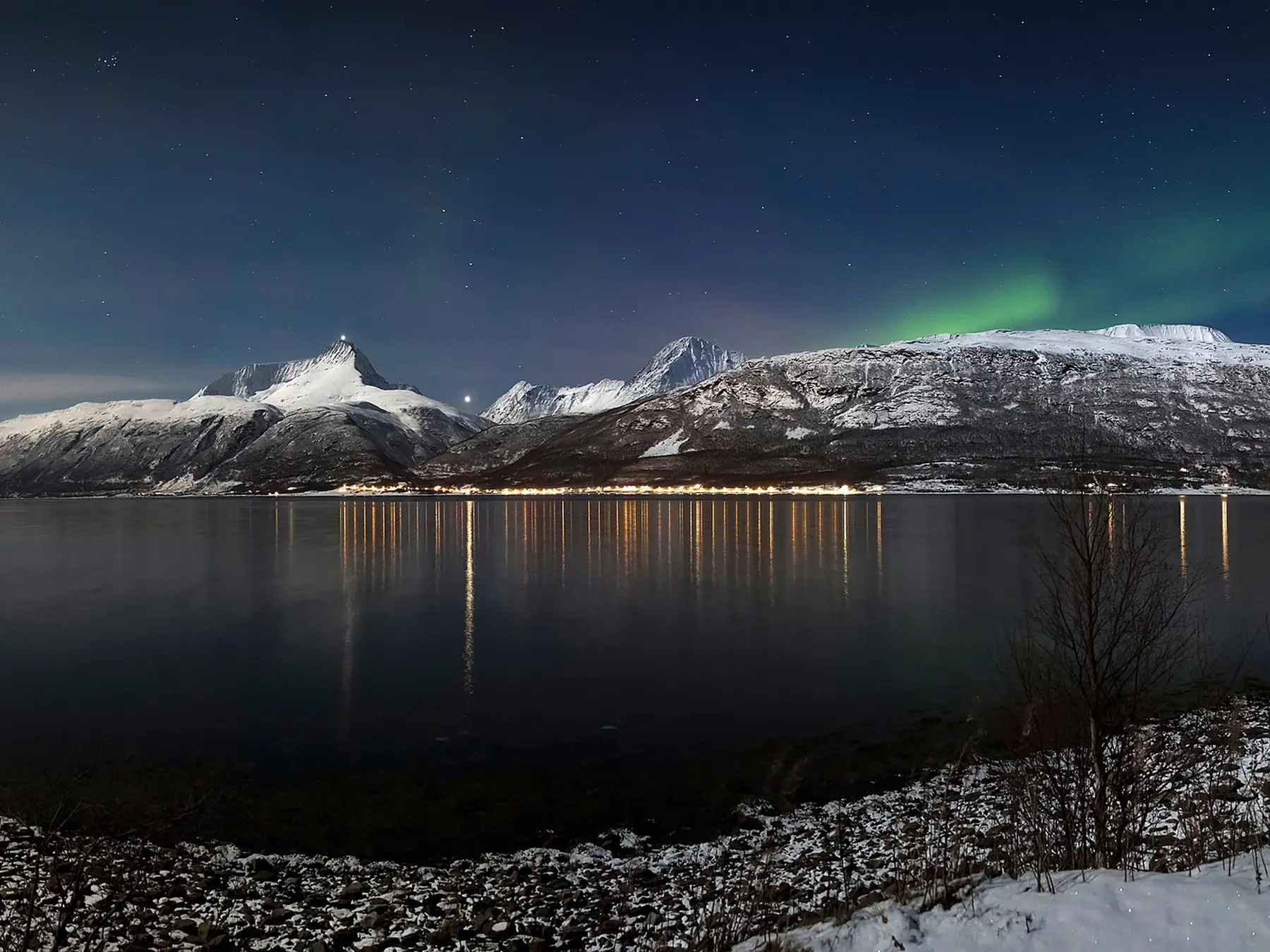
- The Sun constantly releases a stream of charged particles called the solar wind.
- The solar wind contains electrons and ions.
- Its speed and density change over time.
- Solar eruptions can send additional material and magnetic fields into space.
- Coronal mass ejections are enormous eruptions of plasma and magnetic field from the Sun.
- CMEs can travel toward Earth.
- Solar flares are intense bursts of electromagnetic radiation.
- Flares and CMEs are related but are not the same phenomenon.
- A flare’s light can reach Earth in about eight minutes.
- A CME usually takes much longer because matter travels far slower than light.
- High-speed solar-wind streams can emerge from coronal holes.
- They can also trigger geomagnetic activity.
- Earth’s magnetic field deflects much of the solar wind.
- Some energy enters the magnetosphere through magnetic interactions.
- Auroras are one beautiful consequence of a much larger Sun-Earth energy system.
Earth’s magnetosphere guides particles
- Earth is surrounded by a magnetic field.
- The solar wind compresses the field on the daytime side.
- It stretches the magnetosphere into a long tail on the night side.
- Magnetic-field lines guide charged-particle motion.
- Particles can become trapped in Earth’s magnetic environment.
- During geomagnetic activity, energy stored in the magnetotail can be released.
- Electrons accelerate toward the upper atmosphere.
- They follow magnetic-field lines toward high latitudes.
- This produces oval-shaped regions of frequent auroral activity around each magnetic pole.
- These regions are called auroral ovals.
- The magnetic poles are not exactly the same as the geographic poles.
- Auroral ovals therefore do not form perfect circles around 90 degrees north and south.
- During strong geomagnetic storms, the auroral oval expands toward lower latitudes.
- That is why rare major displays can appear over places that usually see auroras only occasionally.
- The lights move because magnetic and electrical conditions in near-Earth space are constantly changing.
Why auroras are green
- Aurora color depends on atmospheric gas, altitude, and energy.
- Atomic oxygen produces the most familiar green auroral light.
- Green oxygen emission commonly occurs around roughly 100 to 200 kilometers altitude.
- Human eyes are relatively sensitive to green light.
- That helps green dominate visual aurora observations.
- Atomic oxygen can also produce red aurora.
- Red oxygen emission becomes important at higher altitudes.
- Those thin upper regions allow excited oxygen atoms time to emit red light before collisions interrupt the process.
- Molecular nitrogen contributes blue and purple emissions.
- Mixed emissions can create pink edges.
- Cameras often capture colors more vividly than human eyes.
- Long exposures collect light over several seconds.
- A faint aurora may look grayish to the eye but green in a photograph.
- Bright auroras can show obvious color without a camera.
- The sky’s palette is an atmospheric spectroscopy experiment visible from the ground.
Auroras are incredibly high
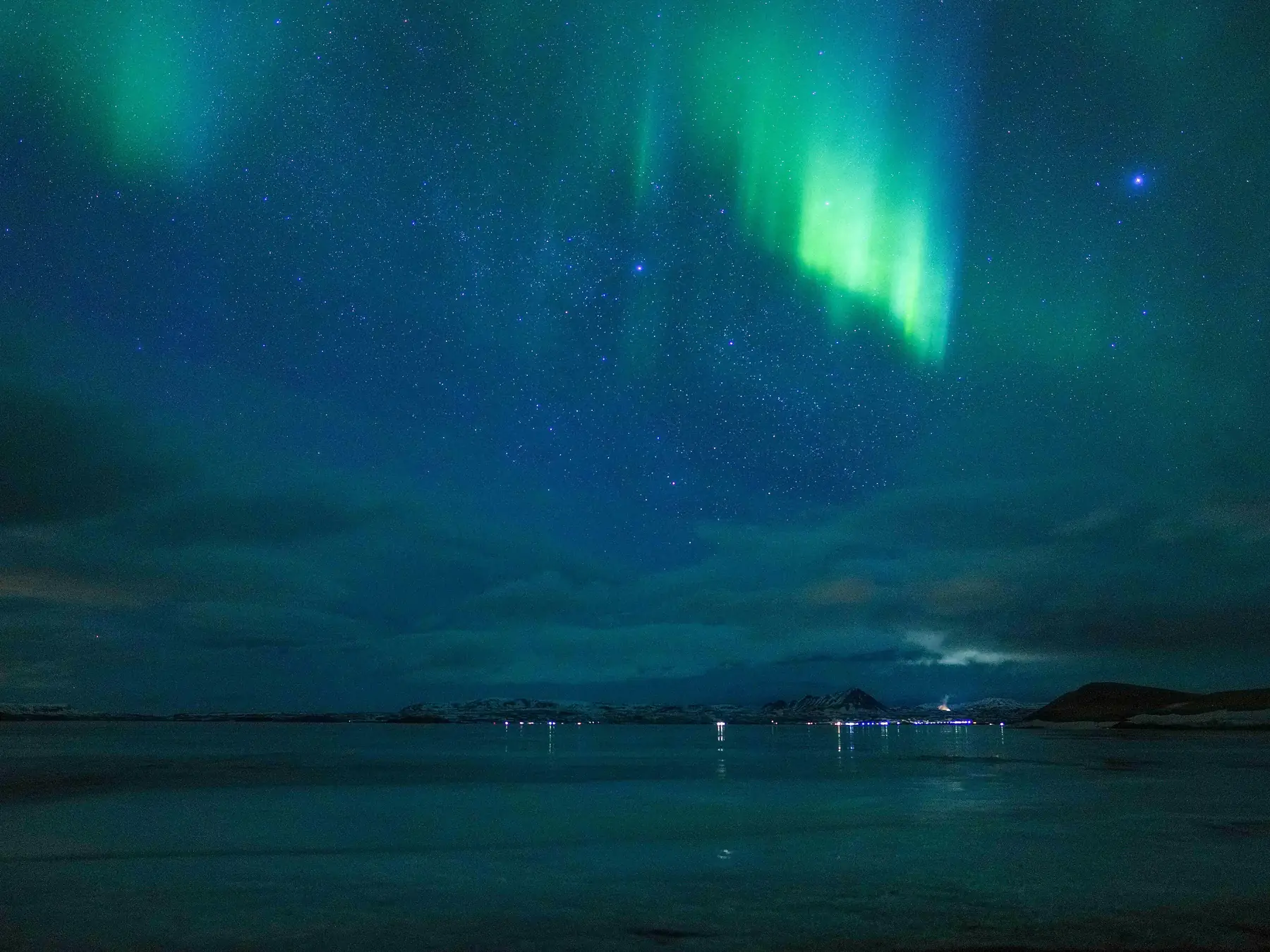
- Auroras occur in the thermosphere and upper atmosphere.
- Typical visible aurora can extend from around 80 kilometers to several hundred kilometers above Earth.
- The International Space Station orbits at roughly 400 kilometers altitude.
- Auroras can therefore occur below, near, or in some cases above parts of the ISS orbital altitude range.
- Astronauts have photographed auroras from space.
- From orbit, glowing auroral curtains can appear along Earth’s curved horizon.
- The lowest auroral emissions occur far above commercial airliner cruising altitude.
- Ordinary weather clouds stay mostly within the troposphere.
- That means clouds can block an aurora from your view even though the aurora itself is far above them.
- Mountain climbing does not bring a person meaningfully close to the lights.
- Even Mount Everest is tiny compared with auroral altitude.
- The upper atmosphere is extremely thin.
- Individual glowing atoms can be separated by large distances compared with sea-level air.
- The aurora can look like a nearby curtain while actually spanning hundreds or thousands of kilometers.
- Its apparent scale is difficult for human depth perception to judge against a dark sky.
Aurora forecasts are space-weather forecasts
- Scientists monitor the Sun for activity that could affect Earth.
- Spacecraft measure solar wind before it reaches the planet.
- NOAA’s Space Weather Prediction Center issues geomagnetic forecasts.
- The Kp index is one common measure of global geomagnetic activity.
- Kp ranges from 0 to 9.
- Higher Kp values generally indicate stronger geomagnetic disturbance.
- Kp is useful but does not guarantee what one person will see at one location.
- Cloud cover remains a completely separate weather problem.
- Moonlight can reduce contrast for faint auroras.
- Light pollution also makes weak aurora harder to see.
- Strong displays can remain visible even with some urban light.
- The orientation of the interplanetary magnetic field strongly affects energy transfer into Earth’s magnetosphere.
- A southward magnetic component is often favorable for geomagnetic activity.
- Forecast confidence improves as solar-wind structures approach Earth.
- Aurora hunting always contains uncertainty because both space weather and ordinary weather must cooperate.
Where to see the northern lights
- The best routine viewing occurs under the auroral oval.
- Northern Norway is a famous aurora destination.
- Swedish and Finnish Lapland also lie in favorable latitudes.
- Iceland often sees auroras.
- Greenland offers dark high-latitude skies.
- Alaska is one of the best U.S. viewing regions.
- Northern Canada lies under large portions of the auroral oval.
- Yellowknife is famous for frequent aurora viewing.
- Fairbanks is a major Alaska aurora destination.
- Clear inland climates can sometimes outperform cloudier coastal areas at similar latitude.
- September through March is a popular northern viewing season because nights are dark.
- Auroras occur in summer too.
- High-latitude summer skies can simply be too bright to see them.
- Strong geomagnetic storms can bring auroras much farther south.
- The best viewing location on any specific night is a combination of magnetic latitude, darkness, cloud cover, horizon visibility, and geomagnetic activity.
Do auroras make sound?
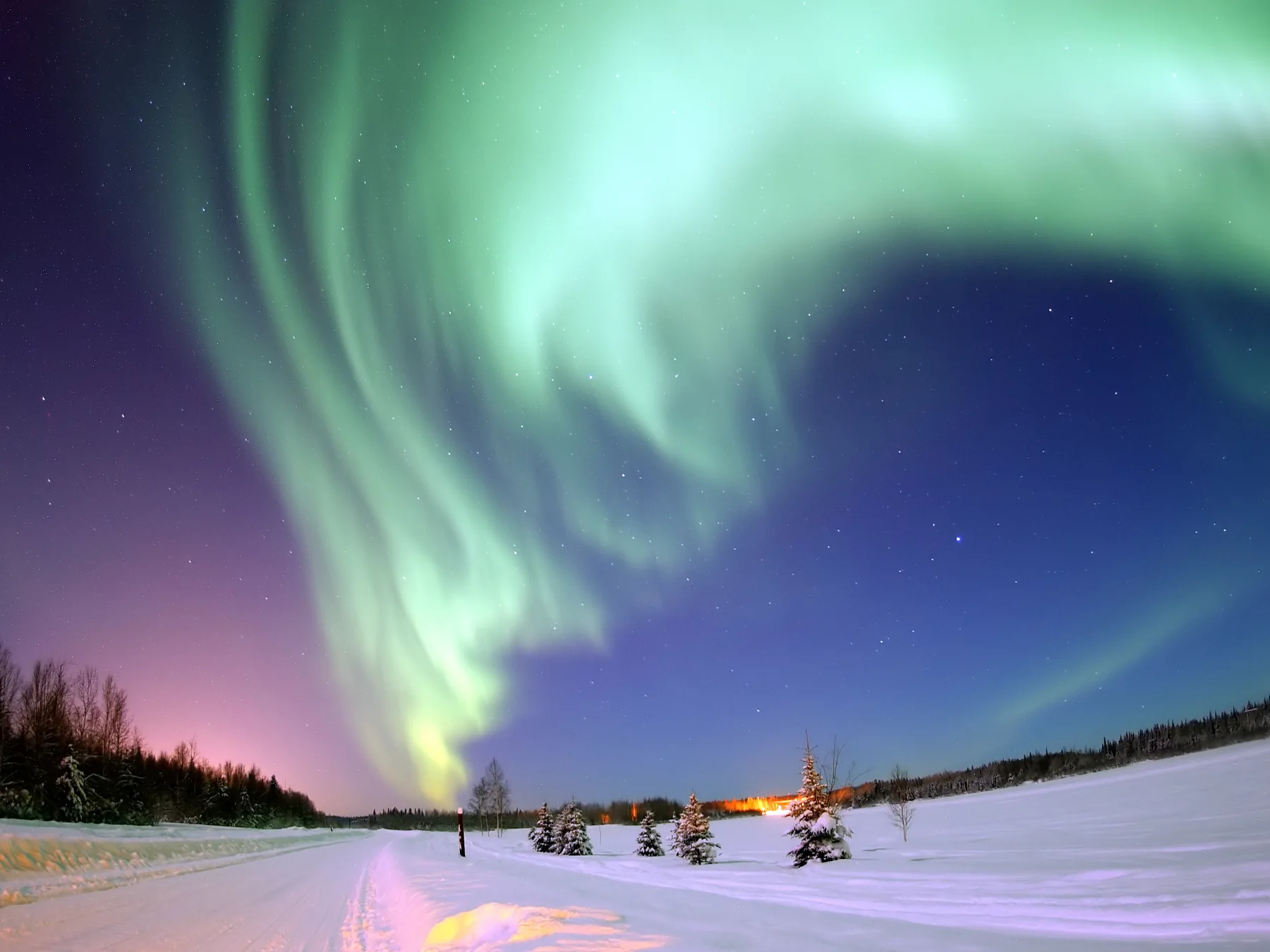
- People have reported hearing faint crackling or rustling during auroras for centuries.
- The glowing aurora itself is far too high for ordinary sound from it to reach the ground in sync with visible motion.
- Sound travels much more slowly than light.
- A noise created 100 kilometers high would arrive many minutes after the visible event.
- That makes direct sound from the glowing curtain an unlikely explanation for simultaneous reports.
- Researchers in Finland have investigated local sounds associated with strong geomagnetic conditions.
- One hypothesis involves electrical discharges in a temperature-inversion layer close to the ground.
- The phenomenon remains difficult to study.
- Not every reported aurora sound has been objectively recorded.
- Expectation and environmental noise can influence human perception.
- Scientific uncertainty does not mean every witness is lying.
- It means the mechanism and frequency are not fully established.
- Auroral light is well understood physically.
- Associated ground-level sound remains a more unusual research question.
- This is a good example of separating a confirmed atmospheric phenomenon from a fascinating but less settled detail.
Auroras happen on other planets
- Earth is not the only planet with auroras.
- Jupiter has spectacular auroral emissions.
- Its powerful magnetic field drives intense activity.
- Jupiter’s moons also influence its auroral system.
- Saturn has auroras around its poles.
- Ultraviolet instruments reveal emissions invisible to human eyes.
- Uranus has auroral activity.
- Neptune has magnetic interactions capable of auroral processes.
- Mars lacks a strong global magnetic field like Earth’s.
- It can still produce auroras associated with localized crustal magnetic fields and solar activity.
- Venus has aurora-like atmospheric emissions despite lacking an Earth-like global magnetic field.
- Auroras reveal interactions between atmospheres, magnetic fields, and space environments.
- A planet’s aurora can help scientists study magnetic-field geometry.
- Space telescopes observe auroras at wavelengths humans cannot see.
- The northern lights are therefore one local example of a phenomenon occurring across the solar system.
Ten surprising northern-lights facts
- Cold weather does not cause the northern lights.
- Green aurora is largely produced by excited atomic oxygen.
- Red aurora can come from the same element at different altitudes and conditions.
- The lights commonly occur around 100 kilometers or more above the ground.
- A mountain does not bring you significantly closer to them.
- Auroras happen in summer, but bright polar skies can hide them.
- The Kp index measures geomagnetic activity, not cloud cover.
- Strong solar storms can push visible auroras far toward lower latitudes.
- Other planets have auroras too.
- For more sky trivia, explore our rainbow facts and Science facts.
Quick northern-lights FAQ
What causes the northern lights?
Energetic charged particles guided by Earth’s magnetic field collide with atoms and molecules in the upper atmosphere, which release visible light.
Why are the northern lights green?
Green light is produced mainly by excited atomic oxygen at common auroral altitudes, and human eyes are particularly sensitive to green.
When is the best time to see auroras?
Dark seasons at high northern latitudes, often September through March, provide the best routine viewing, but actual displays depend on geomagnetic activity and clear skies.
Can auroras be predicted?
Space-weather forecasts can estimate geomagnetic activity and auroral extent, especially as solar wind approaches Earth, but local visibility still depends on clouds, darkness, and timing.
Can you see the northern lights from the United States?
Yes. Alaska sees them regularly, and major geomagnetic storms can make auroras visible across northern and sometimes much farther southern parts of the contiguous United States.

Ellie is the owner and sole author of Fun Facts, combining her mechanical engineering background with years of research-driven writing to deliver facts you can trust. Every article is thoroughly fact-checked and routinely updated as new science and sources emerge to keep information accurate and current. Her mission is to make learning delightful while upholding high standards of reliability and transparency.