
A rainbow is not a colored object hanging at one fixed place in the sky. It is an optical geometry that exists at a specific angle between sunlight, water droplets, and an observer, which means everyone technically sees a slightly different rainbow. The familiar seven-color arc is only part of the story: double rainbows reverse color order, circular rainbows exist, extra faint bands can appear, and moonlight can make rainbows too. These 145 rainbow facts explore refraction, reflection, dispersion, colors, angles, double bows, circular rainbows, moonbows, fogbows, supernumerary arcs, prisms, polarization, history, myths, and why you can never reach the end.
Rainbow basics
- A rainbow is an optical phenomenon involving light and water droplets.
- Sunlight enters a droplet and changes direction through refraction.
- Different wavelengths bend by slightly different amounts.
- This separates white light into colors.
- Light reflects from the back of the droplet.
- It refracts again as it leaves.
- Many droplets send different colors toward an observer at specific angles.
- A primary rainbow appears opposite the Sun.
- The Sun must therefore be behind the observer.
- Primary rainbows have red on the outer edge.
- Violet lies on the inner edge.
- A rainbow is not physically located at one fixed distance.
- Its appearance depends on the observer’s position.
- Two people standing apart receive light from different droplets.
- In that sense, each observer sees a slightly different rainbow.
Why rainbows are curved
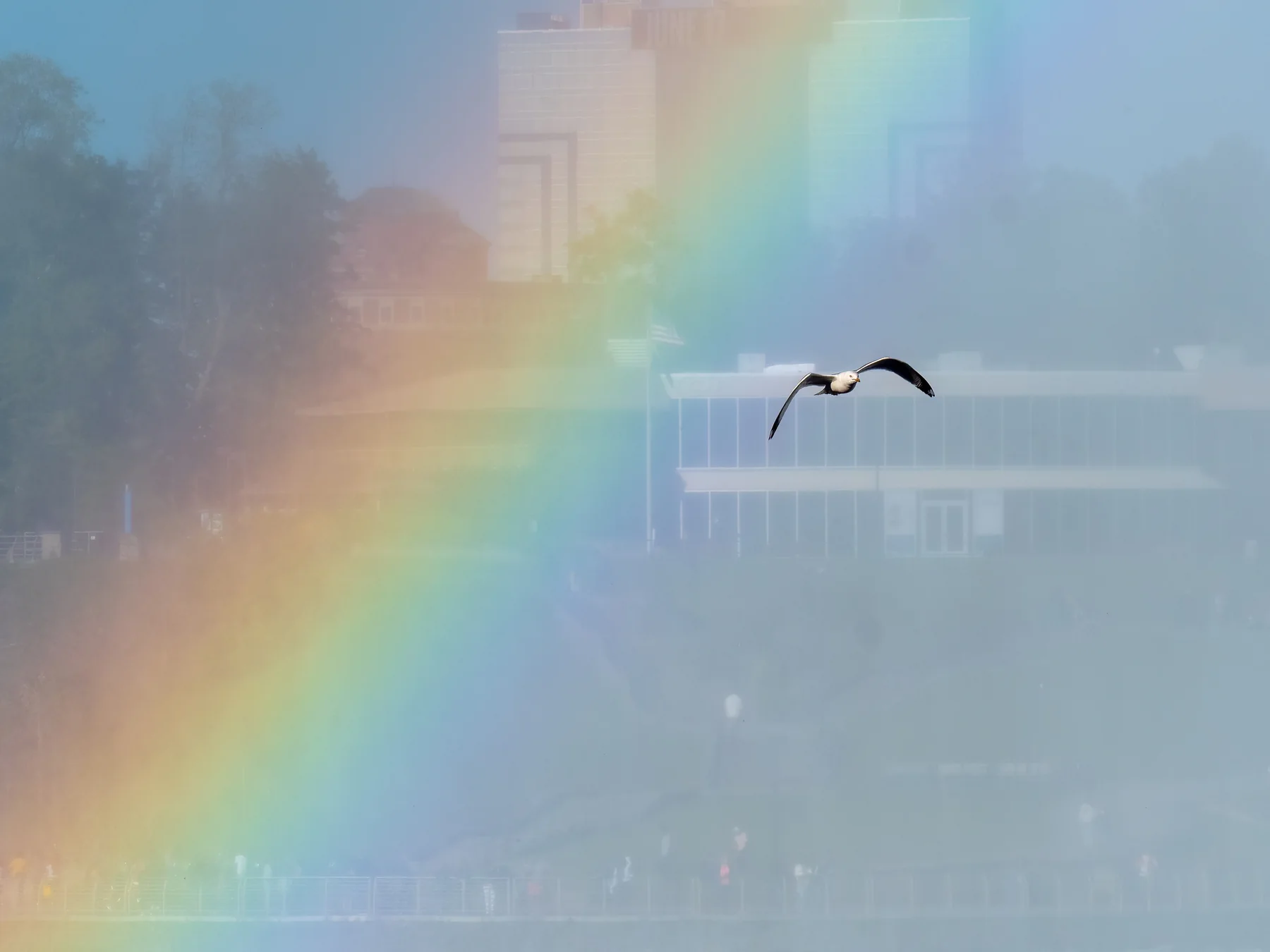
- A primary rainbow forms around an imaginary line extending from the Sun through the observer’s head.
- This direction is called the antisolar point.
- Red light in the primary bow reaches the eye near an angle of about 42 degrees from that point.
- Violet arrives at a slightly smaller angle.
- All droplets at the correct angular positions form a cone around the observer.
- The intersection of that cone with the distant field of view appears as a circle.
- From the ground, the horizon usually blocks the lower part.
- That is why most people see an arc rather than a complete circle.
- From an airplane or high mountain, a more complete circle can sometimes be visible.
- The observer’s shadow points roughly toward the rainbow’s center when the Sun is low.
- A rainbow becomes taller as the Sun gets lower.
- When the Sun is high, less of the rainbow rises above the horizon.
- If the Sun is more than about 42 degrees above the horizon, an ordinary primary rainbow’s center is too far below the horizon for the arc to appear above flat ground.
- Water spray below an observer can still reveal parts of the circle.
- The rainbow’s curve comes from geometry, not from a curved wall of rain.
Why white light becomes colors
- Visible sunlight contains a continuous range of wavelengths.
- Human vision interprets different wavelength mixtures as colors.
- Water’s refractive index changes slightly with wavelength.
- Shorter visible wavelengths generally bend more than longer ones.
- This wavelength-dependent bending is called dispersion.
- Red light bends less than violet light in water.
- A raindrop therefore separates incoming white light.
- Prisms separate light through the same broad principle of dispersion.
- Isaac Newton famously studied sunlight with prisms.
- He showed that a prism does not create color from nothing.
- The colors are already contained in white light.
- Newton used the word spectrum for the band of colors.
- He also recombined separated colors into white light.
- Rainbow color boundaries are not physically sharp lines.
- The familiar bands are human labels imposed on a continuous spectrum.
Why we say seven colors
- The common rainbow list is red, orange, yellow, green, blue, indigo, and violet.
- The acronym ROYGBIV helps English speakers remember that sequence.
- Nature does not divide the spectrum into exactly seven objective stripes.
- Color categories depend partly on human perception and language.
- Isaac Newton initially described fewer main color divisions.
- He later emphasized seven.
- Newton was interested in parallels between color and musical scales.
- Indigo became one of his seven named categories.
- Modern observers often find the distinction between blue and indigo less obvious than textbook diagrams suggest.
- Other languages divide color categories differently.
- A rainbow contains countless distinguishable wavelengths rather than seven kinds of photons.
- Human cone cells respond broadly to overlapping wavelength ranges.
- The brain constructs perceived color from those signals.
- Seven-color rainbow art is therefore a useful cultural model, not a literal map of seven separate physical bands.
- The spectrum is continuous even when a crayon box is not.
Double rainbows reverse the colors
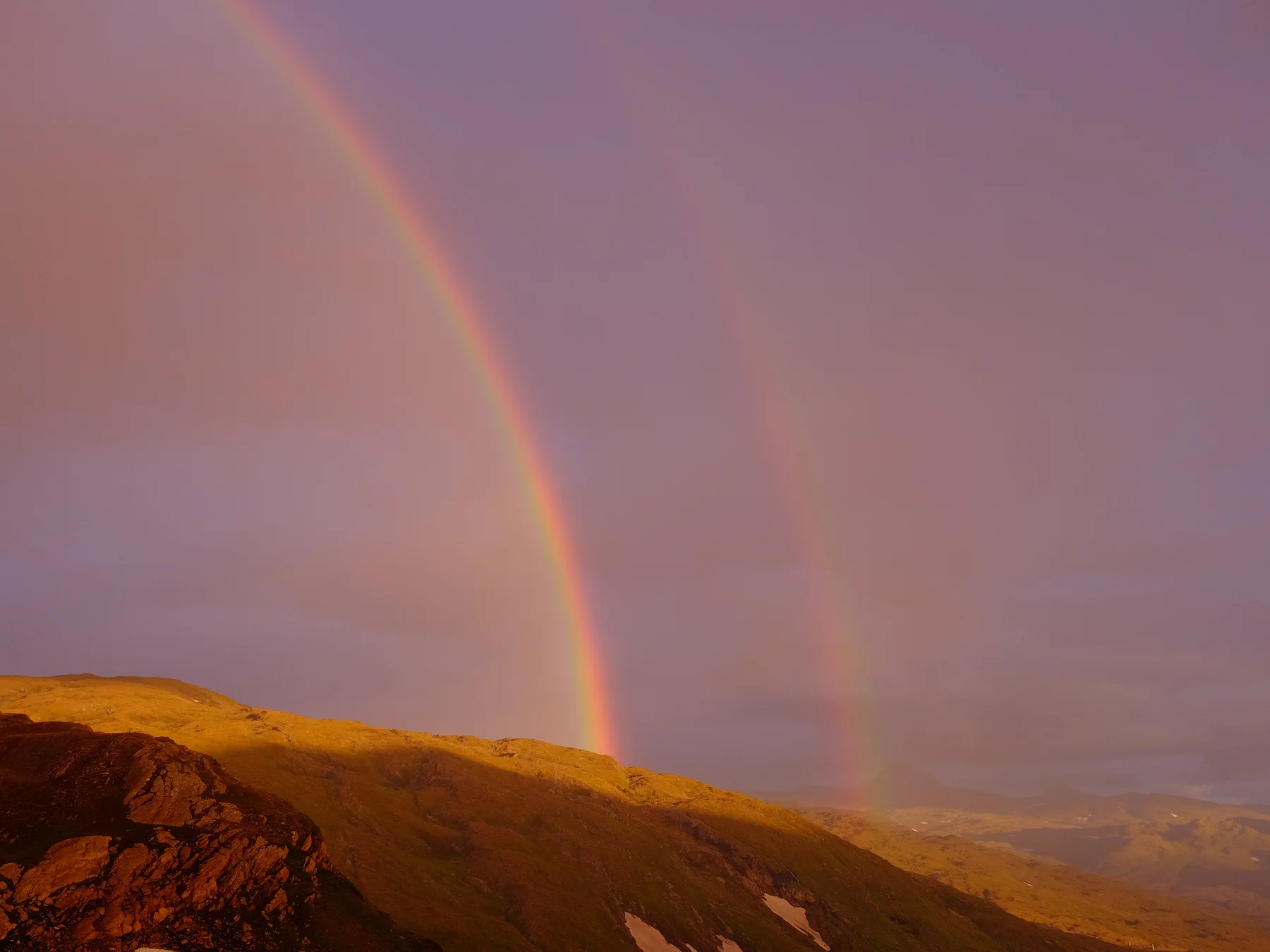
- A secondary rainbow can appear outside the primary bow.
- It forms when light reflects twice inside raindrops.
- The extra reflection makes the secondary bow fainter.
- Its colors appear in reverse order.
- Red lies on the inner edge of a secondary rainbow.
- Violet lies on the outer edge.
- The secondary bow appears at a larger angle than the primary.
- It is roughly centered around the same antisolar point.
- The sky between the two bows often looks darker.
- This region is called Alexander’s band.
- Its name honors Alexander of Aphrodisias, who described the dark region in antiquity.
- The darkness occurs because fewer internally reflected rays reach the observer from those angles.
- A secondary rainbow is not simply a reflection of the first in the sky.
- It is created by a different family of light paths inside droplets.
- Additional higher-order rainbows are physically possible but are much fainter and harder to observe.
Supernumerary rainbows reveal wave physics
- Faint extra colored bands sometimes appear just inside a primary rainbow.
- They are called supernumerary bows.
- Simple ray optics does not fully explain them.
- They arise from interference between light waves following slightly different paths.
- Constructive interference strengthens some colors.
- Destructive interference weakens others.
- Small similarly sized droplets make supernumerary bows easier to see.
- The bands can appear pinkish, greenish, or purple.
- Thomas Young used rainbow phenomena as evidence for the wave nature of light.
- Rainbows therefore helped scientists understand both ray optics and wave optics.
- Droplet size affects how sharp the colors look.
- Large raindrops can produce vivid saturated bows.
- Very small droplets blur colors together.
- The rainbow’s exact appearance contains information about the water droplets producing it.
- A faint extra stripe can reveal quantum-era wave behavior through an everyday sky phenomenon.
Fogbows can look almost white
- A fogbow forms in tiny water droplets suspended in fog.
- It uses the same broad geometry as a rainbow.
- Fog droplets are much smaller than ordinary raindrops.
- Diffraction spreads the colors strongly.
- The color bands overlap.
- Fogbows therefore often appear white or very pale.
- They are sometimes called white rainbows.
- A faint red outer edge can appear.
- Blue may appear toward the inside.
- Fogbows can be seen from mountains, ships, or aircraft.
- They appear opposite the Sun like ordinary rainbows.
- Cloudbows are related phenomena produced by tiny cloud droplets.
- A glory is a different colored ring phenomenon often seen around an observer’s shadow on clouds.
- Glories involve wave effects including diffraction and backscattering.
- The sky contains multiple circular optical effects that casual observers may incorrectly call rainbows.
Moonbows are real
- A moonbow is a rainbow created by moonlight.
- Moonlight is reflected sunlight.
- It therefore contains the wavelengths needed to form a rainbow.
- Moonbows require water droplets opposite the Moon.
- A bright Moon helps.
- Full or nearly full Moon conditions are most favorable.
- Dark skies are also important.
- Moonbows are much fainter than daytime rainbows.
- Human night vision often sees them as white or gray.
- Cameras can reveal their colors more clearly.
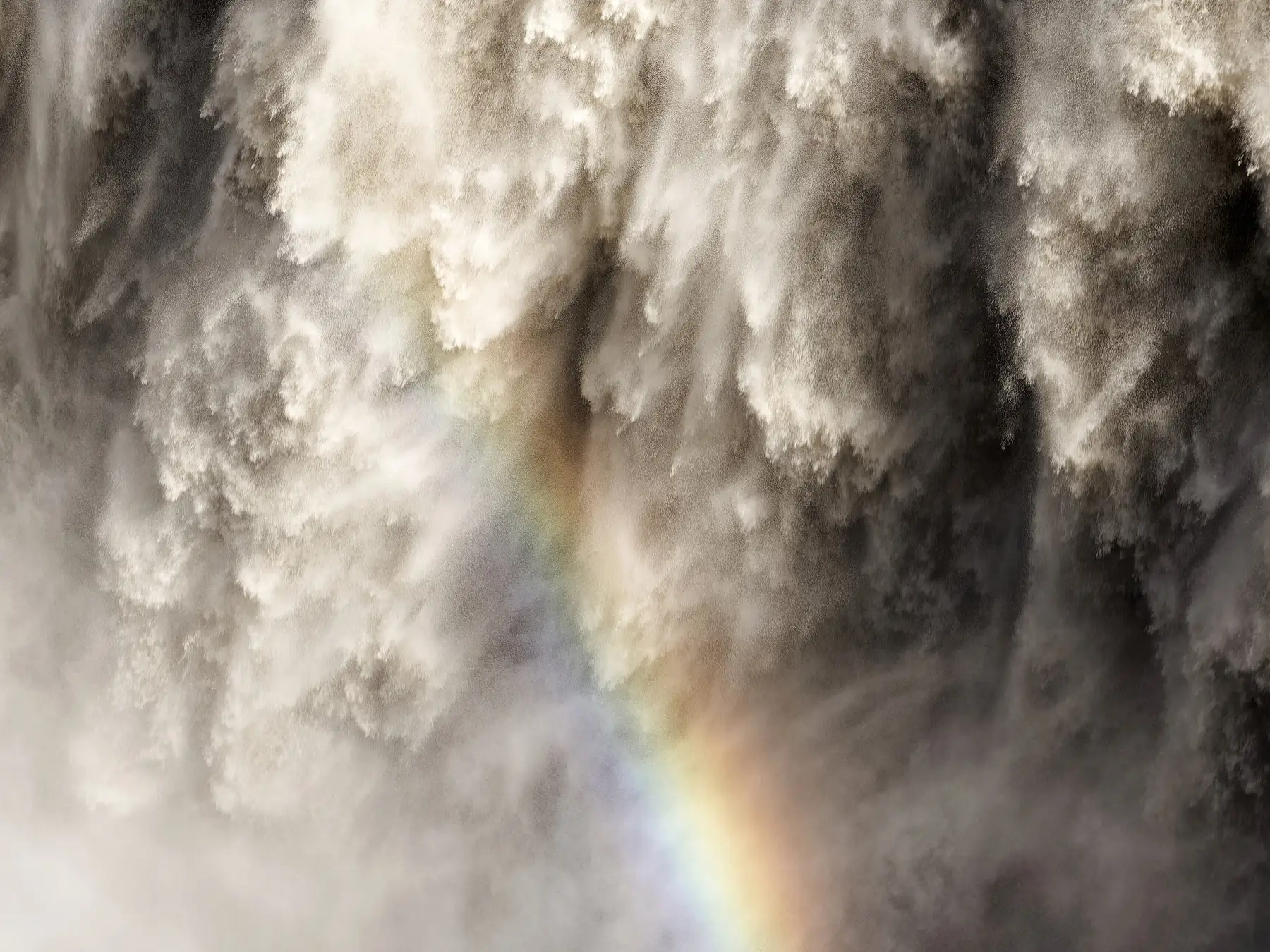
- Waterfalls can create reliable spray for moonbows.
- Yosemite Falls is famous for seasonal moonbows.
- Victoria Falls is another well-known location.
- A lunar rainbow obeys the same basic optical laws as a solar rainbow.
- The main difference is that the light source is dramatically dimmer.
Rainbows are polarized
- Rainbow light is strongly polarized.
- Polarization describes the orientation of light’s electric-field oscillation.
- Reflection and refraction inside droplets favor particular polarization directions.
- Polarizing sunglasses can therefore change how bright a rainbow appears.
- Rotating a polarizing filter can make parts of a rainbow fade.
- Photographers use polarizers carefully.
- A polarizer can increase contrast in some orientations.
- It can also accidentally remove much of the bow.
- Rainbows can appear in sprinkler spray.
- Garden hoses can create them too.
- Waterfalls produce excellent artificial rainbow conditions.
- Fountains can form complete arcs or circles from the right viewpoint.
- Small glass beads in road signs and retroreflective materials can create rainbow-like effects through different optical paths.
- Not every colored arc is a true water-droplet rainbow.
- Optical identification depends on geometry, light source, droplet size, and color ordering.
Ten surprising rainbow facts
- Every observer technically sees a different rainbow made from different droplets.
- A rainbow is a full circle, but the ground usually hides the lower portion.
- You can never physically reach the end because the rainbow moves with your viewing geometry.
- Double rainbows reverse the color order.
- The dark region between two bows has its own name: Alexander’s band.
- The spectrum is continuous rather than divided into exactly seven physical stripes.
- Supernumerary bows are evidence of light-wave interference.
- Fogbows can look nearly white.
- Moonlight can create genuine rainbows.
- For more weather trivia, explore our upcoming lightning and cloud guides and Science facts.

Quick rainbow FAQ
What causes a rainbow?
Sunlight is refracted, dispersed, internally reflected, and refracted again inside water droplets, sending different colors toward an observer at different angles.
Why are rainbows curved?
Light reaches the observer from droplets lying at a particular angle around the antisolar point, creating a cone whose visible cross-section is circular.
Can a rainbow be a full circle?
Yes. From high viewpoints such as aircraft, observers can sometimes see much or all of the circular bow.
Why are double-rainbow colors reversed?
The secondary bow involves two internal reflections inside each droplet, which reverses the angular color ordering relative to the primary bow.
Can you reach the end of a rainbow?
No. A rainbow is defined by the angle between the light source, droplets, and your eyes, so its apparent position changes as you move.

Ellie is the owner and sole author of Fun Facts, combining her mechanical engineering background with years of research-driven writing to deliver facts you can trust. Every article is thoroughly fact-checked and routinely updated as new science and sources emerge to keep information accurate and current. Her mission is to make learning delightful while upholding high standards of reliability and transparency.