
Raccoons look like tiny burglars because evolution accidentally gave them masks, dexterous hands, excellent climbing skills, and the confidence to investigate anything with a lid. They are smarter, more adaptable, and more ecologically complicated than the “trash panda” nickname suggests, although the nickname remains extremely difficult to improve upon.
Raccoon basics behind the famous mask
- The common raccoon's scientific name is Procyon lotor.
- Common raccoons are native to North America.
- Their natural range extends through southern Canada, the United States, Mexico, and parts of Central America.
- Humans introduced raccoons to parts of Europe and Asia.
- They are members of the family Procyonidae.
- Coatis, kinkajous, and ringtails are among their relatives.
- Raccoons are not rodents.
- They are also not closely related to giant pandas despite the trash-panda nickname.
- The black facial markings help create their bandit-mask appearance.
- The mask may reduce glare around the eyes and improve visual contrast, although its exact evolutionary advantages are difficult to prove.
- A raccoon's tail usually has several dark rings.
- Tail patterns vary among individuals.
- Adults commonly weigh roughly 10 to 30 pounds, but size varies substantially.
- Northern raccoons tend to be larger than animals from warmer regions.
- Males are generally larger than females.
- Raccoons walk on the soles of their feet, a posture called plantigrade.
- Humans and bears are also plantigrade.
- Raccoons can stand briefly on their hind legs to inspect surroundings.
- They can run surprisingly fast for such round-looking animals.
- The body shape says “stuffed animal,” while the feet say “I have already opened your cooler.”
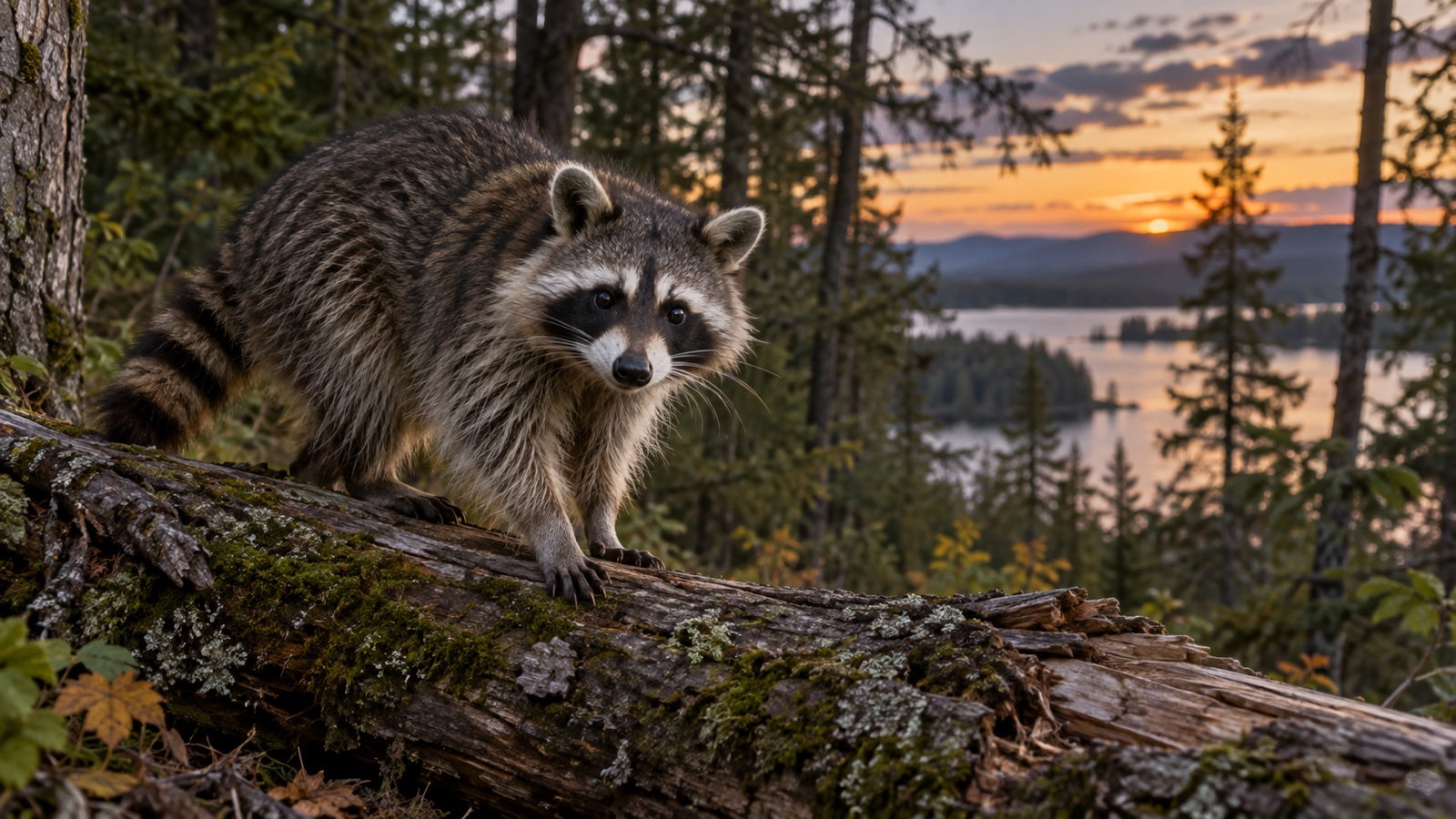
Their front paws are astonishingly sensitive
- Raccoons have five long toes on each front paw.
- Their front paws can grasp, rotate, and manipulate objects with impressive precision.
- They do not have truly opposable thumbs.
- The lack of opposable thumbs has not prevented them from defeating many garbage-can designs.
- Touch is one of a raccoon's most important senses.
- The front paws contain dense sensory receptors.
- Wet skin can increase the sensitivity of those receptors.
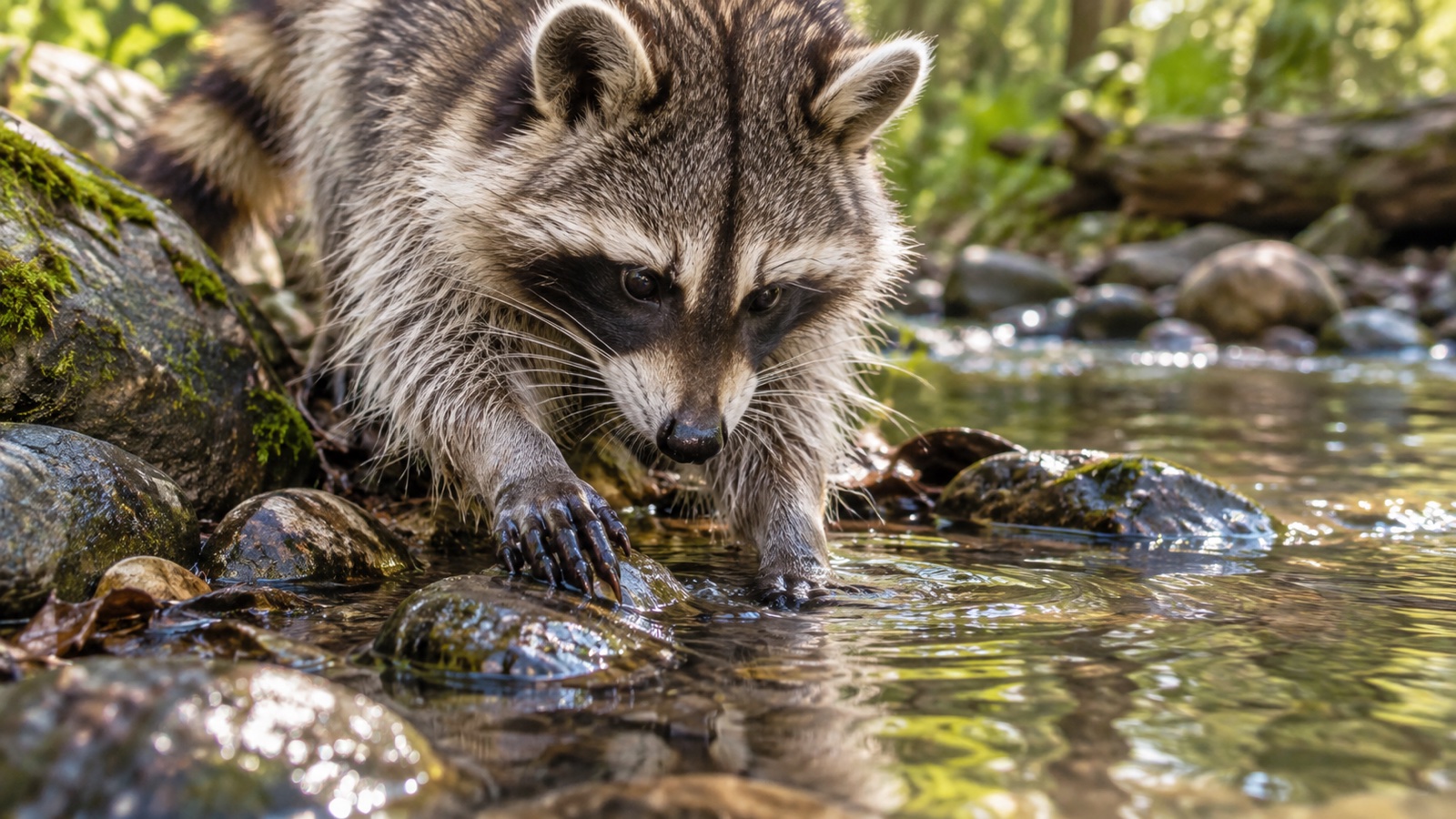
- This may help explain why raccoons often manipulate food in water.
- They are not actually washing food for cleanliness in the human sense.
- The species name lotor comes from a Latin word associated with washing.
- Older observations of captive raccoons helped popularize the “food washing” idea.
- Raccoons can identify objects largely through touch.
- They can feel for aquatic prey beneath water or mud.
- Long fingers help them search inside holes and crevices.
- Their claws are not retractable like a cat's claws.
- Sharp curved claws make raccoons excellent climbers.
- They can descend tree trunks headfirst.
- Raccoons rotate their hind feet to help control headfirst descents.
- They can open simple latches and containers after learning how they work.
- If a raccoon fails a puzzle, the safest assumption is that it has not finished testing the hinges yet.
Raccoons are flexible omnivores, not dedicated garbage eaters
- Raccoons are omnivores.
- Their natural diet changes with season and habitat.
- They eat fruits, nuts, seeds, insects, worms, crayfish, frogs, eggs, and small animals.
- They may eat fish or other aquatic prey when available.
- Acorns can become important autumn foods.
- Corn and other crops may attract raccoons to farms.
- Bird nests can be vulnerable to raccoon predation.
- Turtle and reptile nests can also be raided.
- Raccoons often forage along streams and wetlands.
- They use both smell and touch to locate food.
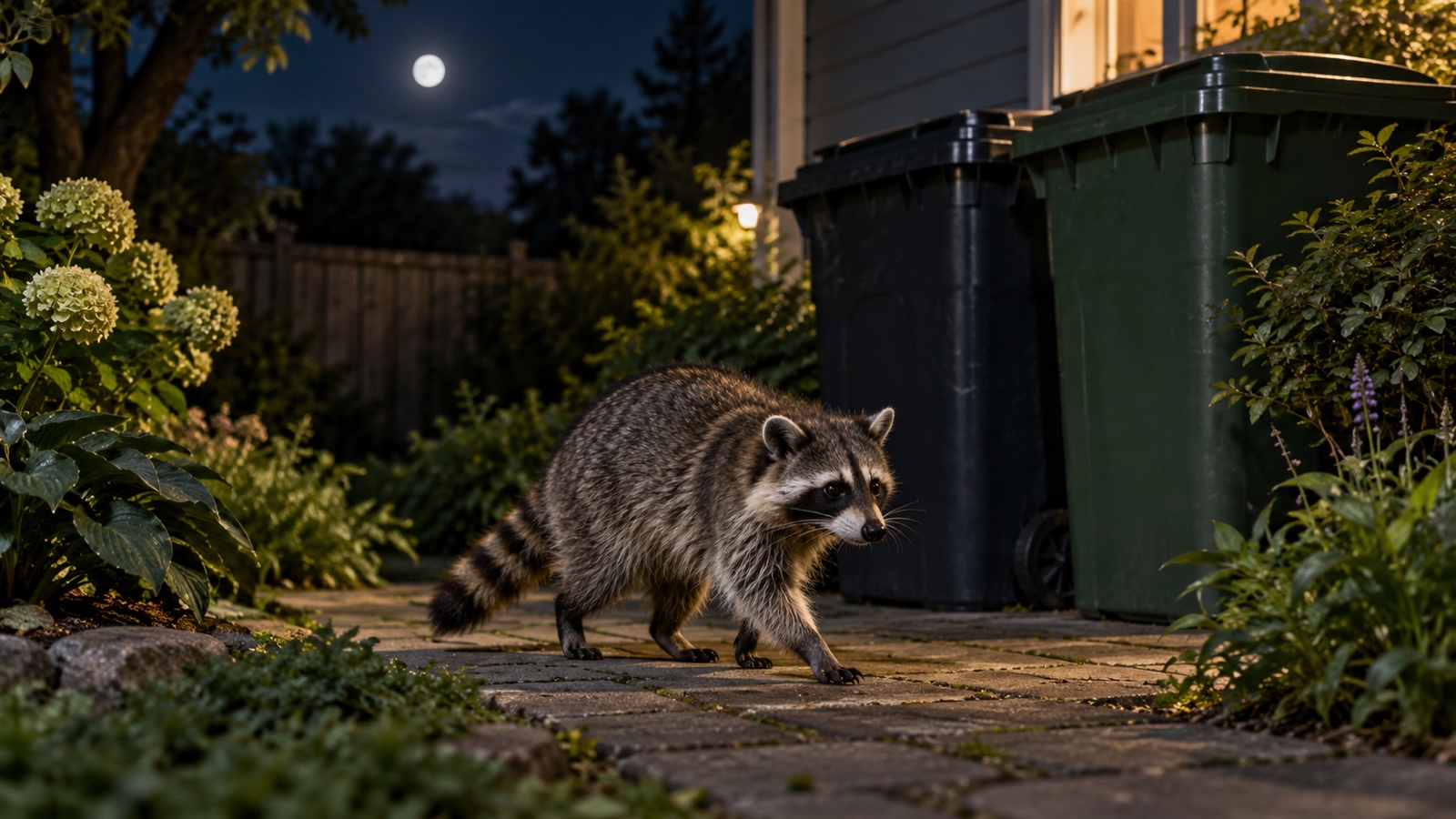
- Urban raccoons exploit pet food, compost, unsecured trash, and outdoor leftovers.
- Garbage is an opportunistic food source rather than the species' original ecological niche.
- Feeding wild raccoons intentionally can cause problems.
- Regular feeding can make animals lose caution around people.
- Artificial food concentrations can also increase disease transmission among raccoons.
- Pet food left outdoors can attract raccoons overnight.
- Bird feeders can attract raccoons directly or through spilled seed.
- Secure lids and enclosed compost reduce easy urban food rewards.
- Raccoons remember profitable feeding locations.
- A raccoon returning to your trash can is not holding a grudge; it is revisiting a restaurant with extremely relaxed closing procedures.
Cities turned out to be excellent raccoon habitat
Raccoons did not evolve for dumpsters, chimneys, storm drains, and suburban decks, but cities accidentally provide several things they already wanted: shelter, water, food, trees, den cavities, and fewer large predators. Their success is less “urban animal” than “forest generalist noticed our infrastructure has snacks.”
- Raccoons adapt unusually well to urban and suburban environments.
- They may den in attics, chimneys, crawl spaces, sheds, storm drains, and hollow trees.
- Chimneys can resemble the hollow tree cavities raccoons naturally use.
- Females may select quiet human structures as maternity dens.
- Raccoons are mostly nocturnal in many areas.
- Seeing a raccoon in daytime does not automatically mean it has rabies.
- Nursing females may forage during daylight because raising young increases food demands.
- Animals disturbed from dens may also appear in daylight.
- Urban raccoons often have smaller home ranges than rural raccoons because food is concentrated.
- Individual home ranges can overlap.
- Raccoons frequently follow fences, tree lines, waterways, and other travel corridors.
- They can swim well.
- Storm drains and creeks can function like hidden urban highways.
- Road traffic is a major cause of raccoon mortality.
- Domestic dogs can injure or kill raccoons.
- Raccoons may defend themselves fiercely if cornered.
- Keeping dogs leashed around wildlife reduces conflict.
- Wildlife-proofing a house is safer than trying to remove animals repeatedly.
- One-way exclusion systems can let animals leave structures, but timing matters when dependent young may be inside.
- The raccoon lesson of suburban ecology is simple: if we build hollow spaces and leave food outside, somebody will eventually move in.
Mothers raise kits in sheltered dens
- Raccoon mating usually occurs during winter or early spring in much of their range.
- Pregnancy lasts roughly two months.
- A typical litter contains several young.
- Baby raccoons are called kits or cubs.
- Kits are born with their eyes closed.
- They depend completely on their mother at first.
- Male raccoons generally do not help raise the litter.
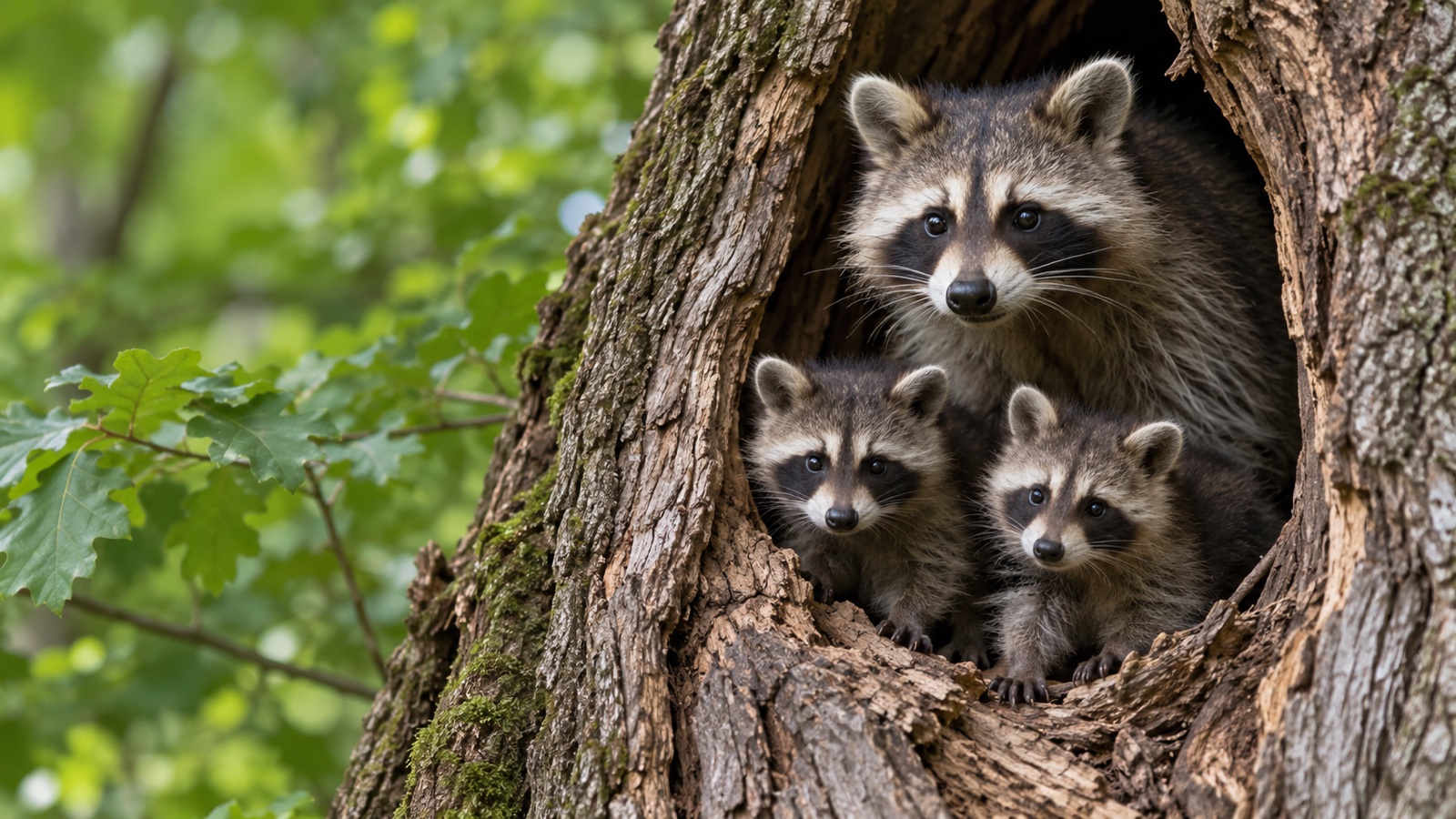
- The mother keeps young in a protected den.
- Tree cavities are natural den sites.
- Rock crevices, logs, and abandoned burrows can also be used.
- Urban mothers may use chimneys or attics.
- Kits begin exploring outside the den as they grow.
- Young raccoons follow their mother on foraging trips.
- They learn routes, foods, hazards, and foraging techniques through experience.
- Family groups may remain together through much of the young raccoons' first year.
- Young eventually disperse and establish their own ranges.
- Males often disperse farther than females.
- Female relatives may occupy neighboring areas.
- Wild raccoons can live several years, though many die young from roads, disease, predation, or conflict.
- A row of baby raccoons following their mother looks adorable because the photo does not include the part where everyone learns which garbage lid opens easiest.
Raccoons are intelligent, vocal and more social than they look
Older descriptions often treated raccoons as mostly solitary, but modern observations show a more flexible social life. Females may tolerate relatives, males can form loose associations, and individuals communicate with vocalizations, scent, posture, and a surprising amount of nighttime negotiation.
- Raccoons can solve simple mechanical problems.
- They can remember solutions for long periods.
- Captive studies have shown strong learning and discrimination abilities.
- Urban environments may reward individuals that explore new objects successfully.
- Raccoons produce a variety of vocal sounds.
- Sounds include growls, hisses, chirps, whistles, squeals, and purr-like noises.
- Mothers and kits use vocal communication.
- Scent marking also communicates information.
- Raccoons have well-developed smell.
- Their hearing can detect subtle sounds from prey and other animals.
- Night vision is useful, but raccoons do not see perfectly in total darkness.
- Whiskers provide additional tactile information.
- Raccoons sometimes use communal resting or denning sites.
- Adult males can form loose social groups in some populations.
- Female home ranges may overlap strongly with daughters or relatives.
- Social behavior varies with food, density, habitat, sex, and season.
- Raccoons can habituate to predictable human activity.
- Habituation does not make a wild raccoon domesticated.
- Trying to keep a wild raccoon as a pet creates welfare, legal, safety, and disease problems.
- The difference between “smart enough to live near humans” and “should live in a human house” is several scratched cabinets and one veterinarian bill.
Safety, ecology and 25 final raccoon facts
- Raccoons can carry rabies in parts of North America.
- Rabies prevalence varies greatly by region.
- Most raccoons encountered by people are not rabid.
- Any wild mammal acting abnormally should be given space and reported when appropriate.
- Rabies exposure requires prompt medical guidance because the disease is almost always fatal after symptoms begin.
- Raccoons can carry the roundworm Baylisascaris procyonis.
- Roundworm eggs can be shed in raccoon feces.
- Old raccoon latrines can remain contaminated for long periods.
- People should avoid bare-handed cleanup of raccoon feces.
- Local health or wildlife guidance is useful for safe latrine cleanup.
- Canine distemper can infect raccoons.
- Distemper can cause neurologic symptoms that may resemble rabies to an observer.
- Raccoons also carry ticks, fleas, and other parasites.
- Predators of raccoons include coyotes, bobcats, large owls, and other carnivores depending on region and age.
- Raccoons themselves influence ecosystems by eating fruits, invertebrates, eggs, and small animals.
- They can disperse seeds after eating fruit.
- High raccoon numbers can increase pressure on vulnerable nesting species.
- On islands or in introduced ranges, raccoons can become harmful invasive predators.
- Germany and Japan are among places with introduced raccoon populations.
- Some introduced populations began through escapes or intentional releases.
- Cold-climate raccoons do not truly hibernate.
- They may stay denned for days during severe winter weather and live partly on stored body fat.
- Raccoons can gain substantial weight before winter in northern areas.
- Their famous mask may make every individual look guilty, but most raccoon behavior is simply normal wildlife adapting brilliantly to whatever humans leave available.
- After 145 facts, the trash panda nickname feels affectionate but incomplete: raccoons are tactile specialists, climbers, swimmers, problem-solvers, mothers, predators, prey, seed dispersers, disease hosts, and some of North America's best urban opportunists.
Quick FAQ
Q: Do raccoons really wash their food?
A: Not for cleanliness the way humans wash food. Wetting and manipulating objects can increase tactile feedback through their extremely sensitive front paws.
Q: Does a raccoon seen during the day have rabies?
A: Not necessarily. Healthy raccoons can be active during daylight, especially nursing mothers. Abnormal behavior is more important than time of day alone.
Q: Are raccoons rodents?
A: No. Raccoons belong to the carnivore order and the family Procyonidae.
Q: Are raccoons smart?
A: Yes. They learn, remember problem-solving strategies, manipulate objects skillfully, and adapt extremely well to changing environments.
Q: Should I feed wild raccoons?
A: No. Feeding can increase habituation, crowding, disease transmission, property conflict, and risk to both raccoons and people.

Ellie is the owner and sole author of Fun Facts, combining her mechanical engineering background with years of research-driven writing to deliver facts you can trust. Every article is thoroughly fact-checked and routinely updated as new science and sources emerge to keep information accurate and current. Her mission is to make learning delightful while upholding high standards of reliability and transparency.