
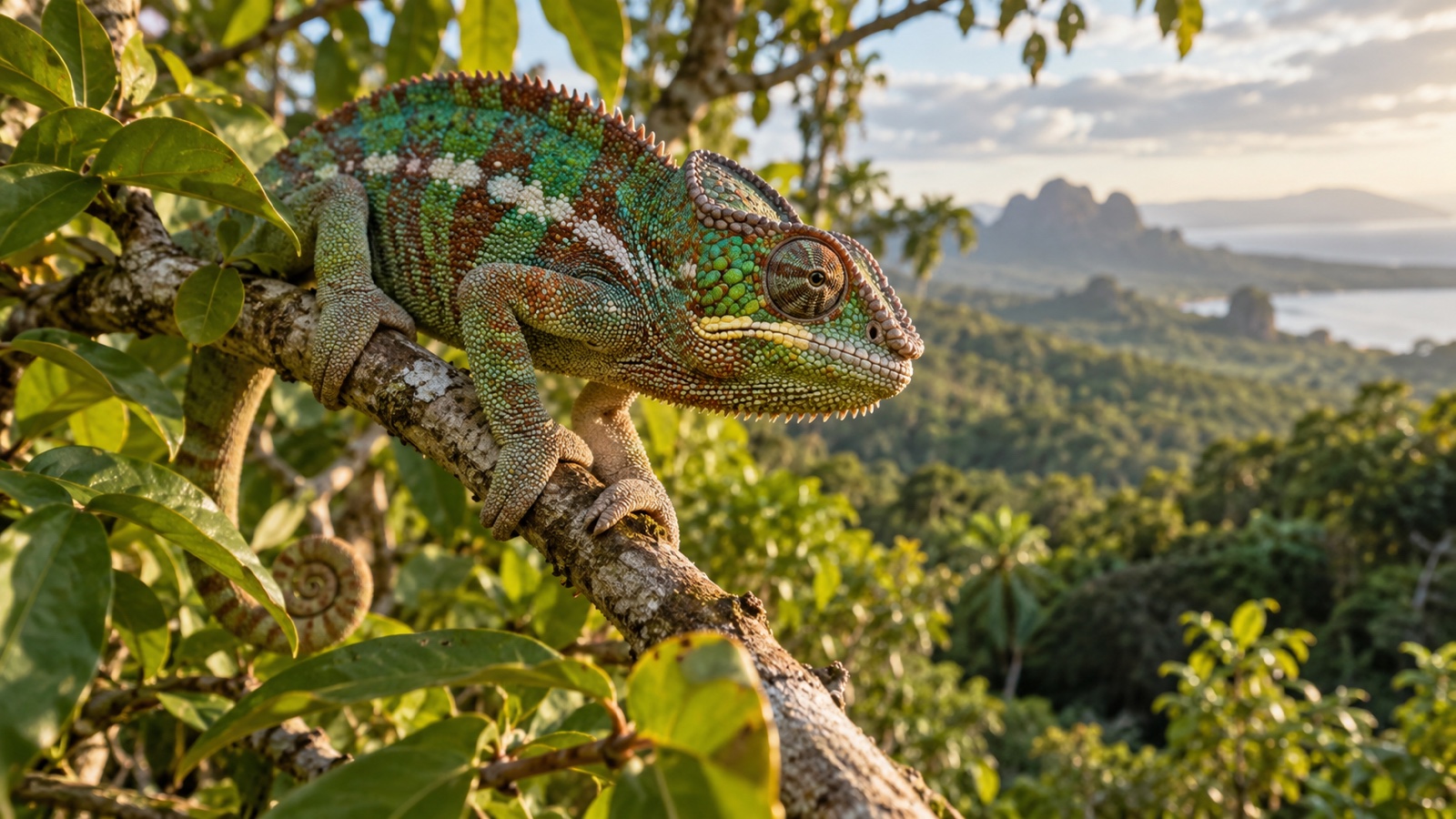
Chameleons are famous for changing color, but that trick is almost the least interesting thing about them. Their eyes scan independently, toes grip branches like tongs, tails coil around perches, tongues launch farther than the body, and tiny species can fit on a fingertip while larger relatives look like miniature dragons.
Chameleons are specialized lizards, not magical camouflage machines
- Chameleons belong to the lizard family Chamaeleonidae.
- More than 200 living chameleon species are recognized.
- Species numbers continue changing as researchers describe and reclassify populations.
- Most chameleon diversity occurs in Africa and Madagascar.
- Madagascar is home to an extraordinary number of chameleon species.
- Chameleons also occur naturally in parts of southern Europe, the Middle East, India, Sri Lanka, and nearby regions.
- Humans have introduced some chameleon species outside their native ranges.
- Veiled chameleons have established introduced populations in places including Florida and Hawaii.
- Chameleons are reptiles.
- They are not amphibians.
- They are not closely related to geckos simply because both are popular pet lizards.
- Most chameleons spend much of their lives in shrubs or trees.
- Some small species live close to the forest floor.
- Body size varies enormously across the family.
- Some Brookesia species are among the smallest known reptiles.
- Large chameleons can exceed a foot in body length when the tail is included.
- Many species have crests, horns, casques, or other dramatic head structures.
- Males are often more ornamented than females.
- Chameleon shape is strongly adapted to slow, deliberate movement through vegetation.
- They look like tiny dragons because apparently normal lizard styling was not ambitious enough.
Color change is mostly about communication and physiology
- Chameleons do change color.
- They do not usually match every background perfectly.
- Color change can communicate social status.
- Males often become brighter when displaying to rivals or potential mates.
- Females of some species change coloration when receptive to mating.
- Females can also display colors that signal nonreceptive or gravid status.
- Temperature influences chameleon coloration.
- Darker colors can help absorb more solar heat.
- Lighter colors can reduce heat absorption.
- Stress can cause dramatic color shifts.
- Sleep can produce different nighttime colors from daytime appearance.
- Hormones and nervous-system signals influence the process.
- Specialized skin cells called chromatophores contain pigments.
- Another layer contains iridophores with microscopic reflective structures.
- Changes in iridophore structure alter which wavelengths of light are reflected.
- This structural mechanism contributes to rapid shifts in greens, blues, yellows, and other colors.
- Pigment movement in other skin cells adds additional color effects.
- Different chameleon species have different color-changing abilities.
- A brown species cannot simply decide to become neon purple because it sat beside a purple flower.
- The famous camouflage story is real in a broad sense, but chameleon color is closer to a mood board, thermostat, and billboard sharing the same skin.
Their eyes can look in two directions at once
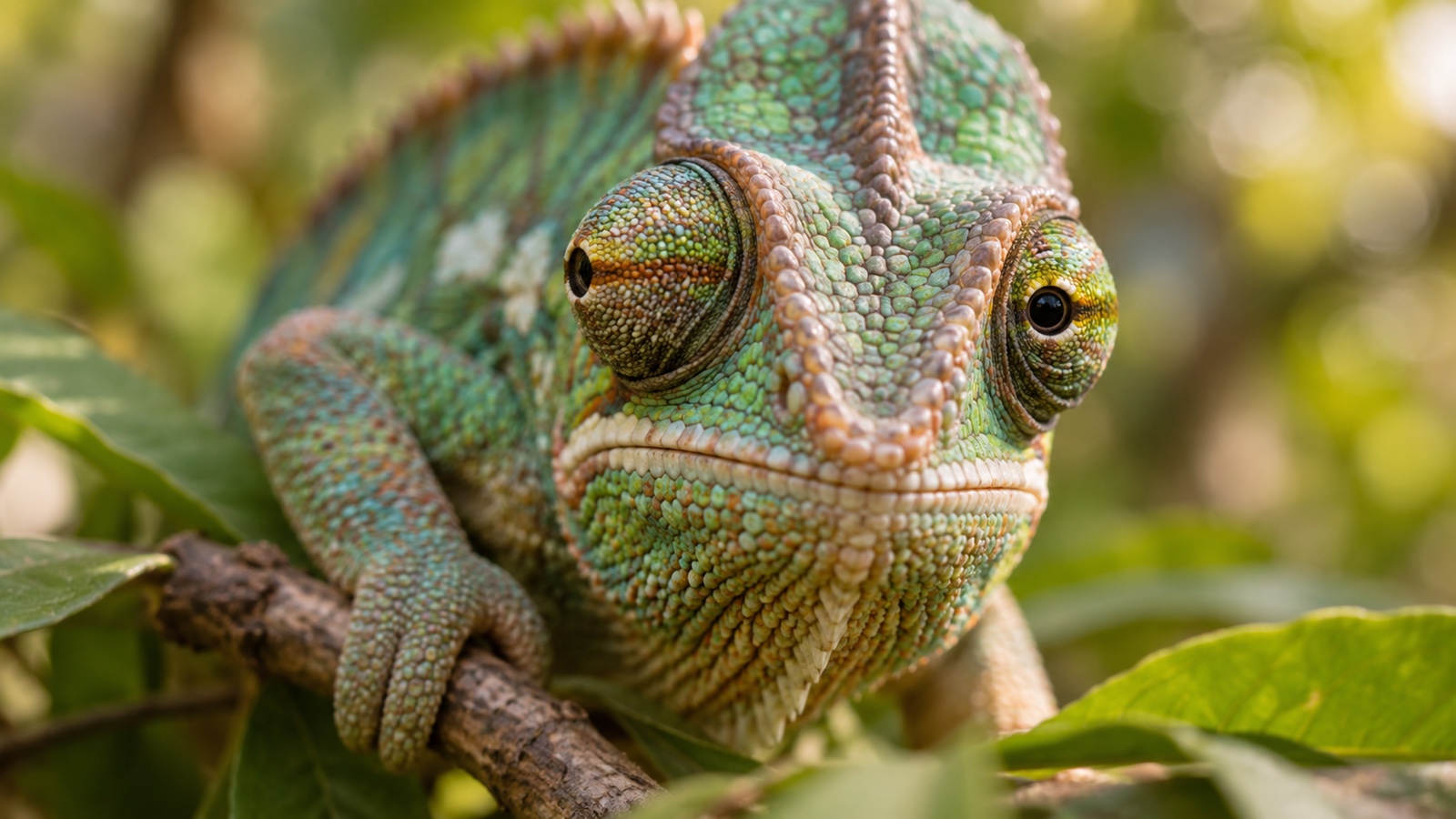
- Chameleon eyes sit inside raised cone-shaped turrets.
- Most of the eyeball is covered by fused eyelids.
- A small central opening exposes the pupil.
- Each eye can rotate through a wide range.
- The two eyes often move independently while searching.
- This gives chameleons an enormous field of view.
- Independent scanning helps detect insects without moving the whole body.
- It also helps watch for predators.
- When prey is spotted, the eyes can converge on the same target.
- Binocular viewing improves depth estimation before the tongue strike.
- Chameleon vision is unusually important compared with smell in prey capture.
- They can detect small moving insects from several feet away depending on species and conditions.
- Chameleons have good daytime color vision.
- Many can detect ultraviolet light.
- Ultraviolet cues may influence behavior and communication.
- Eye movements can reveal whether a chameleon is alert or stressed.
- Closed eyes during daytime are often a warning sign in captive chameleons.
- Healthy daytime animals normally keep their eyes open while active.
- Eyes are cleaned partly by movements beneath the fused eyelids.
- Watching one eye track you while the other scans a branch behind you is the exact moment a chameleon starts feeling less like a pet lizard and more like surveillance equipment.
The tongue is a biological catapult
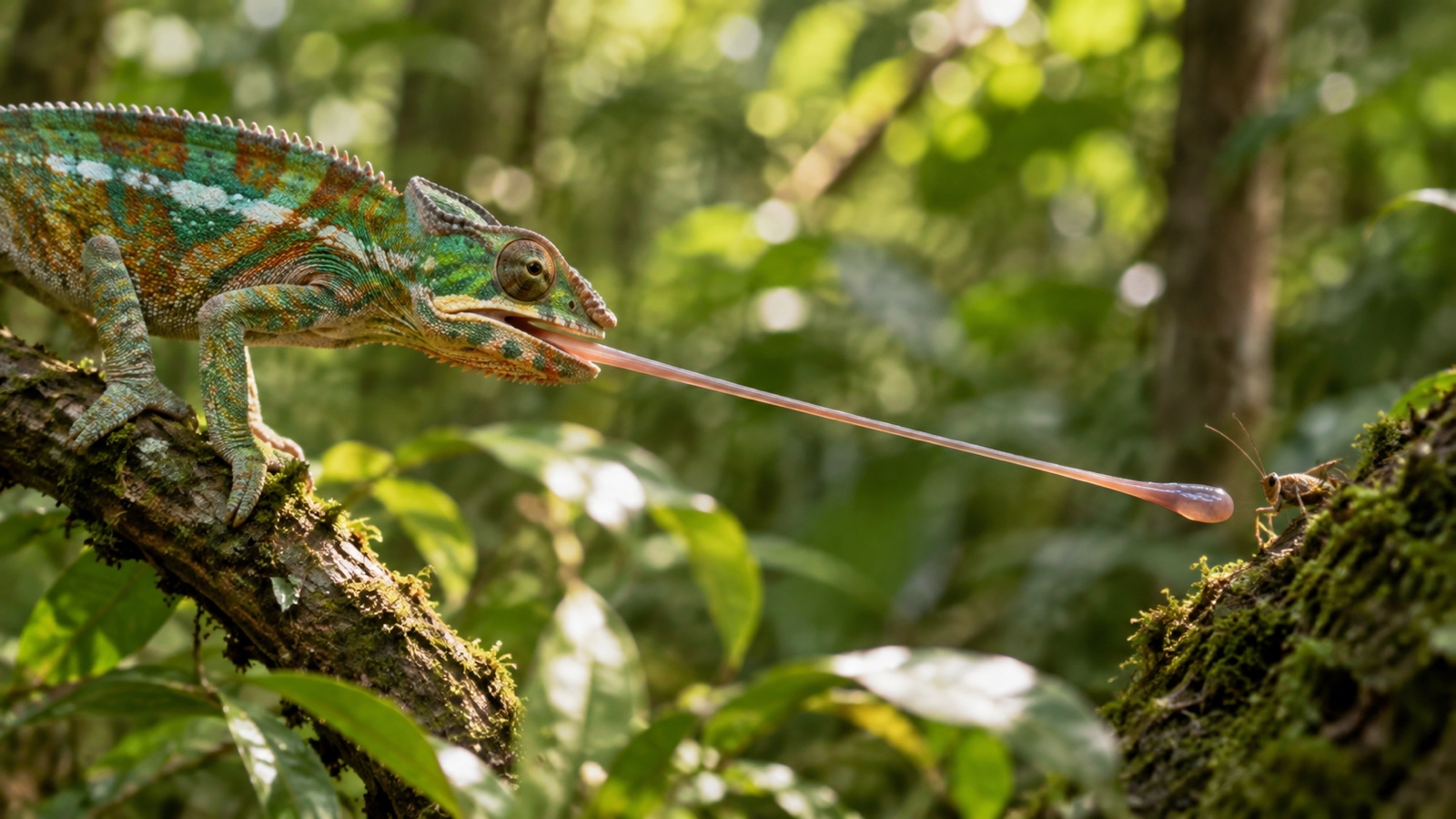
The tongue strike is the part I could watch in slow motion all day. A chameleon stores elastic energy in specialized tissues, launches the tongue at extraordinary acceleration, sticks the tip to prey, and reels dinner back before the insect has much time to reconsider its afternoon plans.
- Chameleon tongues can extend extremely quickly.
- In many species, the tongue can reach farther than the body length excluding the tail.
- Small species can produce especially extreme tongue accelerations relative to body size.
- The tongue rests over a long skeletal structure called the hyoid apparatus.
- Muscles load elastic tissues before a strike.
- Stored elastic energy helps launch the tongue faster than muscle contraction alone could manage.
- The enlarged tongue tip is sometimes called the tongue pad.
- It spreads against prey on impact.
- Sticky mucus helps secure insects.
- Suction and surface contact also contribute to prey capture.
- The tongue retracts through powerful muscles.
- Chameleons usually aim using binocular vision first.
- A failed strike can happen if prey moves at the last instant.
- Young chameleons can use the tongue soon after hatching or birth.
- Cold temperatures can slow muscle performance.
- Elastic tongue mechanics help preserve surprisingly good strike performance in cool conditions.
- Different species specialize on different prey sizes.
- Large chameleons can eat sizable insects and occasionally small vertebrates.
- Most diets are dominated by arthropods.
- The tongue is basically a spring-loaded flyswatter that retracts into the mouth with lunch attached.
Feet and tails turn branches into highways
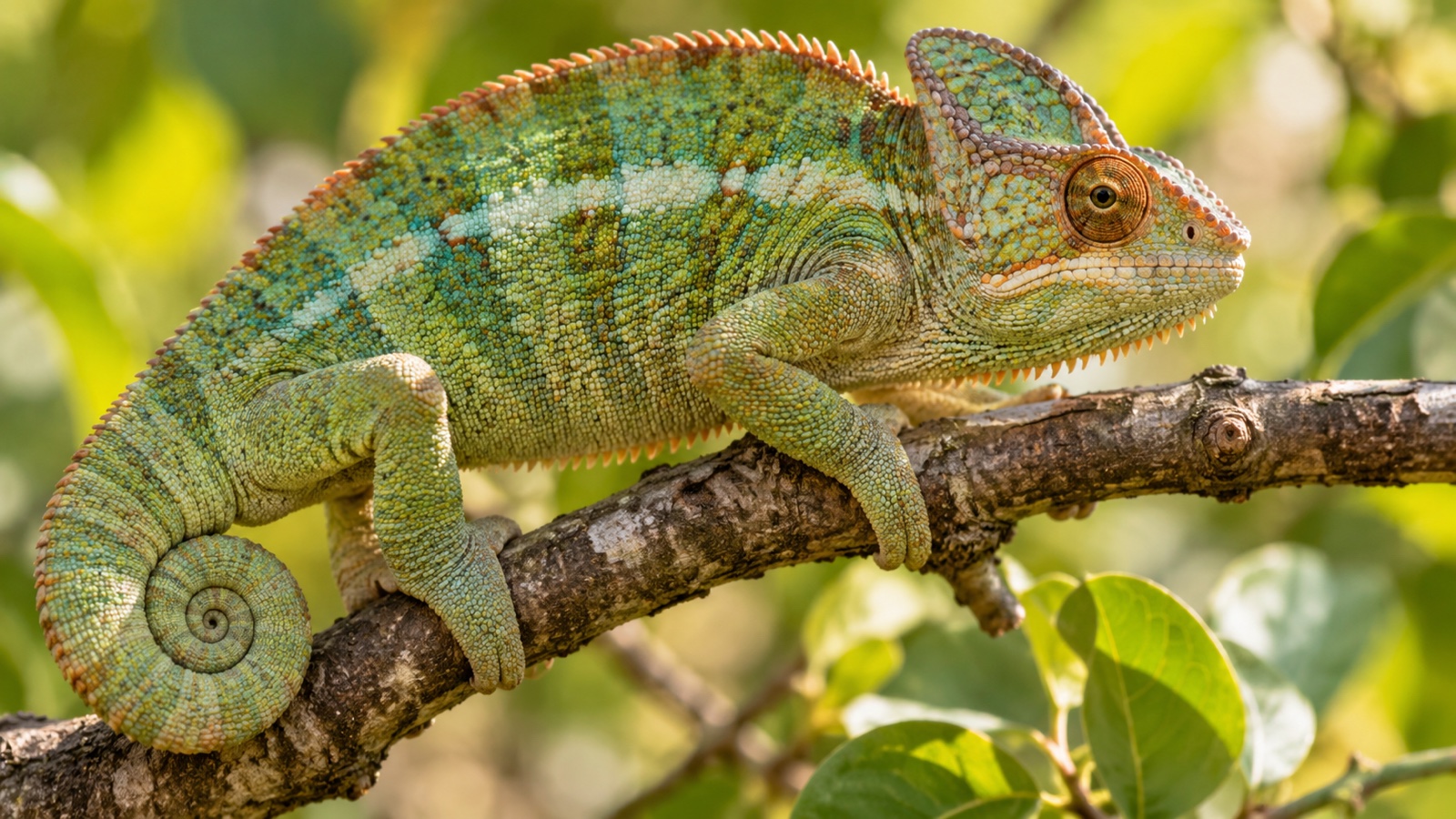
- Chameleon feet are highly specialized for gripping branches.
- Toes are grouped into opposing bundles.
- On the front feet, the toe grouping differs from the rear feet.
- The arrangement acts like gripping tongs around a branch.
- Sharp claws add traction on bark.
- Most arboreal chameleons also have prehensile tails.
- A prehensile tail can wrap around branches.
- The tail provides an extra anchor while the animal reaches forward.
- Chameleons cannot regrow a lost tail the way some other lizards can.
- The tail should never be pulled or treated like a detachable handle.
- Chameleons walk with a distinctive rocking gait.
- The back-and-forth movement may help them resemble leaves moving in vegetation.
- Slow movement also reduces attention from predators and prey.
- They can freeze nearly motionless when threatened.
- Some flatten the body to appear larger.
- They may turn sideways to display a larger silhouette.
- Hissing is a common defensive response.
- A threatened chameleon can bite.
- Color change can intensify during defensive encounters.
- A chameleon crossing one branch can look like someone taught a leaf to walk while carrying five separate gripping systems.
Reproduction ranges from eggs to live-bearing species
Chameleon reproduction is another reminder that the family is much more diverse than one pet-store species. Many females bury eggs underground, while some mountain chameleons retain developing young inside the body and give birth to live offspring adapted to cooler climates.
- Many chameleon species lay eggs.
- Egg-laying species are called oviparous.
- Females often descend to the ground to dig nest holes.
- Eggs are buried in soil.
- Clutch size varies greatly among species.
- Some small species lay only a few eggs.
- Large veiled chameleons can lay several dozen eggs in one clutch.
- Females can produce eggs even without mating.
- Unfertilized egg production can still place heavy nutritional demands on captive females.
- Excessive egg production is a serious husbandry concern in pet chameleons.
- Some chameleons give birth to live young.
- Jackson's chameleons are a well-known live-bearing example.
- Live-bearing reproduction is common in some species from cooler high-elevation habitats.
- Newborn chameleons are miniature independent hunters.
- Parents usually provide little or no care after birth or hatching.
- Young begin capturing tiny prey quickly.
- Growth can be rapid in species with short life cycles.
- Labord's chameleon in Madagascar is famous for an exceptionally short post-hatching lifespan in the wild.
- Much of one generation's life can occur inside the egg before hatching.
- A newborn chameleon enters the world already expected to grip branches, aim both eyes, and operate a tongue catapult with no parental tutorial.
Madagascar, conservation and 25 final chameleon facts
- Madagascar is a global hotspot for chameleon evolution.
- Many Malagasy chameleons live nowhere else on Earth.
- Panther chameleons are native to Madagascar and nearby islands.
- Panther chameleon males can display spectacular regional color variation.
- Parson's chameleon is one of the largest chameleon species.
- Brookesia chameleons include extremely tiny leaf-litter species.
- Some Brookesia adults are small enough to perch comfortably on a fingertip.
- Habitat destruction threatens many chameleon populations.
- Forest clearing is especially serious for species with tiny geographic ranges.
- Climate change can shift suitable habitat for mountain species.
- Wildlife collection for the pet trade has affected some populations.
- International trade in many chameleons is regulated through CITES.
- Captive-bred animals are generally preferable to wild-caught pets where legal and responsibly produced.
- Chameleons are demanding reptiles to keep well.
- They need species-appropriate heat gradients.
- They also need ultraviolet-B lighting in most indoor captive setups.
- UVB supports vitamin D production and calcium metabolism.
- Inadequate calcium or UVB can contribute to metabolic bone disease.
- Many chameleons prefer drinking droplets from leaves rather than recognizing a standing water bowl readily.
- Misting or dripping systems are commonly used in appropriate captive care.
- Ventilation is important because stagnant humid conditions can create respiratory and skin problems.
- Handling often stresses chameleons more than owners expect.
- Many are best treated as display animals rather than frequently handled reptiles.
- Healthy chameleon care requires research specific to the exact species, not one generic “lizard setup.”
- After 145 facts, color change feels almost ordinary compared with the independently moving eyes, spring-powered tongue, gripping toes, prehensile tail, strange reproduction, and evolutionary experiments packed into this one lizard family.
Quick FAQ
Q: Do chameleons change color to match any background?
A: No. Their color range is biologically limited, and changes are strongly influenced by communication, temperature, light, stress, and reproductive state.
Q: Can chameleons move their eyes separately?
A: Yes. They often scan independently, then bring both eyes onto the same target before striking prey.
Q: How far can a chameleon shoot its tongue?
A: In many species the tongue can extend farther than the body length excluding the tail, with small species achieving especially extreme relative distances.
Q: Can chameleons regrow their tails?
A: No. Unlike some other lizards, chameleons do not normally regenerate a lost tail.
Q: Are chameleons easy pets?
A: Usually not. Correct lighting, heat, hydration, ventilation, nutrition, supplementation, enclosure design, and low-stress handling require careful species-specific husbandry.

Ellie is the owner and sole author of Fun Facts, combining her mechanical engineering background with years of research-driven writing to deliver facts you can trust. Every article is thoroughly fact-checked and routinely updated as new science and sources emerge to keep information accurate and current. Her mission is to make learning delightful while upholding high standards of reliability and transparency.