
The Milky Way is our home galaxy, but we live inside it, which makes seeing its full shape surprisingly difficult. It contains hundreds of billions of stars, an enormous black hole, spiral arms, dark matter, stellar nurseries, ancient star clusters, and a disk so wide that light needs about 100,000 years to cross it. These 145 facts explore our galaxy’s structure, center, stars, motion, neighbors, history, future collision, and the glowing band humans have watched for thousands of years.
Milky Way basics
- The Milky Way is the galaxy that contains our solar system.
- It is a barred spiral galaxy.
- The visible stellar disk is roughly 100,000 light-years across by common estimates.
- A light-year is the distance light travels in one year.
- The galaxy contains hundreds of billions of stars.
- The exact star count is difficult to determine because faint stars and dust hide parts of the galaxy.
- The Milky Way also contains gas, dust, planets, stellar remnants, dark matter, and a central black hole.
- Most visible stars occupy a flattened rotating disk.
- A central bar of stars crosses the inner galaxy.
- Spiral arms extend through the disk.
- A more diffuse halo surrounds the disk.
- Globular star clusters orbit within the halo.
- Dark matter extends far beyond most visible stars.
- The Milky Way belongs to a small association of galaxies called the Local Group.
- NASA classifies our galaxy among the universe’s enormous population of galaxies.
Why it looks like a milky band
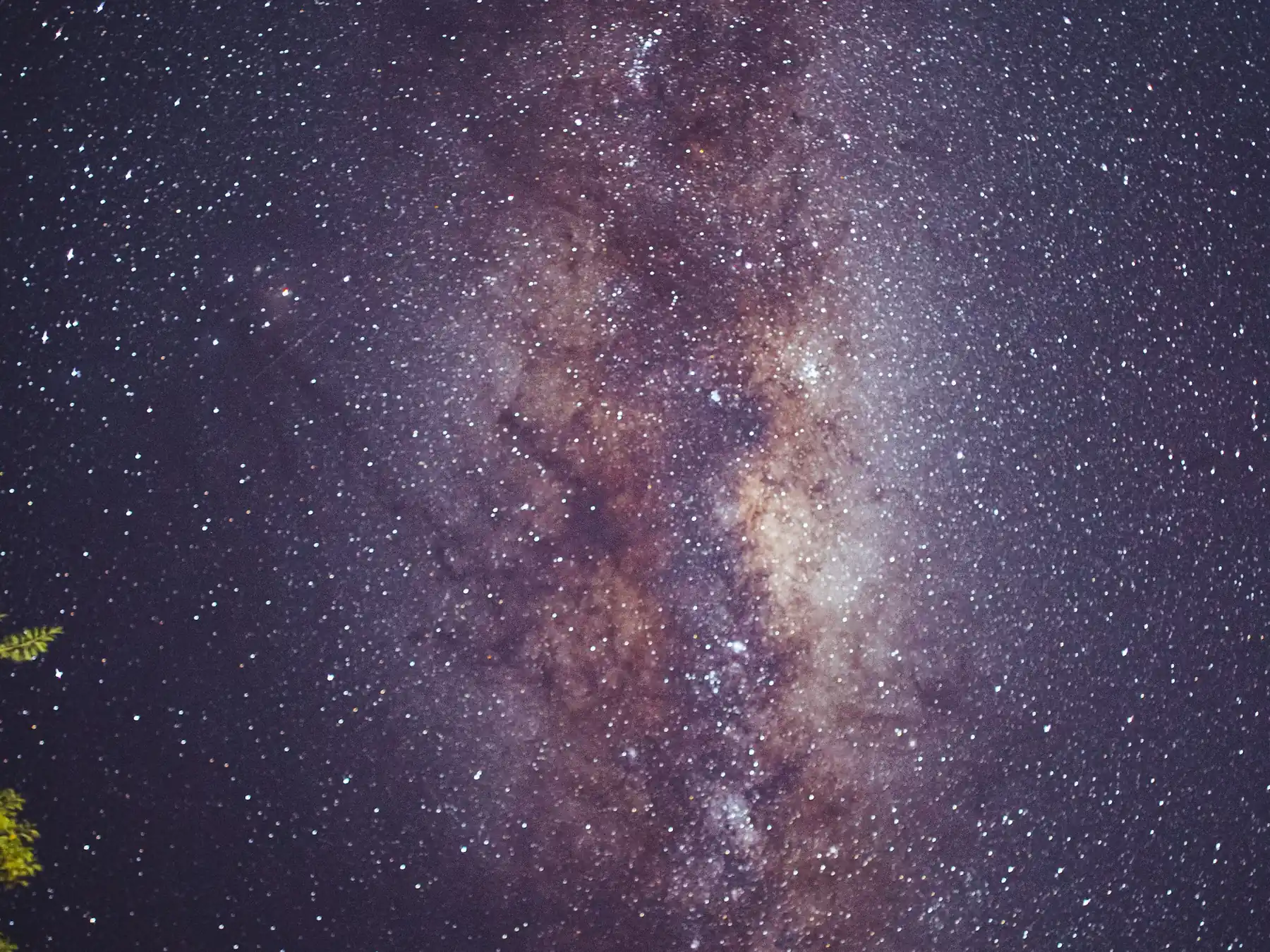
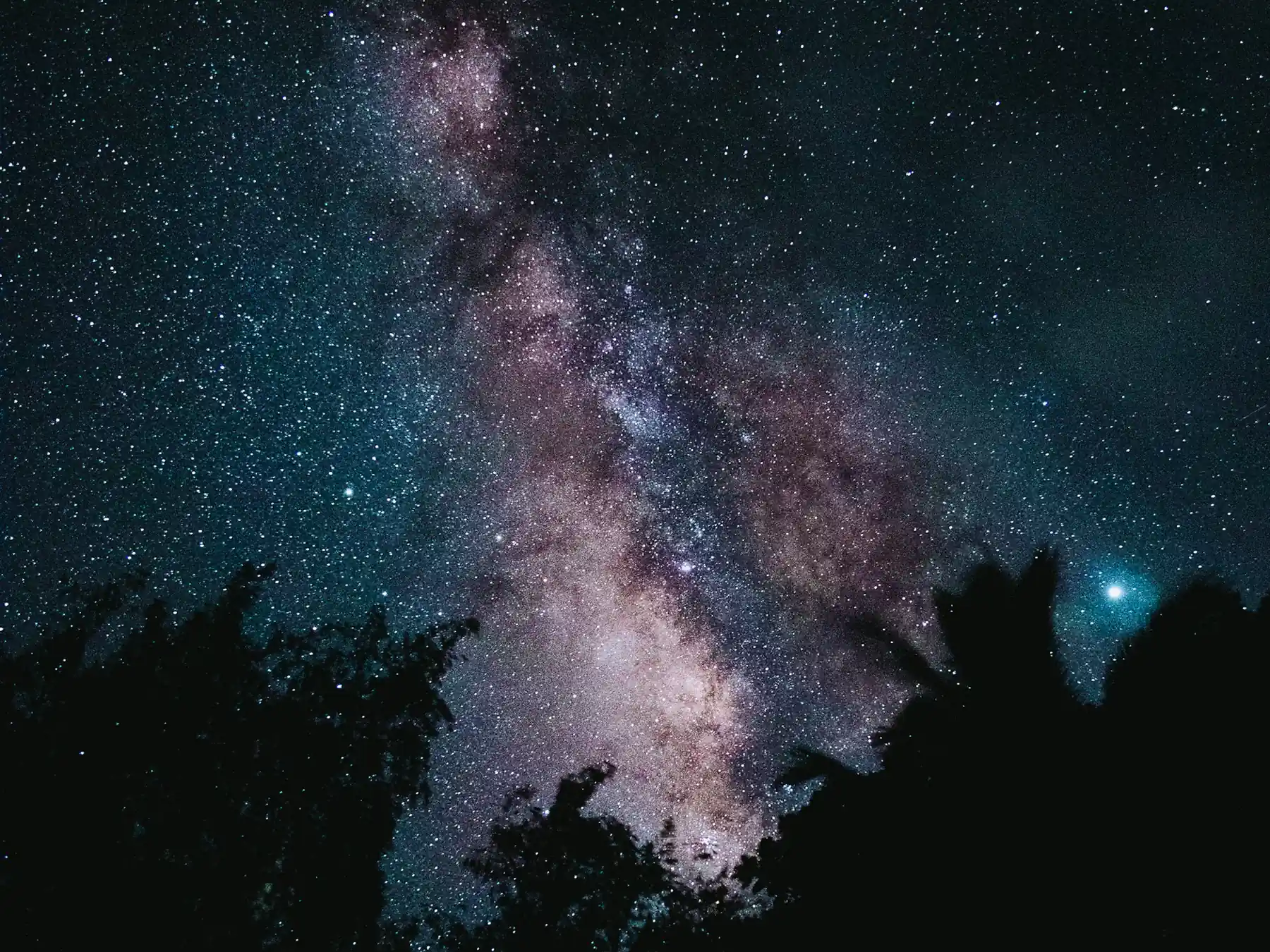
- From a dark location, the Milky Way appears as a pale band stretching across the night sky.
- The band is our edge-on view through the galaxy’s crowded disk.
- Billions of distant stars blend into a continuous glow to unaided human vision.
- Dark clouds interrupt the bright band.
- Those dark patches are interstellar dust that blocks background starlight.
- The Milky Way is easier to see far from city lights.
- Light pollution can erase nearly the entire band from urban skies.
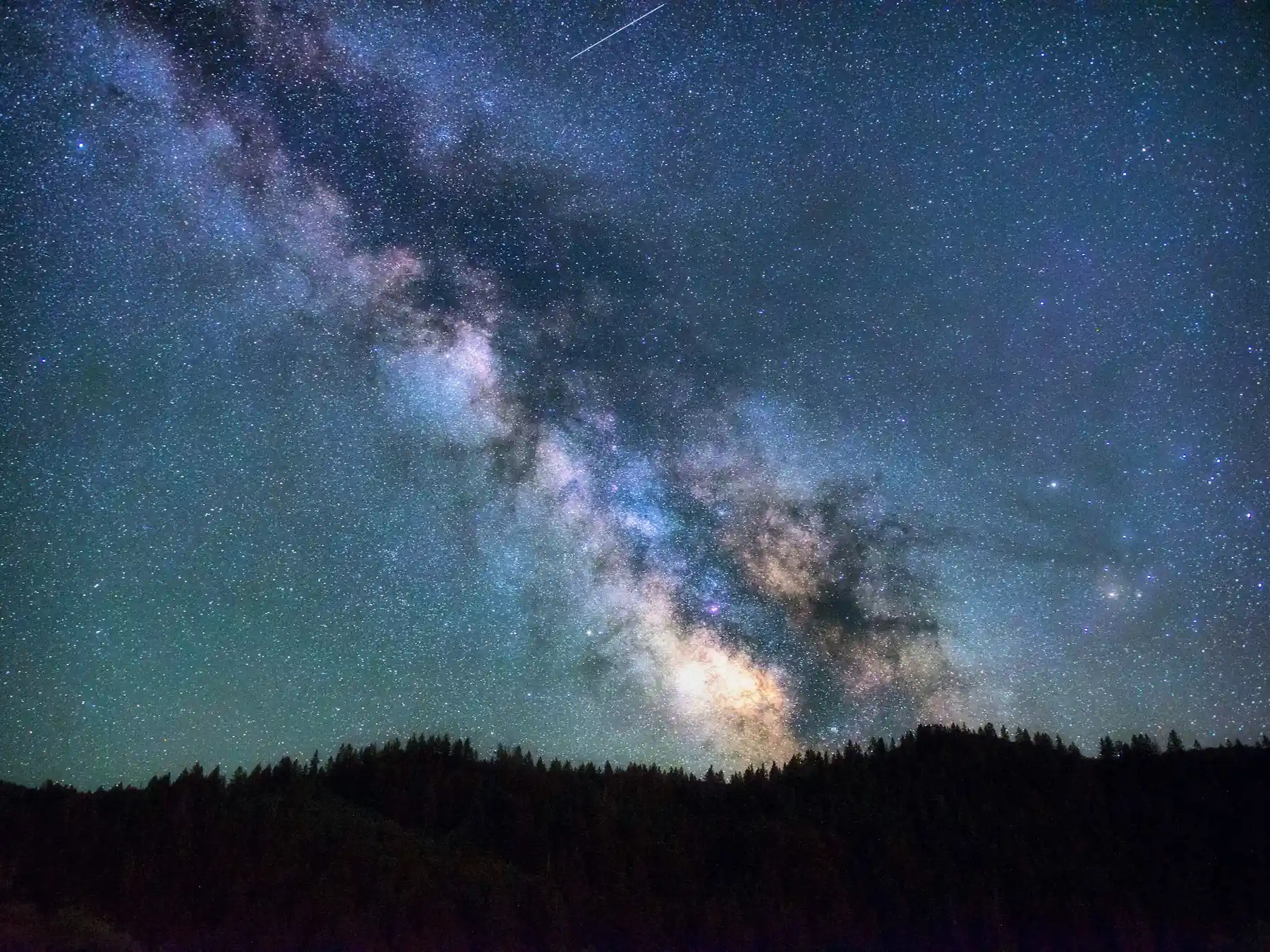
- The brightest region lies toward the galactic center.
- That direction is near the constellation Sagittarius.
- Dust blocks much of the center in visible light.
- Infrared and radio telescopes can penetrate or bypass much of that dust.
- Different wavelengths reveal completely different structures in the same galaxy.
- Radio maps trace cold gas and magnetic phenomena.
- Infrared images reveal embedded stars and dust-warmed regions.
- X-ray and gamma-ray observations expose some of the galaxy’s most energetic objects.
Where the Sun lives
- The Sun is not near the Milky Way’s center.
- Our solar system lies roughly 26,000 light-years from the galactic center.
- It occupies a smaller spiral feature commonly called the Orion Spur or Orion Arm.
- The Orion Spur lies between larger spiral-arm structures.
- The Sun orbits the center of the Milky Way.
- One galactic orbit takes roughly 225 to 250 million years.
- This timescale is sometimes called a galactic year.
- The dinosaurs appeared and disappeared during only part of one solar galactic orbit.
- The Sun travels through the galaxy at hundreds of kilometers per second.
- Yet neighboring stars appear relatively stable because many are moving around the galaxy too.
- The solar system also moves up and down relative to the galactic midplane over long timescales.
- Stars near the Sun have different orbital velocities and directions.
- Our stellar neighborhood is only a tiny sample of the entire galaxy.
- The nearest star system is Alpha Centauri, not the galactic center.
- Even nearby stars are separated by immense distances compared with planetary scales.
Sagittarius A* sits at the center
- A supermassive black hole lies at the Milky Way’s center.
- It is called Sagittarius A*, usually pronounced Sagittarius A-star.
- The black hole has a mass of about four million Suns.
- Its gravity strongly affects stars in the central region.
- Astronomers tracked stars moving around an invisible compact object for decades.
- Some central stars complete highly elongated orbits.
- These observations provided compelling evidence for a supermassive black hole.
- The Event Horizon Telescope produced the first image of Sagittarius A*’s shadow-like ring structure in 2022.
- The image used radio telescopes spread across Earth.
- Combining distant observatories created an Earth-sized virtual telescope.
- The black hole itself does not emit light from inside its event horizon.
- Hot material around it produces detectable radiation.
- Sagittarius A* is relatively quiet compared with luminous quasars.
- Evidence shows the Milky Way’s central black hole was more active at other times.
- The galactic center also contains dense star clusters, gas clouds, magnetic fields, and energetic sources.
Spiral arms are star-forming neighborhoods
- The Milky Way’s disk contains multiple spiral-arm structures.
- Major arms include the Perseus and Scutum-Centaurus arms.
- The exact spiral pattern is still refined as astronomers map the galaxy.
- We cannot photograph the Milky Way from outside because no spacecraft has left the galaxy.
- Astronomers infer structure from distances, velocities, gas maps, and star surveys.
- Spiral arms contain large concentrations of gas and dust.
- They host many active star-forming regions.
- Massive young stars are especially useful tracers of spiral structure.
- Those stars live too briefly to wander far from their birth regions.
- Stellar nurseries form inside cold molecular clouds.
- Gravity can collapse dense pockets of gas into new stars.
- Hot young stars illuminate surrounding nebulae.
- Supernovae later enrich galactic gas with heavy elements.
- The solar system’s carbon, oxygen, iron, and other heavy elements came from earlier generations of stars.
- The Milky Way is therefore continually recycling matter through stellar birth and death.
The galactic halo
- The Milky Way’s disk is surrounded by a much larger roughly spherical halo.
- The stellar halo contains relatively few stars compared with the disk.
- Many halo stars are extremely old.
- Globular clusters orbit throughout the halo.
- Globular clusters can contain hundreds of thousands of stars packed tightly together.
- Many formed early in the Milky Way’s history.
- The halo also contains streams of stars torn from smaller galaxies and clusters.
- These streams reveal past mergers.
- The Milky Way’s dark-matter halo is much more massive than its visible stellar halo.
- Dark matter does not emit ordinary detectable light.
- Its existence is inferred largely through gravitational effects.
- Stars orbit too quickly at large galactic radii for visible matter alone to explain their motion.
- A massive unseen halo helps account for those rotation speeds.
- Dark matter makes up most of the Milky Way’s total mass by current models.
- Scientists still do not know the fundamental particle nature of dark matter.
Our galaxy eats smaller galaxies
- The Milky Way grew partly by merging with smaller galaxies.
- Evidence of ancient mergers remains embedded in stellar motions and chemistry.
- The Sagittarius Dwarf Spheroidal Galaxy is currently being disrupted by the Milky Way.
- Its stars form enormous streams wrapping around our galaxy.
- The Large and Small Magellanic Clouds are nearby dwarf-galaxy companions.
- They are especially prominent in southern skies.
- The Magellanic Clouds interact gravitationally with each other and the Milky Way.
- A long trail of hydrogen gas called the Magellanic Stream extends around the system.
- Galactic cannibalism is a normal part of galaxy evolution.
- Small galaxies contribute stars, gas, and dark matter to larger ones.
- The Milky Way’s stellar halo preserves the fossils of these events.
- Astronomers use stellar chemical compositions to identify groups with common origins.
- Gaia spacecraft data revealed detailed motions for enormous numbers of Milky Way stars.
- Those motions helped uncover ancient collision structures.
- Our galaxy looks serene from Earth because galactic mergers unfold over hundreds of millions or billions of years.
Andromeda is coming
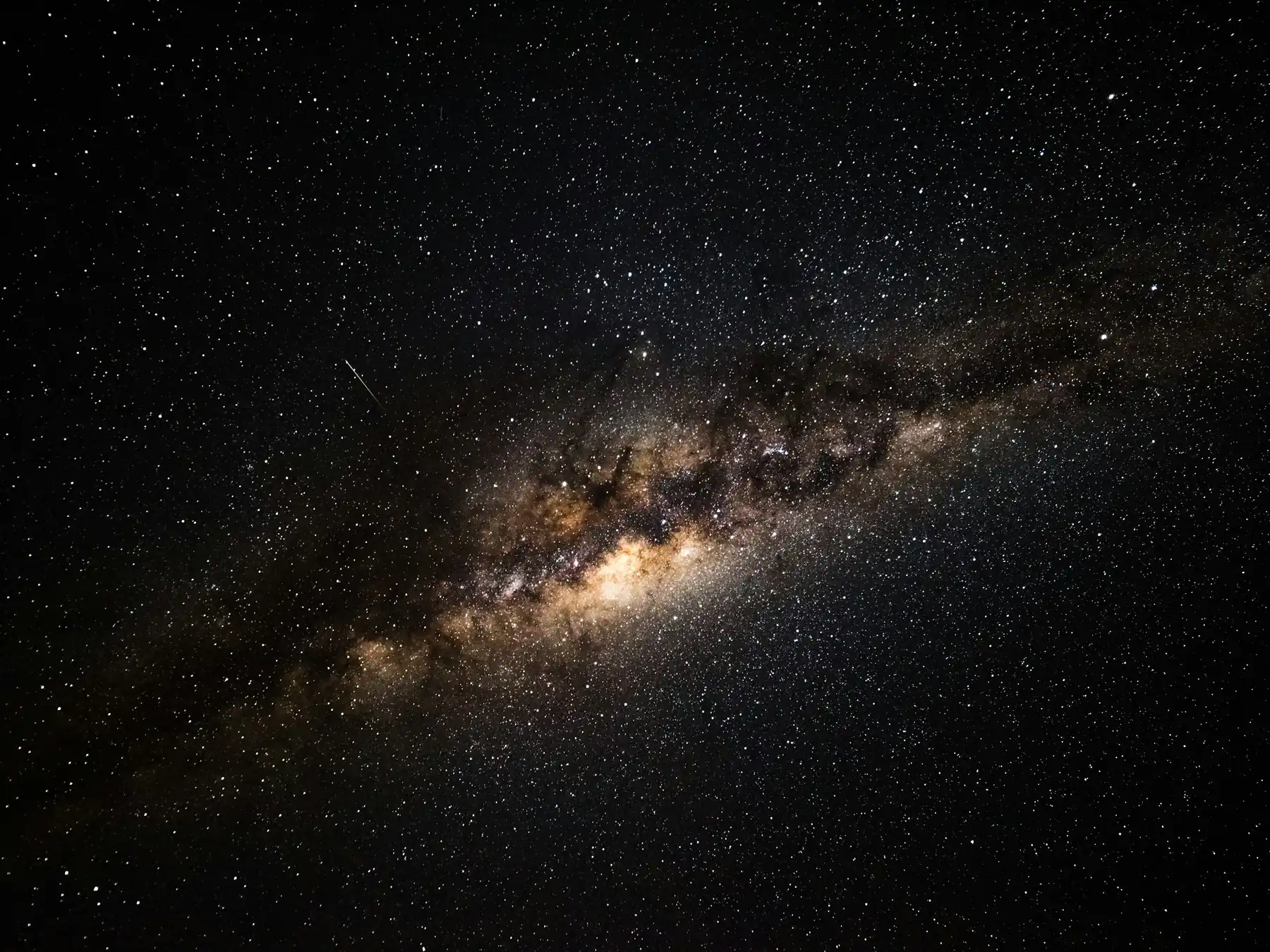
- Andromeda is the nearest large spiral galaxy to the Milky Way.
- It lies about 2.5 million light-years away.
- Andromeda and the Milky Way are moving toward one another overall.
- They are expected to interact billions of years from now.
- Older simplified descriptions often said a direct collision in about four billion years was certain.
- More recent measurements allow a range of future encounter geometries and timing.
- A major interaction remains likely on long cosmic timescales.
- Galaxy interactions can radically reshape stellar orbits.
- The two spiral structures may eventually merge into one larger galaxy.
- Individual stars are unlikely to collide directly.
- Stars are tiny compared with the enormous spaces between them.
- Gas clouds can collide and trigger star formation.
- The Sun may end up on a very different galactic orbit.
- Earth’s own habitability will be affected by solar evolution on similarly enormous timescales.
- No human civilization needs to prepare an evacuation plan for the Andromeda encounter.
Humans mapped the Milky Way from inside it
- Ancient cultures created myths around the Milky Way’s glowing band.
- The English name compares it with spilled or flowing milk.
- The word galaxy itself comes from a Greek root connected with milk.
- Galileo used a telescope to resolve parts of the Milky Way into countless faint stars.
- William Herschel attempted an early map by counting stars in different directions.
- His map was limited because he did not fully account for obscuring dust.
- Harlow Shapley used globular clusters to infer that the Sun was far from the galactic center.
- That overturned older pictures placing the solar system near the center.
- Radio astronomy later mapped hydrogen throughout the galactic disk.
- Radio waves can pass through dust that blocks visible light.
- Modern surveys measure distances using parallax, variable stars, stellar spectra, and other methods.
- The European Space Agency’s Gaia mission has measured positions and motions of more than a billion stars.
- Infrared surveys reveal hidden star-forming regions.
- Mapping the Milky Way is like reconstructing the shape of a forest while standing among its trees.
- Every new survey turns our home galaxy into a more detailed three-dimensional map.
Ten surprising Milky Way facts
- We have never taken a photograph of the Milky Way from outside it.
- The bright Milky Way band is an inside view through our own galactic disk.
- The Sun takes roughly a quarter-billion years to orbit the galactic center once.
- A black hole with about four million solar masses sits at the center.
- The Milky Way is a barred spiral, not the simpler spiral often shown in old illustrations.
- Dark matter outweighs the visible stars and gas in our galaxy.
- Our galaxy contains stellar streams that are remnants of smaller galaxies it tore apart.
- The Sun sits in a smaller feature called the Orion Spur rather than one of the largest arms.
- Galileo was among the first to show that the milky glow contains enormous numbers of stars.
- For more cosmic trivia, explore our solar-system facts and galaxy facts.
Quick Milky Way FAQ
What type of galaxy is the Milky Way?
A barred spiral galaxy with a rotating disk, central bar, spiral structures, bulge, and large halo.
How big is the Milky Way?
The visible stellar disk is roughly 100,000 light-years across by common estimates, while its halo extends much farther.
Where is our solar system?
Roughly 26,000 light-years from the galactic center in a smaller spiral feature called the Orion Spur.
What is at the center of the Milky Way?
A supermassive black hole called Sagittarius A*, with a mass of about four million Suns.
Will the Milky Way collide with Andromeda?
The galaxies are approaching and are expected to interact on billion-year timescales, though current measurements allow uncertainty in the exact encounter path and timing.

Ellie is the owner and sole author of Fun Facts, combining her mechanical engineering background with years of research-driven writing to deliver facts you can trust. Every article is thoroughly fact-checked and routinely updated as new science and sources emerge to keep information accurate and current. Her mission is to make learning delightful while upholding high standards of reliability and transparency.