
The NBA has grown from an 11-team league playing in small arenas into a global sports powerhouse filled with dynasties, record chases, rule changes, unforgettable rivalries, and players from around the world. These 145 NBA facts cover league history, championships, legends, scoring, uniforms, expansion, the draft, All-Star Weekend, international growth, and the quirks that make basketball’s biggest league endlessly fun to follow.
NBA basics
- The NBA stands for National Basketball Association.
- The league was founded in 1946 as the Basketball Association of America.
- It adopted the NBA name in 1949 after merging with the National Basketball League.
- The NBA is the top professional men’s basketball league in North America.
- The league has 30 teams.
- Twenty-nine teams are based in the United States.
- The Toronto Raptors are based in Canada.
- NBA teams are split between the Eastern and Western Conferences.
- Each conference is divided into three divisions.
- NBA regular-season games are 48 minutes long.
- Those 48 minutes are divided into four 12-minute quarters.
- Overtime periods are five minutes long.
- A standard NBA roster can include up to 15 players on regular contracts.
- Teams can also use two-way contracts that connect NBA and G League opportunities.
- The NBA season typically begins in October and ends with the Finals in June.
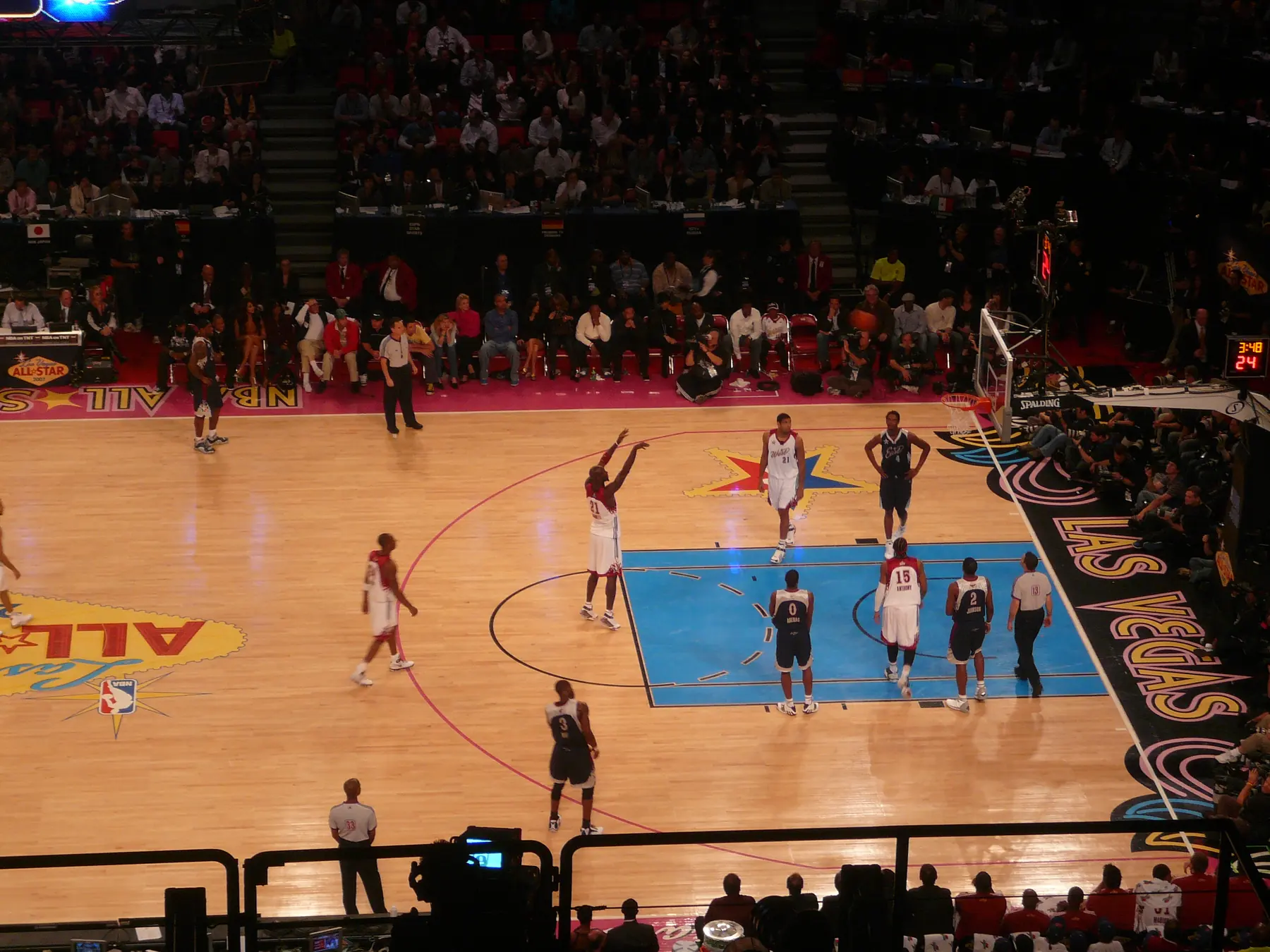
The league almost had a different identity
- The original Basketball Association of America launched with 11 teams.
- Its first game was played on November 1, 1946.
- The New York Knicks beat the Toronto Huskies in that first game.
- The game took place at Maple Leaf Gardens in Toronto.
- The first BAA champion was the Philadelphia Warriors.
- The Warriors later moved to San Francisco and eventually became the Golden State Warriors.
- The Minneapolis Lakers were one of the league’s first great dynasties.
- George Mikan was the biggest early star of that Lakers era.
- The NBA merger in 1949 expanded the league dramatically.
- Many merged teams folded within a few years.
- The surviving league eventually stabilized around stronger franchises.
- Several modern NBA teams can trace their histories back to the BAA or NBL era.
- The league’s earliest years included teams in much smaller markets than fans see today.
- Some franchises changed cities several times before finding permanent homes.
- The NBA’s modern identity emerged through decades of contraction, relocation, and expansion.
The 24-second shot clock changed everything
- The NBA introduced the 24-second shot clock for the 1954-55 season.
- Before the shot clock, teams could stall for long stretches.
- Low-scoring games became a serious entertainment problem.
- Syracuse Nationals owner Danny Biasone is widely credited with developing the 24-second concept.
- He reportedly used the idea of dividing a 48-minute game into roughly 120 possessions.
- Twenty-four seconds gave each team a limited time to attempt a shot.
- The rule dramatically increased pace and scoring.
- It also changed the strategy of late-game possessions.
- The shot clock resets differently depending on how possession changes.
- An offensive rebound can produce a 14-second reset in many situations.
- The shot clock is displayed above or near each basket in NBA arenas.
- A shot must leave a player’s hand before the clock reaches zero.
- The ball must then touch the rim for the attempt to satisfy the rule.
- The shot clock became so fundamental that modern basketball is difficult to imagine without it.
- Many leagues around the world later adopted their own shot-clock rules.
The three-point line arrived surprisingly late
- The NBA adopted the three-point line for the 1979-80 season.
- The rival American Basketball Association had already used a three-point line.
- The ABA also helped popularize a faster, more colorful style of play.
- The NBA and ABA merged in 1976.
- Four ABA teams joined the NBA after the merger.
- Those teams were the Denver Nuggets, Indiana Pacers, New York Nets, and San Antonio Spurs.
- The New York Nets later became the Brooklyn Nets.
- The NBA three-point line is farther from the basket at the top than in the corners.
- The corner three is therefore a shorter shot.
- Early NBA teams attempted relatively few three-pointers.
- The shot became much more important during the 1990s and 2000s.
- The analytics era accelerated the emphasis on three-point shooting.
- Stephen Curry helped reshape perceptions of how far and how often elite players could shoot.
- Modern offenses frequently space four or five players beyond the arc.
- The three-point line transformed floor spacing, roster construction, and defensive strategy.
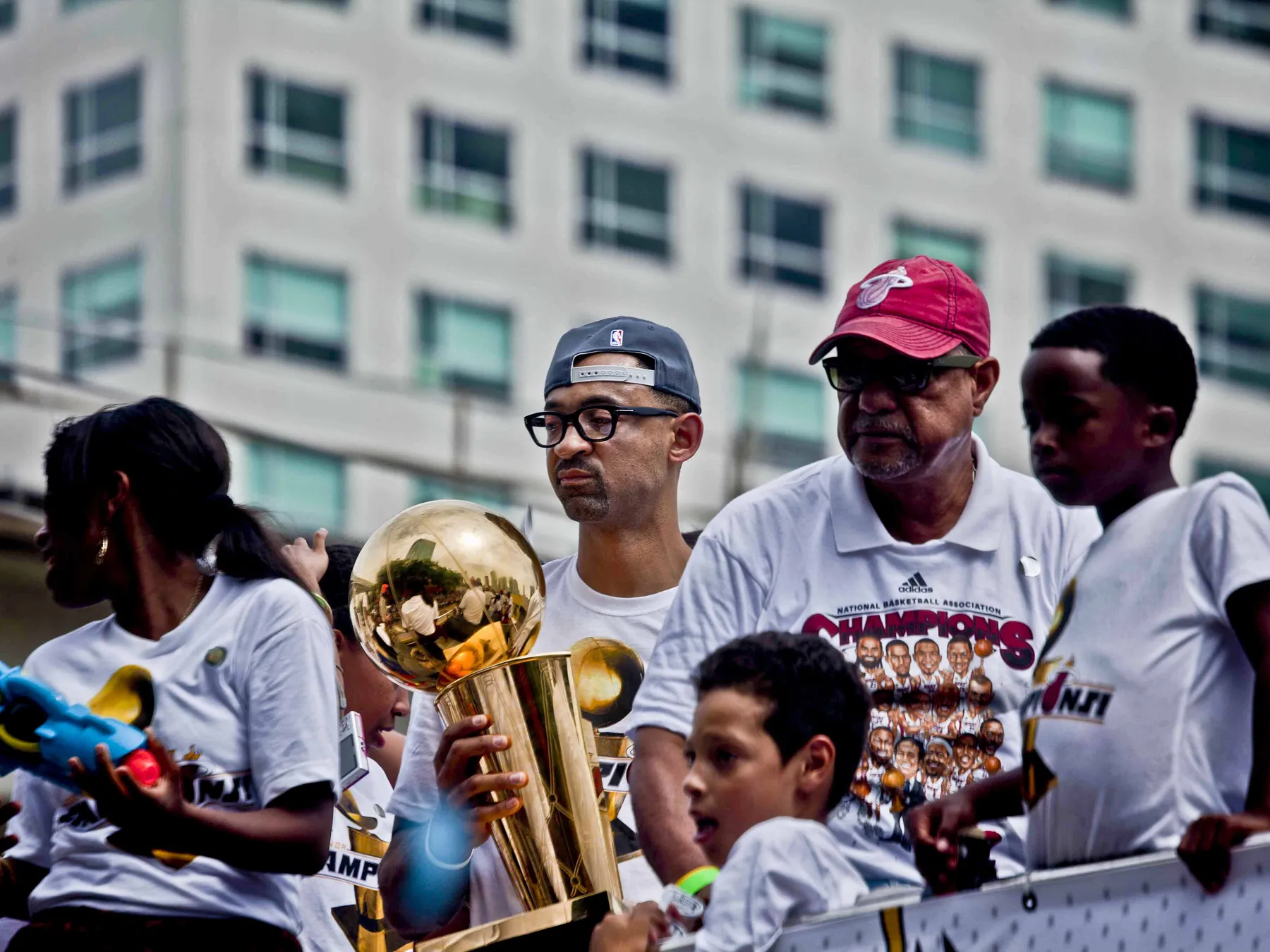
Championship history
- The NBA championship is decided in the NBA Finals.
- The Finals are played as a best-of-seven series.
- The first team to win four games becomes champion.
- The championship trophy is named the Larry O’Brien Championship Trophy.
- Larry O’Brien served as NBA commissioner from 1975 to 1984.
- The trophy name changed in 1984.
- The Boston Celtics and Los Angeles Lakers are two of the league’s most successful franchises.
- Their rivalry became one of the defining stories of professional basketball.
- Boston dominated much of the late 1950s and 1960s.
- The Celtics won eight consecutive championships from 1959 through 1966.
- Bill Russell was the defensive and rebounding centerpiece of those teams.
- The Lakers reached the Finals repeatedly during several different eras.
- Magic Johnson and Larry Bird helped revive league popularity in the 1980s.
- Michael Jordan and the Chicago Bulls defined much of the 1990s.
- The NBA Finals have produced some of the most watched basketball games in history.
Michael Jordan changed basketball culture
- Michael Jordan entered the NBA in 1984.
- The Chicago Bulls selected him with the third overall pick.
- Hakeem Olajuwon went first in the same draft.
- Jordan won six NBA championships with Chicago.
- He won six Finals MVP awards.
- The Bulls never lost an NBA Finals series with Jordan.
- Chicago won three straight titles from 1991 through 1993.
- The Bulls won another three straight from 1996 through 1998.
- Jordan retired from basketball after the 1993 title run.
- He briefly played professional baseball in the Chicago White Sox organization.
- He returned to the Bulls in 1995.
- Jordan later returned to the NBA again with the Washington Wizards.
- His partnership with Nike turned Air Jordan shoes into a global brand.
- Jordan helped make NBA stars central figures in worldwide popular culture.
- His influence extended far beyond statistics and championships.
The draft can change a franchise overnight
- The NBA Draft is held annually.
- It currently consists of two rounds.
- Teams select eligible players from colleges, international clubs, and other pathways.
- The draft order is partly determined by the previous season’s standings.
- Non-playoff teams enter the NBA Draft Lottery.
- The lottery determines the order for the top selections.
- The system is designed to discourage teams from intentionally losing solely for the first pick.
- Draft odds have changed several times over NBA history.
- Some first overall picks become superstars.
- Others struggle or suffer injuries.
- Some of the greatest players in NBA history were not selected first.
- Kobe Bryant was selected 13th overall in 1996.
- Giannis Antetokounmpo was selected 15th overall in 2013.
- Nikola Jokić was selected 41st overall in 2014.
- Draft-night trades can make the team that selects a player different from the team he actually joins.
The All-Star Game became a full weekend
- The first NBA All-Star Game was played in 1951.
- It was held at Boston Garden.
- The event was created in part to promote the league after a college basketball gambling scandal hurt public confidence in the sport.
- The All-Star Game eventually became the centerpiece of a multi-day event.
- The Slam Dunk Contest became a signature attraction.
- The NBA held its first official Slam Dunk Contest in 1984.
- Julius Erving had already helped popularize dunk contests in the ABA.
- Michael Jordan’s 1988 dunk contest performance became iconic.
- The Three-Point Contest debuted in 1986.
- Larry Bird won the first three editions.
- Rising Stars events showcase younger NBA players.
- Celebrity games and skills competitions have also become part of the weekend.
- The NBA has repeatedly changed the All-Star Game format.
- Those changes reflect the league’s effort to balance entertainment and competition.
- All-Star Weekend is also a major gathering for sponsors, media, retired players, and fans.
The NBA became a global league
- International players now make up a significant share of NBA rosters.
- Players from dozens of countries have competed in the league.
- Hakeem Olajuwon was born in Nigeria.
- Dirk Nowitzki came from Germany.
- Yao Ming became one of the most important NBA figures in China.
- Pau Gasol became a Spanish NBA star and champion.
- Giannis Antetokounmpo was born in Greece to Nigerian parents.
- Nikola Jokić is from Serbia.
- Luka Dončić is from Slovenia.
- The NBA has played regular-season and preseason games outside the United States and Canada.
- The league operates international academies and development programs.
- NBA games are broadcast in countries around the world.
- The Basketball Africa League launched with NBA involvement.
- International scouting is now essential for every serious NBA front office.
- The league’s talent pool has become more global with each generation.
Ten surprising NBA facts
- The NBA began as the Basketball Association of America.
- The league’s first game was played in Toronto, not the United States.
- The 24-second shot clock was introduced only after stalling threatened the entertainment value of games.
- The NBA did not adopt the three-point line until 1979.
- Four former ABA teams joined the NBA in 1976.
- Boston once won eight championships in a row.
- Michael Jordan was the third pick in his draft, not the first.
- Nikola Jokić became an MVP-level star after being drafted 41st overall.
- All-Star Weekend began with a single exhibition game and grew into a league-wide festival.
- For more basketball trivia, explore our basketball facts, Super Bowl facts, and Olympics facts.
Quick NBA FAQ
How many teams are in the NBA?
Thirty teams compete in the league, with 29 in the United States and one in Canada.
When was the NBA founded?
The league began in 1946 as the Basketball Association of America and adopted the NBA name in 1949.
How long is an NBA game?
Regulation is 48 minutes, divided into four 12-minute quarters, with five-minute overtime periods if needed.
When did the NBA add the three-point line?
The league introduced it for the 1979-80 season.
What is the NBA championship trophy called?
The Larry O’Brien Championship Trophy.

Ellie is the owner and sole author of Fun Facts, combining her mechanical engineering background with years of research-driven writing to deliver facts you can trust. Every article is thoroughly fact-checked and routinely updated as new science and sources emerge to keep information accurate and current. Her mission is to make learning delightful while upholding high standards of reliability and transparency.