
The Olympics can turn a hundredth of a second into history, but the Games themselves stretch back thousands of years. Ancient athletes competed at Olympia, modern organizers revived the festival in 1896, and today the Olympic movement combines sport, ceremony, politics, art, engineering, television, and global symbolism. These 145 Olympic facts cover the ancient Games, modern revival, rings, torch, medals, records, traditions, unusual sports, and behind-the-scenes details.
Olympic basics
- The modern Olympic Games are an international multi-sport competition.
- The Summer and Winter Olympics are organized under the Olympic movement.
- The International Olympic Committee is commonly shortened to IOC.
- The IOC was founded in 1894.
- The first modern Olympic Games were held in Athens in 1896.
- Olympic Games normally take place on a four-year cycle.
- The four-year period between Games is called an Olympiad.
- Summer and Winter Games are held in different years.
- The IOC awards hosting rights to selected cities or regions.
- A local organizing committee plans and stages each edition.
- Athletes compete representing National Olympic Committees rather than ordinary club teams.
- The Olympic program includes individual and team sports.
- Events are divided into competitions for specific disciplines, distances, weights, or formats.
- Gold, silver, and bronze medals are awarded to the top three finishers in most events.
- The IOC publishes historical records through its official Olympic Games archive.
The ancient Olympic Games
- The ancient Olympic Games were held at Olympia in Greece.
- Traditional chronology dates the first recorded ancient Olympics to 776 BCE.
- The festival honored Zeus.
- Olympia was a religious sanctuary as well as an athletic center.
- Ancient Games were held every four years.
- The Olympic cycle became a way for Greeks to reckon time.
- Only free Greek males could compete in the traditional ancient Games.
- Women did not compete in the main Olympic festival.
- A separate festival called the Heraean Games included races for women.
- Ancient athletes competed nude in many events.
- Events included running, wrestling, boxing, pentathlon, and chariot racing.
- The ancient pentathlon included running, long jump, discus, javelin, and wrestling.
- Ancient boxing lacked modern padded gloves.
- Pankration combined striking and grappling in an extremely rough combat event.
- Ancient Olympic victors received wreaths of wild olive rather than gold medals.
The ancient Games were intense
- Winning brought enormous prestige to an athlete’s home city.
- Victors could receive money, meals, statues, privileges, and public honors at home.
- Chariot owners, not necessarily the drivers, were officially credited with victories.
- This allowed wealthy women to become Olympic victors through horse ownership.
- Spartan princess Cynisca became the first recorded woman to win an ancient Olympic event.
- Her horses won the four-horse chariot race in the fourth century BCE.
- Ancient long jumpers may have used handheld weights called halteres.
- Musicians sometimes accompanied athletic movements and ceremonies.
- Judges called Hellanodikai enforced competition rules.
- Athletes swore oaths before competing.
- Cheating could lead to fines.
- Fines from cheaters were used to fund statues of Zeus called Zanes.
- Inscriptions warned future athletes against dishonesty.
- The Roman Empire continued the ancient Games for centuries.
- The festival disappeared in late antiquity as the religious and political world changed.
Pierre de Coubertin and the modern revival
- French educator Pierre de Coubertin became the central organizer of the modern Olympic revival.
- He believed international sport could support education and cultural exchange.
- Coubertin promoted an Olympic revival during the late 19th century.
- An international congress in Paris created the IOC in 1894.
- Athens was chosen for the first modern Games.
- The 1896 Olympics featured male athletes from several nations.
- The Panathenaic Stadium hosted major events.
- The stadium was built using marble on the site of an ancient stadium.
- Spyridon Louis became a Greek national hero by winning the marathon.
- The first modern marathon was inspired by the ancient story of a messenger from Marathon.
- The exact ancient Pheidippides story is more complicated than the familiar modern legend.
- The modern marathon distance was not originally fixed at 26.2 miles.
- The familiar 42.195-kilometer distance was standardized later.
- Paris hosted the second modern Olympics in 1900.
- Women first participated in the modern Olympic Games in 1900.
The Olympic rings
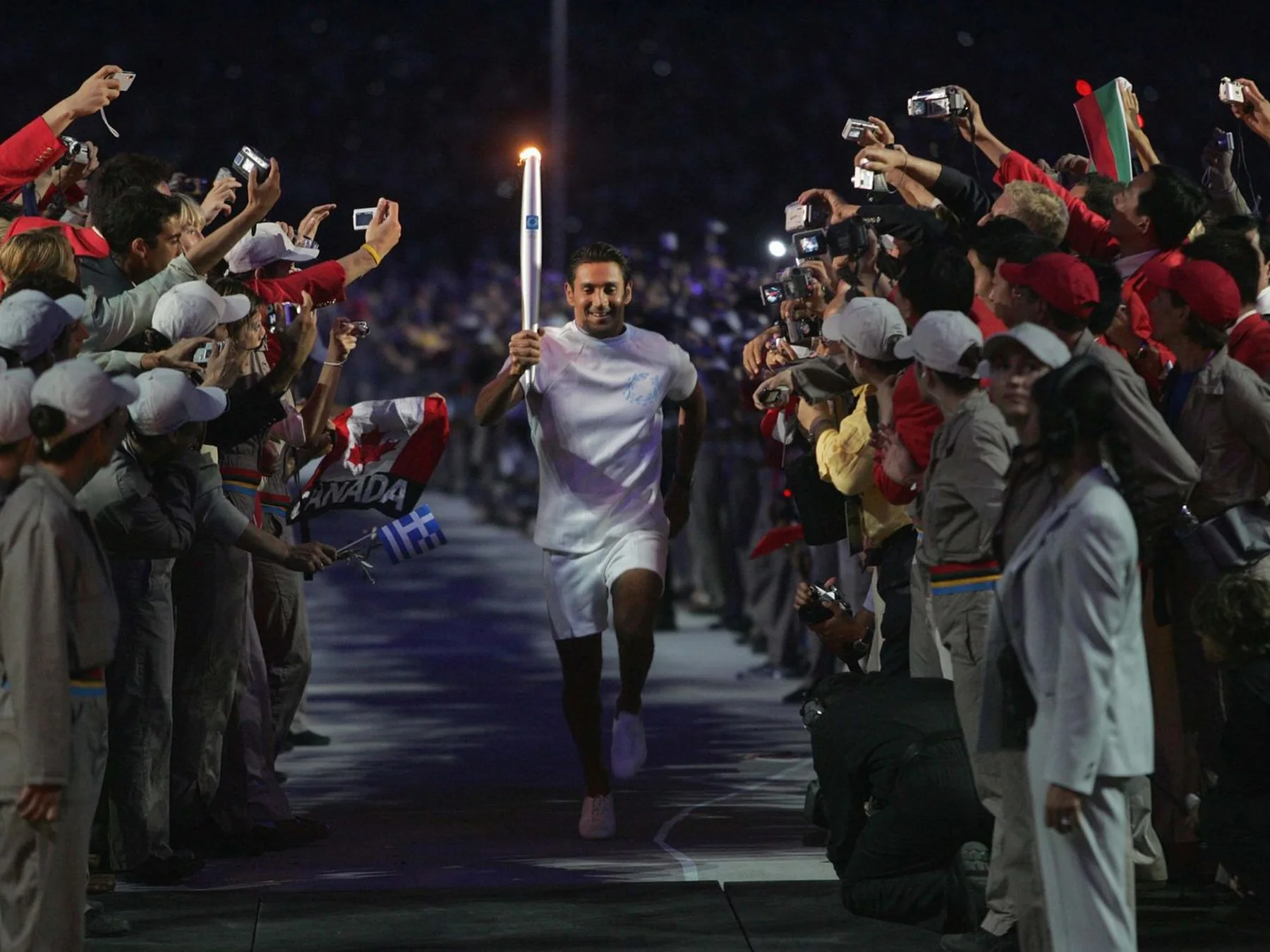
- The Olympic symbol contains five interlocking rings.
- The ring colors are blue, yellow, black, green, and red on a white field.
- Pierre de Coubertin designed the Olympic rings in 1913.
- The rings represent the union of the inhabited continents through Olympism.
- They do not officially assign one specific ring color to one specific continent.
- The popular continent-by-color chart is a myth.
- Coubertin noted that the ring colors plus white included colors appearing in national flags of his era.
- The Olympic flag first flew at an Olympic Games in Antwerp in 1920.
- The rings are among the most tightly protected symbols in international sport.
- Organizers follow detailed visual rules when displaying them.
- The Olympic motto historically used Latin words meaning faster, higher, stronger.
- The IOC later added a word meaning together to the official motto.
- The Olympic creed emphasizes striving and participation rather than victory alone.
- Olympic symbols are intended to connect athletic competition with broader ideals.
- The rings became recognizable worldwide through broadcasting, merchandise, ceremonies, and host-city design.
The torch and flame
- A flame burns at the main Olympic venue during the Games.
- Modern organizers light the flame at ancient Olympia in Greece.
- Actresses dressed as priestesses use a parabolic mirror to focus sunlight for the ceremony.
- The flame is then carried toward the host through a torch relay.
- The modern Olympic flame appeared at the Amsterdam Games in 1928.
- The first modern torch relay from Olympia to a host city occurred for Berlin in 1936.
- That 1936 relay was created under Nazi Germany and has a politically complicated history.
- Later Olympic movements retained and reinterpreted the relay tradition.
- Torch designs change for every edition.
- Engineers design torches to remain lit through wind, movement, and varying weather.
- Backup flames are kept from the original Olympia lighting.
- Organizers can relight a torch from preserved official flame if necessary.
- Relays have used runners, boats, aircraft, skis, horses, camels, and other transport methods.
- Some torch journeys have gone underwater using specially engineered flame effects.
- Lighting the cauldron is usually one of the opening ceremony’s biggest secrets.
Olympic medals are not solid gold
- Modern first-place athletes receive gold medals.
- Second place receives silver.
- Third place receives bronze.
- Solid gold Olympic medals disappeared more than a century ago.
- Modern gold medals are primarily silver with a gold coating.
- IOC standards require minimum dimensions and material specifications.
- Host organizers design the medals within IOC requirements.
- Medals often contain symbols of the host culture.
- Summer Olympic medals traditionally include imagery linked with Nike, the Greek goddess of victory.
- Early modern Olympics did not always use today’s gold-silver-bronze order.
- At Athens 1896, winners received silver medals and runners-up received bronze.
- Gold medals for first place became standard later.
- Medals are physically heavier than many television viewers expect.
- Athletes often bite medals for photographers.
- The medal-biting pose is mostly a media tradition rather than a scientific purity test.
Winter Olympics and changing sports
- The first Winter Olympic Games were held in Chamonix, France, in 1924.
- They were initially called an International Winter Sports Week.
- The event was later recognized as the first Winter Olympics.
- Winter sports include skiing, skating, sliding, and ice-based team events.
- Some sports have appeared at the Olympics and later disappeared.
- Tug of war was once an Olympic sport.
- Live pigeon shooting appeared at the 1900 Paris Games but was not retained as a normal Olympic event.
- Rope climbing appeared in early gymnastics competitions.
- Solo synchronized swimming was once an Olympic event.
- Art competitions awarded Olympic medals from 1912 through 1948.
- Those competitions included architecture, literature, music, painting, and sculpture tied to sport.
- Some sports begin as demonstration events before possible future inclusion.
- The Olympic program changes as sport culture and host priorities evolve.
- Newer disciplines can bring younger audiences and different athletic communities.
- Olympic history therefore contains far more sports than the current program shows.
Athletes, ceremonies, and traditions
- Athletes traditionally parade during the opening ceremony.
- Greece enters near the beginning because of the ancient and modern Olympic connection.
- The host delegation traditionally enters last.
- Other delegation order depends on the host language and Olympic protocol.
- Opening ceremonies mix official rituals with large artistic productions.
- An athlete takes an Olympic oath on behalf of competitors.
- Officials and coaches also have oath traditions.
- The Olympic Village houses athletes and team personnel during the Games.
- Villages create temporary international communities inside host cities.
- Dining halls must serve enormous numbers of meals across many dietary traditions.
- Olympic timing systems measure some events to thousandths of a second.
- Photo-finish cameras resolve races too close for ordinary eyesight.
- Swimming pools use electronic touchpads to register finishes.
- Anti-doping programs collect biological samples to enforce sport rules.
- The Olympics combine athlete performance with logistics on the scale of a temporary city.
Ten surprising Olympic facts
- Ancient Olympic winners received olive wreaths, not medals.
- A woman became an ancient Olympic champion through ownership of a winning chariot team.
- The five ring colors do not officially correspond one-by-one to five continents.
- The first modern Olympic gold medals were not actually awarded at Athens 1896.
- Modern gold medals are mostly silver.
- Olympic art competitions once awarded real medals.
- Tug of war was once an Olympic medal sport.
- The famous torch relay began only in 1936 and carries a complicated political origin.
- Medal biting is mainly a photographer-friendly tradition.
- For more sports trivia, explore our gymnastics facts once available and Random facts.
Quick Olympics FAQ
When were the first modern Olympics?
The first modern Olympic Games were held in Athens, Greece, in 1896.
What do the five Olympic rings mean?
They represent the union of the inhabited continents through the Olympic movement. The individual ring colors are not officially assigned to specific continents.
Are Olympic gold medals solid gold?
No. Modern gold medals are primarily made of silver and coated with gold according to Olympic standards.
When were the first Winter Olympics?
The 1924 winter sports event in Chamonix, France, was later recognized as the first Winter Olympic Games.
Did the Olympics really award medals for art?
Yes. From 1912 through 1948, Olympic art competitions awarded medals in categories including architecture, literature, music, painting, and sculpture.

Ellie is the owner and sole author of Fun Facts, combining her mechanical engineering background with years of research-driven writing to deliver facts you can trust. Every article is thoroughly fact-checked and routinely updated as new science and sources emerge to keep information accurate and current. Her mission is to make learning delightful while upholding high standards of reliability and transparency.