
Gymnastics turns strength, flexibility, speed, balance, timing, and nerve into movements that can look almost impossible. A tenth of a point once separated Olympic legends, apparatus have changed shape for safety, and some skills are literally named after the athletes who first performed them. These 145 gymnastics facts explore artistic events, scoring, Olympic history, perfect 10s, equipment, famous skills, training, physics, safety, and the tiny technical details hidden inside every routine.
Gymnastics basics
- Gymnastics is a family of sports built around controlled body movement.
- Competitive disciplines include artistic, rhythmic, trampoline, acrobatic, aerobic, and parkour events under international governance.
- Artistic gymnastics is the discipline most familiar from the Summer Olympics.
- Men and women compete on different artistic apparatus programs.
- Women’s artistic gymnastics has four apparatus events.
- Those events are vault, uneven bars, balance beam, and floor exercise.
- Men’s artistic gymnastics has six apparatus events.
- They are floor exercise, pommel horse, still rings, vault, parallel bars, and horizontal bar.
- Gymnasts also compete for all-around titles based on multiple apparatus.
- Team competitions combine scores from several athletes.
- Gymnastics requires both explosive power and precise body control.
- Flexibility helps athletes create shapes and ranges of motion required by many skills.
- Strength-to-body-mass ratio is especially important.
- International rules are maintained by the Fédération Internationale de Gymnastique, or FIG.
- The FIG is one of the world’s oldest international sports federations.
Gymnastics has ancient roots
- Ancient Greek physical training included running, jumping, wrestling, climbing, and other gymnastic-style exercises.
- The English word gymnastics comes through Greek terminology connected with physical exercise.
- Ancient gymnasia were centers for physical education and civic life.
- Modern competitive gymnastics is not an unchanged survival of an ancient Greek sport.
- European physical-education movements reshaped gymnastics during the 18th and 19th centuries.
- German educator Friedrich Ludwig Jahn became especially influential.
- Jahn developed outdoor exercise grounds using apparatus.
- He helped popularize equipment related to bars, rings, and vaulting.
- German Turnverein clubs spread organized gymnastics.
- Swedish systems emphasized structured physical education and body development.
- European immigrants carried gymnastics traditions into the United States.
- Schools, military programs, clubs, and civic organizations adopted gymnastic exercises.
- Early competitive programs looked different from today’s specialized routines.
- Events once included activities that modern fans would not recognize as artistic gymnastics.
- The sport gradually standardized as national and international federations developed.
Gymnastics and the Olympics
- Men’s gymnastics appeared at the first modern Olympics in Athens in 1896.
- Early Olympic gymnastics included team and apparatus competitions.
- Women first competed in Olympic gymnastics in 1928.
- The first Olympic women’s competition was a team event.
- Women’s individual apparatus and all-around competition developed later.
- The modern apparatus program became increasingly recognizable during the mid-20th century.
- Olympic gymnastics is one of the most watched Summer Games sports.
- Artistic gymnastics awards team, all-around, and individual apparatus medals.
- Qualification rounds determine who advances to many Olympic finals.
- Countries face limits on how many athletes can advance to some finals.
- This can leave a high-scoring gymnast out if too many teammates rank above them.
- The rule is designed to increase representation among nations in finals.
- Olympic rhythmic gymnastics became a medal sport in 1984.
- Trampoline gymnastics became an Olympic sport in 2000.
- Gymnastics has therefore continued adding disciplines long after the modern Games began.
Nadia Comăneci and the perfect 10
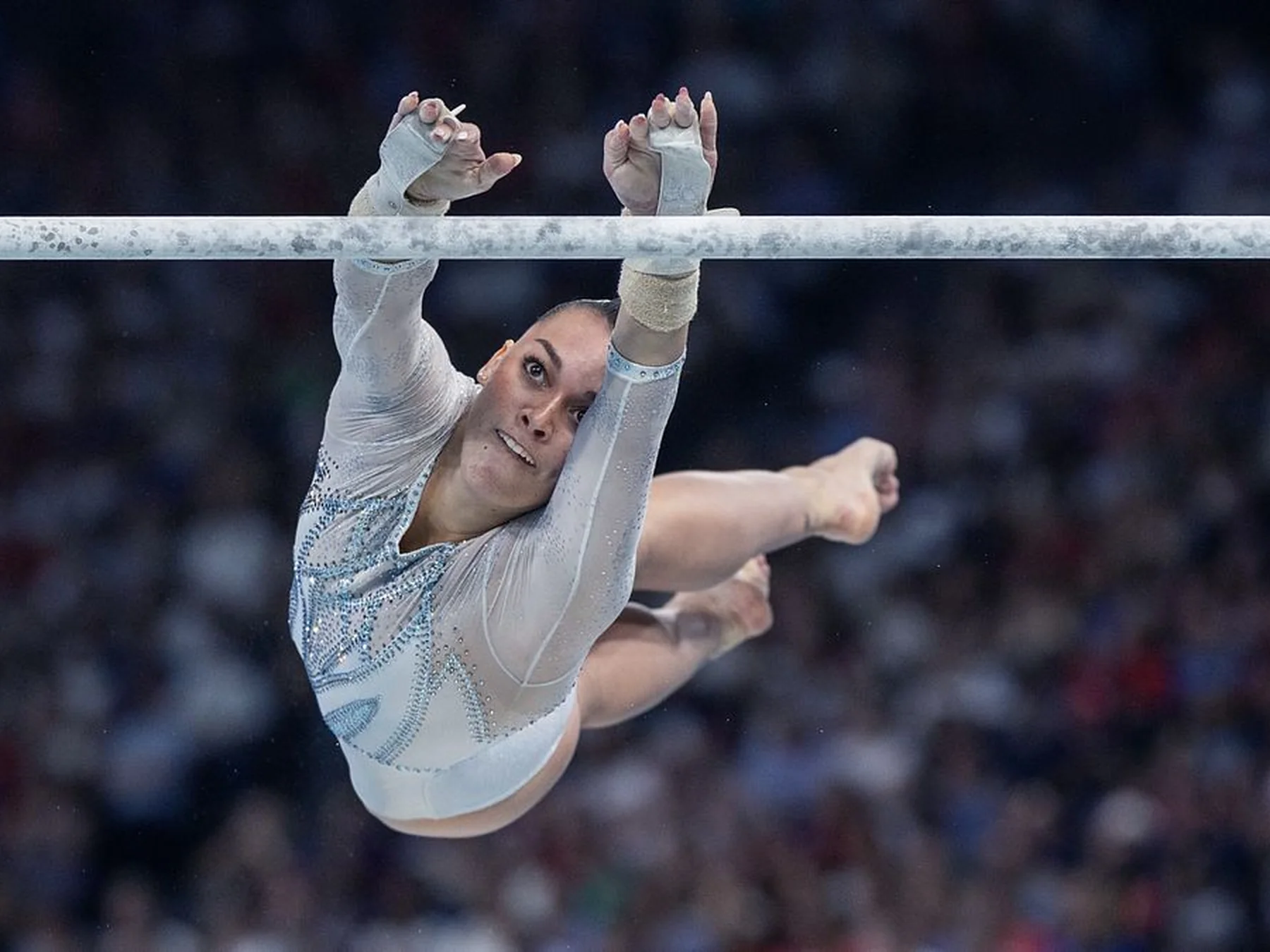
- Romanian gymnast Nadia Comăneci became one of gymnastics’ most famous athletes at the 1976 Montreal Olympics.
- She was 14 years old during those Games.
- Comăneci received the first perfect 10.00 in Olympic artistic-gymnastics history.
- The score came on the uneven bars.
- The arena scoreboard was not designed to display 10.00.
- It showed 1.00 instead.
- Officials and spectators initially had to understand that 1.00 represented a perfect 10.
- Comăneci earned multiple perfect 10s during the Montreal Games.
- She won the individual all-around title.
- She also won gold on uneven bars and balance beam.
- The perfect 10 became a cultural symbol far beyond gymnastics.
- Other gymnasts also achieved perfect scores under the old system.
- The 10-point system eventually disappeared from elite international artistic gymnastics.
- Modern scoring can produce totals higher than 10.
- Comăneci’s historic performance remains the reason many casual fans still associate gymnastics with a perfect 10.
Why modern scores go above 10
- Elite artistic gymnastics now uses an open-ended scoring system.
- A gymnast receives a Difficulty score, often called the D score.
- The D score reflects the difficulty and composition of the routine.
- A separate Execution score is commonly called the E score.
- The E score begins from a maximum value and loses points for errors.
- Falls, bent legs, steps, form breaks, and poor landings can reduce execution.
- The final score combines difficulty and execution, with penalties applied where relevant.
- This allows gymnasts to receive total scores higher than 10.
- The system was introduced internationally after the 2004 Olympic cycle.
- One goal was to better reward increasingly difficult routines.
- A harder routine is not automatically better if execution deteriorates badly.
- Gymnasts and coaches therefore balance risk against potential scoring reward.
- Codes of Points are revised periodically by the FIG.
- Skills can change value between rule cycles.
- A routine optimized for one Olympic cycle may need redesign under the next code.
Vault happens incredibly fast
- Vault begins with a sprint down a runway.
- The gymnast hurdles onto a springboard.
- The springboard converts downward force into upward and forward motion.
- The athlete contacts the vault table with the hands.
- A powerful block through the shoulders launches the gymnast away from the table.
- Gymnasts may twist and somersault before landing.
- Vaults are grouped into families according to entry and flight technique.
- The Yurchenko family uses a roundoff onto the springboard and back-handspring-style entry onto the table.
- Natalia Yurchenko helped popularize the technique that bears her name.
- Modern vault tables replaced the older narrow vaulting horse.
- The wider table gives athletes a larger hand-contact surface.
- The change followed serious safety concerns around the older apparatus.
- Vault scoring depends on the listed difficulty of the selected vault.
- Landing control can strongly affect the final score.
- The entire competitive action lasts only seconds despite requiring years of preparation.
The balance beam is only 10 centimeters wide
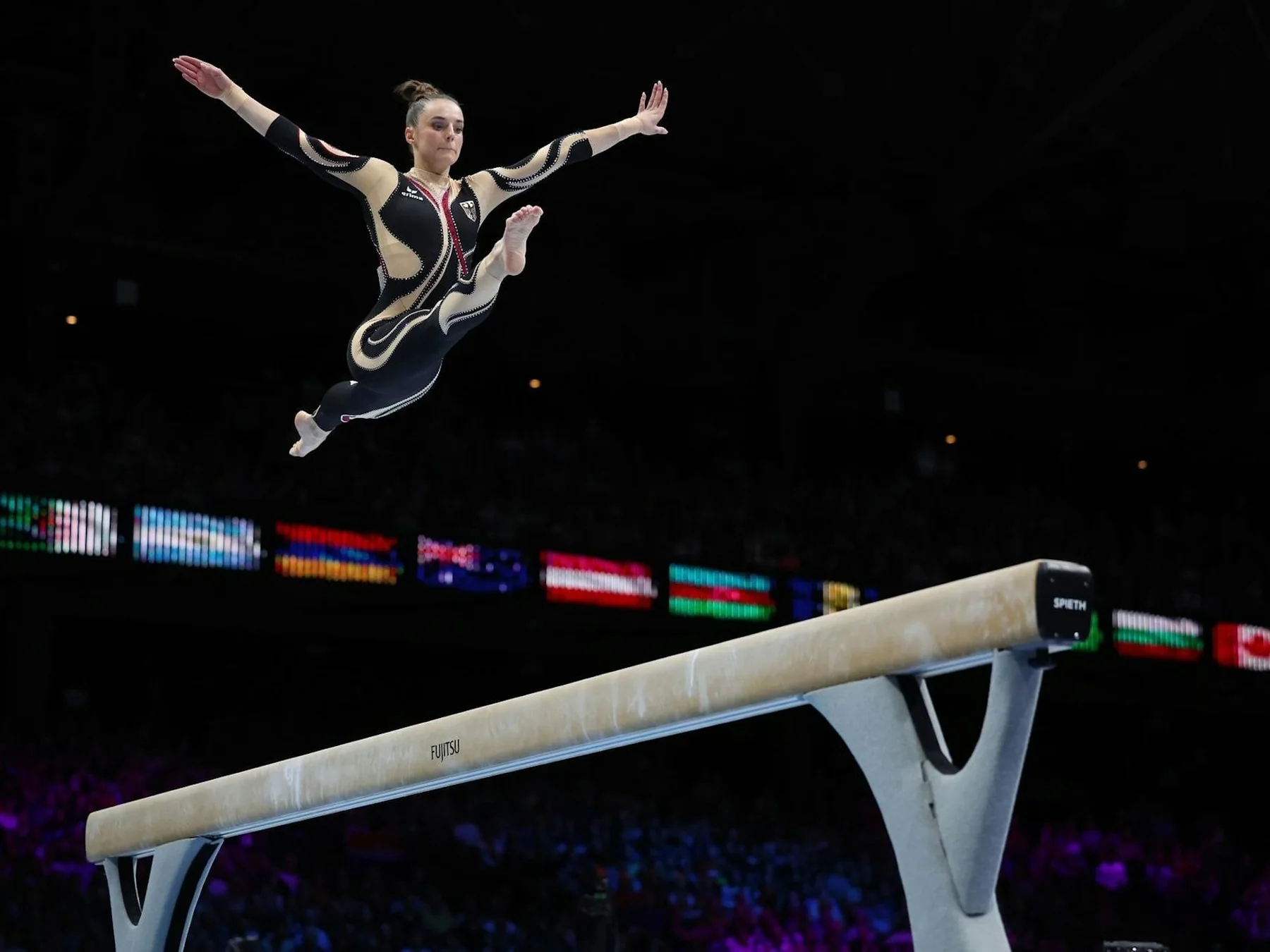
- The women’s balance beam is only 10 centimeters, or about 4 inches, wide.
- It is 5 meters, or about 16.4 feet, long.
- The competition beam stands 1.25 meters above the floor.
- Gymnasts perform leaps, turns, acrobatics, dance, and connections on that narrow surface.
- A routine includes a mount and dismount.
- Even tiny alignment errors can become major balance problems.
- Gymnasts use visual reference points to orient themselves.
- Arms help control rotational momentum and balance.
- Toe and ankle adjustments happen almost constantly.
- The beam surface has padding but remains firm enough for takeoff.
- Gymnasts train skills first on floor lines and low beams.
- Soft mats and spotting reduce risk during skill development.
- Falls during competition create major execution deductions.
- A wobble can cost points even if the gymnast stays on the apparatus.
- Beam combines the precision of dance with the risk of airborne acrobatics.
Bars, rings, and impossible-looking strength
- Women’s uneven bars use two fiberglass-based rails set at different heights.
- Gymnasts swing around, between, above, and between the bars.
- Release moves require letting go and catching the bar again in flight.
- Hand grips help protect skin and improve connection with the apparatus.
- Chalk absorbs moisture and improves friction.
- Men’s horizontal bar also features high-speed giant swings and release skills.
- Still rings demand exceptional upper-body strength and stabilization.
- The rings are suspended on straps and can move independently.
- A strength hold is harder because the gymnast must prevent the rings from swinging outward.
- The iron cross is one of the most recognizable ring strength positions.
- In an iron cross, the arms extend outward while the body hangs upright.
- Pommel horse routines rely on continuous circular leg motions and hand support.
- Parallel bars combine swinging, balancing, flight, and strength.
- Men’s floor exercise uses tumbling and strength elements without music at elite international level.
- Each apparatus rewards a different mix of biomechanical skills.
Skills can be named after gymnasts
- Elite gymnastics contains many eponymous skills named after athletes.
- A gymnast generally must successfully perform a new skill at an eligible major international competition for naming consideration.
- The skill must also satisfy FIG technical requirements.
- Simone Biles has multiple skills named after her.
- The Biles on floor is a double layout with a half twist.
- Another Biles floor skill is a triple-twisting double back somersault.
- Biles also has vault skills named for her.
- The Yurchenko double pike vault became one of the most difficult women’s vaults performed internationally.
- Named skills preserve athlete innovation inside the official Code of Points.
- A skill name can remain long after its originator retires.
- Not every new-looking variation qualifies as a separately named element.
- Judges must distinguish among hundreds of coded skills.
- Difficulty values encourage athletes to keep pushing technical boundaries.
- Safety rules can limit or prohibit skills considered excessively dangerous.
- Gymnastics history is therefore literally written into the names of movements.
Ten surprising gymnastics facts
- The balance beam is only about four inches wide.
- Nadia Comăneci’s first Olympic perfect 10 appeared as 1.00 because the scoreboard could not display 10.00.
- Modern elite gymnastics scores can exceed 10 because difficulty and execution are scored separately.
- The modern vault table replaced a much narrower horse partly for safety.
- Gymnasts use chalk mainly to manage moisture and friction, not for decoration.
- Still rings move independently, which makes static strength positions harder.
- Some official skills permanently carry the names of the athletes who introduced them.
- Gymnastics entered the modern Olympics in 1896, but women did not compete there until 1928.
- Trampoline became an Olympic gymnastics discipline only in 2000.
- For more sports trivia, explore our Olympics facts and Simone Biles facts.
Quick gymnastics FAQ
How wide is a balance beam?
Only 10 centimeters, or about 4 inches.
Why can gymnastics scores be higher than 10 now?
Elite artistic gymnastics combines an open-ended Difficulty score with an Execution score and any penalties, so the total is not capped at 10.
Who earned the first Olympic perfect 10?
Nadia Comăneci of Romania at the 1976 Montreal Olympics on uneven bars.
What events do women compete in?
Vault, uneven bars, balance beam, and floor exercise in artistic gymnastics.
How does a gymnastics skill get named after an athlete?
The gymnast must successfully perform a qualifying new element at an eligible major international competition and the element must meet FIG requirements for recognition.

Ellie is the owner and sole author of Fun Facts, combining her mechanical engineering background with years of research-driven writing to deliver facts you can trust. Every article is thoroughly fact-checked and routinely updated as new science and sources emerge to keep information accurate and current. Her mission is to make learning delightful while upholding high standards of reliability and transparency.