
Thailand is colorful, welcoming, and full of surprises, from mountain temples and coral reefs to spicy street food and ancient history.
Dive into these bite-size facts to learn how Thailand’s places, people, language, animals, and traditions all fit together.
Ready to explore the “land of the free”?
Origins & definitions
- Thailand is the only Southeast Asian nation never colonized by a European power.
- The country was known as Siam until 1939 and again from 1945 to 1949.
- The name "Thailand" translates as "land of the free."
- Thailand is a constitutional monarchy with a parliamentary system.
- A common national motto is "Nation, Religion, King."
- The flag has five horizontal stripes: red, white, blue, white, red.
- The central blue stripe on the flag is twice as wide as the others.
- The national anthem is "Phleng Chat Thai," adopted in 1939.
- The elephant is a national symbol, with white elephants historically reserved for royalty.
- The official currency is the Thai baht (THB).

Geography & nature
- Thailand covers about 513,000 square kilometers, roughly the size of Spain.
- It lies entirely within the tropics between about 5° and 21° north.
- Thailand shares land borders with Myanmar, Laos, Cambodia, and Malaysia.
- The country has coastlines on the Andaman Sea to the west and the Gulf of Thailand to the east.
- The highest peak is Doi Inthanon at 2,565 meters.
- The Chao Phraya River flows about 372 kilometers through central Thailand to Bangkok.
- The Mekong River forms much of the northeastern border with Laos.
- Northern Thailand is mountainous, while the central plain is a major rice-growing lowland.
- The northeast, called Isan, sits on the Khorat Plateau with sandy, ancient soils.
- Southern Thailand narrows into the Malay Peninsula with two contrasting coasts.
- Thailand lies in the monsoon belt with a wet season roughly from May to October.
- Average Bangkok temperatures range around 26–32°C year-round.
- Thailand observes Indochina Time at UTC+7 and does not use daylight saving time.
- The country has more than 100 national parks protecting forests, reefs, and mountains.
- Khao Yai, established in 1962, is Thailand’s first national park.
- Thailand includes more than 1,000 islands of various sizes and shapes.
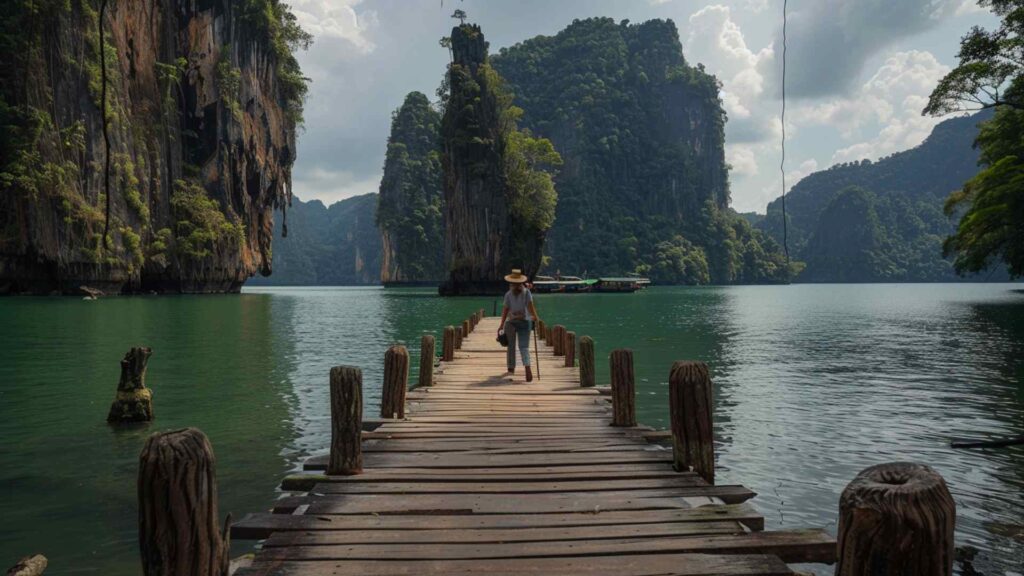
- Phang Nga Bay is famous for limestone karst pillars rising from emerald water.
- The two coasts have different monsoon peaks, creating beach seasons that alternate through the year.
- The Similan Islands are renowned for clear-water diving with granite boulder reefs.
- The Thai–Myanmar border runs for more than 2,400 kilometers across mountains and rivers.
History & timeline
- Humans have lived in Thailand for tens of thousands of years, as shown by prehistoric sites.
- Ban Chiang in Udon Thani reveals Bronze Age metallurgy dating back over 3,000 years.
- The Sukhothai Kingdom emerged in the 13th century as an early Thai polity.
- The Ramkhamhaeng Inscription is often cited as an early record of Thai script from 1292.
- The Ayutthaya Kingdom lasted from 1351 to 1767 and became a regional trading power.
- Ayutthaya fell to a Burmese invasion in 1767 after a long siege.
- General Taksin established the Thonburi Kingdom and reunited much of the land by the 1770s.
- In 1782 the Chakri dynasty founded the Rattanakosin Kingdom and moved the capital to Bangkok.
- Nineteenth-century treaties opened Siam to global trade and Western influence.
- Thailand modernized its legal and educational systems during the late 1800s.
- The country transitioned to a constitutional monarchy in 1932.
- During World War II, Thailand experienced occupation and complex wartime alliances.
- Rapid industrialization transformed Thailand’s economy from the 1960s onward.
- Bangkok’s BTS Skytrain opened in 1999, reshaping urban transport.
- The 1997 Constitution was dubbed the “People’s Constitution” for expanding civil rights.
- The 2004 Indian Ocean tsunami impacted Thailand’s Andaman coast, including Phuket.
- The 2018 Tham Luang cave rescue brought global attention to northern Thailand.
- Thailand’s administrative map includes 76 provinces plus Bangkok as a special administrative area.
- Provincial governors are appointed by the Interior Ministry except for Bangkok’s elected governor.
- The Buddhist Era calendar used officially is 543 years ahead of the Gregorian year.
Language & writing
- Thai is the official language and a member of the Tai-Kadai language family.
- Thai is tonal with five tones that change word meaning.
- Standard Thai uses 44 consonant letters in its alphabet.
- There are 15 vowel symbols that combine into more than 28 vowel forms.
- Thai script is written left to right without spaces between words.
- The Thai writing system traces historical roots to Old Khmer script.
- Royal vocabulary forms a special register used when speaking about the monarchy.
- Many regional languages are spoken, including Isan Lao, Northern Thai, and Southern Thai.
- English is widely taught in schools and used in tourism and business.
- Thai personal names typically include a unique surname and a given name.
- Thailand introduced family names nationwide in 1913, making duplicate surnames uncommon.
- Most people use short nicknames in daily life, often one syllable.
- Loanwords in Thai come from Pali, Sanskrit, Khmer, Chinese, and English.
- The polite particles "khrap" and "kha" are added to soften speech.
- The greeting "wai" involves pressing the palms together and bowing slightly.
Culture, customs & daily life
- Over 90% of Thais identify with Theravada Buddhism alongside local spirit beliefs.
- Temples, called "wats," serve as religious and community centers.
- Visitors should dress modestly at temples and remove shoes before entering.
- The Emerald Buddha is Thailand’s most sacred image and sits in Wat Phra Kaew.
- The Emerald Buddha is about 66 centimeters tall and wears seasonal costumes changed by the monarch.
- Thai etiquette discourages touching someone’s head, which is considered the most sacred part of the body.
- Feet are viewed as low status, so pointing feet at people or images is impolite.
- Respect for the monarchy is a deeply ingrained social norm.
- Muay Thai is recognized as the national sport and is called the "art of eight limbs."
- The Wai Khru Ram Muay dance pays respect to teachers before a Muay Thai bout.
- Songkran, the Thai New Year from 13–15 April, features water splashing to symbolize renewal.
- Loy Krathong in the 12th lunar month floats decorated leaf boats on waterways.
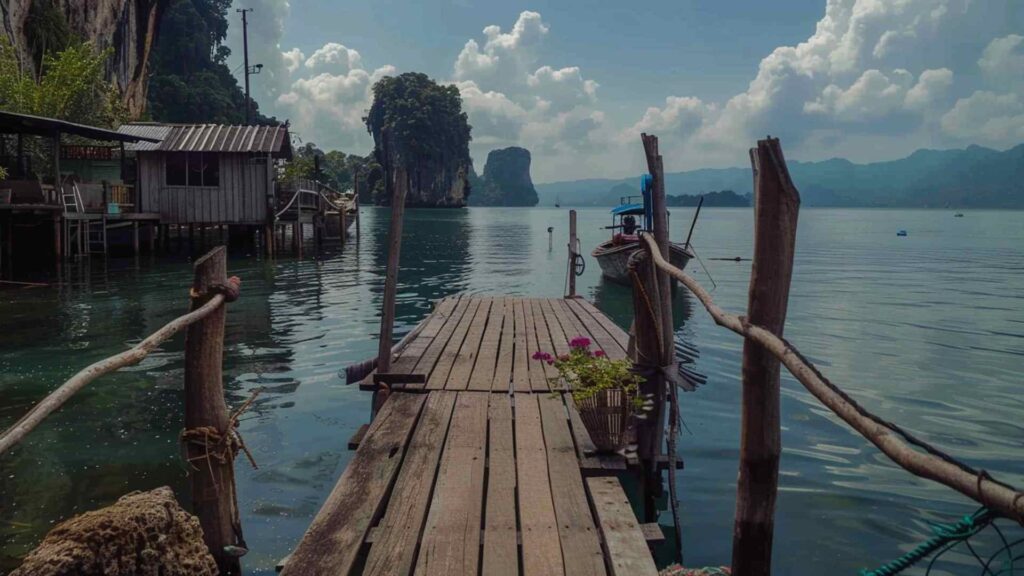
- Traditional Thai houses are raised on stilts to handle floods and increase airflow.
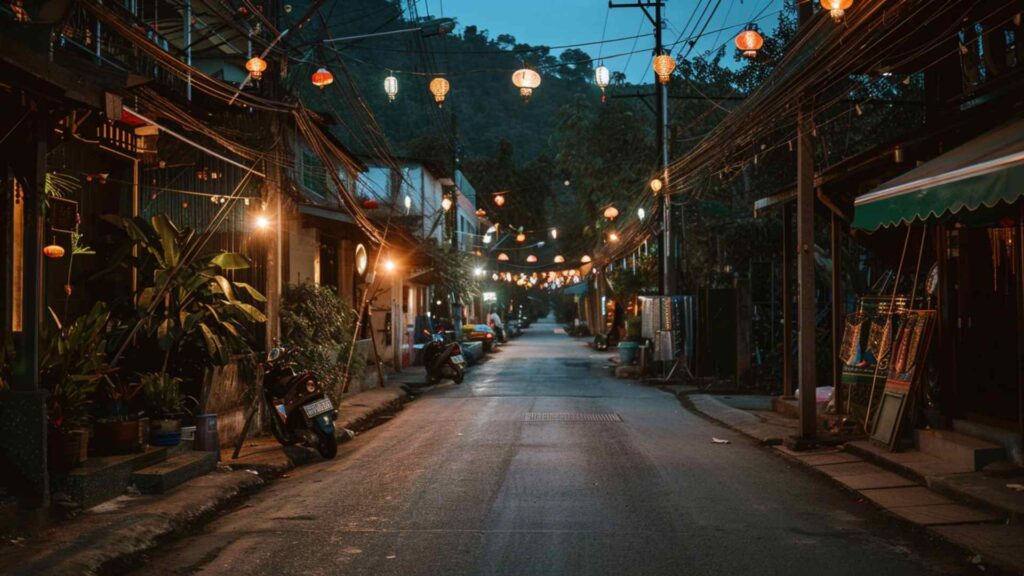
- Many markets open before dawn, while night markets buzz late into the evening.
- Thai massage uses stretching and acupressure techniques developed over centuries.
- Color symbolism is popular, with days of the week linked to specific colors.
- Spirit houses are small shrines placed outside buildings to honor protective spirits.
- Rocket festivals in the northeast launch homemade rockets to call for rain before planting.
- Thailand drives on the left side of the road.
- Family ties are strong, and many households include multiple generations.
Food & flavors
- Rice is a daily staple, and Thailand is a leading producer of fragrant jasmine rice.
- Sticky rice is favored in the north and northeast, often eaten by hand.
- The classic Thai flavor balance mixes spicy, sour, sweet, bitter, and salty.
- Fish sauce, called "nam pla," provides salty umami in many dishes.
- "Nam prik" refers to a family of chili dips eaten with vegetables and proteins.
- Pad thai stir-fried noodles became popular nationwide in the 20th century.
- Tom yum soup combines lemongrass, galangal, lime, chilies, and herbs for a hot-sour kick.
- Green curry uses green chilies and coconut milk for a fragrant stew.
- Som tam is a crunchy papaya salad pounded in a mortar with lime and chilies.
- Satay skewers with peanut sauce are common street snacks.
- Thai bird’s eye chilies often reach 50,000–100,000 Scoville heat units.
- Thai basil, holy basil, and sweet basil are distinct herbs used in different dishes.
- Mango sticky rice pairs ripe mango with coconut-sweetened sticky rice.
- Durian is nicknamed the "king of fruits" for its strong aroma and creamy texture.
- Mangosteen is often called the "queen of fruits" for its sweet-tart segments.
- Street food stalls commonly specialize in a single dish for consistency.
- Thai iced tea is brewed strong and sweetened with sugar and milk.
- Coconut milk is a key ingredient in many curries and desserts.
- Northern "khao soi" is a curry noodle soup topped with crunchy noodles.
- "Pad kra prao" stir-fries holy basil with meat and chilies, often topped with a fried egg.
Cities, places & landmarks
- Bangkok’s local name is Krung Thep Maha Nakhon, meaning "City of Angels."
- Bangkok’s ceremonial name contains more than 160 Thai characters in full.
- The Grand Palace complex began construction in 1782 along the Chao Phraya River.
- Wat Pho houses a Reclining Buddha statue about 46 meters long.
- Wat Arun’s central prang rises around 70 meters above the riverside.
- Chiang Mai was founded in 1296 as the capital of the Lanna Kingdom.
- The old city of Chiang Mai is surrounded by a square moat and remnants of walls.
- Sukhothai Historical Park preserves temple ruins set among ponds and laterite columns.
- Ayutthaya’s ruined prangs once formed a skyline of hundreds of temples.
- Kanchanaburi’s bridge over the River Kwai memorializes a World War II railway.
- Phuket is Thailand’s largest island by area.
- Railay in Krabi is famed for rock climbing on steep limestone cliffs.
- Pai in Mae Hong Son Province is a small mountain town popular for its relaxed vibe.
- The Erawan Falls in Kanchanaburi cascade over seven tiers of turquoise pools.
- The Ancient City park near Bangkok displays scaled replicas of Thai landmarks.
- The Damnoen Saduak floating market features boats selling fruit, snacks, and souvenirs.
- The Chatuchak Weekend Market in Bangkok spans thousands of stalls across dozens of sections.
- Suvarnabhumi Airport opened in 2006 as Bangkok’s main international gateway.
- The BTS Skytrain and MRT subway connect many of Bangkok’s key districts.
- Long-tail boats with repurposed car engines power through canals and island waters.
Animals & environment
- Asian elephants live in Thailand’s forests and are protected by law.
- Gibbons, langurs, and macaques swing and scamper in national parks.
- Hornbills with large beaks nest in old hollow trees in the south.
- Tigers still roam remote parks, though in low numbers.
- The whale shark, the world’s largest fish, sometimes visits Thai waters.
- Dugongs graze on seagrass in sheltered Andaman Sea bays.
- Coral reefs around the Andaman and the Gulf host clownfish, rays, and groupers.
- Monsoon forests drop leaves in the dry season to conserve water.
- Community projects promote mangrove restoration along coastal zones.
- Plastic reduction campaigns encourage refill bottles and fewer single-use bags.
Pop culture, sports & fun extras
- Thai cinema ranges from historical epics to quirky comedies with growing international audiences.
- Luk thung and mor lam are popular folk music styles from central and northeastern regions.
- Traditional khon dance uses masked performers to retell epic stories.
- Shadow puppetry called nang yai projects intricate leather figures against lit screens.
- The Ramakien is Thailand’s national epic adapted from the Ramayana.
- Thai silk, especially from Isan, is prized for its sheen and handwoven patterns.
- The color yellow is often worn on Mondays to honor the monarch’s birth day.
- Weekend walking streets are popular in many Thai towns.
- Community morning alms give food to monks walking barefoot at dawn.
- Firefly watching along mangrove-lined canals lights up warm, humid nights.
Quick FAQ
What is the capital of Thailand?
Bangkok is the capital and largest city.
What language do people speak in Thailand?
Thai is the official language, with many regional languages also spoken.
What currency does Thailand use?
Thailand uses the Thai baht (THB).
When is Thai New Year celebrated?
Songkran is celebrated from 13–15 April each year.
Do people in Thailand drive on the left?
Yes, Thailand drives on the left side of the road.

Ellie is the owner and sole author of Fun Facts, combining her mechanical engineering background with years of research-driven writing to deliver facts you can trust. Every article is thoroughly fact-checked and routinely updated as new science and sources emerge to keep information accurate and current. Her mission is to make learning delightful while upholding high standards of reliability and transparency.