
Snow leopards live high in the world’s great mountains, where thin air, cold winds, and rocky cliffs shape every move they make.
This friendly guide packs crisp, kid-safe facts about their jumps, diet, families, and clever survival tricks.
Ready to track the “ghost of the mountains”? Let’s go.
Origins & definitions
- The snow leopard is a wild cat native to high mountain ranges of Central and South Asia.
- Its scientific name is Panthera uncia.
- People often call it the “ghost of the mountains” because it is very hard to see.
- Snow leopards belong to the big cat lineage but cannot roar like lions or tigers.
- They typically live between 3,000 and 5,500 meters above sea level.
- Their range spans 12 countries across Asia’s great ranges.
- They favor rocky cliffs, ravines, and alpine meadows above the tree line.
- Adults are solitary and defend large home ranges.
- A wild snow leopard usually lives around 10 to 12 years.
- In human care, some individuals have reached over 20 years of age.
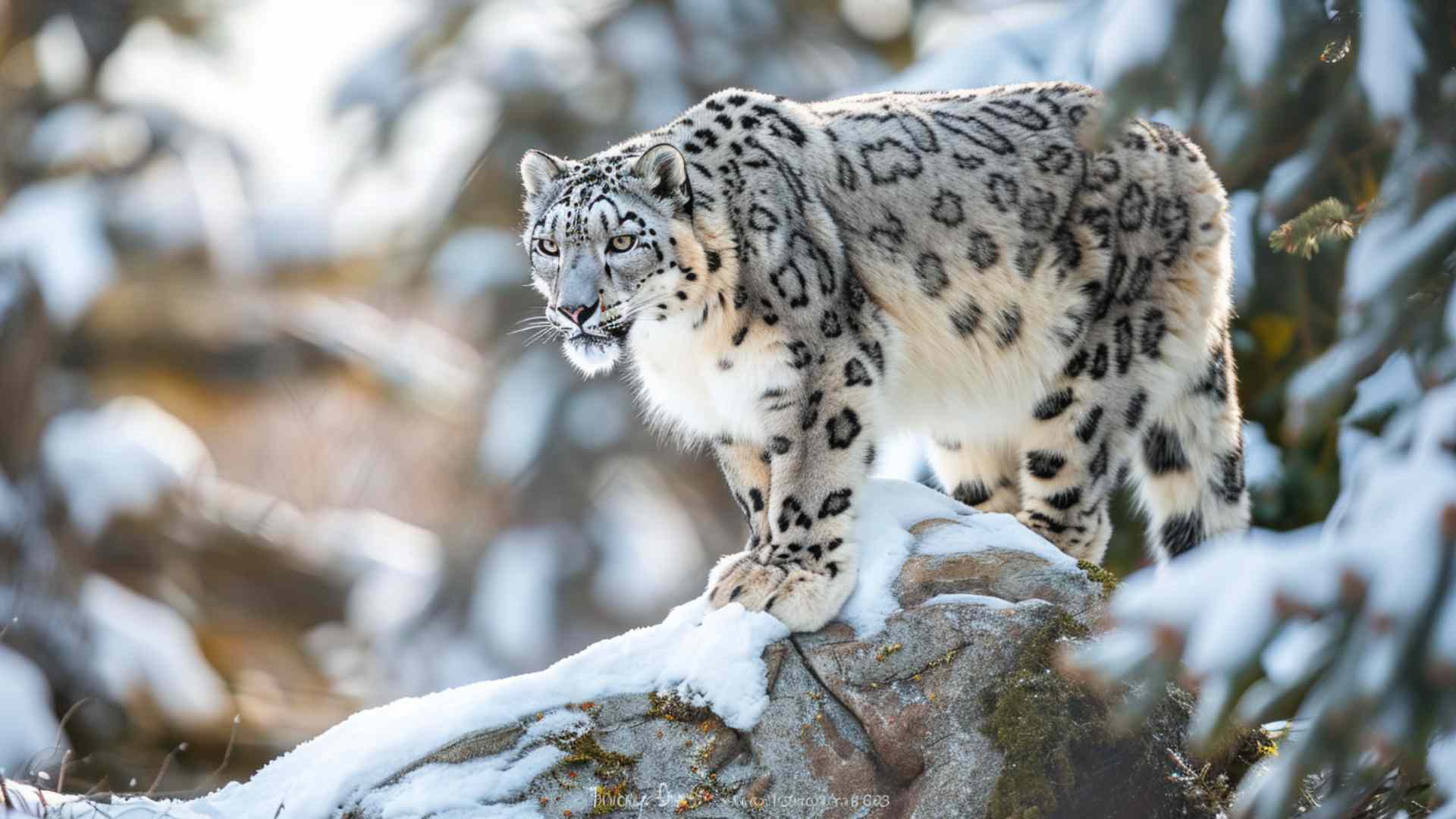
- Their coat shows pale gray to smoky brown fur with dark rosettes and spots.
- Every snow leopard’s spot pattern is unique, like a fingerprint.

Record-breakers & wow numbers
- A snow leopard can leap as far as 15 meters in a single bound.
- Its tail can be nearly as long as its body, reaching about 80 to 100 centimeters.
- The thick tail helps with balance on cliffs and works like a warm scarf during rest.
- The cat can bring down prey three times its own body weight on steep ground.
- A typical adult weighs 22 to 55 kilograms, with big males sometimes heavier.
- Body length usually ranges from 100 to 130 centimeters, not counting the tail.
- Shoulder height is about 60 centimeters, giving a low, powerful profile.
- Home ranges can cover over 200 square kilometers in areas with little prey.
- In richer valleys, some cats use much smaller ranges under 50 square kilometers.
- Their paws can be 10 to 12 centimeters across, spreading their weight on snow.
- Guard hairs on the back can reach about 5 centimeters in length for insulation.
- The fur on the belly can grow even longer, sometimes near 12 centimeters.
- Kittens are born weighing roughly 300 to 600 grams.
- A single large ibex can feed one cat for a week or more.
- The cat can silently stalk for hundreds of meters before the final rush.
- Their night vision is several times better than a human’s, aiding crepuscular hunts.
- Litters commonly contain two to three kittens.
- Gestation lasts about 90 to 100 days.

Anatomy & adaptations
- A broad nasal cavity warms icy air before it reaches the lungs.
- Small rounded ears reduce heat loss in freezing winds.
- Extra fur grows on the soles of their feet to insulate against snow.
- Long hind legs give strong upward thrust for cliffside jumps.
- The long tail stores fat and helps the cat steer during leaps.
- Their fur shows open rosettes that are larger and paler than those of leopards.
- Thick underfur traps air and keeps body heat close to the skin.
- The eyes are usually pale green or gray, blending with snowy rock.
- Whiskers act as sensors that help judge gaps and ledges in low light.
- Adults have 30 permanent teeth specialized for slicing meat.
- The carnassial pair shears flesh like scissors during feeding.
- Retractable claws stay sharp for gripping ice and rock.
- The cat’s spine is flexible, allowing a long reach during a leap.
- A thick ruff around the neck adds insulation in storms.
- The tail has dark rings toward the tip with a black end.
- The nose and lungs are adapted for thin air at high altitude.
- Their pupils are round, a trait shared with most big cats.
- The cat communicates friendly intent with a soft “chuff” sound.
- It also growls, hisses, and yowls when threatened or during mating.
- Scent glands on cheeks and near the tail help mark rocks and trails.
- The coat sheds seasonally, growing denser before winter.
- Cubs are born with a woolly coat that thickens rapidly in the first month.
- Kittens open their eyes about a week after birth.
- The skull has wide zygomatic arches to anchor strong jaw muscles.
- Their heart and lungs are proportionally large for endurance in thin air.
- A countershaded belly reduces shadows and helps the cat blend into snow.
- The whisker spots on a snow leopard’s muzzle remain stable throughout life.
- The tail is so supple that resting cats can curl it around the face like a muffler.
Habitat, behavior & diet
- Snow leopards are most active at dawn and dusk when prey moves.
- They travel along ridgelines to stay hidden and watch the valleys below.
- The species prefers broken terrain where cliffs offer cover for ambush.
- Alpine meadows provide summer hunting grounds for goats and sheep.
- In winter many cats follow prey to slightly lower slopes and valleys.
- Primary wild prey includes blue sheep, ibex, and other mountain ungulates.
- Smaller prey such as marmots, pikas, and hares fill gaps in their diet.
- The cat often approaches from above and launches a sudden downhill sprint.
- If a first rush fails, the cat may abandon the chase to save energy.
- Cats drag kills to ledges where they can feed in safety.
- They cache leftovers under snow or rocks to return over several days.
- Snow leopards sometimes take livestock, which can cause conflict with herders.
- Their presence often signals a healthy community of wild mountain prey.
- Snow leopards share ranges with wolves, lynx, and foxes that also hunt the slopes.
- Competition with wolves can push the cats into rougher terrain.
- Adults keep loose boundaries marked with scrapes and scent sprays.
- Males often overlap ranges with several females.
- Females defend key denning cliffs and hunting travel routes.
- Travel routes include saddles, passes, and boulder fields that hide their approach.
- Snow and wind erase tracks fast, helping the cat stay unseen.
- Cats cross scree slowly, placing each foot carefully to avoid slides.
- In Mongolia and parts of China, some cats use arid mountains near the Gobi edges.
- In the Himalaya, cats climb above 5,000 meters where oxygen is thin.
- The northern range reaches the Altai and other ranges of southern Siberia.
- The western range extends into the Hindu Kush and Pamir mountains.
- The southern range includes the highlands of India, Nepal, and Bhutan.
- The eastern range touches the Tien Shan and Kunlun chains of western China.
- Many cats cross political borders as they follow herds along mountain chains.
- Avalanches and rockfalls are natural hazards in their daily travel.
- Snow leopards often rest on sunny ledges during the day to conserve heat.
Reproduction & life cycle
- Mating usually peaks in late winter when days start to lengthen.
- Pairs may call to each other across cliffs during the brief breeding season.
- After about 90 to 100 days, the female gives birth in a sheltered den.
- Dens are often deep cracks, caves, or boulder piles lined with fur.
- Litters range from one to five kittens, with two or three most common.
- Kittens start to walk around five weeks of age.
- By two months, kittens begin to nibble at meat from the mother’s kills.
- Weaning typically finishes by three months.
- The family starts traveling with the mother when the kittens are a few months old.
- Youngsters practice stalking and pouncing during play near the den.
- Juveniles stay with their mother through their first winter.
- Independence usually comes at 18 to 22 months.
- Young cats may disperse long distances to find their own ranges.
- Females can breed again once their previous litter becomes independent.
- In the wild, many kittens do not survive their first year due to hazards and hunger.

Conservation & status
- Snow leopards are classified as Vulnerable as of 2024.
- The global population is estimated in the low thousands, with many areas still unsurveyed.
- Main threats include loss of wild prey, habitat fragmentation, and retaliatory killing.
- Poaching for pelts and body parts remains a risk in some regions.
- Warmer temperatures may push the tree line higher and shrink alpine habitat.
- Expanding roads and mines can cut travel corridors between valleys.
- Camera traps and genetic sampling have improved counts in remote ranges.
- Community programs that reduce livestock losses can lower conflict with herders.
- Predator-proof corrals help protect goats and sheep at night.
- Insurance schemes that pay for verified losses can prevent retaliatory hunts.
- Local guards and rangers monitor trade routes for illegal wildlife items.
- Transboundary cooperation helps protect cats that cross national borders.
- Many countries now celebrate a dedicated snow leopard day each year in October.
- Eco-tourism, when well managed, can provide income that rewards protection.
Names & etymology
- The common name uses “leopard” because of the rosette pattern on the fur.
- The older English word “ounce” once referred to this mountain cat.
- The scientific species name uncia echoes that old term.
- In several languages of Central Asia the cat is called “irbis.”
- The nickname “ghost of the mountains” highlights its silent, elusive habits.
- In Chinese the modern name means “snow leopard.”
- In Mongolian the animal is widely known as “irves.”
- Regional names often reference snow, rock, or ghosts to match the cat’s world.
For kids: quick comparisons
- A snow leopard is shorter and lighter than a tiger but has a longer tail for its size.
- Unlike lions, snow leopards do not form prides.
- Compared with cheetahs, snow leopards trade speed for climbing power.
- Compared with clouded leopards, snow leopards live much higher in the mountains.
- Against common leopards, snow leopards have paler fur and larger rosettes.
- A snow leopard’s tail is proportionally longer than the tail of most big cats.
- The cat’s gray coat blends with rock better than a tiger’s orange stripes would.
- On level ground a cheetah is faster, but on cliffs the snow leopard is steadier.
- A house cat’s paw has the same basic structure, just in a much smaller size.
- A snow leopard hunts mostly alone, while wolves usually hunt as a pack.
- Snow leopards prefer cold, high places, while jaguars favor warm, low forests.
- The snow leopard’s thick fur makes it look larger than its true weight.
Pop culture & fun extras
- Many mountain towns use snow leopards on badges and flags as proud symbols.
- The cat appears in children’s books as a quiet guardian of the peaks.
- Wildlife cameras have captured playful kittens tumbling in talus near dens.
- Artists often paint the cat with swirling snow to show its stealthy grace.
- Films and documentaries have made the “ghost of the mountains” famous worldwide.
- A snow leopard was chosen as a Winter Games mascot in the 2010s.
- Plush snow leopards help teach kids about mountain wildlife and conservation.
- Seeing clear paw prints on a fresh drift is a thrilling sign that a cat passed nearby.
Quick FAQ
What is a snow leopard’s scientific name?
Panthera uncia.
Where do snow leopards live?
They live in high Asian mountains, mainly between 3,000 and 5,500 meters.
How big is a snow leopard?
Adults usually weigh 22–55 kg and measure 100–130 cm long, plus an 80–100 cm tail.
Can snow leopards roar?
No, they cannot roar, but they chuff, growl, and yowl.
What do snow leopards eat?
They mostly hunt wild goats and sheep, plus smaller prey like marmots and pikas.
Are snow leopards endangered?
They are classified as Vulnerable as of 2024, with populations still in the low thousands.

Ellie is the owner and sole author of Fun Facts, combining her mechanical engineering background with years of research-driven writing to deliver facts you can trust. Every article is thoroughly fact-checked and routinely updated as new science and sources emerge to keep information accurate and current. Her mission is to make learning delightful while upholding high standards of reliability and transparency.