
Sloths are the famously slow tree dwellers of the American tropics, but there’s much more to them than sleepy smiles.
From algae-covered fur to super swimmer skills, these gentle mammals are full of surprises.
Dive into 145 kid-friendly facts that make sloths unforgettable and wonderfully weird.
Origins & definitions
- Sloths are tree-dwelling mammals native to tropical forests of the Americas.
- Modern sloths are split into two groups: two-toed sloths and three-toed sloths.
- The “two-toed” and “three-toed” names refer to the number of fingers on the front limbs.
- Both two-toed and three-toed sloths have three toes on their hind feet.
- There are six living sloth species across two genera.
- Sloths belong to the order Xenarthra, along with anteaters and armadillos.
- The animal’s name describes a slow lifestyle rather than laziness.
- Sloths are arboreal, meaning they spend most of their lives in trees.
- Sloths are primarily leaf eaters and are considered folivores.
- Sloths are most active in the canopy and rarely visit the forest floor.

Record-breakers & wow numbers
- On land, sloths move at around 0.24 km/h (0.15 mph).
- A sloth can hold its breath underwater for up to 40 minutes.
- A three-toed sloth can rotate its head up to about 270 degrees.
- Sloths typically sleep about 10–15 hours per day.
- Digestion in sloths can take a week or more to complete.
- Many sloths descend to the ground only about once a week to defecate.
- Sloth claws can reach roughly 10 cm (4 in) in length.
- Adult sloths usually weigh between 3–9 kg (7–20 lb) depending on species.
- Sloths swim several times faster in water than they move on land.
- Three-toed sloths have up to nine neck vertebrae, more than most mammals.
- Sloth fur can host dozens of tiny moths and other critters at once.
- Wild sloths often use small home ranges measuring only a few hectares.
Biology & anatomy
- Sloth fur grows from belly to back, the opposite of most mammals, to shed rain while hanging.
- Grooves in the outer hairs trap moisture and help algae grow.
- Green algae in sloth fur adds camouflage among leaves.
- Sloths have a multi-chambered stomach that ferments tough leaves.
- Their teeth are simple, peg-like, and grow continuously.
- Sloths lack incisors and canines and crop leaves using their lips.
- Long forelimbs and curved claws make them excellent climbers.
- Special tendons help lock their grip so hanging uses little energy.
- Sloths can slow their heart rate to conserve oxygen.
- Sloth body temperature is low and varies with the environment.
- Their eyes work in low light but have limited sharpness.
- Hearing helps sloths detect nearby movement in dense forest.
- Three-toed sloths have a short tail, while two-toed sloths have a tiny or absent tail.
- Sloths have many ribs that help support their body while inverted.
- Some internal organs are attached to the rib cage to prevent pressure on the lungs when upside down.
- Sloths have small brains compared with many mammals of similar size.
- The sloth coat hosts algae, fungi, mites, beetles, and moths in a mini-ecosystem.
- Male brown-throated three-toed sloths often show a bright orange back patch.

Behavior & lifestyle
- Sloths are mostly solitary and do not form large groups.
- They spend most of their time in the upper canopy of tropical forests.
- Sloths often rotate among a handful of favorite trees.
- Scent marking and calls help sloths communicate and find mates.
- Three-toed sloths sometimes produce a high-pitched “ahh” call.
- Activity patterns vary by species and habitat, with some more nocturnal than others.
- Sloths climb branch to branch using a slow hand-over-hand motion.
- On the ground, sloths crawl by pulling with their forelimbs.
- Sloths are strong swimmers and can cross rivers and flooded forests.
- Grooming includes licking the fur and scratching with the claws.
- Sloths rest curled in tree forks that provide shelter from sun and rain.
- They bask in sun patches or move to shade to manage body temperature.
- Sloths sometimes descend to switch trees when canopies do not connect.
- They avoid open ground because it increases predator risk.
- Sloths stay quiet most of the time to avoid drawing attention.
- Their strong grip allows them to hang even while sleeping.
- Flexible joints and slow movement help sloths withstand occasional falls.
- Sloths remember routes through their personal network of trees.
Diet & digestion
- Sloths mainly eat leaves from a limited set of tree species.
- Some individuals also nibble fruit, flowers, and tender shoots.
- Leaf diets are low in calories, which shapes the sloth’s slow lifestyle.
- Gut microbes help break down tough plant cellulose.
- Sloth digestion yields little energy compared with many mammals.
- Food can remain in the stomach for many days before moving on.
- Sloths get much of their water from juicy leaves.
- They may lick raindrops or dew from leaf surfaces.
- Salt is scarce in leaves, so sloths sometimes seek natural mineral sources.
- The weekly bathroom trip sheds extra weight before the climb back up.
- Sloths often defecate at the base of the same tree they use.
- The exact reasons for the bathroom descent are still debated.
Reproduction & life cycle
- Sloths usually give birth to a single baby.
- Three-toed sloths have a gestation of about 5–6 months.
- Two-toed sloths have a gestation of about 10–12 months.
- Births happen in trees, with the baby arriving headfirst.
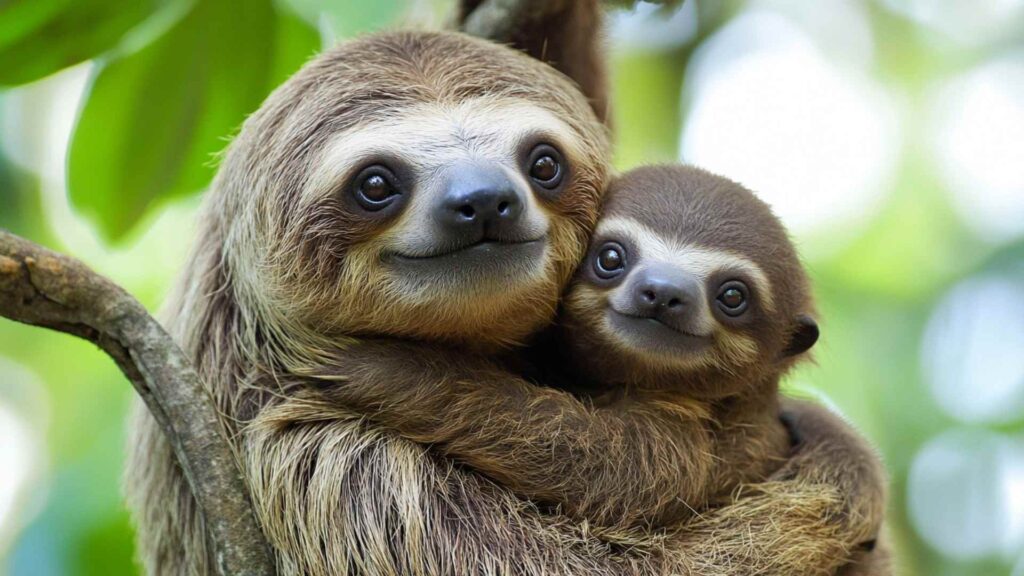
- Newborns cling to the mother’s chest using a strong grip.
- Mothers nurse their young for about 4–6 months.
- Babies start tasting leaves while still riding on their mother.
- Young sloths learn food choices by sampling their mother’s trees.
- Juveniles remain near their mother’s range for months after weaning.
- Sloths reach sexual maturity at roughly 2–3 years old.
- Male and female home ranges can overlap without close social ties.
- Sloth mothers groom and carry their infants throughout the day.
Habitat & range
- Sloths live from Central America through northern and central South America.
- Two-toed and three-toed sloths occupy slightly different forest niches.
- The maned sloth lives only in Brazil’s Atlantic Forest.
- The pygmy sloth lives only on a small island off Panama.
- Sloths move along natural canopy highways of vines and branches.
- Some populations live from sea level up into montane forests.
- Evergreen cover and high rainfall create ideal sloth habitat.
- Secondary forests can support sloths if the canopy stays connected.
- Habitat fragmentation limits safe movement between feeding trees.
- Rope bridges and canopy crossings help sloths traverse roads.
- Sloths sometimes use tall trees near towns and farms.
- Seasonal floods can force sloths to swim between tree islands.
Evolution & fossils
- Modern sloths descend from ancient ground-dwelling relatives.
- Giant ground sloths such as Megatherium reached enormous sizes.
- Many ground sloths went extinct near the end of the last Ice Age.
- Some Caribbean ground sloths survived until only a few thousand years ago.
- Sloths evolved in the Americas and never naturally spread to other continents.
- Today’s tree sloths represent a small branch of a once diverse group.
- Extra neck vertebrae in three-toed sloths evolved independently from other mammals.
- Two-toed and three-toed sloths are not very close relatives despite similar looks.
- Their common features are mainly due to similar tree-based lifestyles.
- Fossils show sloths ranged from small species to giants.
- Ancient sloths lived in open habitats as well as forests.
- Some ground sloths likely sheltered in caves during parts of the year.
- Ground sloth claws were adapted for pulling branches and digging.
- Genetic studies place sloths within Xenarthra alongside anteaters and armadillos.
Conservation & humans
- Major threats to sloths include deforestation, car strikes, and power-line shocks.
- The illegal pet trade removes sloths from the wild and harms populations.
- Canopy bridges and wildlife crossings reconnect broken habitats.
- Planting native trees boosts sloth food and shelter.
- Protecting riverside forest corridors helps sloths move safely.
- Careful ecotourism can support conservation while reducing stress on animals.
- Keeping dogs restrained near forest edges prevents sloth injuries.
- Teaching communities to recognize sloth-friendly trees aids protection.
- Quick reporting of injured sloths improves rescue outcomes.
- Many countries protect sloths by law from hunting and trade.
- Road signs and slower speed limits in sloth zones reduce collisions.
- Reforestation with continuous canopy lets sloths recolonize new areas.
- Pygmy sloths face high risk because their range is extremely small.
- Changing climate may shift where suitable sloth forests occur.
Names & etymology
- The English word “sloth” comes from an old term for slowness.
- Scientific family names reflect digit number and body form.
- The three-toed sloth’s genus Bradypus means “slow foot.”
- The two-toed sloth’s genus Choloepus is often translated as “lame foot.”
- The brown-throated sloth is named for its darker throat fur.
- The maned sloth is named for long mane-like hairs on its neck and shoulders.
- The pygmy sloth is named for its smaller size compared with mainland relatives.
For kids: quick comparisons
- A sloth moves at around one twentieth of a normal human walking speed.
- A sloth’s claw can be about as long as a short pencil.
- A sloth’s hook-like grip works like curved climbing hooks on a branch.
- Swimming sloths use a gentle dog-paddle stroke and float well.
- Extra neck bones let sloths scan for danger without moving their bodies much.
- A sloth’s fur is like a tiny garden where algae and insects live.
- A baby sloth rides its mother like a backpack for months.
- Sloths can lift their own body weight with their forelimbs.
- Sloth teeth keep growing through life, unlike adult human teeth.
Pop culture & fun extras
- Sloths are often used as symbols of calm and patience.
- Cartoon sloths usually show big smiles and sleepy eyes for a friendly look.
- Sloths appear in many children’s stories about rainforest animals.
- Slow-motion sloth videos are popular because their natural pace looks dramatic.
- Countries in sloth range sometimes feature them on postage stamps.
- People celebrate International Sloth Day in October to raise awareness.
- Sloth crafts and school projects often highlight the toe difference between species.
Quick FAQ
Q: How many species of sloths are there?
A: There are six living species: two two-toed species and four three-toed species.
Q: Are sloths really the slowest mammals?
A: They are among the slowest on land, moving at about 0.24 km/h, which helps save energy.
Q: Do sloths have predators?
A: Yes, major predators include big eagles, large cats, and snakes, especially when sloths are on the ground.
Q: Why do sloths go to the bathroom on the ground?
A: They usually descend weekly, and the exact reason is still debated.
Q: How long do sloths live?
A: Wild sloths often live over a decade, and some in human care can live for several decades.

Ellie is the owner and sole author of Fun Facts, combining her mechanical engineering background with years of research-driven writing to deliver facts you can trust. Every article is thoroughly fact-checked and routinely updated as new science and sources emerge to keep information accurate and current. Her mission is to make learning delightful while upholding high standards of reliability and transparency.