
Coffee is more than a morning routine, it’s a whole world in a cup.
From tiny flowers on mountain trees to rich espresso shots, every step shapes flavor.
Ready to learn how beans grow, roast, and brew into your favorite drinks? Sip these quick, friendly facts and become the coffee expert in your group.
Origins & Definitions
- Coffee is a brewed drink made from roasted seeds of the Coffea plant, which are called beans even though they are seeds.
- The Coffea fruit is known as a cherry and usually holds two seeds facing flat sides together.
- A coffee cherry with one round seed is called a peaberry and it often roasts a bit differently.
- Most coffee comes from two main species: Coffea arabica and Coffea canephora, commonly called Robusta.
- Arabica generally offers sweeter, more complex flavors, while Robusta is bolder and more bitter.
- Robusta plants tend to be hardier and more disease-resistant than Arabica plants.
- Arabica typically grows best at higher elevations between about 900 and 2,000 meters.
- The “coffee belt” is the tropical zone roughly between 25°N and 30°S where coffee grows well.
- The word “coffee” entered English through languages that borrowed from Arabic and Turkish.
- Espresso is a brewing method that uses pressure to force hot water through finely ground coffee.
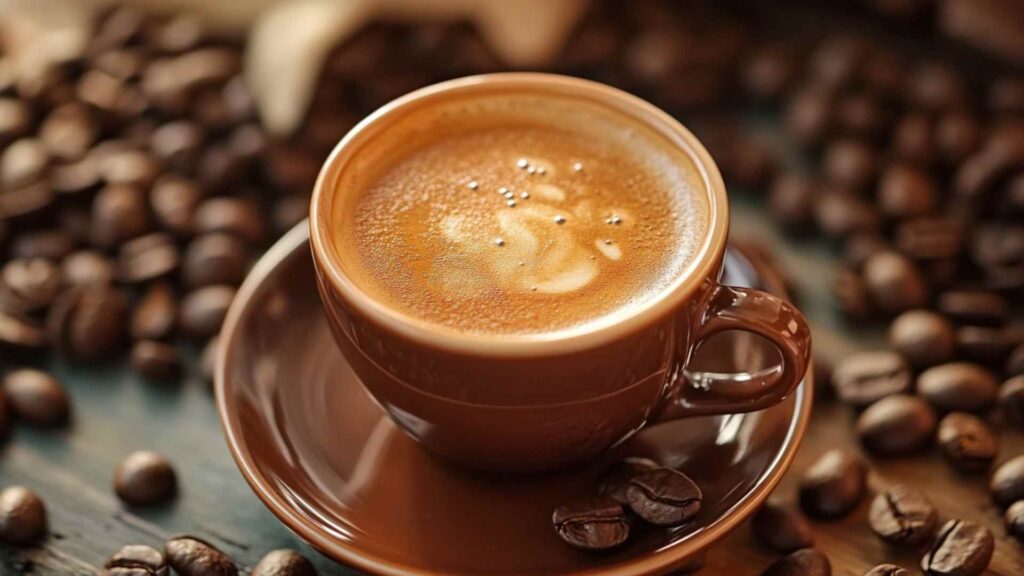
- “Crema” is the golden foam on top of a well-pulled espresso shot formed by emulsified oils and trapped gases.
- Decaf coffee is made from beans that have had most of their caffeine removed before roasting.
Record-breakers & Wow Numbers
- Brazil is the world’s largest coffee producer as of 2024.
- Vietnam ranks among the top global producers, especially known for Robusta as of 2024.
- Coffee plants can live for decades, and some well-cared trees produce for 20–30 years.
- A typical coffee cherry ripens in about 6–9 months after flowering.
- Light roasts generally retain slightly more caffeine by volume than dark roasts because they are denser.
- A standard 240 ml cup of brewed coffee often contains roughly 80–140 mg of caffeine.
- A single 25–35 ml espresso shot commonly holds about 50–75 mg of caffeine.
- Caffeine’s half-life in healthy adults is roughly 3–5 hours.
- An espresso machine usually brews at about 9 bars of pressure.
- Ideal brew water is typically around 90–96°C.
- Specialty-grade coffee is often scored 80 points or higher on a 100-point quality scale.
- Roasting can reduce bean weight by about 14–20% due to moisture loss and gas release.
- Freshly roasted beans can release noticeable CO₂ for several days, a process called degassing.
- Paper-filtered coffee tends to have lower oil content than unfiltered methods.
- Coffee aroma is extremely complex, involving hundreds of identifiable volatile compounds.

Botany & Biology
- Coffee plants are evergreen shrubs or small trees with glossy leaves and white, jasmine-like flowers.
- Coffee flowers are usually self-pollinating but can also be pollinated by insects and wind.
- Arabica plants have 44 chromosomes, while Robusta has 22.
- Arabica is a natural hybrid of two older species related to Coffea eugenioides and Coffea canephora.
- Robusta beans typically contain more caffeine than Arabica beans by weight.
- Higher altitude often leads to slower cherry maturation and denser beans with brighter acidity.
- Shade-grown coffee can support more bird and insect biodiversity than full-sun farms.
- Coffee cherries change color as they ripen, usually from green to yellow to red or sometimes yellow when ripe.
- Coffee plants prefer well-drained, slightly acidic soils.
- Drought stress can reduce yields and affect bean size and flavor.
- The fungus that causes coffee leaf rust can defoliate trees and lower harvests.
- Pests like the coffee berry borer beetle can damage cherries from the inside.
- Selective hand-picking focuses on ripe cherries to improve cup quality.
- Strip-picking removes many cherries at once and is faster but less selective.
From Cherry to Cup: Processing & Roasting
- After harvest, coffee cherries are processed to remove skin, pulp, and parchment before the beans are dried.
- Washed processing removes pulp before drying and often yields cleaner, brighter flavors.
- Natural processing dries whole cherries and often produces fruitier, heavier-bodied cups.
- Honey processing leaves some sticky fruit mucilage on the bean for drying and can balance clarity and sweetness.
- Controlled fermentation helps break down fruit layers and can shape flavor notes.
- Sun-drying on raised beds improves airflow and can reduce defects from uneven drying.
- Mechanical dryers can speed up drying in wet or humid climates.
- Properly dried green coffee usually targets a moisture content around 10–12% before storage.
- Green coffee is graded for size, defects, and screen uniformity before export.
- Roasting transforms green beans through drying, Maillard reactions, and caramelization.
- The “first crack” is an audible popping stage signaling a light to medium roast level.
- A “second crack” may follow at higher temperatures, leading toward darker roasts.
- Light roasts highlight origin character and acidity more than dark roasts.
- Medium roasts aim for balance among sweetness, acidity, and body.
- Dark roasts emphasize roast flavors like chocolate, smoke, and spice over origin nuance.
- Roasters adjust heat, airflow, and time to shape bean development curves.
- Rests of 1–7 days after roasting can allow flavors to settle as CO₂ escapes.
- One-way valves on bags let gases leave without letting air in.
- Whole beans keep flavor longer than ground coffee because less surface is exposed to oxygen.
- Oxygen, heat, light, and moisture speed up staling and flavor loss.
- Freezing beans in airtight, moisture-proof containers can help preserve freshness.
- Thawing sealed portions reduces condensation and protects aroma.

Brewing Science & Methods
- Grind size strongly affects extraction, with finer grounds extracting faster than coarse ones.
- Water-to-coffee ratios guide strength, with common starting points near 1:15 to 1:17 by mass for drip and pour-over.
- Espresso often targets a brew ratio near 1:2 by mass, such as 18 g in and 36 g out.
- Extraction yield is the percentage of soluble coffee taken into the drink, often targeted around 18–22% for filter brews.
- Total dissolved solids (TDS) describes how concentrated a coffee is, with filter brews commonly near 1.2–1.5%.
- Pre-infusion wets the puck or grounds before full flow to reduce channeling.
- Channeling occurs when water finds easy paths, causing over- and under-extraction in the same shot.
- Blooming pour-over for 30–45 seconds helps release trapped CO₂ and improves flow.
- Freshly roasted beans need a longer bloom because they hold more CO₂.
- Water composition matters because minerals affect extraction and flavor clarity.
- Very soft water can make coffee taste flat, while very hard water can mute brightness.
- French press is an immersion brew that typically steeps for about 4 minutes.
- Paper filters capture fine particles and many oils, producing a cleaner cup.
- Metal filters allow more oils and microfines through for a heavier body.
- Cold brew steeps grounds in cool water for many hours, often 12–24 hours.
- Cold brew concentrates are commonly diluted before serving.
- Iced coffee is hot coffee cooled quickly over ice for a brighter flavor than cold brew.
- Nitro cold brew is coffee infused with nitrogen gas for a creamy, cascading effect.
- A moka pot uses steam pressure from boiling water to push water through grounds on a stovetop.
- Turkish coffee is simmered in a small pot and served unfiltered with very fine grounds.
- A siphon brewer uses vapor pressure to push water up and gravity to draw brewed coffee back down.
- Percolation methods like pour-over move water through a coffee bed by gravity.
- Immersion methods like French press soak grounds fully before separating them.
- Agitation during brewing, like stirring or swirling, can increase extraction.
- A consistent kettle pour helps keep the coffee bed flat and flow even.
- Keeping water near 90–96°C avoids under- or over-extraction due to temperature swings.
- Espresso shot times often fall around 25–35 seconds but depend on dose, grind, and machine.
- Tamping compresses the espresso puck to make resistance uniform before brewing.
- Milk for latte art is usually steamed to around 55–65°C to keep it sweet and stable.
- Microfoam forms when steam stretches milk proteins into tiny bubbles for glossy texture.
- Skim milk can make very fine foam, while whole milk makes richer, creamier microfoam.
- Oat and other plant milks can steam well if proteins and fats are balanced for foaming.
- The “dead spot” in a milk pitcher is avoided by adjusting the wand to keep a rolling whirlpool.
- Latte art patterns like heart, tulip, and rosetta are created by controlled pouring and wiggles.
- Overheating milk above about 70°C can taste scorched and reduces sweetness.
- Espresso does not require dark roast; any roast can be used if dialed in correctly.
- Ristretto shots use less water than standard shots for higher concentration.
- Lungo shots run longer for a larger, lighter-bodied cup.
- A bottomless portafilter can help diagnose channeling by showing the flow.
- Using a scale to measure dose and yield improves repeatability more than timing alone.
- Burr grinders usually create more uniform particle sizes than blade grinders.
- Single-dosing grinders help reduce retention and keep doses consistent.
- Freshly grinding just before brewing preserves aroma better than grinding ahead.
- Keeping equipment clean prevents rancid oils from affecting flavor.
- High altitude lowers water’s boiling point, which can require brew adjustments.
- Salt in tiny amounts can reduce bitterness perception without adding sweetness.
- Preheating cups helps keep espresso temperature stable in the first sips.
- Stirring espresso can blend layers of crema and liquid for a consistent taste.
- Tasting coffee at multiple temperatures reveals new flavors as it cools.
- A refractometer can measure TDS to help dial in extraction.

Culture, History & Economy
- Ethiopia is widely regarded as coffee’s birthplace, with deep cultural ceremonies around serving it.
- Coffee drinking has written records going back to the 15th century in Yemen.
- Coffeehouses spread through the Ottoman Empire in the 16th century as places to talk, read, and play games.
- Coffee reached Europe in the 17th century and quickly became a social drink in city cafés.
- Early American colonists drank coffee more after the Boston Tea Party made tea politically unpopular.
- Many countries have strong coffee rituals, such as short, frequent espresso breaks in parts of Southern Europe.
- Some Nordic countries rank among the highest per-capita coffee consumers as of 2024.
- Coffee is a major export crop for several tropical nations and supports millions of smallholder farmers.
- Weather events like droughts and frosts can cause price swings in green coffee markets.
- Fairer pay and traceability initiatives aim to improve farmer livelihoods and transparency.
- Shade-grown coffee can help conserve habitats for migratory birds.
- Wet mills and dry mills are key links between farms and exporters in producing regions.
- Home roasting has grown in popularity with affordable small roasters and simple stovetop methods.
- The “first wave, second wave, third wave” idea describes shifts from mass coffee to café culture to quality and origin focus.
- Coffee competitions showcase barista skills and encourage innovation in drinks and service.
- Coffee cupping sessions let professionals score aroma, flavor, acidity, body, and aftertaste.
- Many cafés display origin details like farm, variety, altitude, and process to educate customers.
- Some cities hold annual coffee festivals that feature tastings, classes, and latte art battles.
- Coffee grounds are commonly reused in gardens and compost piles.
- Spent coffee grounds are close to neutral pH and are not strongly acidic by the time you brew.
- Traditional New Orleans–style coffee often includes roasted chicory root for a unique taste.
- The moka pot became a popular stovetop brewer in Italy in the 20th century.
- Turkish coffee culture includes reading patterns in the grounds left in the cup for fun.
- Espresso bars often serve small glasses of water alongside shots to cleanse the palate.
- Some cafés use seasonal menus to match roast profiles and flavors to weather and holidays.
Names, Drinks & Etymology
- The English word “coffee” traces back to Arabic “qahwa” through Turkish “kahve” and Italian “caffè.”
- “Mocha” originally referred to a Yemeni port long linked to coffee trade before becoming a chocolate-coffee drink name.
- “Java” became slang for coffee because coffee once shipped widely from the Indonesian island of Java.
- A cappuccino is traditionally espresso with steamed milk and a cap of foam.
- A latte is espresso with more steamed milk and a thin layer of microfoam.
- A macchiato is an espresso “stained” with a small amount of milk or foam.
- An Americano is espresso diluted with hot water to a filter-like strength.
Pop Culture & Fun Extras
- A demitasse is the small cup used for serving espresso.
- Coffee shops often double as study spaces, art galleries, or live-music venues.
- Latte art throwdowns are friendly contests where baristas compete to pour the best designs.
- Coffee flavor notes like “berry,” “caramel,” or “floral” are comparisons, not added flavors.
- Many cafés rotate single-origin coffees so regulars can travel the world by cup.
For Kids: Quick Comparisons
- One coffee tree can make enough beans for a few hundred cups a year, depending on care and climate.
- An espresso shot is small but strong, while a big mug of drip coffee is larger but lighter.
- Cold brew tastes smoother to many people because it is brewed slowly with cool water.
- A paper filter makes a clearer cup, while a metal filter makes a heavier, richer cup.
- Whole beans stay tasty longer than pre-ground coffee because less air reaches them.
Quick FAQ
What is the difference between Arabica and Robusta?
Arabica often tastes sweeter and more complex, while Robusta is stronger, more bitter, and higher in caffeine.
How much caffeine is in a cup of coffee?
A typical 240 ml mug has around 80–140 mg of caffeine, but the exact amount varies by bean, roast, and brew method.
Does darker roast mean more caffeine?
By scoop, light roasts can have slightly more caffeine because they are denser, but by weight the difference is small.
What grind should I use for my brewer?
Go fine for espresso, medium for drip and pour-over, and coarse for French press as a starting point.
How should I store coffee at home?
Keep beans in an airtight, opaque container away from heat and moisture, and consider freezing sealed portions for longer storage.

Ellie is the owner and sole author of Fun Facts, combining her mechanical engineering background with years of research-driven writing to deliver facts you can trust. Every article is thoroughly fact-checked and routinely updated as new science and sources emerge to keep information accurate and current. Her mission is to make learning delightful while upholding high standards of reliability and transparency.