
Kentucky packs a lot into one state, from underground worlds to thundering hooves and river towns.
This friendly guide gives you quick, clear facts about nature, history, food, and fun so you can explore Kentucky with confidence.
Ready to gallop through the Bluegrass State’s biggest surprises?
Origins & definitions
- Kentucky is a U.S. state in the east south-central region known as the Bluegrass State.
- It became the 15th state on June 1, 1792.
- The state’s official style is the Commonwealth of Kentucky.
- Frankfort is the state capital.
- Louisville is the largest city by population.
- Lexington is the second-largest city and the heart of the Bluegrass region.
- Kentucky spans both the Eastern and Central time zones.
- The state motto is “United we stand, divided we fall.”
- The two-letter postal abbreviation for Kentucky is KY.
- The state bird is the northern cardinal.
- The state flower is the goldenrod.
- The state tree is the tulip poplar.
- The state song is “My Old Kentucky Home".
- Kentucky has 120 counties.
- The state flag shows two friends shaking hands beneath the motto on a deep blue field.
Record-breakers & wow numbers
- Mammoth Cave is the world’s longest known cave system.
- Kentucky produces about 95% of the world’s bourbon as of 2024.
- The Kentucky Derby has run every year since 1875 on the first Saturday in May.
- The Corvette is the official state sports car.
- Lake Cumberland ranks among the largest man-made reservoirs east of the Mississippi by volume.
- Kentucky Lake is one of the largest artificial lakes east of the Mississippi by surface area.
- Fort Knox houses a large portion of the United States bullion reserves.
- The highest point in Kentucky is Black Mountain at 1,263 m (4,145 ft).
- The state’s lowest point is the Mississippi River at about 78 m (257 ft) above sea level.
- Central Kentucky contains thousands of documented caves because of its limestone bedrock.
- A sudden sinkhole in 2014 at a museum in Bowling Green swallowed eight sports cars.
- Churchill Downs can host crowds well over 100,000 on Derby day.
- The Daniel Boone National Forest covers hundreds of thousands of acres across eastern Kentucky.
- Kentucky has more navigable miles of water than any U.S. state except Alaska.
- Barrels of aging bourbon in Kentucky outnumber the state’s people by more than two to one in the 2020s.
Geography & nature
- The Ohio River forms Kentucky’s entire northern border.
- The Mississippi River touches Kentucky at its far western tip.
- The Tennessee and Cumberland Rivers shape much of western Kentucky’s waterways.
- The Appalachian Mountains rise along the state’s eastern edge.
- The Bluegrass region is named for springtime blades of grass that show a bluish tint.
- Kentucky Bend is an isolated pocket of Kentucky cut off by a loop of the Mississippi River.
- Much of Kentucky sits on karst terrain with caves, springs, and underground streams.
- Sinkholes are common in the central “Pennyroyal” region because water dissolves limestone.
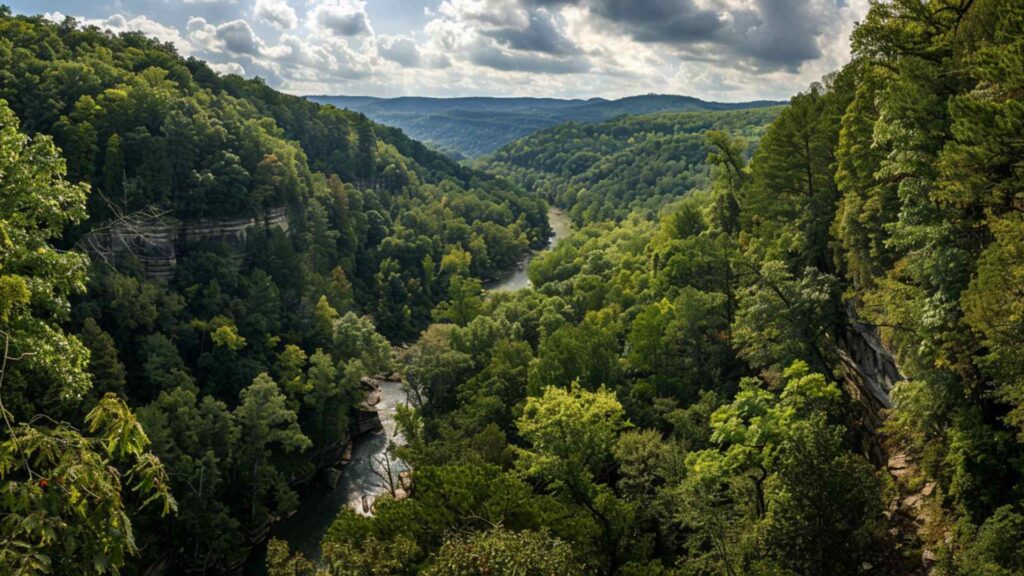
- Red River Gorge is famed worldwide for its steep sandstone cliffs and natural arches.
- Natural Bridge State Resort Park features a sweeping sandstone arch carved by erosion.
- Cumberland Falls is nicknamed the “Niagara of the South.”
- A rare nighttime rainbow called a moonbow often appears at Cumberland Falls during clear full moons.
- Land Between the Lakes National Recreation Area lies between Kentucky Lake and Lake Barkley.
- The Pennyroyal Plateau is named after a native mint that grows on its fields.
- Clifty Wilderness protects wild gorges, hemlocks, and clear streams in the east.
- Kentucky’s climate is humid subtropical with four distinct seasons.
- Redbud and dogwood trees light up hillsides with color each spring.
- White-tailed deer are common across the state.
- Elk were successfully reintroduced to eastern Kentucky in the late 1990s.
- Black bears have returned to forested areas of southeastern Kentucky.
- The state butterfly is the Viceroy.
- The official state fish is the Kentucky spotted bass.
- The state mineral is coal.
- The state rock is Kentucky agate.
- The state gemstone is the freshwater pearl.
- The state fossil is a brachiopod.
- The official state soil is the Crider series.
- The state drink is milk.
- The state dance is clogging.
- The state insect is the honeybee.
History & culture
- Indigenous peoples including the Shawnee and Cherokee used Kentucky as hunting grounds for centuries.
- Daniel Boone and others blazed the Wilderness Road through Cumberland Gap in 1775.
- Fort Harrod at Harrodsburg became Kentucky’s first permanent European-descended settlement in 1774.
- The name Kentucky likely comes from an Iroquoian word meaning “meadowland” or “land of tomorrow.”
- Kentucky entered the Union as a slaveholding border state but did not secede during the Civil War.
- The state declared neutrality early in the Civil War before aligning with the Union.
- Abraham Lincoln was born near Hodgenville in 1809.
- Jefferson Davis was born in Fairview in 1808.
- Kentucky thus was the birthplace of both opposing Civil War presidents.
- Shaker Village of Pleasant Hill preserves notable 19th-century Shaker architecture and crafts.
- Berea College became the first interracial and coeducational college in the South.
- Bluegrass music takes its name from the region and the band that popularized the style.
- The Appalachian dulcimer and fiddle anchor much traditional mountain music.
- The Appalachian dulcimer is Kentucky’s official state musical instrument.
- Visitors travel a bourbon-themed route to tour distilleries across the state.
- The mint julep is a signature drink served on Derby weekend.
- The Fancy Farm Picnic in Graves County is famous for lively political stump speeches each August.
- Baseball bats have been manufactured in Louisville for more than a century.
- The Belle of Louisville is a historic steamboat still cruising the Ohio River.
- Folk arts such as quilt making, chair caning, and basket weaving remain vibrant traditions.
- Tobacco farming shaped rural life in Kentucky for generations.
- Coal mining powered the economy and communities of eastern Kentucky in the 20th century.
- New Deal work programs built trails and facilities still used in state parks today.
- Keeneland in Lexington hosts prestigious Thoroughbred sales and seasonal race meets.
- Rock climbers from around the world visit Red River Gorge for its challenging sandstone routes.
- The Kentucky State Fair showcases agriculture, crafts, and concerts each August in Louisville.
- Muhammad Ali grew up in Louisville and became a world heavyweight boxing champion.
- Country music legends including Loretta Lynn came from Kentucky’s coal country.
- The pennyroyal herb lent its name to a broad region of south-central Kentucky.
- Classic Kentucky dishes include burgoo, soup beans with cornbread, and spoonbread.
- The Hot Brown sandwich was created at a Louisville hotel in the 1920s.
- Bold hats and fashion are beloved parts of Kentucky Derby traditions.
- A downtown museum in Louisville celebrates the life and legacy of Muhammad Ali.
- Civil War battlefields across Kentucky interpret the experiences of both Union and Confederate forces.
- Many counties use local-option votes to decide whether alcohol sales are allowed.

Economy & innovation
- Manufacturing is a major employer in Kentucky, including automobiles, aerospace parts, and appliances.
- Farms produce poultry, corn, soybeans, cattle, and horses across different regions.
- Bourbon is a protected American whiskey that must contain at least 51% corn by law.
- Limestone-rich water in the Bluegrass is prized for horse breeding and whiskey making.
- Louisville’s international airport is a global air cargo hub.
- The Port of Louisville moves barge traffic along the Ohio River system.
- Thoroughbred auctions in Lexington attract buyers from around the world.
- The U.S. Bullion Depository at Fort Knox sits beside a large Army post.
- Aluminum production and fabrication cluster along the Ohio River corridor.
- A major assembly plant in Bowling Green builds the Corvette sports car.
- The National Corvette Museum in Bowling Green showcases the model’s history and technology.
- Tourism highlights include horses, bourbon, caves, lakes, and outdoor recreation.
- Hardwood forests supply oak, hickory, and maple used in furniture, flooring, and barrels.
- Appalachian counties are investing in broadband and tech training to diversify their economies.
- Lexington calls itself the “Horse Capital of the World.”
- An industrial park near Bowling Green known as the Kentucky Transpark draws logistics and manufacturing firms.
- Agricultural researchers in Kentucky test tobacco alternatives and specialty crops.
- Solar projects on reclaimed mine lands are adding new energy capacity.
- Major interstates including I-64, I-65, I-71, I-75, and I-24 cross the state.
- Locks and dams help maintain navigation on the Ohio, Kentucky, and Green Rivers.
Names & etymology
- “Bluegrass” refers to grasses whose tips can appear bluish in cool spring light.
- “Kentucky” likely comes from an Iroquoian word meaning “land of tomorrow” or “meadowland.”
- Counties named Bourbon and Fayette preserve names from the period when the area was part of Virginia.
- Town names like Paris, Versailles, and London reflect settlers’ European influences.
- The city of Hazard honors naval hero Oliver Hazard Perry.
- “The Knobs” describes a ring of isolated conical hills around the Bluegrass region.
- The “Jackson Purchase” region comes from an 1818 land cession by the Chickasaw.
- “Pennyroyal” comes from a fragrant mint once used in kitchens and folk medicine.
- “Cumberland” in Kentucky place names honors the Duke of Cumberland.
- “Red River Gorge” reflects the warm hues of iron-rich sandstone exposed in its cliffs.
For kids: quick comparisons
- Kentucky covers about 104,700 km² (40,400 sq mi) of land.
- Driving from Ashland in the northeast to Paducah in the west takes roughly seven hours.
- Kentucky’s tallest mountain is lower than many towns in high-altitude Colorado.
- Kentucky has 120 counties, which is a lot for a state its size.
- The Ohio River is a major shipping route carrying long strings of barges past Louisville.
- From downtown Louisville you can stand in Kentucky and see Indiana across the river.
- Kentucky touches seven other states.
- You can drive from the Appalachian Mountains to the Mississippi River within a day.
- Some neighboring counties use different time zones in western Kentucky.
- Popular school field trips in Kentucky include caves, horse farms, and state history museums.
Pop culture & fun extras
- The state’s name is famously linked to a style of crispy fried chicken.
- A ginger-citrus soft drink called Ale-8-One was created in Winchester in 1926.
- The Hatfield–McCoy feud is part of folklore along the Kentucky–West Virginia borderlands.
- U.S. Route 23 in eastern Kentucky is known as the Country Music Highway.
- The Louisville Mega Cavern offers underground tram tours and seasonal light displays.
- The Corvette Museum sinkhole became an attraction before being partially filled and stabilized.
- Films and novels often set scenes on Kentucky horse farms and in Appalachian “hollers.”
- Winter eagle-watching cruises operate on Kentucky’s big lakes.
- A railpark museum in Bowling Green lets visitors tour historic locomotives and railcars.
- Horse farms with white fences are a common sight along rural roads near Lexington.
Quick FAQ
What is Kentucky known for?
Kentucky is known for horses, bourbon, bluegrass music, Mammoth Cave, and the Kentucky Derby.
What is the capital of Kentucky?
The capital of Kentucky is Frankfort.
Why is it called the Bluegrass State?
It is called the Bluegrass State because certain grasses can look bluish in the spring.
When did Kentucky become a state?
Kentucky became a state on June 1, 1792.
What time zones are in Kentucky?
Kentucky uses both Eastern Time and Central Time depending on the county.

Ellie is the owner and sole author of Fun Facts, combining her mechanical engineering background with years of research-driven writing to deliver facts you can trust. Every article is thoroughly fact-checked and routinely updated as new science and sources emerge to keep information accurate and current. Her mission is to make learning delightful while upholding high standards of reliability and transparency.