
Isaac Newton is remembered for gravity and an apple, but that barely scratches the surface. He transformed mathematics, optics, mechanics, astronomy, telescope design, and even Britain’s currency system, while privately filling pages with alchemy and theology. These 145 Newton facts explore the real experiments, famous rivalries, plague-year discoveries, Principia, calculus controversy, Royal Mint detective work, and the surprisingly complicated truth behind one of science’s most famous apple stories.
Isaac Newton basics
- Isaac Newton was an English mathematician, physicist, astronomer, natural philosopher, and public official.
- He was born at Woolsthorpe in Lincolnshire, England.
- Newton was born on December 25, 1642, under the Julian calendar then used in England.
- That date corresponds to January 4, 1643, in the modern Gregorian calendar.
- His father, also named Isaac Newton, died before Newton was born.
- Newton was born prematurely and was reportedly very small as an infant.
- His mother was Hannah Ayscough Newton.
- When Newton was a young child, his mother remarried and left him in his grandmother’s care.
- Newton later attended the King’s School in Grantham.
- As a schoolboy, he became interested in building mechanical devices and models.
- Stories describe him making sundials, miniature windmills, and other gadgets.
- His family initially expected him to manage agricultural property.
- Newton showed little enthusiasm for becoming a farmer.
- He eventually returned to school and prepared for university.
- Newton became one of the most influential figures in the history of science.
Newton at Cambridge
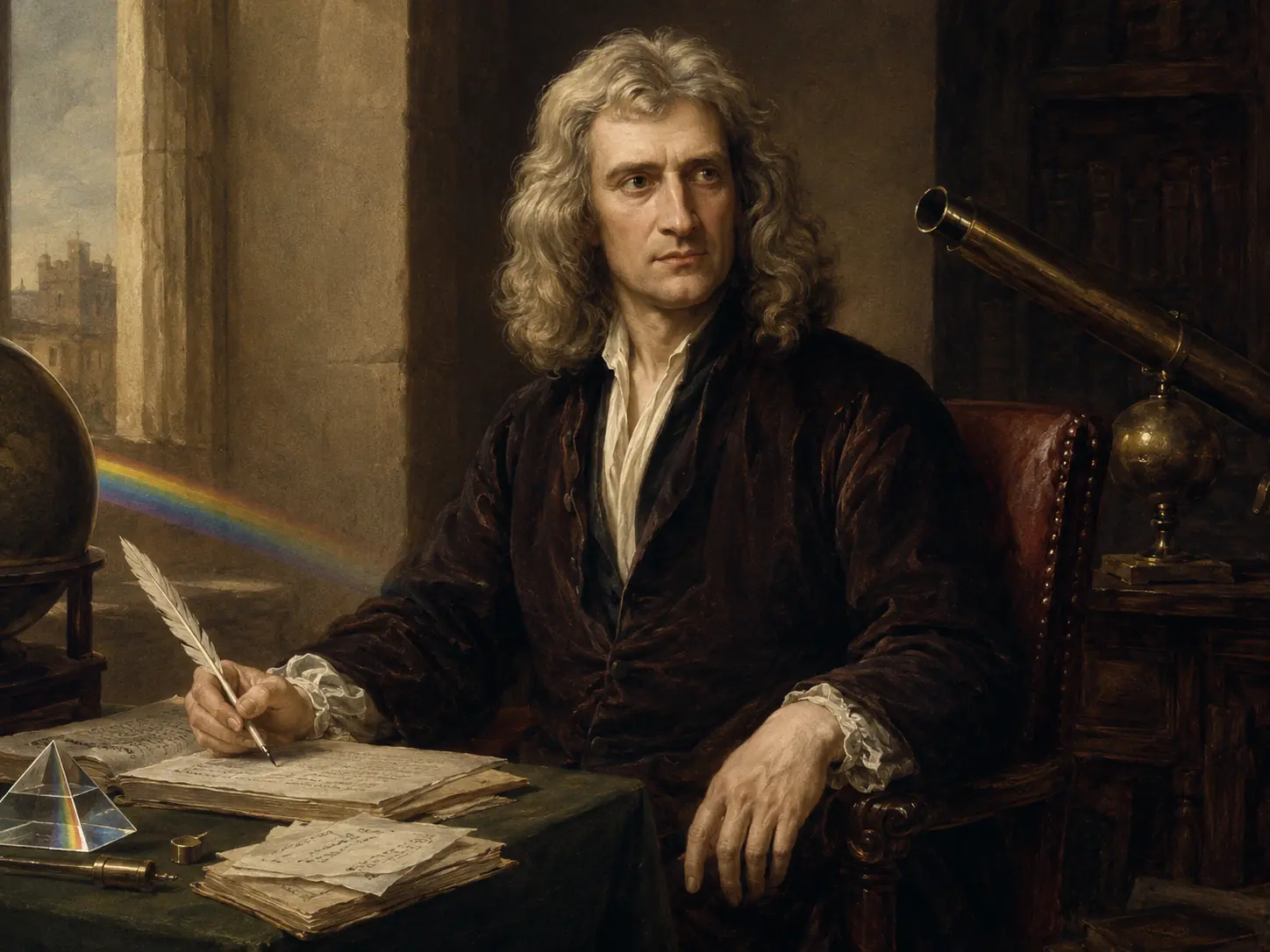
- Newton entered Trinity College, Cambridge, in 1661.
- Cambridge teaching still relied heavily on classical Aristotelian philosophy when he arrived.
- Newton independently read newer thinkers including René Descartes, Galileo Galilei, and Johannes Kepler.
- He became increasingly absorbed in mathematics.
- Isaac Barrow, the first Lucasian Professor of Mathematics, recognized Newton’s abilities.
- Newton earned his bachelor’s degree in 1665.
- He became a Fellow of Trinity College in 1667.
- Newton earned a master’s degree in 1668.
- He succeeded Barrow as Lucasian Professor of Mathematics in 1669.
- Newton was only in his twenties when he received that prestigious chair.
- He held the Lucasian professorship until 1701.
- Cambridge required fellows to meet religious obligations that created difficulties for Newton’s private beliefs.
- King Charles II eventually granted Newton a special exemption from taking holy orders.
- Newton spent decades connected with Trinity even after becoming famous internationally.
- His Cambridge papers are now major historical sources for studying how his ideas developed.
The plague years changed science
- Cambridge University temporarily closed during outbreaks of plague in 1665 and 1666.
- Newton returned to his family home at Woolsthorpe during much of this period.
- He later described these years as exceptionally productive.
- At Woolsthorpe, Newton developed major ideas in mathematics.
- He worked on what he called the method of fluxions.
- That method became part of what is now called calculus.
- He also investigated light and color.
- Newton performed prism experiments that separated white light into colors.
- He developed early versions of ideas about motion and gravity.
- The productive period is sometimes called Newton’s annus mirabilis, or miraculous years.
- Not every mature theory appeared fully formed during those two years.
- Newton refined many ideas for decades before publishing them.
- The plague therefore created isolation that accelerated his work without magically producing finished modern physics overnight.
- His later publications supplied the rigorous mathematical structure that made the early insights transformative.
- The Newton Project describes 1665 to 1667 as a foundational period in his work on calculus, optics, mechanics, and gravity.
The real story of Newton’s apple
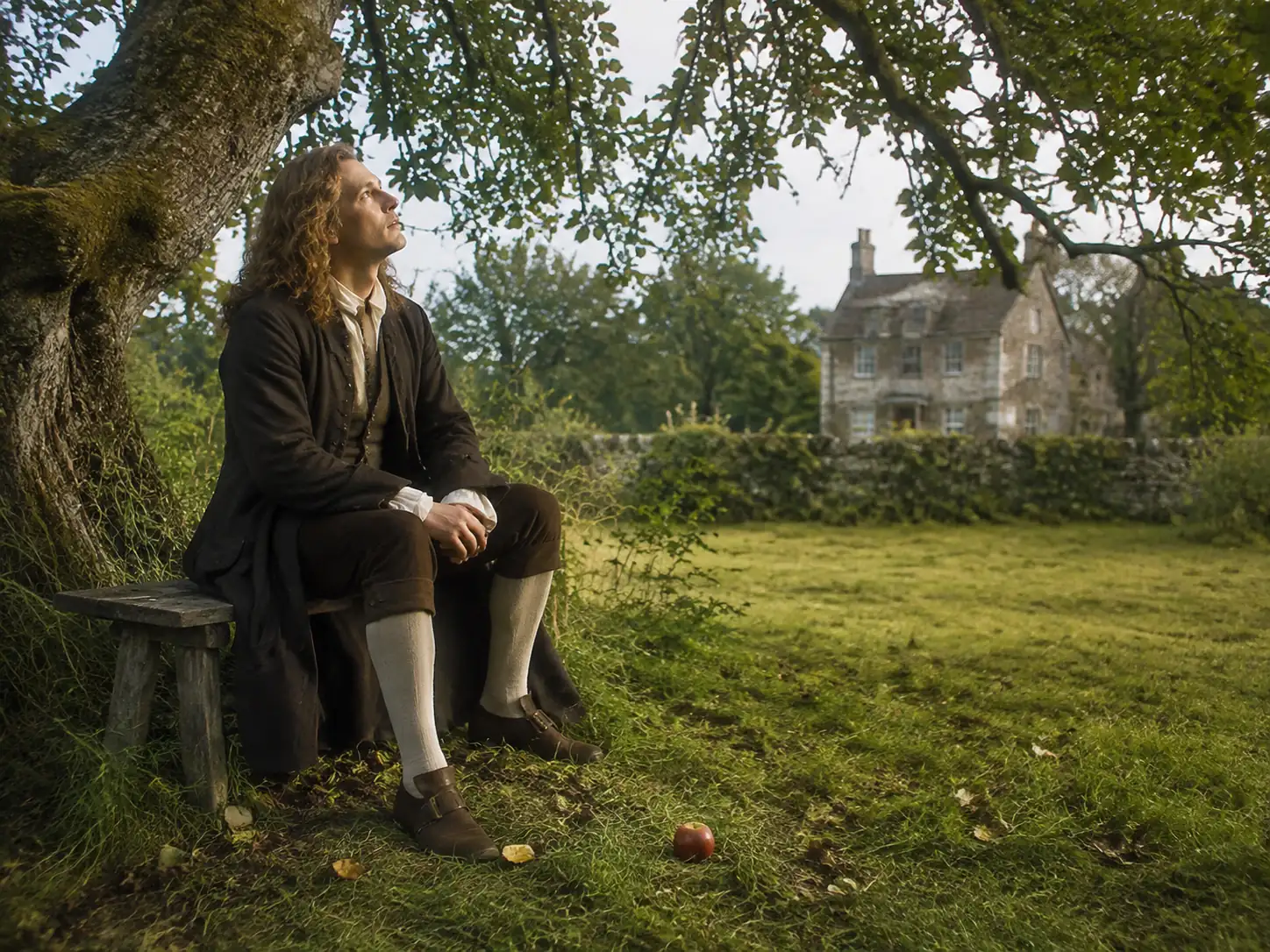
- Newton really did later connect an apple fall with thinking about gravity.
- The famous story was recorded by people who knew Newton personally.
- William Stukeley wrote an account after discussing the event with Newton.
- John Conduitt, Newton’s relative by marriage, recorded a similar story.
- The apple did not need to hit Newton on the head.
- No reliable early account says it struck him.
- The important question was why an apple falls toward Earth rather than sideways or upward.
- Newton began considering whether Earth’s attractive power might extend far beyond the tree.
- He asked whether the same force could influence the Moon.
- This connected ordinary falling objects with celestial motion.
- The insight alone was not a complete theory of universal gravitation.
- Newton needed mathematics and astronomical data to turn the idea into a quantitative law.
- The original apple tree at Woolsthorpe Manor became a famous scientific landmark.
- Grafted descendants of the tree grow at Cambridge and other institutions.
- The Cambridge University Botanic Garden maintains a tree propagated from the famous Woolsthorpe lineage.
Newton transformed our understanding of light
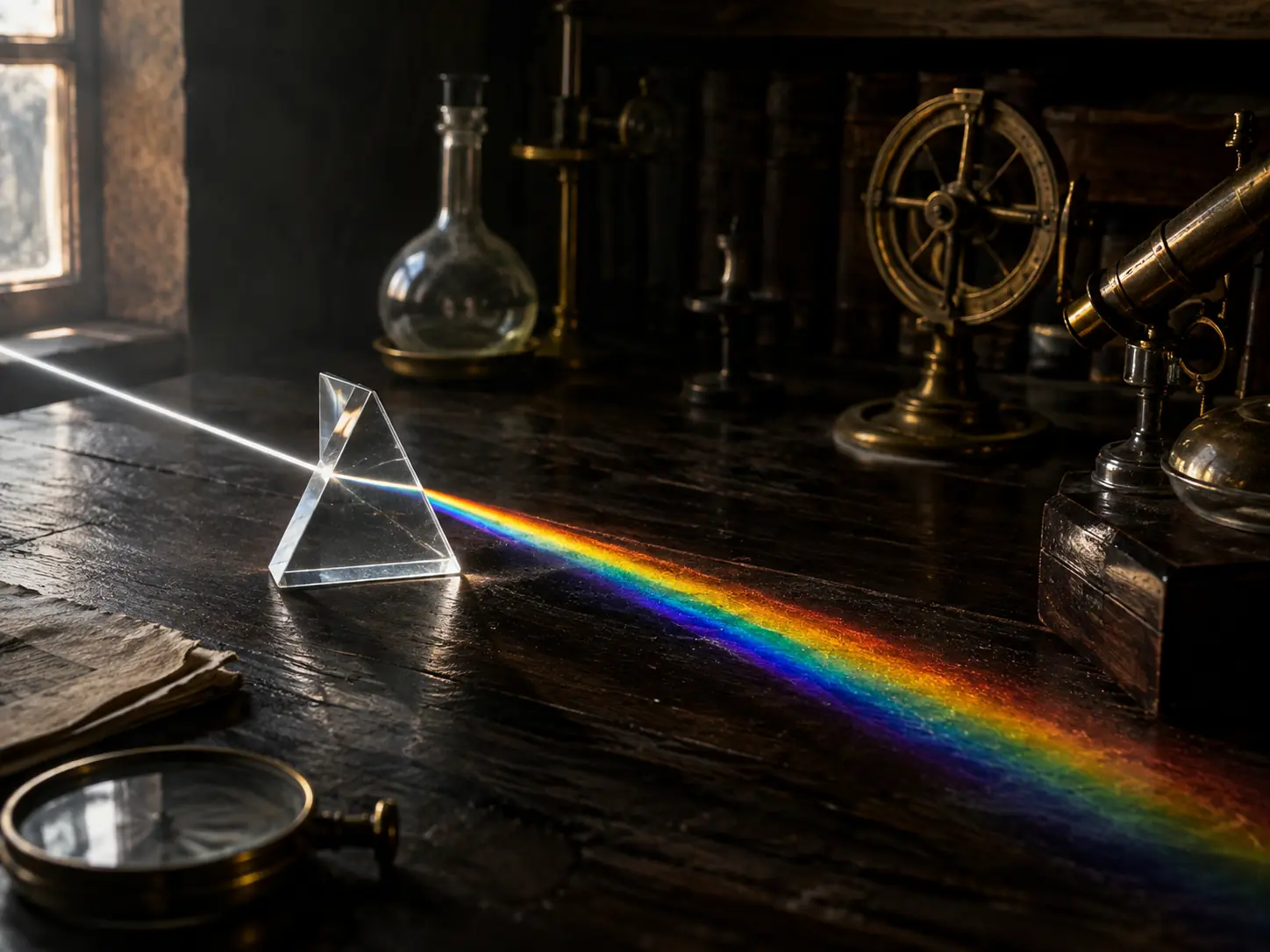
- Newton used glass prisms to study sunlight.
- A prism spreads white light into a visible spectrum.
- Earlier thinkers often believed prisms somehow colored otherwise pure white light.
- Newton concluded that white light already contains rays with different color properties.
- He passed separated colored light through additional prisms.
- A single spectral color did not split into a new rainbow in the same way white light did.
- Newton also recombined separated colors to produce white light again.
- These experiments supported his claim that color is a property of light rather than something added by glass.
- He connected different colors with different degrees of refraction.
- Violet light bends more strongly through ordinary glass than red light.
- This difference causes chromatic aberration in simple lenses.
- Chromatic aberration creates colored fringes and reduces image sharpness.
- Newton’s optical research changed both physics and telescope design.
- He published a major account of optical research in Opticks in 1704.
- His experiments helped establish controlled experimentation as a powerful method for studying light.
Newton built a new kind of telescope
- Early astronomical telescopes usually relied on lenses.
- Lens telescopes suffered strongly from chromatic aberration.
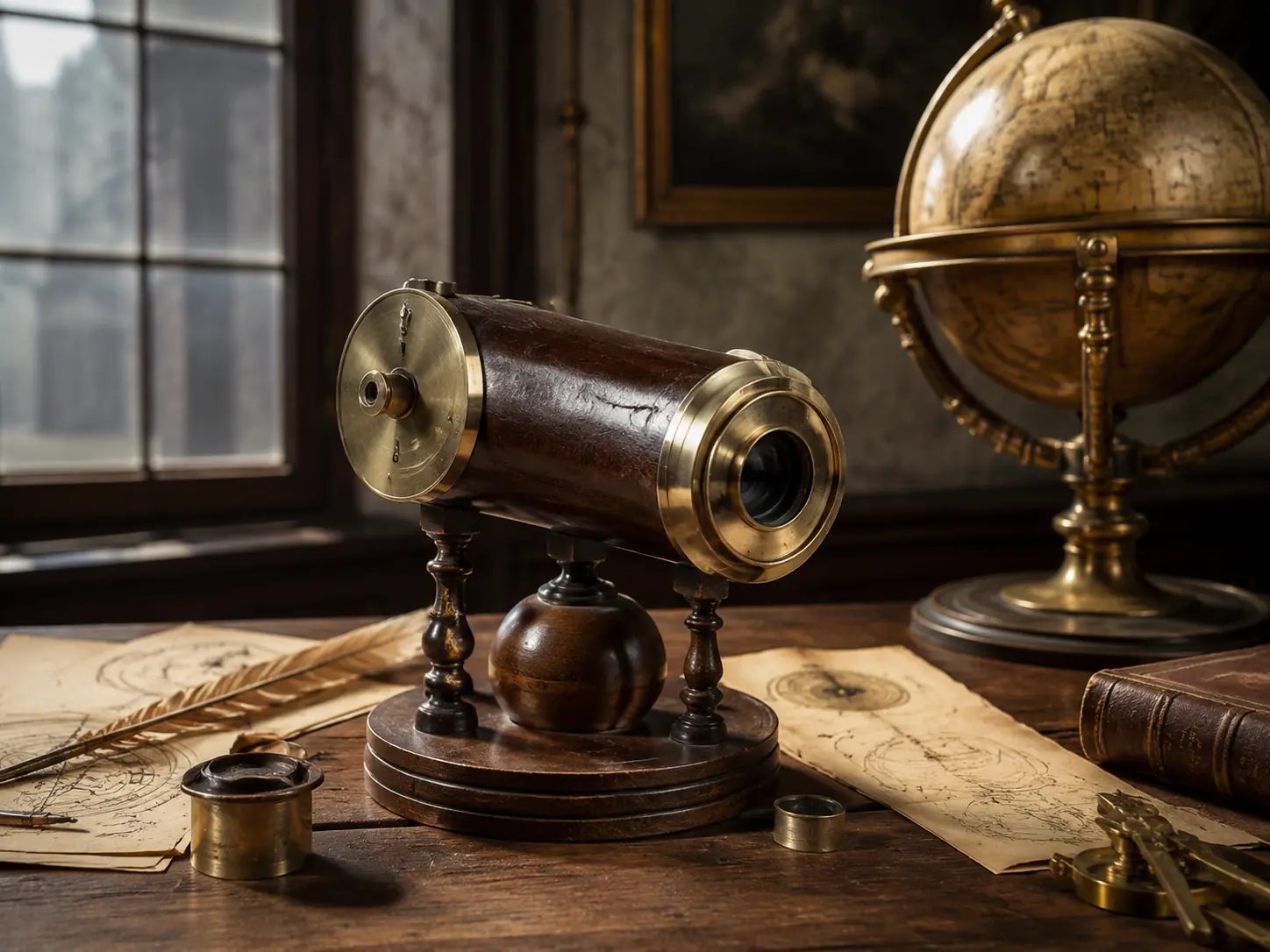
- Newton designed a telescope using a curved mirror as its primary light-gathering element.
- A mirror reflects different visible wavelengths without the same lens color dispersion problem.
- Newton completed an influential reflecting telescope around 1668.
- His design used a concave primary mirror.
- A small angled secondary mirror redirected the image toward an eyepiece on the side.
- This arrangement became known as the Newtonian reflector.
- Newton demonstrated a reflecting telescope to the Royal Society.
- The instrument helped establish his scientific reputation.
- He was elected a Fellow of the Royal Society in 1672.
- Reflecting telescopes later became essential to professional astronomy.
- Many enormous modern observatories use mirrors rather than giant objective lenses.
- Amateur astronomers still build and use Newtonian telescopes today.
- A design created in the 17th century therefore remains practical more than three centuries later.
The Principia changed physics
- Newton’s masterpiece is Philosophiae Naturalis Principia Mathematica.
- Its title is commonly shortened to the Principia.
- The first edition was published in 1687.
- Astronomer Edmond Halley strongly encouraged Newton to write and publish the work.
- Halley personally helped finance publication.
- The Royal Society officially backed the work but lacked enough money to cover the printing itself.
- The Principia presented Newton’s three laws of motion.
- The first law describes inertia.
- The second law relates changes in motion to applied force.
- The third law states that forces occur in mutual interactions between bodies.
- The book also presented the law of universal gravitation.
- Newton showed mathematically that one gravitational framework could explain both falling bodies and planetary orbits.
- He derived important results connected with Kepler’s empirical laws of planetary motion.
- The Principia treated mechanics, fluids, orbital motion, tides, and other physical problems mathematically.
- It became one of the foundational works of classical physics.
Newton and calculus
- Newton developed methods equivalent to major parts of calculus during the 1660s.
- He called changing quantities fluents.
- He called their rates of change fluxions.
- Gottfried Wilhelm Leibniz independently developed calculus using a different notation.
- Leibniz published his calculus methods before Newton published a full public account of his own.
- A bitter priority dispute later erupted between supporters of Newton and Leibniz.
- Both men made fundamental independent contributions.
- Modern calculus notation owes much more to Leibniz than to Newton’s dot-based fluxion notation.
- The familiar integral sign comes from Leibniz’s notation.
- Newton’s methods were deeply connected with problems of motion and changing quantities.
- The dispute became nationalistic, with British and continental mathematicians taking sides.
- Newton’s position as president of the Royal Society complicated attempts at neutral investigation.
- A Royal Society report on the controversy strongly favored Newton.
- Newton had substantial involvement in shaping that report.
- Historians now reject the simplistic claim that either Newton or Leibniz merely stole calculus from the other.
Newton had another career at the Royal Mint
- Newton left Cambridge for a major government job in London during the 1690s.
- He became Warden of the Royal Mint in 1696.
- The post might have been treated as largely ceremonial by a less determined officeholder.
- Newton instead took Mint work extremely seriously.
- Britain was undertaking a major recoinage to replace worn and clipped silver currency.
- Newton supervised complicated administrative and technical work during the recoinage.
- He investigated counterfeiters personally.
- Newton gathered testimony and evidence in taverns, prisons, and court proceedings.
- Counterfeiting was a serious crime carrying severe penalties.
- He pursued notorious counterfeiter William Chaloner.
- Chaloner was eventually convicted and executed.
- Newton became Master of the Mint in 1699.
- He held that office until his death.
- His Mint career made him a powerful public administrator as well as a scientist.
- The Newton Project preserves extensive documents from Newton’s years managing British currency.
Ten surprising Isaac Newton facts
- Newton spent enormous amounts of private time studying alchemy.
- He also wrote extensively about religion and biblical chronology.
- His private theology differed in important ways from orthodox Anglican doctrine.
- Newton served as president of the Royal Society from 1703 until his death in 1727.
- Queen Anne knighted him in 1705.
- He represented Cambridge University in Parliament during two periods.
- Newton never married and had no known children.
- He was buried in Westminster Abbey, an extraordinary honor for a scientist of his era.
- A piece associated with Newton’s famous apple tree spent time aboard the International Space Station in 2010.
- For more scientific history, explore our Albert Einstein facts and History facts.
Quick Isaac Newton FAQ
Did an apple really hit Isaac Newton on the head?
The apple story has credible roots because people who knew Newton recorded him talking about seeing an apple fall. No reliable early account says it hit his head.
Did Newton discover gravity?
People obviously knew objects fell before Newton. His breakthrough was developing a mathematical theory of universal gravitation that connected falling objects with the motions of planets and moons.
Did Newton invent calculus?
Newton and Gottfried Wilhelm Leibniz developed calculus independently. Newton worked on his methods earlier, while Leibniz published first and introduced much of the notation used today.
What are Newton’s three laws of motion?
They describe inertia, how force changes motion, and the mutual forces bodies exert on one another. Together they form the core of classical mechanics.
Why did Newton work at the Mint?
He accepted the Warden of the Mint position in 1696 and became Master in 1699. He managed recoinage, improved administration, and aggressively investigated counterfeiters.

Ellie is the owner and sole author of Fun Facts, combining her mechanical engineering background with years of research-driven writing to deliver facts you can trust. Every article is thoroughly fact-checked and routinely updated as new science and sources emerge to keep information accurate and current. Her mission is to make learning delightful while upholding high standards of reliability and transparency.