
Ready to meet the mind behind relativity?
These 145 bite-size facts about Albert Einstein cover his childhood, discoveries, and fun extras.
You’ll see wow numbers, quick comparisons, and simple explanations that make tricky ideas click. From E=mc² to everyday life, here’s a friendly tour of a giant of science.
Origins & definitions
- He was born on March 14, 1879, in Ulm in the Kingdom of Württemberg in the German Empire.
- His family was Jewish and soon moved to Munich, where his father and uncle ran an electrical business.
- As a child he built mechanical models and loved puzzles and geometry.
- He did not speak unusually late, but he was a thoughtful and quiet child by many accounts.
- He renounced his German citizenship in 1896 and was stateless until he became Swiss in 1901.
- He enrolled at the Swiss Federal Polytechnic in Zurich in 1896 to train as a teacher in physics and mathematics.
- He graduated in 1900 after initially struggling with the rigid teaching style but excelling in independent study.
- He worked as a patent examiner in Bern starting in 1902, evaluating electromechanical inventions.
- He married Mileva Marić in 1903 after meeting her at the Polytechnic.
- Their first son, Hans Albert Einstein, was born in 1904 and became a noted engineer.
- Their second son, Eduard Einstein, was born in 1910 and later faced serious mental health challenges.
- A daughter, nicknamed Lieserl, was born in 1902, and her later life remains uncertain to historians.
- He obtained a PhD from the University of Zurich in 1905 with a thesis on molecular dimensions.
- He became a Swiss citizen in 1901 and kept that citizenship for life, even after moving abroad.
- In 1914 he accepted a research post in Berlin and joined the Prussian Academy of Sciences.
- He and Mileva divorced in 1919 after years of separation.
- He married his cousin Elsa Löwenthal in 1919, and she died in 1936.
- He left Germany for good in 1933 as authoritarian rule escalated.
- He settled in Princeton, New Jersey, to work at the newly formed Institute for Advanced Study.
- He became a United States citizen in 1940 while retaining Swiss citizenship.
- He died on April 18, 1955, in Princeton at age 76 from a ruptured abdominal aortic aneurysm.
- His ashes were scattered at an undisclosed location to prevent a shrine.
- His preserved brain was studied by researchers to explore anatomical correlates of creativity and cognition.
- He enjoyed playing the violin throughout his life and often used music to relax and think.
- He loved sailing as a quiet hobby even though he was not especially skilled at it.
Record-breakers & wow numbers
- The year 1905 is called his “annus mirabilis” or miracle year because he published four groundbreaking papers in about nine months.
- His iconic equation E=mc² shows that 0.001 kg of mass corresponds to about 9×10¹³ joules of energy.
- The speed of light in vacuum, central to his work, is exactly 299,792,458 meters per second.
- General relativity correctly explains the extra 43 arcseconds per century in Mercury’s perihelion precession.
- Light passing near the Sun is deflected by about 1.75 arcseconds at the solar limb according to general relativity.
- GPS satellites need relativistic corrections of about 38 microseconds per day to keep your maps accurate.
- He authored or coauthored more than 300 scientific papers in his lifetime.
- He also wrote over 150 essays and books on topics beyond physics, including education and society.
- He received the 1921 Nobel Prize in Physics for explaining the photoelectric effect, not for relativity.
- He introduced the cosmological constant in 1917 with a value chosen to make a static universe possible.
- He predicted gravitational waves in 1916 as ripples in spacetime caused by accelerating masses.
- The first direct detection of gravitational waves was reported in 2015 from the merger of two black holes.
- A perfect Einstein ring in gravitational lensing appears when source, lens, and observer align nearly exactly.
- The Einstein crater on the Moon spans about 200 kilometers across the far side.
- Asteroid 2001 Einstein honors him as a main-belt object discovered in the 1970s.
- Einsteinium, element 99 on the periodic table, was named after him following its discovery in the 1950s.
- The Einstein Tower observatory in Potsdam was built in the 1920s to test relativity effects in spectra.
- The Einstein–de Sitter model of 1932 describes a flat, matter-dominated universe with zero cosmological constant.
- The Einstein Cross is a famous gravitational lens system that splits a distant quasar into four images.
- The Einstein summation convention shortens equations by assuming repeated indices are summed automatically.

Science: how it works
- Special relativity, published in 1905, describes physics for observers moving at constant speeds relative to each other.
- It states that the laws of physics are the same in all inertial frames and that the speed of light is constant for all observers.
- Time dilation in special relativity means a moving clock ticks more slowly than a stationary one from the observer’s view.
- Length contraction means objects moving quickly appear shortened in the direction of motion to an outside observer.
- Mass–energy equivalence says mass is a concentrated form of energy that can be converted under the right conditions.
- Minkowski later framed special relativity in four-dimensional spacetime where time acts like a fourth dimension.
- General relativity extends the idea by describing gravity as the curvature of spacetime caused by mass and energy.
- The equivalence principle, emphasized by him in 1907, states that gravitational and inertial mass are locally indistinguishable.
- Free fall is inertial motion in curved spacetime, so astronauts feel weightless while orbiting Earth.
- The Einstein field equations link spacetime curvature to the energy and momentum of matter and radiation.
- These equations reduce to Newton’s law of gravity in the weak-field and low-speed limit, preserving earlier results.
- Gravitational time dilation predicts that clocks run faster higher in a gravitational field and slower deeper down.
- Light loses energy climbing out of a gravitational well, producing gravitational redshift measurable with precise spectroscopy.
- Gravitational lensing occurs when mass bends light paths, magnifying and distorting background objects.
- Black holes are extreme solutions of general relativity where gravity is so strong that not even light escapes.
- He initially doubted that such collapsed objects would exist in nature, though the theory allows them.
- The perihelion shift of Mercury emerges naturally from the curved geometry around the Sun.
- The deflection of starlight by the Sun during a total eclipse provided early observational support for general relativity.
- The Shapiro time delay shows that radar signals take slightly longer to pass near a massive body due to curved spacetime.
- Frame dragging predicts that a rotating mass drags spacetime around with it, slightly twisting nearby orbits.
- Gravity Probe B measured tiny relativistic precessions of gyroscopes in Earth orbit consistent with these predictions.
- Gravitational waves carry energy away from orbiting massive objects like pairs of neutron stars or black holes.
- His 1905 photoelectric paper treated light as packets of energy, later called photons.
- The photoelectric effect shows that light of sufficient frequency can knock electrons out of a metal.
- Brownian motion work in 1905 explained the jitter of tiny particles in liquid as evidence for atoms and molecules.
- He introduced coefficients describing absorption, spontaneous emission, and stimulated emission of light in 1917.
- Stimulated emission became the key physical principle behind lasers decades later.
- The Bose–Einstein statistics he developed with Satyendra Nath Bose describe particles that prefer to occupy the same state.
- A Bose–Einstein condensate forms when such particles crowd into the lowest energy state at ultracold temperatures.
- The Stokes–Einstein relation connects diffusion of small spheres in a fluid to temperature and viscosity.

History & culture
- He lectured widely after 1919 when eclipse observations brought him worldwide fame.
- He used simple thought experiments, or “gedankenexperiments,” to clarify deep ideas without complex apparatus.
- He taught at the University of Zurich, the German University in Prague, ETH Zurich, and the University of Berlin.
- He joined the Institute for Advanced Study in Princeton in 1933 and remained there until his death.
- He was a strong critic of racial discrimination and spoke publicly for civil rights in the United States.
- He supported the founding of a university in Jerusalem and served on its board of governors.
- He was offered the presidency of Israel in 1952 but declined, saying he lacked political experience.
- In 1939 he co-signed a letter warning that chain reactions in uranium could lead to powerful new weapons.
- He did not work on the wartime bomb project itself and held no security clearance for it.
- After the war he became a prominent voice for international cooperation and nuclear arms control.
- He described his religious outlook as a sense of awe at the order of nature rather than belief in a personal deity.
- He collaborated with mathematician Marcel Grossmann, who helped him master tensor calculus for general relativity.
- He enjoyed long walks around Princeton while turning over physics problems in his head.
- He kept a famously untidy desk that has been photographed on the day he died.
- He wrote a short book explaining relativity in plain language for general readers.
- He corresponded with many leading scientists and thinkers across Europe, America, and Asia.
- He visited Asia in the early 1920s, giving lectures in countries such as Japan and China.
- He received numerous honors including medals and memberships in scientific academies around the world.
- He spent his later decades trying to build a unified field theory connecting gravity with electromagnetism.
- He partnered with Leo Szilard to patent an absorption refrigerator with no moving parts in the late 1920s.

Names & etymology
- The surname Einstein means “one stone” in German, a common name in German-speaking regions.
- An "Einstein ring" is the circular image of a lensed background source produced by symmetrical mass alignment.
- "Einstein coefficients" quantify how atoms interact with radiation through absorption and emission.
- The "Einstein radius" sets the angular scale of a gravitational lens based on mass and geometry.
- The "Einstein solid" is a simple model of a crystal where each atom vibrates independently at one frequency.
- "Bose–Einstein statistics" describe identical particles with integer spin that can share the same state.
- A "Bose–Einstein condensate" is the macroscopic quantum state predicted by those statistics at very low temperatures.
- The "Einstein–Rosen bridge" is a theoretical tunnel in spacetime connecting two regions, often nicknamed a wormhole.
- The "Einstein–de Haas effect" links magnetism to the angular momentum of electrons inside materials.
- The "Einstein notation" or summation convention streamlines tensor equations by dropping explicit summation signs.
- The "Einstein relation" connects mobility and diffusion in systems ranging from semiconductors to electrolytes.
- The "Einstein tensor" packages curvature information on the left-hand side of the field equations.
- The "Einstein field equations" relate this curvature to the stress–energy content on the right-hand side.
- An "Einstein ring galaxy" refers to a ringlike image produced by strong lensing rather than a ring-shaped galaxy itself.
- The obsolete "einstein" unit once meant a mole of photons in early photochemistry literature.
- The "Einstein Observatory" was an early space X-ray telescope named in his honor.
- The "Einstein papers" commonly refers to the 1905 publications that reshaped modern physics.
- The "Einstein summation index" rule appears in many textbooks to simplify derivations in relativity.
- The "Einstein refrigerator" uses a heat source and circulating fluids to produce cooling without electricity.
- The "Einstein coefficients A and B" are central to understanding the operation of lasers.
For kids: quick comparisons
- If you could ride a fast spaceship at 90% of light speed, a one-hour movie for you would last more than two hours for people at home.
- GPS works because satellite clocks run a little fast in space and a little slow because they move, and both effects must be corrected.
- A bowling ball on a stretched rubber sheet is a model for how mass bends spacetime around it.
- Light bending around the Sun is like a car following a curved road laid out by gravity.
- The twin who flies near light speed and returns will be younger than the twin who stayed on Earth because of time dilation.
- Turning energy into mass is like freezing water into ice, because matter is another form of the same stuff called energy.
- A laser pointer works thanks to stimulated emission, an idea he worked out in 1917.
- Brownian motion looks like pollen dancing in water because unseen molecules are bumping into it.
- A Bose–Einstein condensate acts like many atoms marching in lockstep as if they were one giant atom.
- Gravitational waves ripple space like tiny stretches and squeezes passing by very sensitive detectors.
- The Sun’s gravity makes a natural telescope that can focus light from faraway stars and galaxies.
- A black hole is like a waterfall in spacetime where the current gets so fast that nothing can swim back out.
- Mercury’s odd orbit is a clue that gravity is geometry, not just a pull between masses.
- High mountains make clocks tick a bit faster than sea level because gravity is slightly weaker up high.
- Riding an elevator that accelerates upward feels the same as adding gravity, which is the heart of the equivalence principle.
Pop culture & fun extras
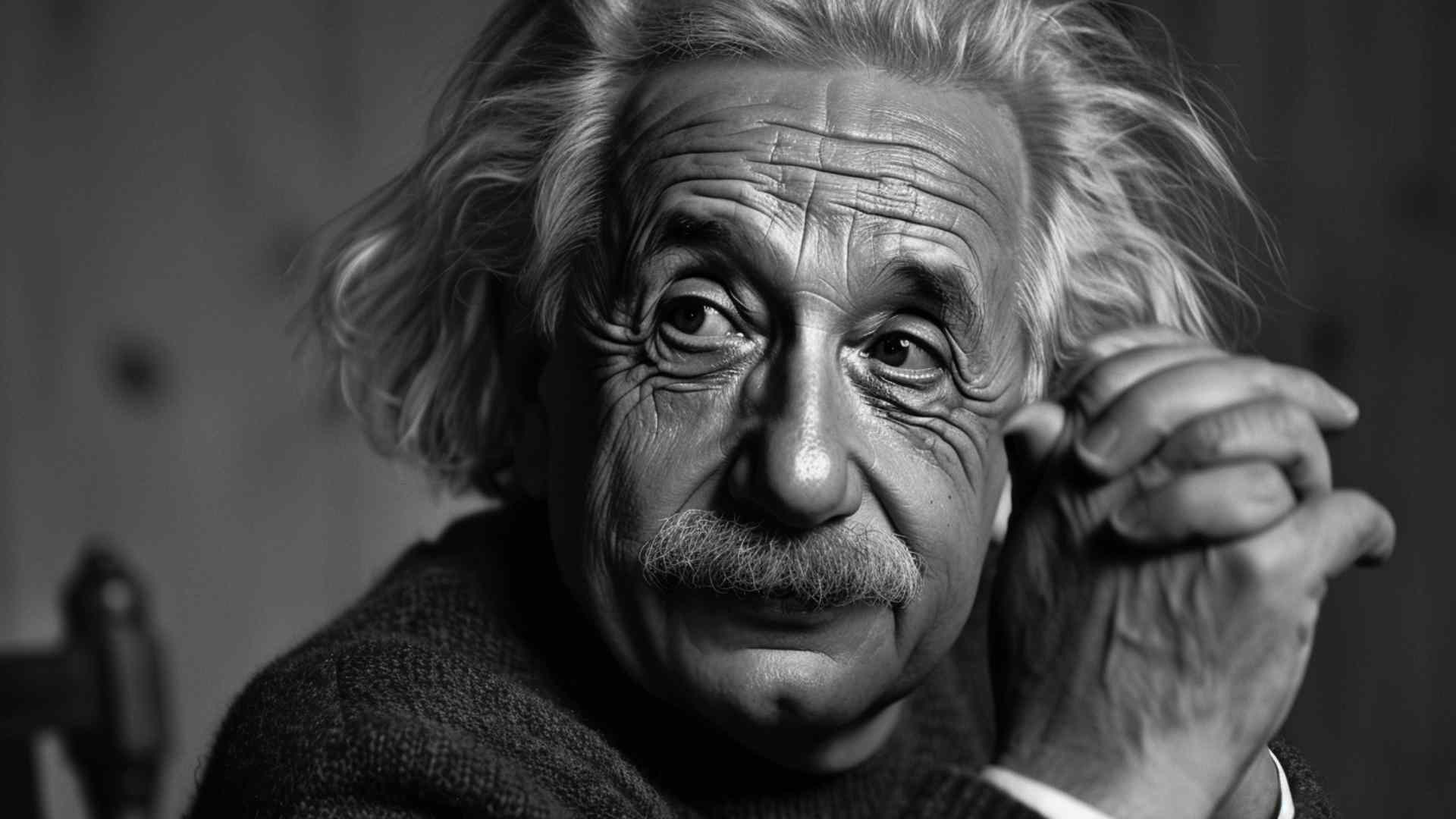
- His abundant hair and mustache became a global visual shorthand for the word “genius.”
- The famous photograph of him sticking out his tongue was taken on his 72nd birthday in 1951.
- Street murals and classroom posters worldwide often feature his portrait alongside E=mc².
- He appeared on postage stamps in many countries across several decades.
- He enjoyed simple clothes and practical shoes rather than formal styles.
- He liked to play chamber music with friends and favored composers like Mozart and Bach.
- He kept a violin nearby in his study and liked to improvise melodies while thinking.
- He often emphasized that curiosity and imagination fuel good science more than memorizing facts.
- Schools and museums use thought experiment exhibits to let kids test relativity ideas with light clocks.
- Toys, puzzles, and brain teasers bearing his name aim to spark interest in problem solving.
- Film and television frequently reference him when characters tackle time travel or paradoxes.
- A college of medicine, research institutes, and prizes bear his name in honor of scientific excellence.
- His signature has been reproduced on posters, mugs, and classroom banners around the world.
- The term “Einstein” is sometimes used in everyday speech to mean a very smart person.
- His birthday on March 14 lines up with Pi Day, which has become a math celebration in many schools.
Quick FAQ
Q: What is Albert Einstein most famous for?
A: He is best known for special and general relativity, the equation E=mc², and foundational work that helped launch quantum physics.
Q: Did Einstein win a Nobel Prize?
A: Yes, he received the 1921 Nobel Prize in Physics for explaining the photoelectric effect.
Q: What does E=mc² mean in simple words?
A: It means mass and energy are two forms of the same thing, so a tiny bit of mass equals a huge amount of energy.
Q: How did Einstein’s ideas affect GPS?
A: GPS works only because engineers correct satellite clocks using both special and general relativity.
Q: When was Albert Einstein born and when did he die?
A: He was born on March 14, 1879, and died on April 18, 1955.

Ellie is the owner and sole author of Fun Facts, combining her mechanical engineering background with years of research-driven writing to deliver facts you can trust. Every article is thoroughly fact-checked and routinely updated as new science and sources emerge to keep information accurate and current. Her mission is to make learning delightful while upholding high standards of reliability and transparency.