
Ice hockey is played on steel blades with a frozen rubber puck, six-player units changing on the fly, goalies dressed like armored acrobats, and decisions that happen in fractions of a second. Its organized history grew strongly in Canada, but the sport now spans Europe, Asia, and beyond. These 145 hockey facts cover the rink, puck, skates, rules, positions, penalties, Stanley Cup, Olympics, women’s hockey, goaltending, and the physics behind a slap shot.
Ice hockey basics
- Ice hockey is a team sport played on a frozen rink.
- Players move on skates with steel blades.
- They use sticks to control a hard rubber puck.
- A team normally has six players on the ice when at full strength.
- Those six usually include one goaltender and five skaters.
- The five skaters are commonly three forwards and two defensemen.
- The objective is to send the puck completely across the opponent’s goal line inside the net.
- A standard game is divided into three periods.
- International and NHL regulation periods are 20 minutes of playing time.
- The clock stops during many whistles.
- This makes a 60-minute hockey game last much longer in real time.
- Players can be substituted while play continues.
- This is called changing on the fly.
- Shifts are usually short because skating at game intensity is exhausting.
- The International Ice Hockey Federation publishes the current international rule book.
The rink and its markings
- An ice-hockey rink is surrounded by boards.
- Transparent shielding above the boards helps keep pucks inside the playing area.
- A red center line divides the rink into two halves.
- Two blue lines divide the ice into defensive, neutral, and attacking zones.
- The area between the blue lines is called the neutral zone.
- Each team defends one goal during a period.
- Teams change ends between regulation periods.
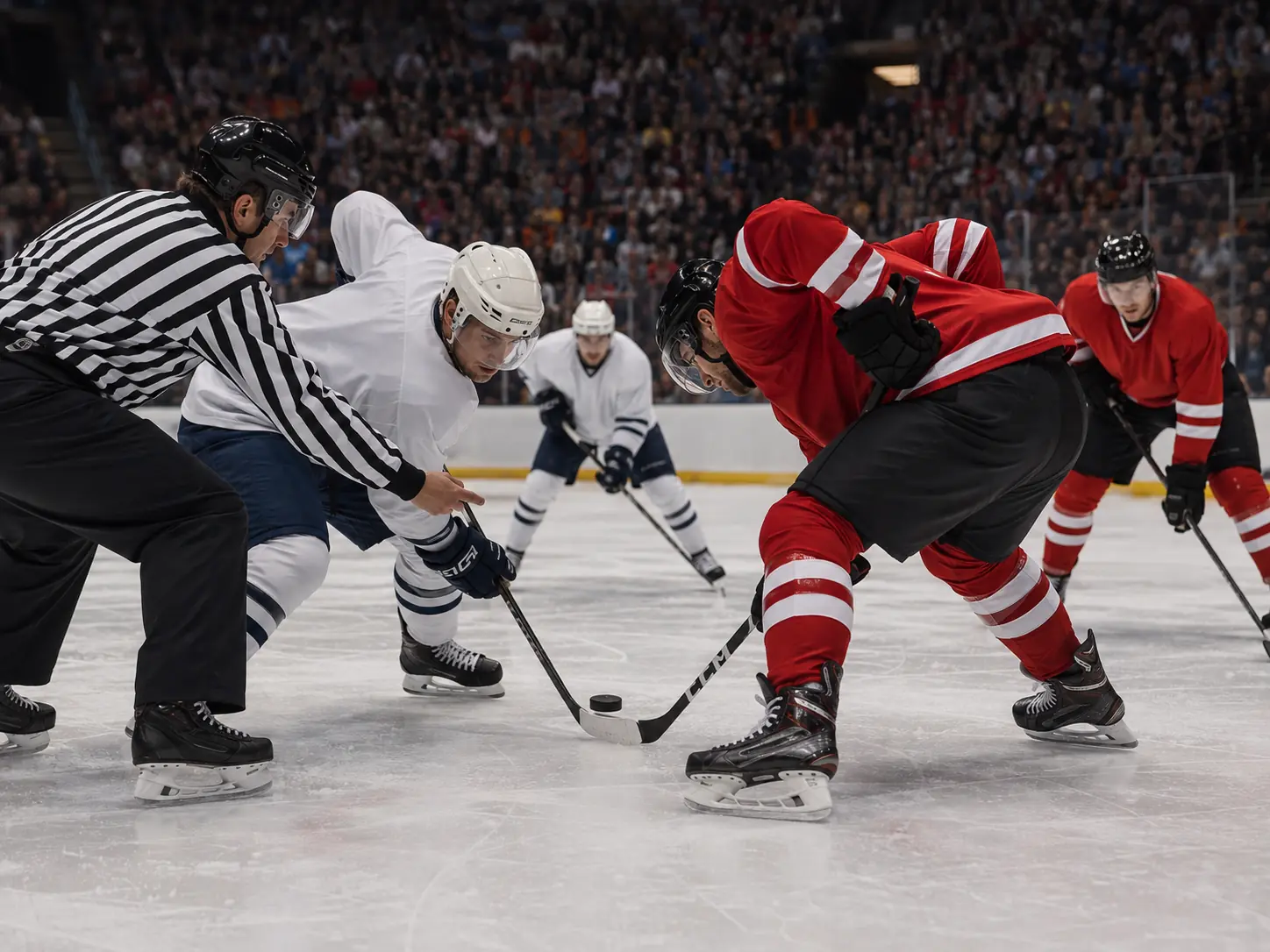
- Faceoff circles and spots mark locations used to restart play.
- The center-ice faceoff begins the game and periods.
- Goal creases mark protected areas around each net.
- Rink dimensions differ between leagues and venues.
- Many North American professional rinks are narrower than traditional international-size rinks.
- International rules now permit several approved rink dimensions.
- Rounded rink corners keep the puck moving along boards more smoothly than square corners would.
- The boards are part of the playable environment, so players intentionally bank passes and shots off them.
The puck is frozen rubber
- A regulation hockey puck is made from vulcanized rubber.
- It is shaped like a short flat cylinder.
- A standard puck is 3 inches, or 7.62 centimeters, in diameter.
- It is 1 inch, or 2.54 centimeters, thick.
- A regulation puck weighs roughly 5.5 to 6 ounces.
- Pucks are commonly frozen before professional games.
- Cold rubber is less bouncy than warm rubber.
- Reduced bounce makes the puck easier to control and more predictable.
- Officials keep replacement pucks available because a puck warms during play.
- A hard shot can send a puck well above 100 miles per hour.
- That speed makes protective equipment essential.
- Pucks can leave the rink despite high glass and netting.
- Fans are warned to remain alert whenever play is active.
- Early versions of ice hockey used different objects before standardized rubber pucks became normal.
- A flat puck is safer and more controllable on ice than a bouncing ball in crowded play.
Skates make hockey possible
- Hockey skates use metal blades attached to stiff boots.
- The blade is not sharpened to one knife-like point.
- Its bottom is ground with a concave hollow.
- This creates two narrow edges that can grip the ice.
- Players lean onto inside and outside edges to turn.
- A deeper hollow creates more bite into the ice but can increase drag.
- A shallower hollow creates more glide but less aggressive grip.
- Skate sharpening preferences differ by player weight, position, ice, and skating style.
- Hockey boots are stiff to support ankles during powerful acceleration and turning.
- Players propel themselves by pushing sideways against the ice.
- Crossovers let skaters accelerate while turning.
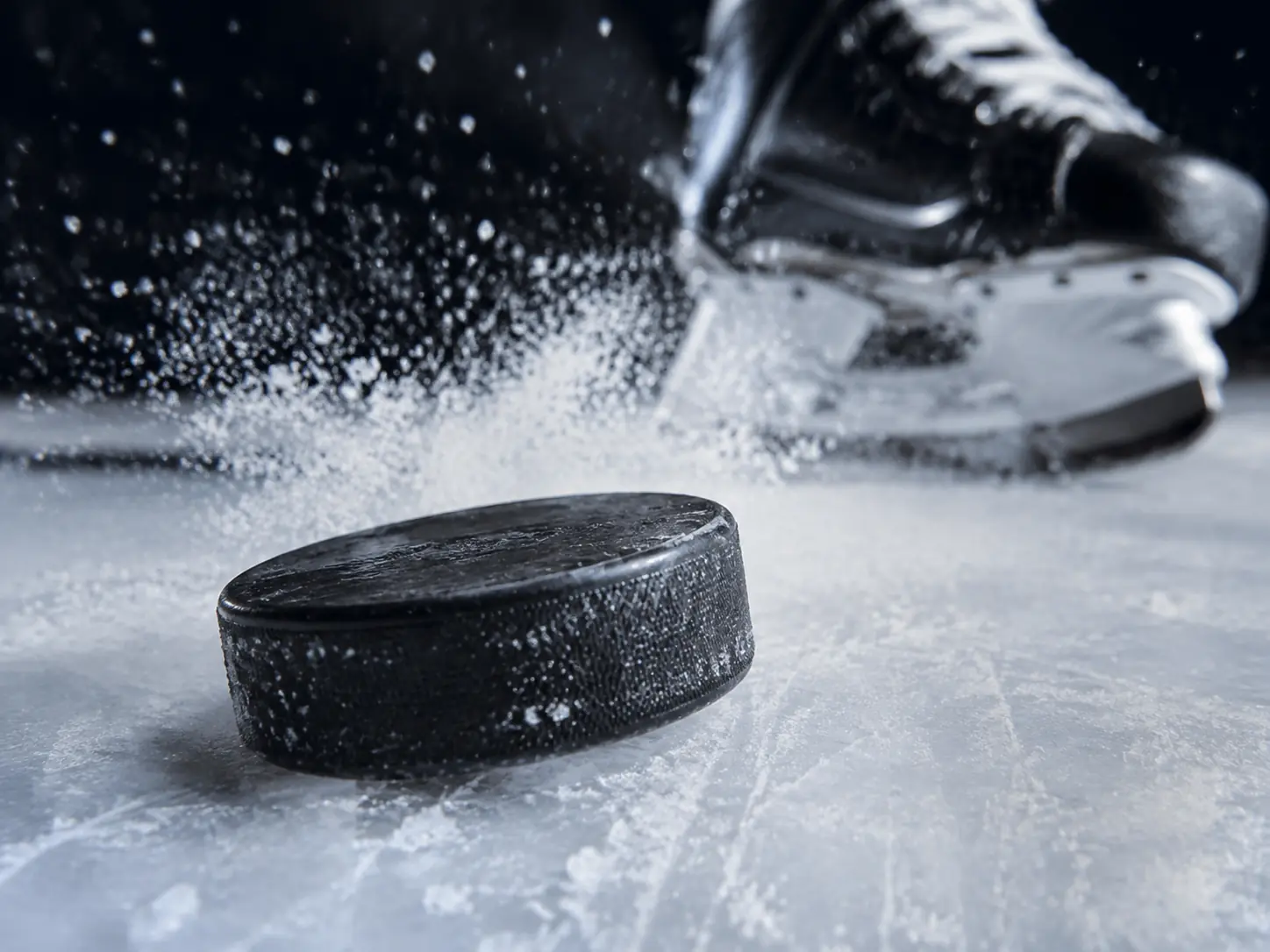
- Hockey players can stop sharply by rotating their skates and shaving ice sideways.
- The spray from a hard hockey stop is finely shaved ice.
- Backward skating is an essential defensive skill.
- Elite players transition between forward, backward, and lateral movement without stopping play.
Hockey sticks and shooting physics
- Modern hockey sticks are commonly made from carbon-fiber composite materials.
- Older sticks were primarily wooden.
- A stick shaft flexes when loaded during a hard shot.
- That flex stores elastic energy.
- The shaft releases energy as it straightens during the shot.
- Stick flex is rated to describe how stiff the shaft is.
- Stronger players do not automatically benefit from the stiffest possible stick.
- A stick that is too stiff can be difficult to load effectively.
- The curved blade helps players cradle, pass, and shoot the puck.
- Blade curves differ in openness, depth, and location.
- A wrist shot combines stick flex with fast wrist and body motion.
- A slap shot uses a larger windup and often strikes the ice just before the puck.
- Contact with the ice bends the stick and loads it like a spring.
- A snap shot uses a shorter release than a full slap shot.
- Modern shooting technique combines legs, hips, torso, arms, hands, stick flex, and blade angle.
Offside and icing
- Offside controls how attacking players enter the offensive zone.
- In ordinary play, the puck must cross the attacking blue line before attacking players do.
- A player can legally straddle or touch the line depending on exact puck and skate positions.
- Delayed offside can allow attackers to clear the zone and reset.
- The offside rule prevents players from simply waiting beside the opponent’s net for long passes.
- Icing limits long uncontrolled shots from one end of the rink to the other.
- In ordinary icing situations, a team shoots the puck from behind the center line beyond the opponent’s goal line without it being touched.
- Icing rules contain exceptions, especially during penalties.
- Many leagues use hybrid icing for player safety.
- Hybrid icing lets officials judge which player would likely reach the puck first rather than always requiring a full-speed race to the end boards.
- An icing call normally returns play to the offending team’s defensive zone.
- The offending team may face substitution restrictions after icing under some rule sets.
- Offside and icing both shape rink spacing and strategy.
- They also changed substantially during hockey history.
- The modern center red line and offside framework developed through 20th-century rule changes.
Penalties and the power play
- Hockey penalties punish prohibited actions.
- A penalized player may be required to sit in the penalty box.
- A minor penalty commonly lasts two minutes.
- During many minor penalties, the opposing team gains a numerical advantage.
- This advantage is called a power play.
- The penalized team is said to be shorthanded.
- A power-play goal often ends an ordinary minor penalty early.
- Major penalties usually last five minutes.
- Major-penalty rules can differ from minor-penalty rules after goals.
- Common infractions include tripping, hooking, slashing, holding, and interference.
- High-sticking penalties involve dangerous stick contact above normal shoulder or head areas.
- Too many players on the ice can produce a bench minor penalty.
- Misconduct penalties address serious or unsportsmanlike behavior.
- Penalty shots can be awarded in specific situations where a scoring opportunity is illegally denied.
- Rule books evolve continually in response to safety, fairness, and style of play.
Goalies are specialists
- Goaltenders wear specialized equipment that is larger and differently shaped than skater gear.
- A goalie uses a catching glove on one hand.
- The other hand holds a stick and wears a blocker.
- Large leg pads protect the lower body and help seal the ice.
- The butterfly technique drops both knees while spreading the pads across the lower net.
- Modern goaltending emphasizes efficient positioning as much as reflexes.
- Goalies track the puck through traffic and screens.
- They also read player body language before shots and passes.
- A goalie can leave the crease to play the puck under normal conditions.
- Goalies may be removed late in games for an extra skater.
- This creates an empty net but gives the trailing team an additional attacker.
- A goalie can occasionally be credited with scoring a goal.
- This can happen if the goalie shoots the puck into the opposite empty net or is the last player to touch it before an own-goal sequence.
- Shutouts occur when a team allows no goals.
- Goaltending combines skating, geometry, reaction time, anticipation, and courage against high-speed shots.
Hockey history and the Stanley Cup
- Ice-and-stick games existed before modern hockey rules were standardized.
- Organized modern ice hockey developed especially strongly in Canada during the 19th century.
- James Creighton is associated with early organized rules in Montreal.
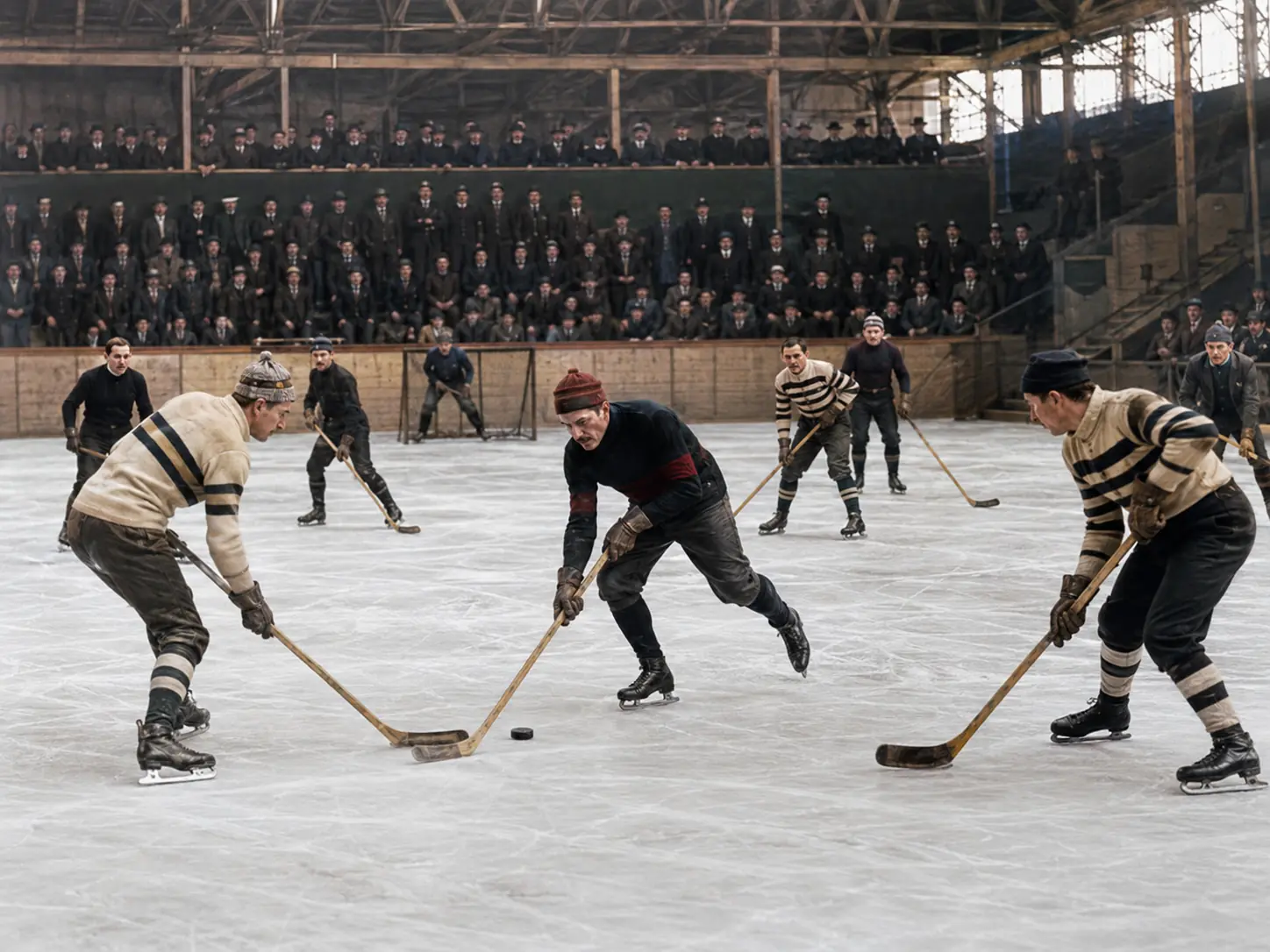
- A famous indoor game was played at Montreal’s Victoria Skating Rink on March 3, 1875.
- That early game used nine players per side rather than today’s typical six.
- The Stanley Cup was donated by Lord Stanley of Preston while he was Governor General of Canada.
- The first Stanley Cup championship was awarded in 1893.
- The Cup initially recognized top Canadian amateur hockey competition.
- Professional teams later became eligible.
- The National Hockey League was founded in 1917.
- The Stanley Cup became the NHL championship trophy after rival major leagues disappeared.
- The 1919 Stanley Cup Final was cancelled because of the influenza pandemic.
- The Seattle Metropolitans had become the first U.S.-based team to win the Stanley Cup in 1917.
- As of 2026, the NHL consists of 32 teams.
- The Stanley Cup remains one of the oldest continuously contested championship trophies in major North American professional sport.
Ten surprising ice-hockey facts
- Professional pucks are chilled because warm rubber bounces more.
- A skate blade actually uses two sharpened edges separated by a hollow.
- A slap shot can flex a composite stick dramatically before the puck leaves the blade.
- Early organized hockey games could use nine players per team.
- The Stanley Cup began as a Canadian challenge trophy rather than an NHL-owned invention.
- The 1919 Stanley Cup Final ended without a champion because of the influenza pandemic.
- Ice hockey appeared at the Olympics before the first Winter Olympic Games existed.
- The first Olympic ice-hockey tournament was held at the 1920 Summer Games in Antwerp.
- Women’s ice hockey became an Olympic event in 1998.
- For more sports trivia, explore our Olympics facts and Random facts.
Quick ice-hockey FAQ
How many hockey players are on the ice?
A full-strength team normally has six, one goaltender and five skaters.
Why are hockey pucks frozen?
Cold rubber is less bouncy, helping the puck stay flatter and behave more predictably during fast play.
What is icing?
It is a rule limiting long shots sent from behind the center line all the way beyond the opponent’s goal line without required contact or exceptions.
When was the first organized indoor hockey game?
A landmark game was played at Montreal’s Victoria Skating Rink on March 3, 1875.
When did ice hockey enter the Olympics?
Men’s ice hockey debuted at the 1920 Summer Olympics in Antwerp, four years before the first Winter Olympics. Women’s hockey joined the Olympic program in 1998.

Ellie is the owner and sole author of Fun Facts, combining her mechanical engineering background with years of research-driven writing to deliver facts you can trust. Every article is thoroughly fact-checked and routinely updated as new science and sources emerge to keep information accurate and current. Her mission is to make learning delightful while upholding high standards of reliability and transparency.