
Tennis has one of sports’ strangest scoring systems, a ball covered in fluorescent felt, courts that change speed with grass, clay, or hard surfaces, and a serve that can travel faster than a car on a highway. Its modern form is less than 200 years old, but its ancestors reach back centuries. These 145 tennis facts explain the court, rules, equipment, Grand Slams, scoring mysteries, famous innovations, and physics behind every rally.
Tennis basics
- Tennis is a racket sport played across a net.
- Singles matches use one player on each side.
- Doubles matches use two players on each side.
- Players hit a felt-covered rubber ball with strung rackets.
- A point begins with a serve.
- The server alternates sides of the center mark after each point.
- The serve must land diagonally in the opposite service box.
- Each player gets up to two serve attempts per point.
- Missing both attempts is a double fault.
- A legal return can be hit before or after one bounce.
- Except for the serve, a player may volley the ball before it bounces.
- A ball touching a boundary line is considered in.
- Players lose points by hitting out, into the net, or after two bounces.
- Match formats vary by event, age group, and governing body.
- The International Tennis Federation publishes the official Rules of Tennis.
The court has exact dimensions
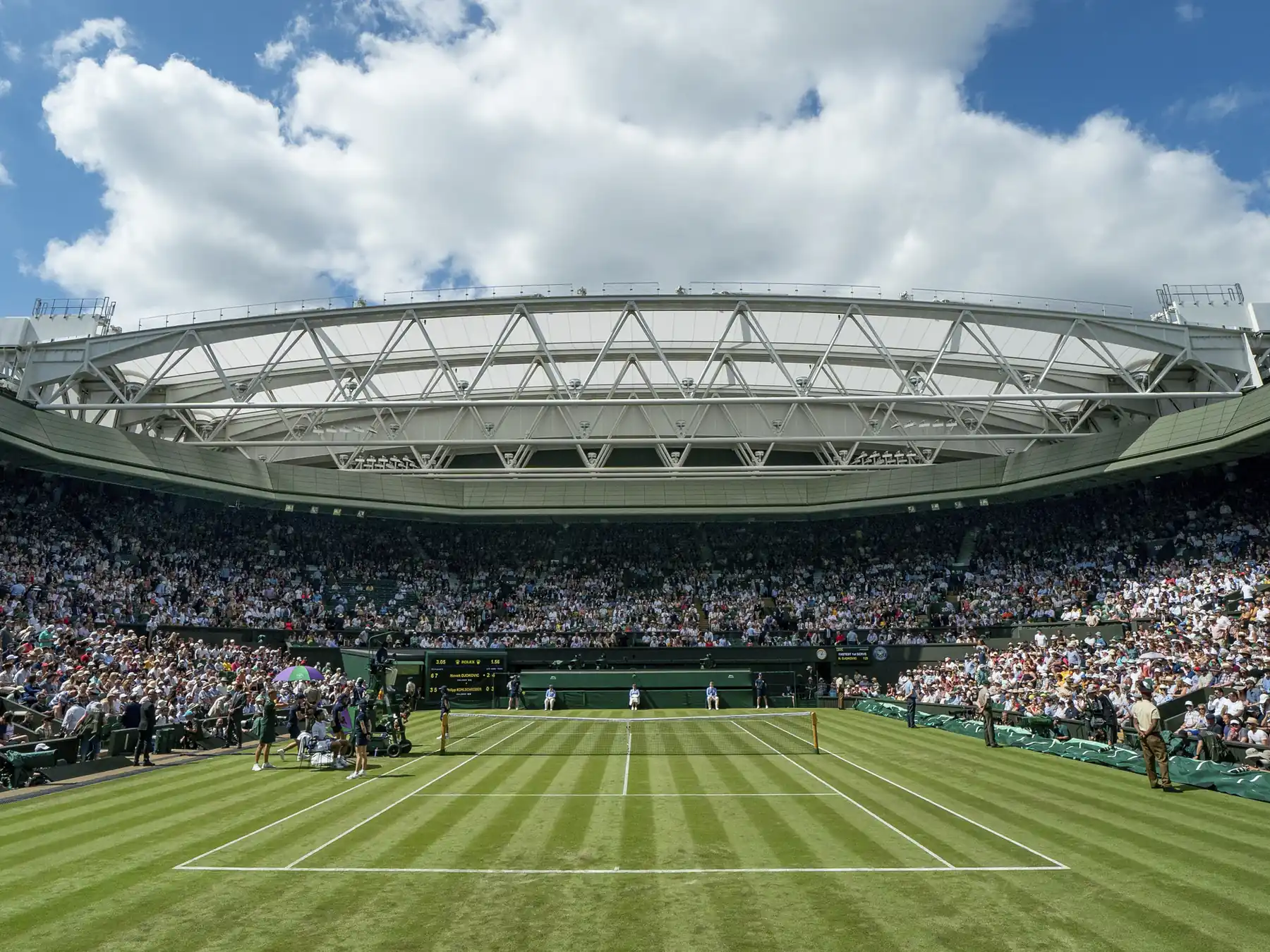
- A standard tennis court is 78 feet, or 23.77 meters, long.
- The singles court is 27 feet, or 8.23 meters, wide.
- The doubles court is 36 feet, or 10.97 meters, wide.
- Doubles alleys add width along each side of the singles court.
- The baseline runs across each end of the court.
- The service line sits 21 feet from the net.
- A center service line divides each side’s service area into two boxes.
- The net is lower in the center than at the posts.
- Its center height is 3 feet, or 0.914 meter.
- The net is 3 feet 6 inches high at the posts.
- The center strap holds the middle of the net down to regulation height.
- Singles sticks may support the net when singles is played on a doubles net.
- Service boxes are used only for serves, not as general rally boundaries.
- The doubles alley is out during singles play.
- Court dimensions stay the same even when surface material changes.
Why tennis scoring says 15, 30, 40
- Tennis points progress from love to 15, 30, 40, and game.
- The exact origin of this scoring sequence is uncertain.
- Popular explanations connect it with clock faces marked in quarter intervals.
- That clock theory is plausible but not proven by definitive evidence.
- Another possibility is that the numbers evolved from older French scoring traditions.
- Originally 45 may have been shortened to 40 for convenience.
- “Love” means zero in tennis scoring.
- The origin of “love” is also debated.
- A famous story connects it to the French word l’oeuf, meaning egg.
- Historians do not treat the egg story as conclusively proven.
- At 40-40, the score is called deuce.
- A player normally needs two consecutive points after deuce to win the game.
- Winning the first point after deuce gives advantage.
- If the advantaged player loses the next point, the score returns to deuce.
- The odd scoring vocabulary preserves tennis’s long historical development.
Games, sets, and tiebreaks
- A set is made up of games.
- A player usually needs at least six games to win a standard set.
- The winner normally must lead by at least two games unless a tiebreak intervenes.
- A 6-4 score wins a set.
- A 6-5 lead does not normally end a standard set.
- At 6-6, many competitions use a tiebreak.
- Tiebreak rules can vary by tournament and deciding-set format.
- James Van Alen played a major role in developing and promoting the modern tiebreak.
- Tiebreaks were introduced to prevent extremely long sets.
- Before tiebreaks, sets could continue indefinitely until someone led by two games.
- Match tiebreaks are used in some doubles and shorter-match formats.
- A best-of-three match ends when one player wins two sets.
- A best-of-five match requires three sets to win.
- Grand Slam men’s singles traditionally uses best-of-five matches.
- Rule formats continue evolving to balance tradition, fairness, broadcast length, and player welfare.
Tennis grew from older racket games
- Modern tennis descended partly from much older European ball games.
- French jeu de paume began as a handball-style game.
- The name means “game of the palm.”
- Players eventually adopted gloves and then racket-like equipment.
- Real tennis developed indoors with walls and complex court features.
- Modern lawn tennis emerged in Britain during the 19th century.
- Major Walter Clopton Wingfield patented and marketed a lawn-tennis set in 1874.
- Wingfield called his game Sphairistikè.
- Early lawn-tennis court shapes and rules differed from modern standards.
- The All England Club held the first Wimbledon Championship in 1877.
- Only men’s singles was contested at the first Wimbledon.
- Women’s singles was added in 1884.
- The rules gradually standardized around the rectangular court we recognize today.
- Tennis spread rapidly through clubs across Europe, North America, and colonial networks.
- The sport entered the modern Olympic Games in 1896.
The four Grand Slam tournaments
- The four major championships are collectively called the Grand Slam tournaments.
- They are the Australian Open, French Open, Wimbledon, and US Open.
- The Australian Open is played in Melbourne.
- The French Open is played at Roland-Garros in Paris.
- Wimbledon is played in London.
- The US Open is played in New York City.
- The four events use different surfaces and conditions.
- Roland-Garros uses red clay courts.
- Wimbledon uses grass.
- The Australian Open uses hard courts.
- The US Open also uses hard courts.
- Winning all four majors in one calendar year is a calendar Grand Slam.
- Winning all four across a career is a career Grand Slam.
- The term Grand Slam was borrowed from card-game vocabulary and became associated with sweeping all major titles.
- Surface differences make winning all four a test of adaptability as well as talent.
Grass, clay, and hard courts
- Grass courts use living turf.
- The ball tends to stay relatively low on grass.
- Grass can reward fast serves and aggressive first-strike play.
- Clay courts are covered with crushed mineral material.
- Red clay slows the ball and produces a higher bounce than many faster surfaces.
- Players can slide into shots on clay.
- Clay preserves visible ball marks that can help with line decisions.
- Hard courts use rigid bases topped with acrylic or similar layers.
- Hard-court pace varies according to surface composition and conditions.
- There is no single speed shared by every hard court.
- Temperature can change ball bounce and court behavior.
- Humidity affects ball flight and felt.
- Altitude changes air density and can make balls travel faster.
- Players adjust string tension, tactics, movement, and positioning to surface conditions.
- A champion on one surface may need a very different style on another.
Rackets and strings evolved dramatically
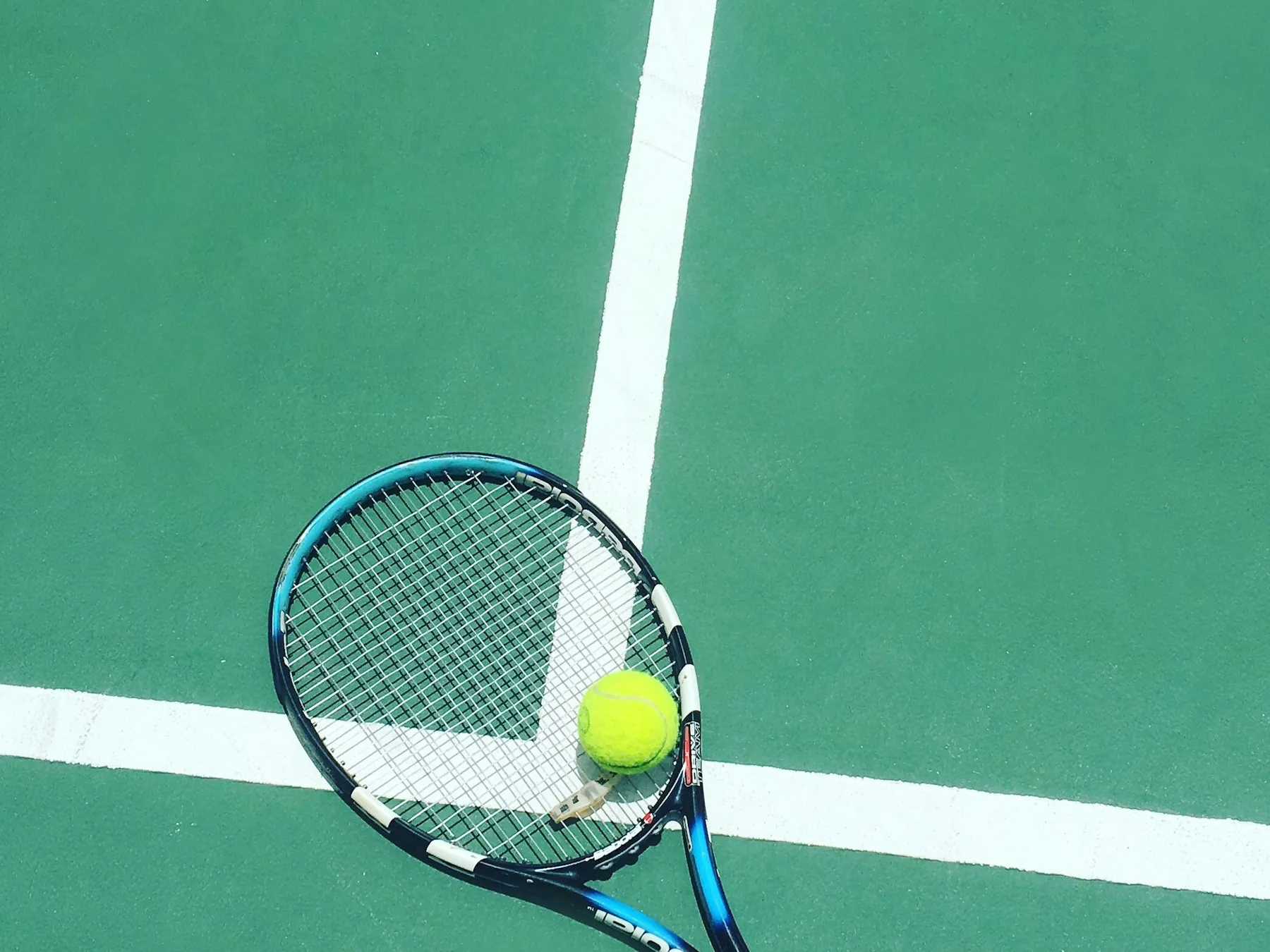
- Early tennis rackets were made primarily from wood.
- Wooden frames limited head size and stiffness.
- Metal rackets appeared during the 20th century.
- Graphite and composite materials eventually became dominant.
- Modern rackets are larger and lighter than classic wooden models.
- A larger head creates a bigger effective hitting area.
- Racket stiffness affects power, feel, vibration, and control.
- Natural-gut strings are traditionally made from animal intestine, usually cow serosa.
- Despite the name, catgut was not normally made from cats.
- Synthetic strings include nylon, polyester, and multifilament materials.
- Polyester strings became popular among advanced players for spin and control.
- Lower string tension generally creates a softer, more powerful response.
- Higher tension can increase perceived control but reduces string-bed deflection.
- Players often customize grip size, balance, weight, strings, and tension.
- Equipment choice interacts with technique rather than replacing it.
Tennis-ball science
- Modern tennis balls have hollow rubber cores covered in woven felt.
- Most tournament balls are pressurized internally.
- Pressure helps produce the required bounce.
- New cans are pressurized to reduce pressure loss before opening.
- Once a can opens, balls gradually lose internal pressure.
- Felt fluffs up during play and changes aerodynamics.
- A fuzzier ball experiences more air drag.
- Professional tournaments replace balls regularly during matches.
- Tennis balls are usually fluorescent yellow-green for high visibility.
- White balls were common before television visibility became a major concern.
- The ITF approved yellow balls for competition during the 1970s.
- Spin changes ball flight through the Magnus effect.
- Topspin makes the ball curve downward more strongly.
- Backspin can keep the ball floating and produce a lower bounce.
- Side spin changes lateral movement and is especially noticeable on serves and slices.
Ten surprising tennis facts
- Nobody knows with certainty why tennis scoring uses 15, 30, and 40.
- The popular story that “love” comes from the French word for egg is also unproven.
- A regulation tennis court is the same length on grass, clay, and hard surfaces.
- Natural-gut strings do not come from cats.
- Tennis balls were commonly white before television helped push fluorescent yellow into prominence.
- A newly opened ball can behaves differently from the same ball after long play because internal pressure escapes.
- The tiebreak was a modern invention designed to stop endless sets.
- Real tennis, the older indoor ancestor, still exists as a separate sport.
- Surface speed changes strategy enough that one sport can feel like several different games.
- For more sports trivia, explore our Olympics facts and Random facts.
Quick tennis FAQ
How long is a tennis court?
A regulation court is 78 feet, or 23.77 meters, long. Singles is 27 feet wide and doubles is 36 feet wide.
Why does tennis score 15, 30, 40?
The exact origin is uncertain. Clock-face and old French scoring explanations are popular, but historians do not have one definitive answer.
Why is zero called love?
The origin is debated. A popular explanation connects it to French l’oeuf, meaning egg, but the evidence is not strong enough to call that certain.
What are the four Grand Slams?
The Australian Open, French Open, Wimbledon, and US Open.
Why are tennis balls fuzzy?
Felt affects drag, spin, bounce, visibility, and how the ball interacts with the racket and court. It is a functional aerodynamic surface, not decoration.

Ellie is the owner and sole author of Fun Facts, combining her mechanical engineering background with years of research-driven writing to deliver facts you can trust. Every article is thoroughly fact-checked and routinely updated as new science and sources emerge to keep information accurate and current. Her mission is to make learning delightful while upholding high standards of reliability and transparency.