
Volleyball began as a gentler YMCA alternative to basketball and became a sport of 100-kilometer-per-hour serves, lightning-fast attacks, specialized defenders, beach tournaments, and Olympic arenas. Its original name was Mintonette, its first net was inspired by tennis, and early rules barely resemble the six-player game played today. These 145 volleyball facts explore William Morgan, scoring, rotations, positions, spikes, blocks, serves, liberos, Olympics, beach volleyball, equipment, and the physics behind keeping a ball off the floor.
Volleyball basics
- Indoor volleyball is played by two teams separated by a net.
- Six players from each team are normally on the court at once.
- The goal is to send the ball over the net and make it touch the opponent’s court.
- A team also scores when the opponent commits a fault.
- A rally begins with a serve.
- Teams normally have up to three contacts to return the ball.
- A block contact does not count as one of those three team hits under international rules.
- Players cannot catch and throw the ball during ordinary play.
- The ball may contact many parts of the body if played legally.
- Modern volleyball uses rally scoring.
- That means every completed rally produces a point.
- Matches are normally best of five sets.
- The first four sets are played to 25 points.
- A deciding fifth set is played to 15.
- A team must win a set by at least two points, so tied sets can continue beyond 25 or 15.
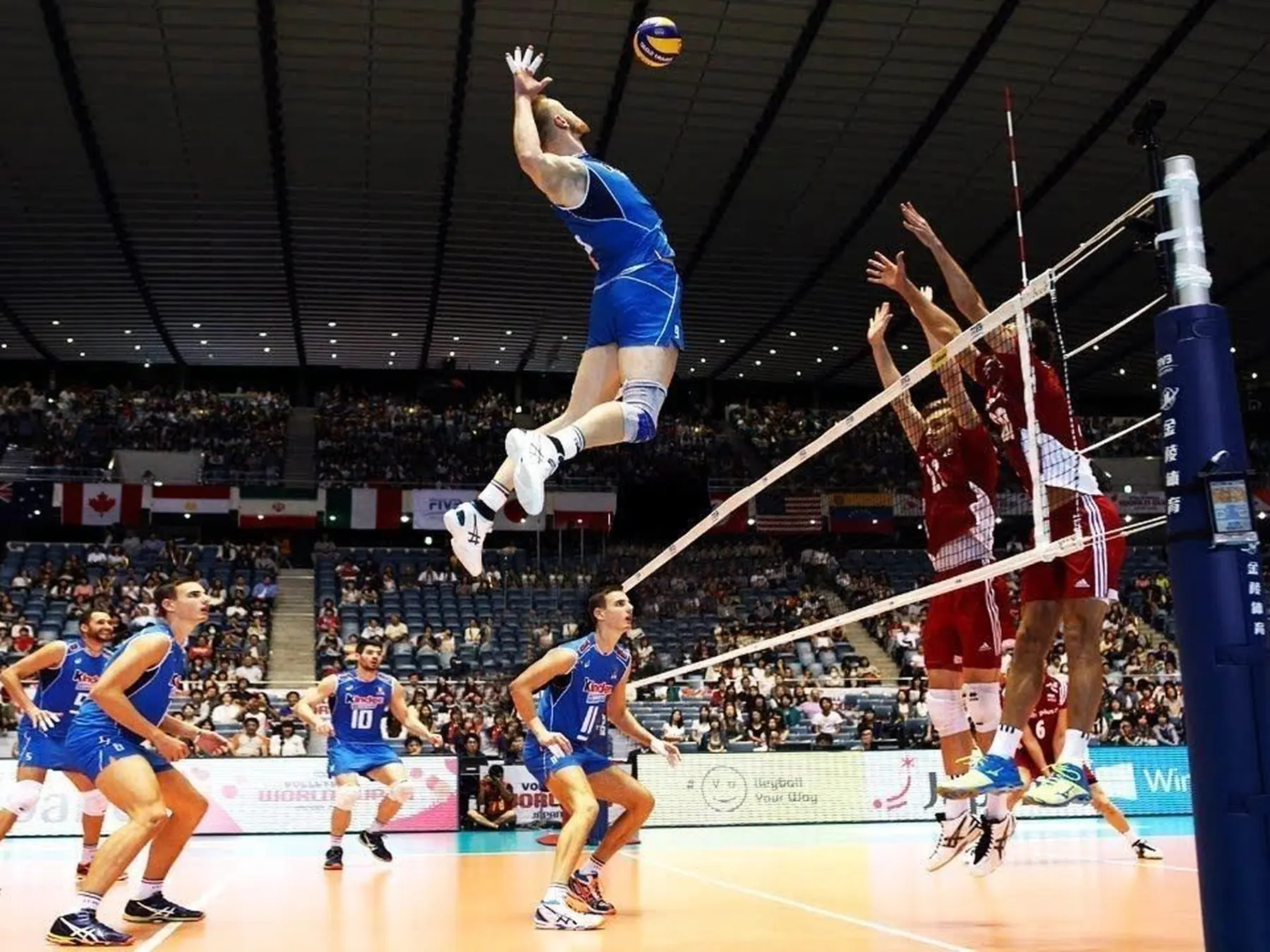
William Morgan invents Mintonette
- William G. Morgan invented volleyball in 1895.
- Morgan was a YMCA physical-education director in Holyoke, Massachusetts.
- He had studied at the YMCA training school in Springfield.
- There he met James Naismith, inventor of basketball.
- Basketball had been invented only four years earlier.
- Morgan wanted a competitive game that was less physically intense for adult businessmen.
- He borrowed ideas from several existing sports.
- Tennis inspired the use of a raised net.
- Early experiments used a basketball bladder as a ball.
- The bladder was too light and slow.
- A full basketball was too heavy.
- Morgan asked A.G. Spalding & Bros. to make a more suitable ball.
- He originally called the game Mintonette.
- The name reflected a loose connection with badminton.
- The FIVB’s official history of volleyball traces the sport directly to Morgan’s 1895 Holyoke YMCA experiments.
How Mintonette became volleyball
- Morgan demonstrated his new game at a YMCA conference in Springfield in 1896.
- Two teams of five men took part in the demonstration.
- Professor Alfred T. Halstead noticed the repeated volleying action.
- He suggested the name Volley Ball.
- Morgan accepted the new name.
- The spelling was originally two words.
- The United States Volleyball Association adopted the one-word spelling volleyball in 1952.
- Early rules allowed an unlimited number of players.
- The first net was roughly 6 feet 6 inches high.
- Early games were organized into innings rather than modern sets.
- Serving rules were very different.
- There was no modern libero.
- Rotation systems evolved later.
- Rules were published in YMCA physical-education materials during the 1890s.
- The sport spread rapidly because YMCA networks could teach it in many cities and countries.
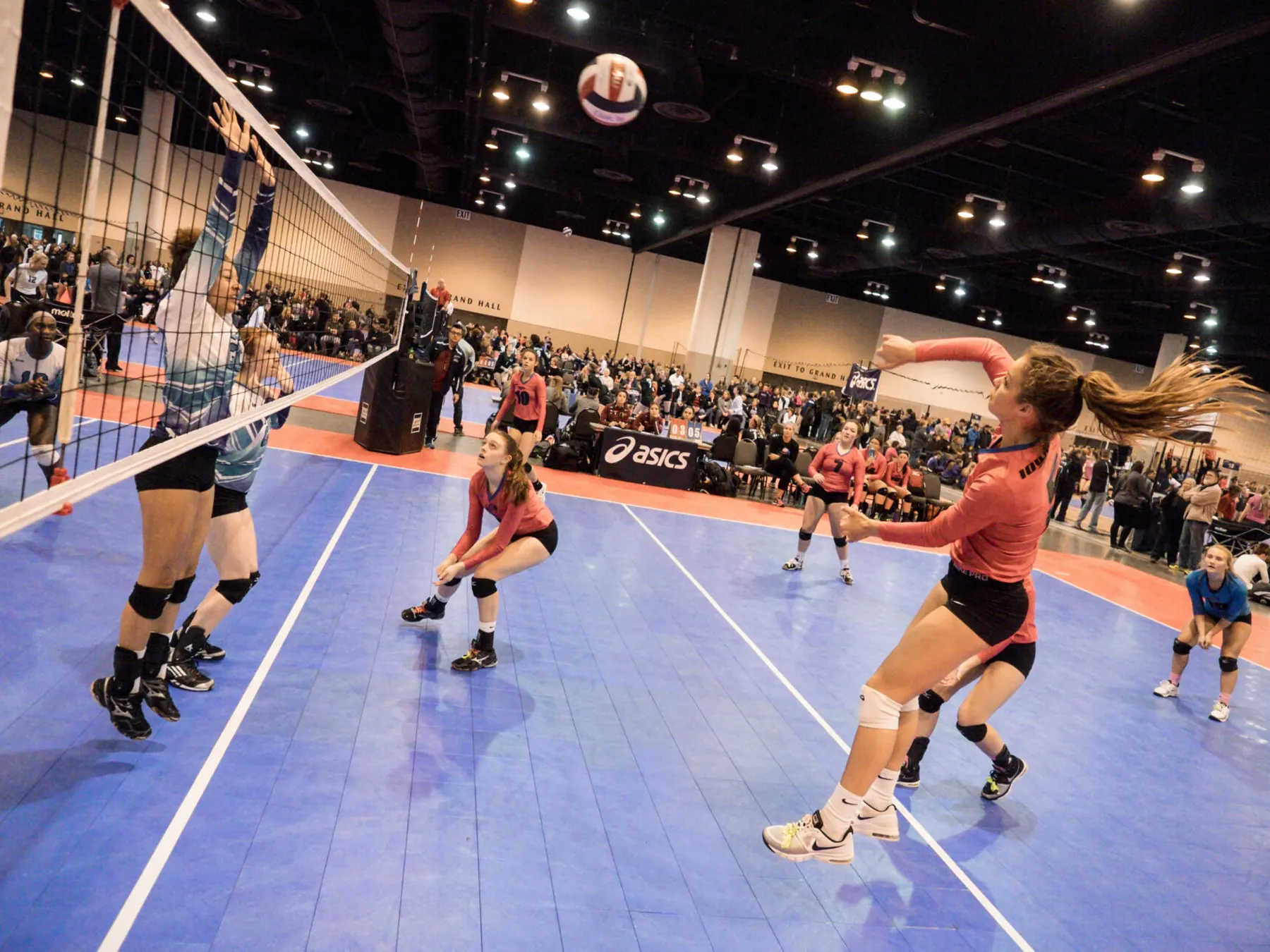
Volleyball spreads around the world
- Canada became one of the earliest countries outside the United States to adopt volleyball.
- YMCA instructors helped introduce the sport across Asia.
- Volleyball reached Japan, China, the Philippines, India, and other countries during the early 20th century.
- The Philippines became especially important to the development of attacking play.
- Asian players experimented with setting the ball high for a teammate to strike downward.
- This style helped develop the modern set-and-spike attack.
- Volleyball appeared in the Far Eastern Games in 1913.
- Different regions initially used different rules and team sizes.
- International standardization took decades.
- The Fédération Internationale de Volleyball was founded in 1947.
- The organization is usually known as the FIVB.
- Its headquarters are in Lausanne, Switzerland.
- The first men’s World Championship was held in 1949.
- The first women’s World Championship followed in 1952.
- International competition helped turn a YMCA recreation into a highly specialized global sport.
Rotations make volleyball unusual
- Indoor volleyball players rotate through six court positions.
- A team rotates when it wins the right to serve from the opponent.
- Players move one position clockwise.
- Three positions are considered front row.
- Three are back row.
- Rotation order limits where players may be positioned at the moment required by the rules.
- After the serve begins, players can move into their tactical locations.
- This lets specialized setters, hitters, and defenders operate where they are strongest.
- Back-row players face restrictions on attacking near the net.
- A back-row player cannot legally complete certain attacks above the net after taking off from in front of the attack line.
- The attack line is 3 meters from the center line in international volleyball.
- Rotation rules force athletes to understand both position and sequence.
- Teams use formations such as 5-1 and 6-2 systems.
- A 5-1 offense normally uses one primary setter across all rotations.
- A 6-2 system can use two setters who set when they rotate into the back row.
Setters run the offense
- The setter is often compared with a quarterback in American football.
- Setters decide which attacker receives many offensive balls.
- A good set must control height, speed, location, and timing.
- Quick sets reach middle attackers extremely fast.
- High outside sets give hitters more time to approach.
- Back sets travel behind the setter.
- Back-row attacks can add another offensive option.
- Setters read blockers before choosing a target.
- They also track which hitters are in rhythm.
- Front-row setters can become attacking threats themselves.
- A setter dump sends the second contact over the net instead of setting a hitter.
- This works best when defenders expect a conventional set.
- Setters often take the second team contact.
- Teammates try to pass the first contact toward a consistent target area.
- One poor pass can completely change the offensive options available on a rally.
Spiking is controlled flight
- A spike is a forceful attacking hit directed into the opponent’s court.
- Attackers use an approach to convert horizontal movement into vertical jump and hitting power.
- The final steps help load the legs for takeoff.
- Arms swing backward and then upward to contribute momentum.
- Hip and torso rotation transfer energy toward the hitting arm.
- The elbow leads before the forearm accelerates.
- Hand position affects direction and topspin.
- Topspin makes the ball dip more quickly after crossing the net.
- That lets hitters swing hard while still aiming inside the court.
- Elite attackers can contact the ball well above the height of a basketball rim.
- The FIVB notes that top spikers may contact the ball around 3.65 meters above the floor.
- Attackers can hit line, cross-court, tip, roll, or use the block deliberately.
- A tool or wipe sends the ball off blockers and out of bounds.
- Shot selection matters as much as raw power.
- The best hitters read blockers and defenders while already airborne.
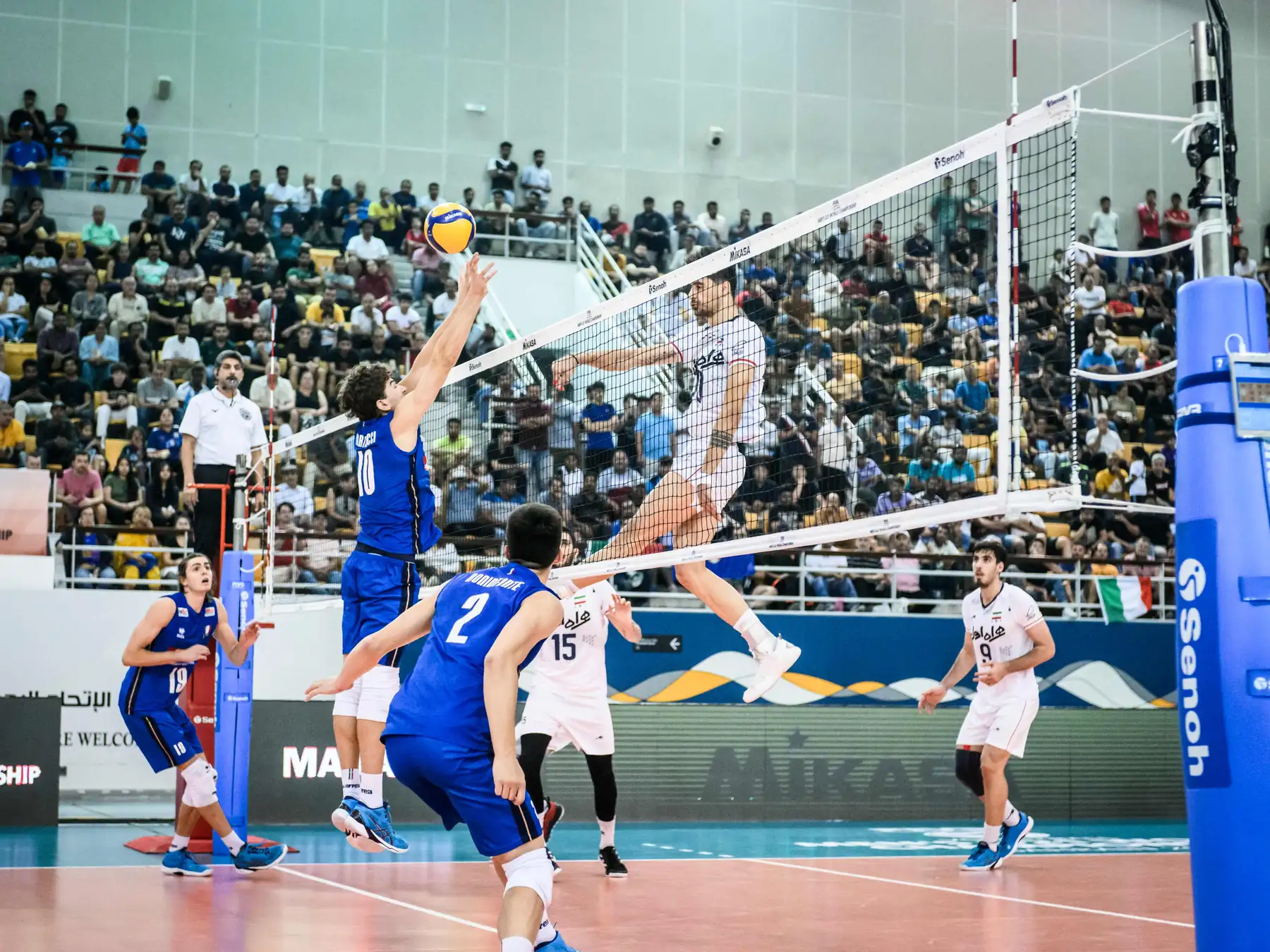
Blocking happens in fractions of a second
- Blocking is the first line of defense against an attack.
- Front-row players jump near the net with arms extended upward.
- Elite blockers reach their hands over the net into the opponent’s space without illegally interfering before the attack.
- This technique is called penetrating the net.
- A solo block uses one blocker.
- Double and triple blocks use two or three.
- Middle blockers move laterally along the net to close blocks.
- They must read the setter and attacker quickly.
- A well-formed block removes part of the court from the hitter.
- Back-row defenders position themselves around the expected block.
- A stuff block sends the attacked ball directly back down.
- A soft block slows the ball enough for defenders to play it.
- Block touches can be difficult for referees to see.
- Video challenge systems are used in major competitions for some disputed calls.
- Blocking combines reaction speed, scouting, footwork, jumping, hand positioning, and teamwork.
The libero changed defense
- The libero is a specialized defensive player.
- The position was introduced internationally during the 1990s.
- A libero wears a jersey that contrasts with teammates.
- The visual difference helps officials track special substitution rules.
- Liberos play in back-row positions.
- They specialize in serve reception and defense.
- Libero replacements do not work exactly like ordinary substitutions.
- The position gives shorter defensive specialists a major role in elite volleyball.
- A libero cannot complete an attack hit if the ball is entirely above the top of the net.
- Special setting restrictions apply if the libero uses an overhand finger pass in the front zone and a teammate attacks it above net height.
- Exact libero serving permissions vary among rule systems and competitions.
- International rules have evolved since the position was introduced.
- Libero play helped lengthen rallies by improving first-contact defense.
- Passing consistency can determine whether a team runs a full offense or simply sends a safe ball back.
- A great libero may touch fewer spectacular balls than a star hitter while quietly controlling the match’s rhythm.
Ten surprising volleyball facts
- Volleyball was invented only four years after basketball.
- Its original name was Mintonette.
- The sport began as a lower-contact activity for adult YMCA members.
- Early volleyball allowed an unlimited number of players.
- The name was originally written as two words, Volley Ball.
- Indoor volleyball became an Olympic sport in 1964.
- Beach volleyball joined the Olympics in 1996.
- Rally scoring became the international standard after major rule changes in the late 1990s.
- The libero is younger than many longtime volleyball fans.
- For more sports trivia, explore our Olympics facts, swimming facts, and Random facts.
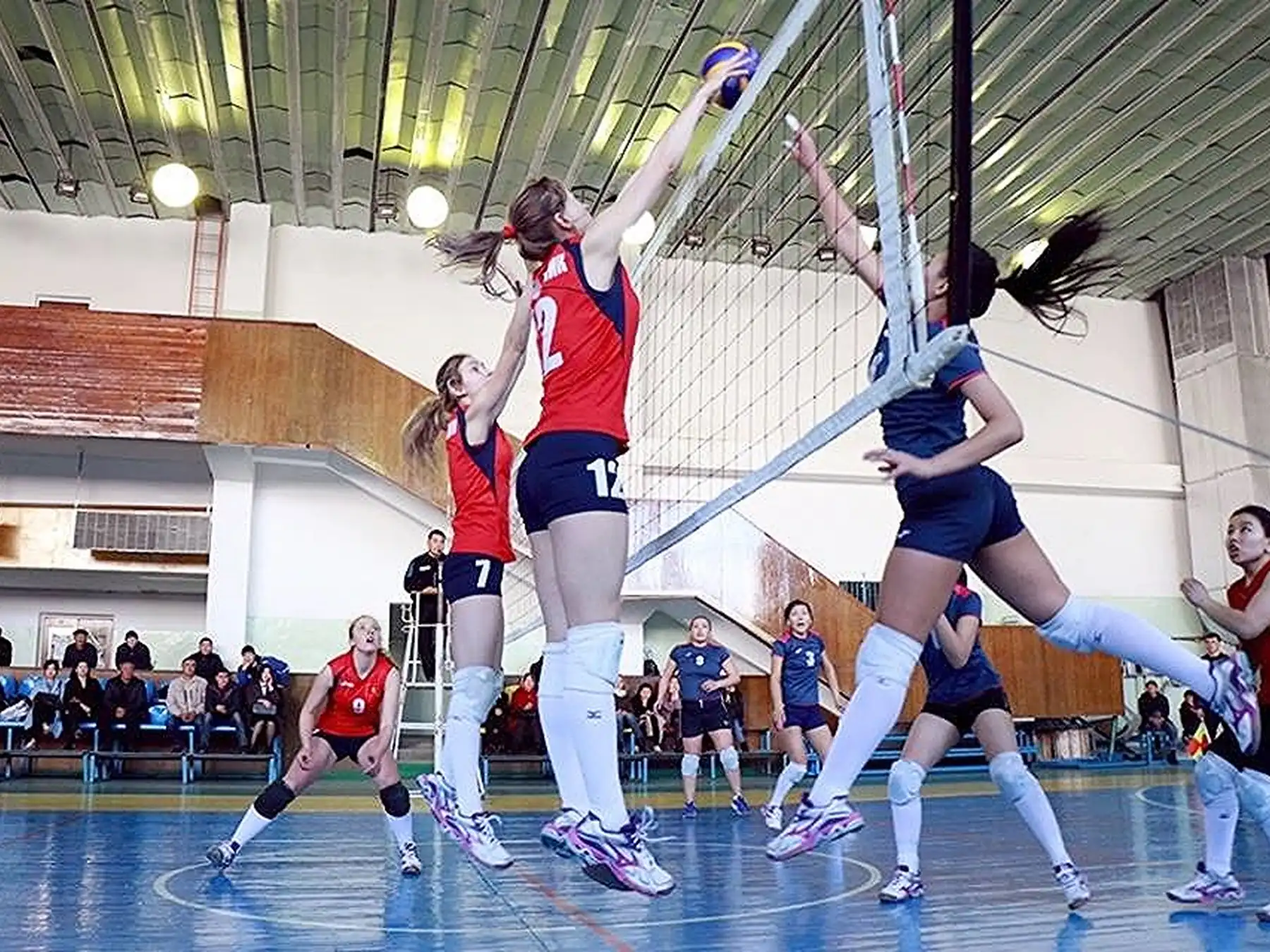
Quick volleyball FAQ
Who invented volleyball?
William G. Morgan, a YMCA physical-education director in Holyoke, Massachusetts, in 1895.
What was volleyball originally called?
Mintonette. The name changed to Volley Ball after an 1896 demonstration emphasized the game’s volleying action.
How many players are on an indoor volleyball court?
Six per team during ordinary play.
How many times can a team touch the ball?
Normally three team hits to return it, with a block contact not counted as one of those three under international rules.
When did volleyball become an Olympic sport?
Indoor volleyball debuted at the 1964 Tokyo Olympics. Beach volleyball joined the Olympic program at Atlanta 1996.

Ellie is the owner and sole author of Fun Facts, combining her mechanical engineering background with years of research-driven writing to deliver facts you can trust. Every article is thoroughly fact-checked and routinely updated as new science and sources emerge to keep information accurate and current. Her mission is to make learning delightful while upholding high standards of reliability and transparency.