
Tanzania has Africa’s highest mountain, enormous wildlife migrations, Zanzibar spice streets, some of humanity’s most important fossil sites, a crater packed with animals, giant lakes, tanzanite found nowhere else commercially, and a national language that helps connect more than 100 ethnic groups. The Serengeti is only the opening scene.
Tanzania stretches from giant lakes to the Indian Ocean
- Tanzania is located in East Africa.
- Dodoma is the national capital.
- Dar es Salaam is the country’s largest city and major commercial center.
- Tanzania borders eight countries.
- They are Kenya, Uganda, Rwanda, Burundi, the Democratic Republic of the Congo, Zambia, Malawi, and Mozambique.
- The Indian Ocean forms the country’s eastern coastline.
- Tanzania includes the semi-autonomous islands of Zanzibar.
- The United Republic of Tanzania formed from the union of Tanganyika and Zanzibar.
- The union took place in 1964.
- The name Tanzania blends parts of the names Tanganyika and Zanzibar.
- The Tanzanian shilling is the national currency.
- Kiswahili, or Swahili, is the national language and dominant language of public life.
- English is also widely used in higher education, law, business, and some government contexts.
- More than 100 Indigenous African languages are spoken in Tanzania.
- The national flag uses green, blue, black, and yellow.
- Green represents vegetation and agriculture in common official explanations.
- Blue represents lakes, rivers, and the Indian Ocean.
- Black represents the people and yellow the country’s mineral wealth.
- Tanzania uses East Africa Time year-round.
- A country can contain both an ocean archipelago and the continent’s tallest mountain, which feels like geographic overachieving.
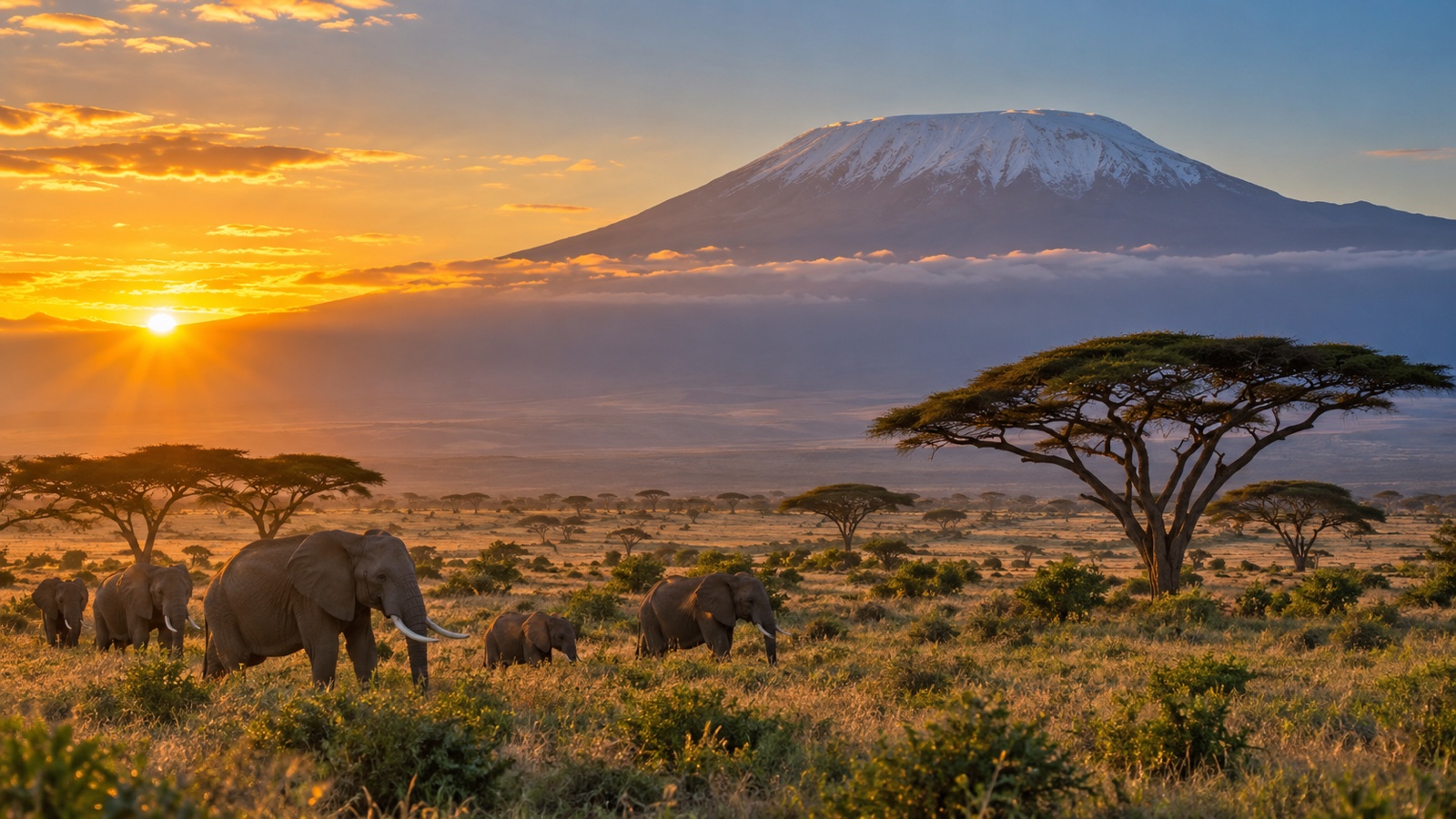
Kilimanjaro rises almost 20,000 feet above sea level
- Mount Kilimanjaro is the highest mountain in Africa.
- Uhuru Peak reaches 19,341 feet above sea level.
- Kilimanjaro is a massive volcanic mountain.
- It has three main volcanic cones: Kibo, Mawenzi, and Shira.
- Kibo contains the mountain’s highest summit.
- Kibo is dormant rather than considered completely extinct.
- Mawenzi and Shira are older and heavily eroded.
- Kilimanjaro rises unusually high above surrounding plains.
- Climbers can pass through several ecological zones on the way to the summit.
- Those zones include cultivated foothills, montane forest, heath, alpine desert, and summit ice.
- Kilimanjaro can be climbed without technical mountaineering on standard trekking routes.
- Altitude sickness is still a serious risk.
- Slow acclimatization improves the chance of reaching the summit safely.
- The mountain’s glaciers and ice fields have shrunk dramatically since the late 19th century.
- Climate change is a major factor in long-term ice loss.
- Mount Kilimanjaro National Park is a UNESCO World Heritage Site.
- The mountain lies near Tanzania’s border with Kenya.
- Some of the most famous photographs of Kilimanjaro are taken from Kenya.
- The name Uhuru means “freedom” in Swahili.
- Kilimanjaro is the rare mountain where the summit name itself celebrates national independence.
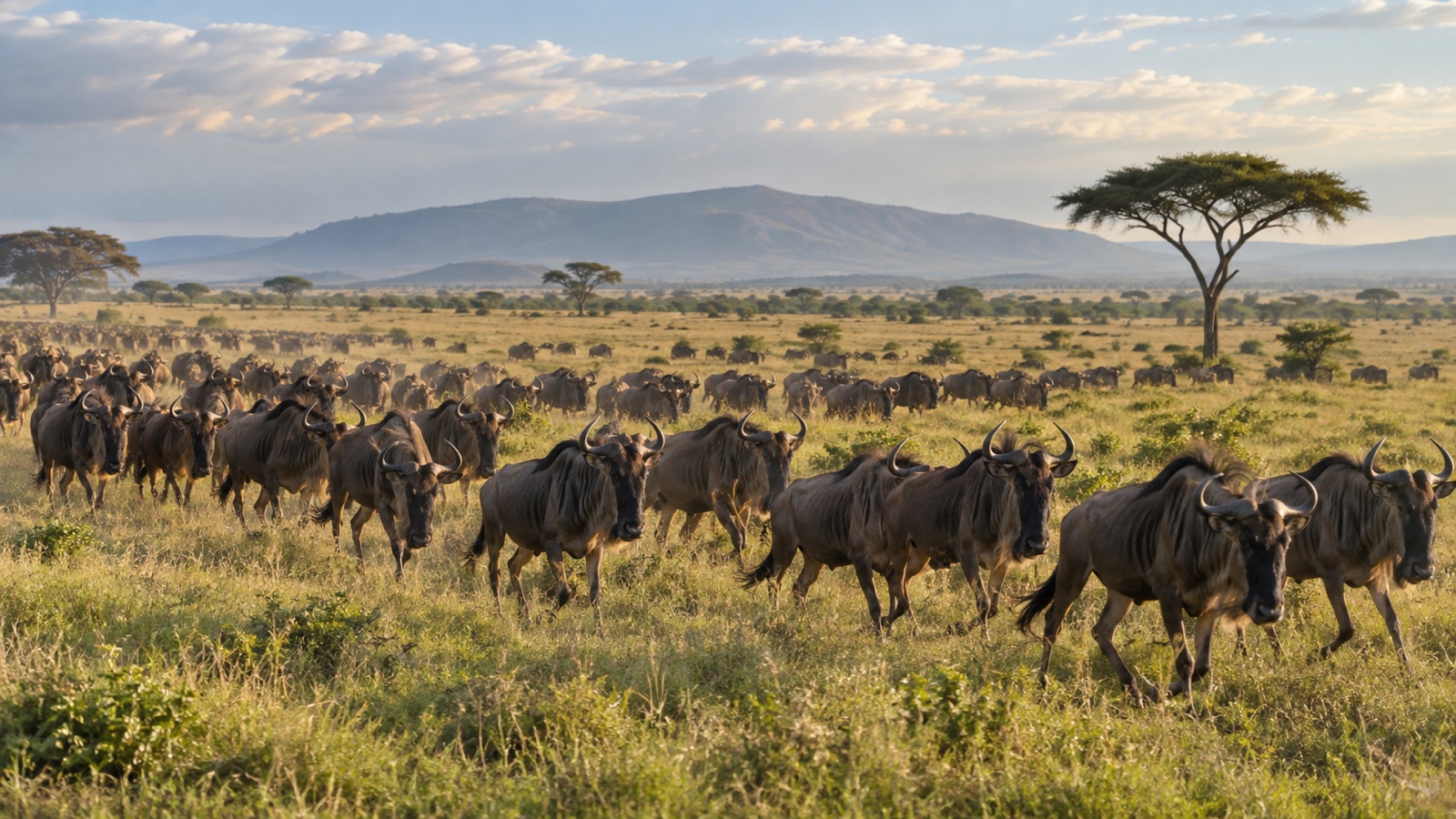
The Serengeti-Mara migration ignores national borders
- Serengeti National Park protects a vast savanna ecosystem in northern Tanzania.
- The park is part of the larger Serengeti-Mara ecosystem.
- That ecosystem extends into Kenya’s Maasai Mara.
- More than a million wildebeest participate in the region’s seasonal migration.
- Hundreds of thousands of zebras and gazelles move with or around the herds.
- The migration follows changing rainfall and fresh grazing.
- It is not one clockwise parade operating on a fixed calendar.
- Calving commonly occurs on the southern Serengeti plains early in the year.
- Large numbers of calves are born within a relatively short period.
- Predators take advantage of the concentration of vulnerable prey.
- Lions are abundant in the Serengeti ecosystem.
- Cheetahs favor open grassland where speed is useful.
- Leopards often use woodland and riverine habitat.
- Spotted hyenas are highly social predators as well as scavengers.
- Crocodiles wait at major river crossings.
- River-crossing scenes are dramatic but represent only a small fraction of the migration cycle.
- The ecosystem also supports elephants, giraffes, buffalo, hippos, and many antelope species.
- Serengeti became a UNESCO World Heritage Site in 1981.
- The name Serengeti is commonly linked to a Maa-language term describing endless plains.
- The migration’s most impressive fact may be that millions of animals operate on rainfall instead of our carefully marketed safari calendar.
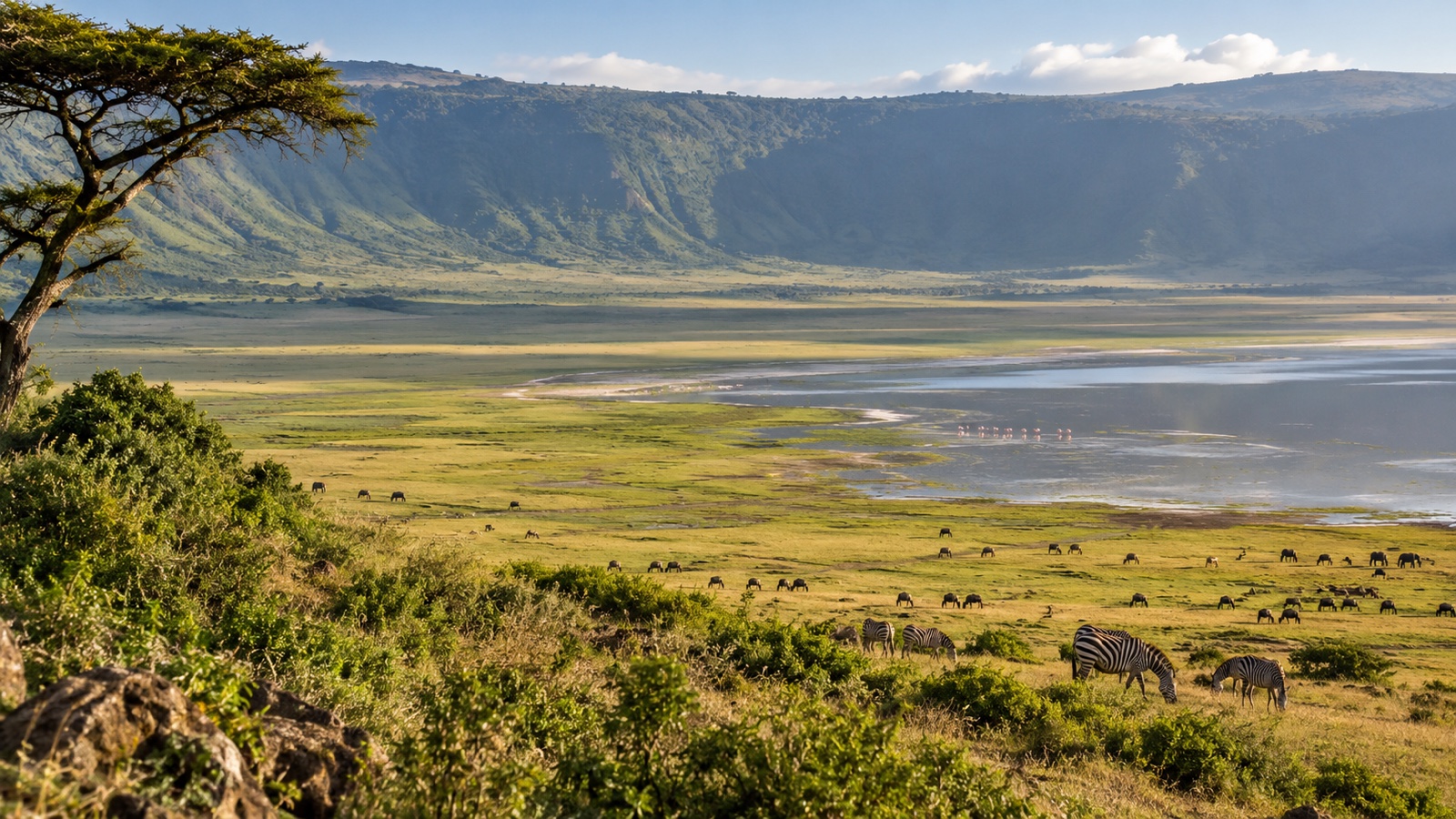
Ngorongoro is a giant volcanic bowl full of life
Ngorongoro looks almost designed for wildlife viewing, but the bowl is the collapsed remains of an enormous ancient volcano. The crater floor holds grasslands, wetlands, forest, salt flats, predators, grazing herds, and roads, while Maasai communities live in the wider conservation area.
- Ngorongoro Crater formed when a huge volcano collapsed after a major eruption.
- The crater is one of the world’s largest intact volcanic calderas.
- Its floor covers roughly 100 square miles.
- Crater walls rise thousands of feet above the floor.
- Large populations of grazing mammals live inside the caldera.
- Lions are among the crater’s major predators.
- Spotted hyenas are also abundant.
- Black rhinoceroses occur in the conservation area.
- Elephants visit forested parts of the crater.
- Giraffes are uncommon on the crater floor despite living in the surrounding region.
- The steep descent and food habitat may help explain their relative absence.
- Lake Magadi is a shallow alkaline lake on the crater floor.
- Flamingos can feed there when conditions are suitable.
- Ngorongoro Conservation Area is not managed exactly like a national park.
- Human residence and livestock grazing are permitted in parts of the wider conservation area.
- Maasai pastoralists have long lived in the region.
- Conservation policies have also created conflicts over land access and Indigenous rights.
- The area is UNESCO-listed for both natural and cultural significance.
- Wildlife conservation and community rights remain an active policy challenge.
- Ngorongoro is beautiful enough that it is easy to forget people live inside the conservation story too.
Olduvai and Laetoli preserve clues to human evolution
- Northern Tanzania contains some of the world’s most important paleoanthropological sites.
- Olduvai Gorge lies within the Ngorongoro Conservation Area.
- Layered sediments there preserve fossils and stone tools spanning immense periods of time.
- Louis and Mary Leakey conducted famous research at Olduvai.
- Mary Leakey discovered a robust hominin skull there in 1959.
- The fossil was originally called Zinjanthropus boisei and is now classified as Paranthropus boisei.
- Homo habilis fossils were also discovered in the Olduvai region.
- Stone tools at Olduvai helped researchers understand early hominin behavior.
- Laetoli lies south of Olduvai Gorge.
- Mary Leakey’s team uncovered ancient hominin footprints at Laetoli in the 1970s.
- The famous footprints are about 3.66 million years old.
- They were preserved in volcanic ash.
- The trackway shows early hominins walking upright.
- Australopithecus afarensis is the species most commonly linked with the footprints.
- The exact identities of individual footprint makers cannot be known.
- Other fossil tracks in the area reveal extinct animals sharing the landscape.
- Tanzania’s Rift Valley geology helps expose ancient sediments through erosion and faulting.
- The region connects modern wildlife tourism with evidence from millions of years of human evolution.
- “Walking in someone’s footsteps” becomes very literal when the someone walked there 3.66 million years ago.
- Tanzania has a remarkable way of making one road connect both safari vans and the deep human past.
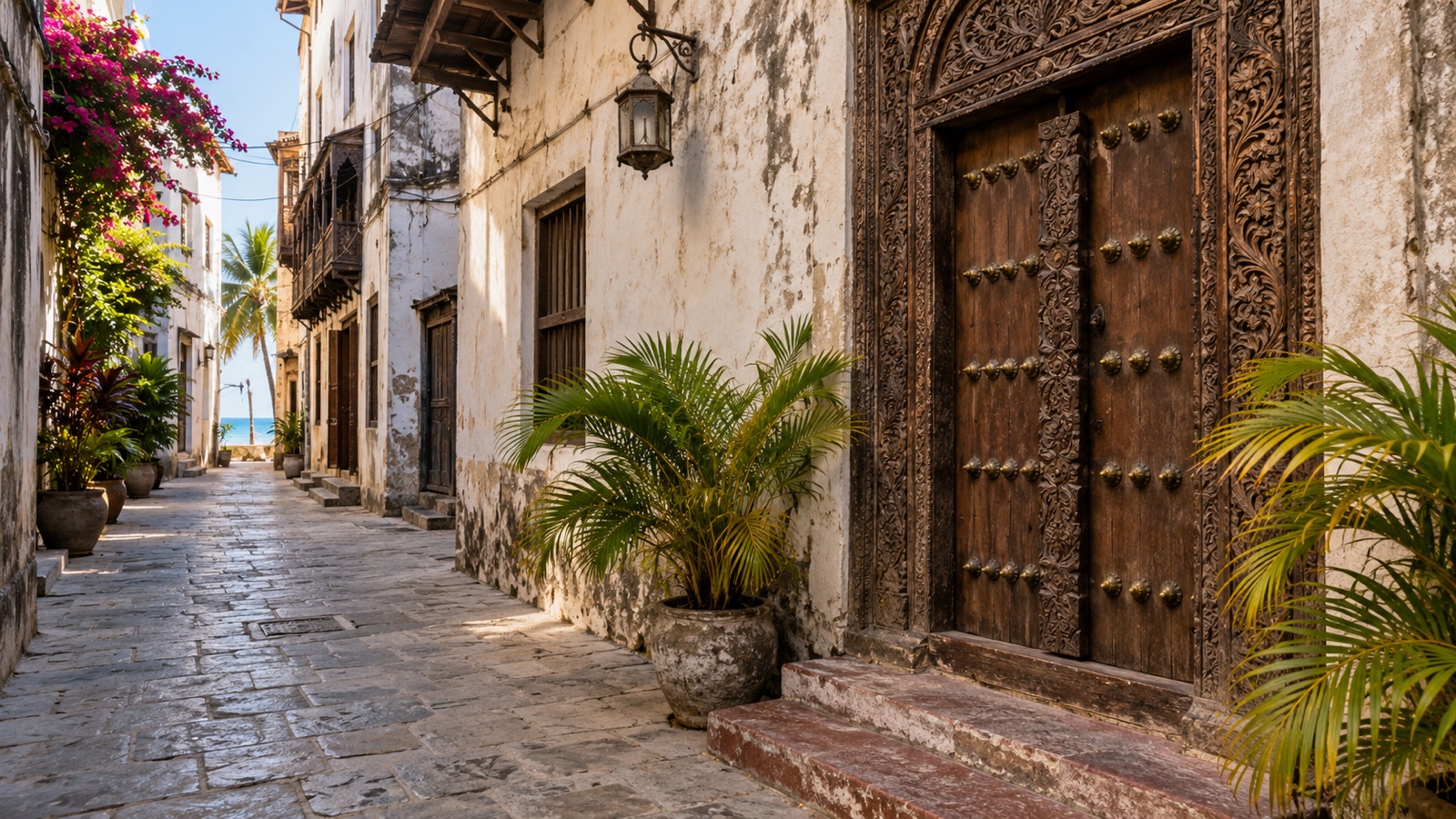
Zanzibar brings Swahili, spice and Indian Ocean history together
Zanzibar is not just “the beach part” of Tanzania. The islands have centuries of African, Arab, Persian, Indian, Portuguese, Omani, and European connections, and Stone Town’s carved doors and tight lanes tell a much more complicated story than a resort brochure.
- Zanzibar is an archipelago off Tanzania’s Indian Ocean coast.
- Unguja is the largest island and is commonly called Zanzibar Island.
- Pemba is the other main large island.
- Zanzibar has its own president and legislature for many internal matters.
- Union matters remain under the national government of Tanzania.
- Stone Town is the historic core of Zanzibar City.
- It is a UNESCO World Heritage Site.
- Coral stone was widely used in historic buildings.
- Elaborately carved wooden doors are famous features of Stone Town architecture.
- Omani rulers made Zanzibar a major political and commercial center during the 19th century.
- The island became a major hub in the East African slave trade.
- Enslaved Africans were forced through Zanzibar’s markets and plantation economy.
- Clove plantations became enormously important.
- Zanzibar remains strongly associated with cloves and other spices.
- Spice farms grow cloves, cinnamon, nutmeg, vanilla, pepper, turmeric, and tropical fruit.
- Swahili culture developed through centuries of African and Indian Ocean exchange.
- Islam is the dominant religion on Zanzibar.
- The Zanzibar Revolution took place in January 1964.
- Zanzibar united with Tanganyika later that year.
- Freddie Mercury of Queen was born in Stone Town in 1946 as Farrokh Bulsara.
Tanzanite, food, music and 25 final Tanzania facts
- Tanzanite is a blue-violet gemstone variety of the mineral zoisite.
- Commercial tanzanite deposits are concentrated in a tiny area near Mount Kilimanjaro.
- The gemstone was introduced to international jewelry markets during the late 1960s.
- Its name was created for marketing based on Tanzania.
- Tanzania is one of the world’s major producers of gold.
- Agriculture employs a large share of the population.
- Coffee, tea, cashews, cotton, tobacco, cloves, and horticultural products are important crops or exports.
- Ugali, a stiff maize-meal staple, is eaten widely.
- Rice is especially common along the coast and on Zanzibar.
- Nyama choma means grilled meat and is popular across East Africa.
- Pilau reflects Indian Ocean spice influences.
- Chipsi mayai combines French fries with eggs in a thick omelet.
- Mishkaki are grilled meat skewers.
- Bongo Flava is a Tanzanian popular-music genre combining hip-hop, R&B, dancehall, local languages, and regional styles.
- Taarab music has deep roots in Zanzibar and the Swahili coast.
- Football is the country’s most popular spectator sport.
- The Maasai live in both Tanzania and Kenya.
- The Hadza of northern Tanzania maintain one of the world’s best-known contemporary hunter-gatherer traditions.
- Hadza language contains click consonants but is not simply a branch of neighboring click-language families.
- Lake Victoria touches northwestern Tanzania.
- Lake Tanganyika forms part of Tanzania’s western boundary.
- Lake Tanganyika is the world’s second-deepest freshwater lake.
- Lake Nyasa, also called Lake Malawi, touches southwestern Tanzania.
- Julius Nyerere was Tanzania’s first president and a central figure in the independence era.
- After 145 facts, Tanzania still feels like several world-class destinations sharing one flag and politely pretending that is normal.
Quick FAQ
Q: What is Tanzania famous for?
A: Mount Kilimanjaro, Serengeti wildlife, Ngorongoro Crater, Zanzibar, the Great Migration, tanzanite, Olduvai Gorge, Swahili culture, and major African lakes.
Q: What is the capital of Tanzania?
A: Dodoma is the capital, while Dar es Salaam is the largest city and main commercial center.
Q: Is Zanzibar a separate country?
A: No. Zanzibar is a semi-autonomous part of the United Republic of Tanzania with its own government for many internal matters.
Q: Is Kilimanjaro in Kenya?
A: No. Mount Kilimanjaro is entirely in Tanzania, though it is famously visible from parts of neighboring Kenya.
Q: What is special about tanzanite?
A: Commercial deposits of the blue-violet gemstone are concentrated in a very small mining area near Mount Kilimanjaro, making it unusually geographically limited.

Ellie is the owner and sole author of Fun Facts, combining her mechanical engineering background with years of research-driven writing to deliver facts you can trust. Every article is thoroughly fact-checked and routinely updated as new science and sources emerge to keep information accurate and current. Her mission is to make learning delightful while upholding high standards of reliability and transparency.