
Rhode Island is the smallest state, but apparently nobody told it to act small. It has colonial rebellion, Gilded Age mansions, serious sailing culture, rocky coastlines, Italian bakeries, quahogs, coffee milk, and a state name long enough to have needed an official shortening.
Rhode Island basics from America’s smallest state
- Rhode Island became the 13th and final original state to ratify the U.S. Constitution.
- It ratified the Constitution on May 29, 1790.
- Providence is the state capital.
- Providence is also Rhode Island’s largest city.
- Rhode Island is the smallest U.S. state by land area.
- Its official name is simply the State of Rhode Island.
- Voters removed “and Providence Plantations” from the official state name in 2020.
- The postal abbreviation is RI.
- The official nickname is the Ocean State.
- Rhode Island has five counties.
- County governments have little governmental function in modern Rhode Island.
- The state borders Connecticut and Massachusetts.
- Rhode Island also has extensive shoreline on Narragansett Bay and the Atlantic Ocean.
- The whole state uses Eastern Time.
- Rhode Island is one of the six New England states.
- Jerimoth Hill is the state’s highest natural point.
- It reaches only 812 feet above sea level.
- The state motto is simply “Hope.”
- The anchor is a major state symbol and appears on the flag.
- A two-word nickname, one-word motto, and tiny footprint feel like Rhode Island practicing excellent editing.
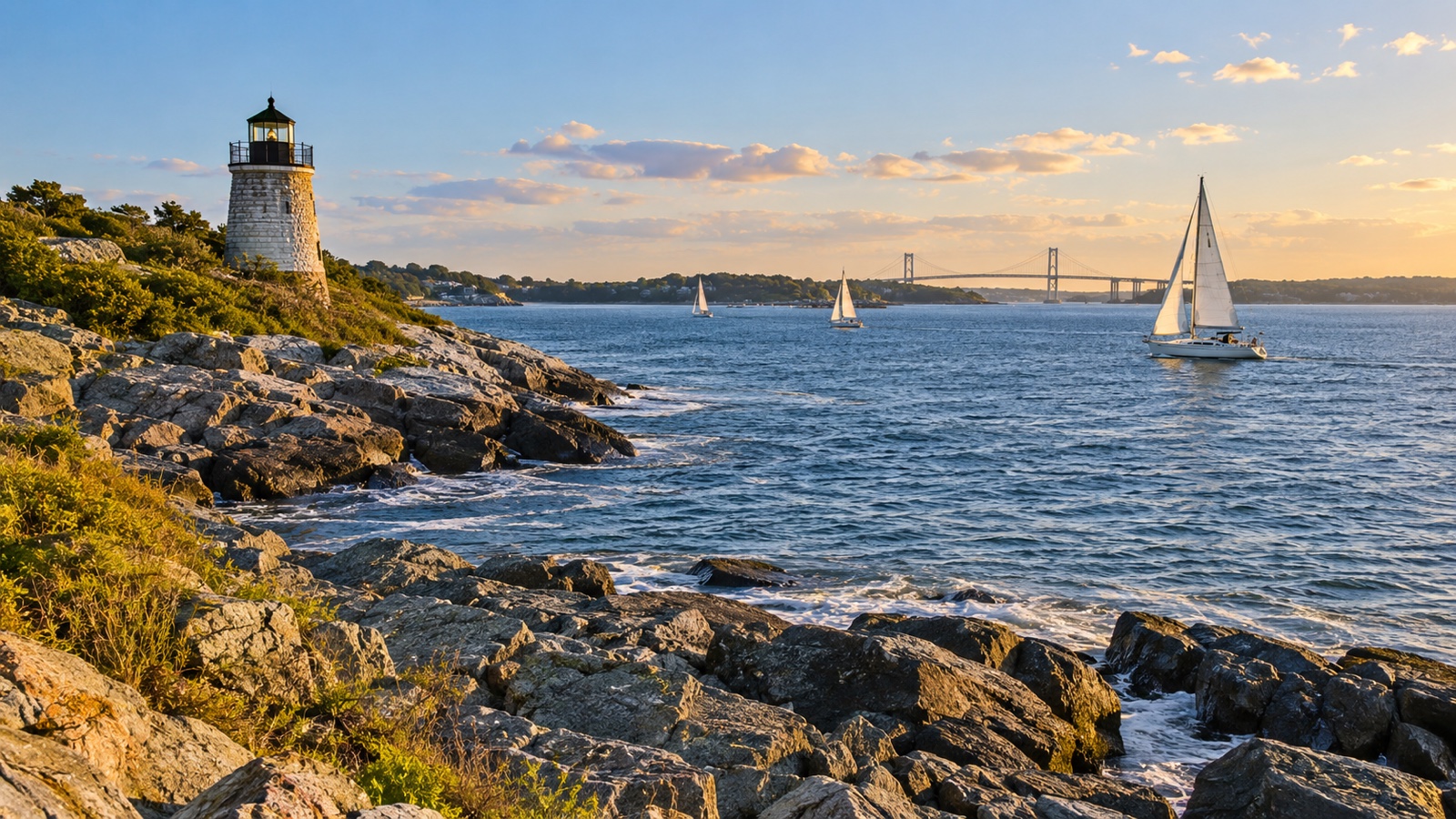
Narragansett Bay makes Rhode Island feel much bigger from the water
- Narragansett Bay reaches deep into the center of Rhode Island.
- The bay contains numerous islands.
- Aquidneck Island is the largest island in Narragansett Bay.
- Newport, Middletown, and Portsmouth are all on Aquidneck Island.
- Despite the state’s name, most of Rhode Island is on the mainland.
- The exact origin of the name “Rhode Island” is debated.
- One explanation connects it with explorer Giovanni da Verrazzano comparing an island to Rhodes.
- Another connects the name with Dutch descriptions of reddish land.
- Block Island lies about 12 miles south of the mainland.
- It is named for Dutch explorer Adriaen Block.
- Block Island has dramatic bluffs, beaches, ponds, and preserved open space.
- Mohegan Bluffs rise along the island’s southern shore.
- Rhode Island’s coast includes sandy beaches and rocky shoreline.
- Salt marshes provide important nursery habitat for fish and birds.
- The Sakonnet River is actually a tidal strait rather than an ordinary river.
- The Providence River is a tidal estuary at the head of Narragansett Bay.
- The Claiborne Pell Newport Bridge crosses the East Passage of the bay.
- Its long suspension span is one of Rhode Island’s most recognizable landmarks.
- Ocean and bay access strongly shaped the state’s trade, naval, fishing, and recreation history.
- Rhode Island is small on a road map and suddenly very complicated once boats enter the conversation.
Roger Williams built Rhode Island around religious freedom
- Narragansett and Niantic peoples lived in the region long before English colonization.
- Roger Williams founded Providence in 1636 after being banished from Massachusetts Bay Colony.
- Williams argued strongly for religious liberty.
- He also advocated separation between civil government and religious institutions.
- Williams purchased land through agreements with Narragansett leaders, though colonial land relationships remained unequal and contested.
- Anne Hutchinson and other religious dissenters helped establish Portsmouth on Aquidneck Island.
- Newport was founded soon afterward.
- Rhode Island became a refuge for several religious minorities excluded elsewhere.
- The Touro Synagogue in Newport was dedicated in 1763.
- It is the oldest surviving synagogue building in the United States.
- George Washington wrote a famous 1790 letter to Newport’s Jewish congregation.
- He promised that the new U.S. government would give “to bigotry no sanction.”
- Rhode Island’s 1663 royal charter protected unusually broad religious liberty for its time.
- The colony developed a strong tradition of local self-government.
- Rhode Island was the first colony to renounce allegiance to King George III.
- It did so on May 4, 1776, before the Declaration of Independence.
- Rhode Island initially refused to ratify the U.S. Constitution.
- Concerns included federal power and the absence of an initial bill of rights.
- The state finally ratified after the new federal government was already operating.
- Rhode Island has been professionally skeptical of being told what to do since the 1600s.
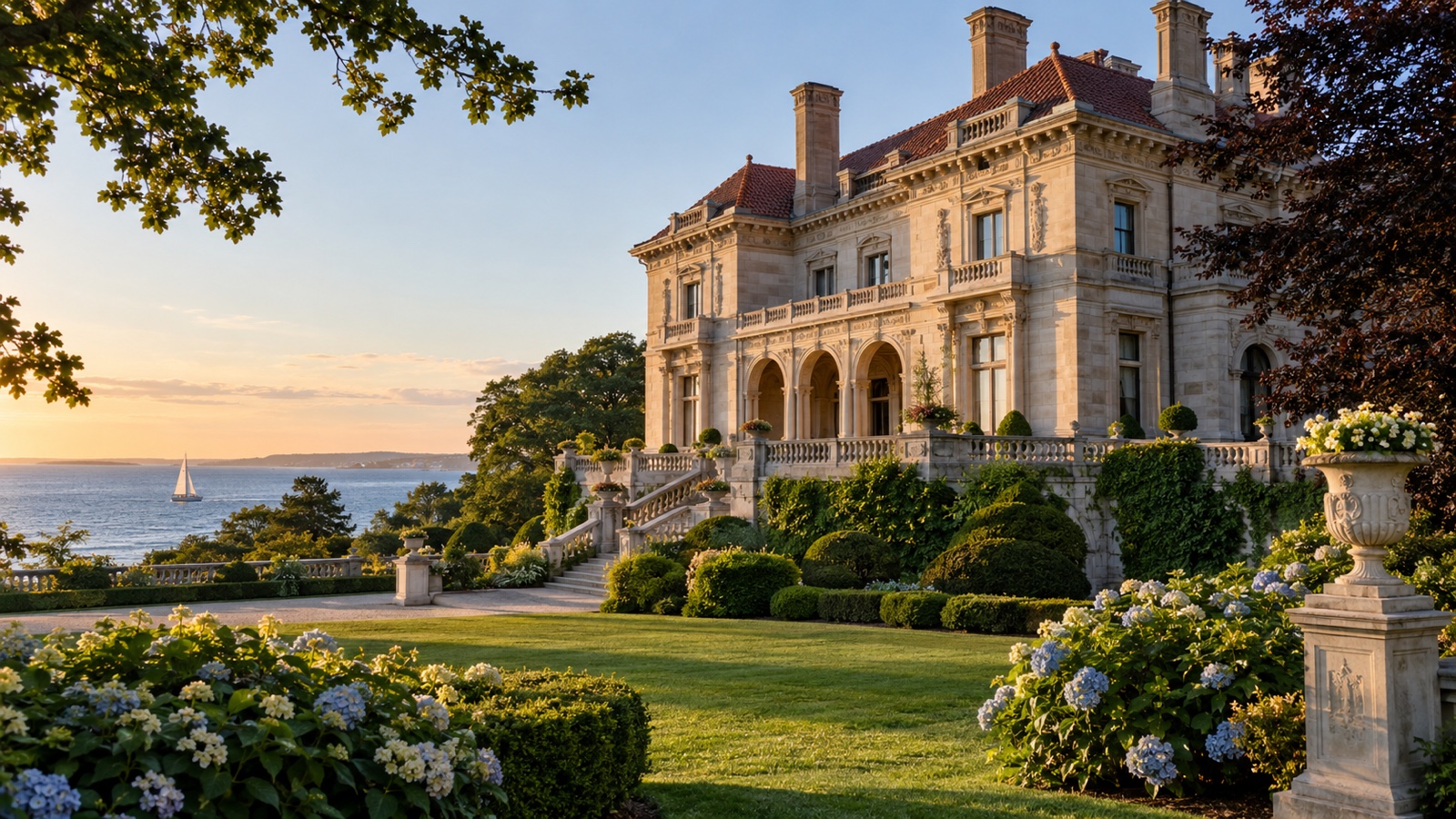
Newport became America’s Gilded Age summer stage
Calling Newport’s famous homes “cottages” is one of my favorite examples of rich-people vocabulary refusing to cooperate with reality. Several contain dozens of rooms, marble halls, ocean terraces, imported art, and enough decorative gold to make a normal cottage feel personally insulted.
- Newport became a fashionable resort for wealthy Americans during the 19th century.
- Industrial fortunes funded enormous summer houses along Bellevue Avenue and the coast.
- The Breakers was built for Cornelius Vanderbilt II.
- The mansion contains about 70 rooms.
- It was designed by architect Richard Morris Hunt.
- Marble House was built for William K. Vanderbilt and Alva Vanderbilt.
- Its design drew inspiration from French classical architecture.
- The Elms was modeled partly on an 18th-century French château.
- Rosecliff became famous for its ballroom and oceanfront setting.
- Several Newport mansions are now operated as historic house museums.
- The Cliff Walk runs between mansion properties and the rocky Atlantic shore.
- The public trail combines ocean scenery with views of private and historic architecture.
- Newport was a major colonial seaport long before the mansions appeared.
- Its harbor supported trade, shipbuilding, and naval activity.
- Newport also profited from the Atlantic slave trade, an essential part of its colonial economic history.
- The U.S. Naval War College was founded in Newport in 1884.
- Naval Station Newport remains an important military installation.
- The International Tennis Hall of Fame is housed in Newport’s historic Casino complex.
- The site hosted early U.S. national tennis championships.
- Newport is where “summer cottage” can mean “please budget extra time for the third floor.”
Sailing, lighthouses & Ocean State life
- Rhode Island has one of America’s strongest recreational sailing cultures.
- Newport hosted the America’s Cup yacht race for decades.
- The America’s Cup is one of the oldest continuing international sporting trophies.
- New York Yacht Club teams defended the cup off Newport for much of the 20th century.
- The trophy left Newport after Australia II defeated the U.S. team in 1983.
- Narragansett Bay offers protected water as well as access to the Atlantic.
- Sailing schools and boatbuilders are major parts of the marine economy.
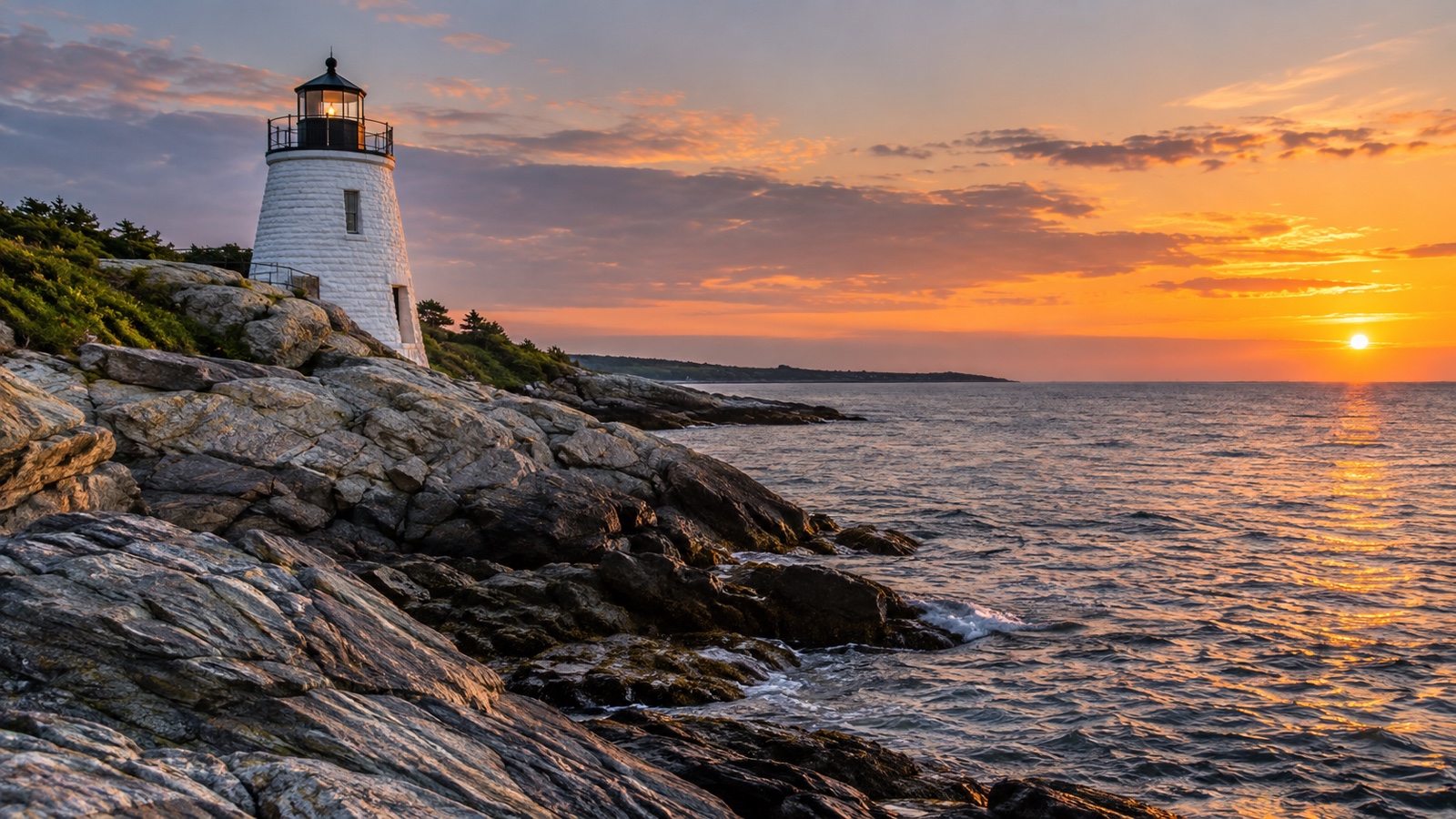
- Rhode Island has dozens of historic lighthouse sites.
- Beavertail Lighthouse stands at the southern tip of Jamestown.
- The site has guided mariners around Narragansett Bay for centuries.
- Southeast Lighthouse stands atop Block Island’s Mohegan Bluffs.
- The lighthouse was moved inland in the 1990s because erosion threatened it.
- Point Judith Lighthouse marks a dangerous coastal area near the entrance to Narragansett Bay.
- Commercial fishing remains important in coastal communities.
- Squid is a major Rhode Island seafood catch.
- Calamari became Rhode Island’s official state appetizer in 2014.
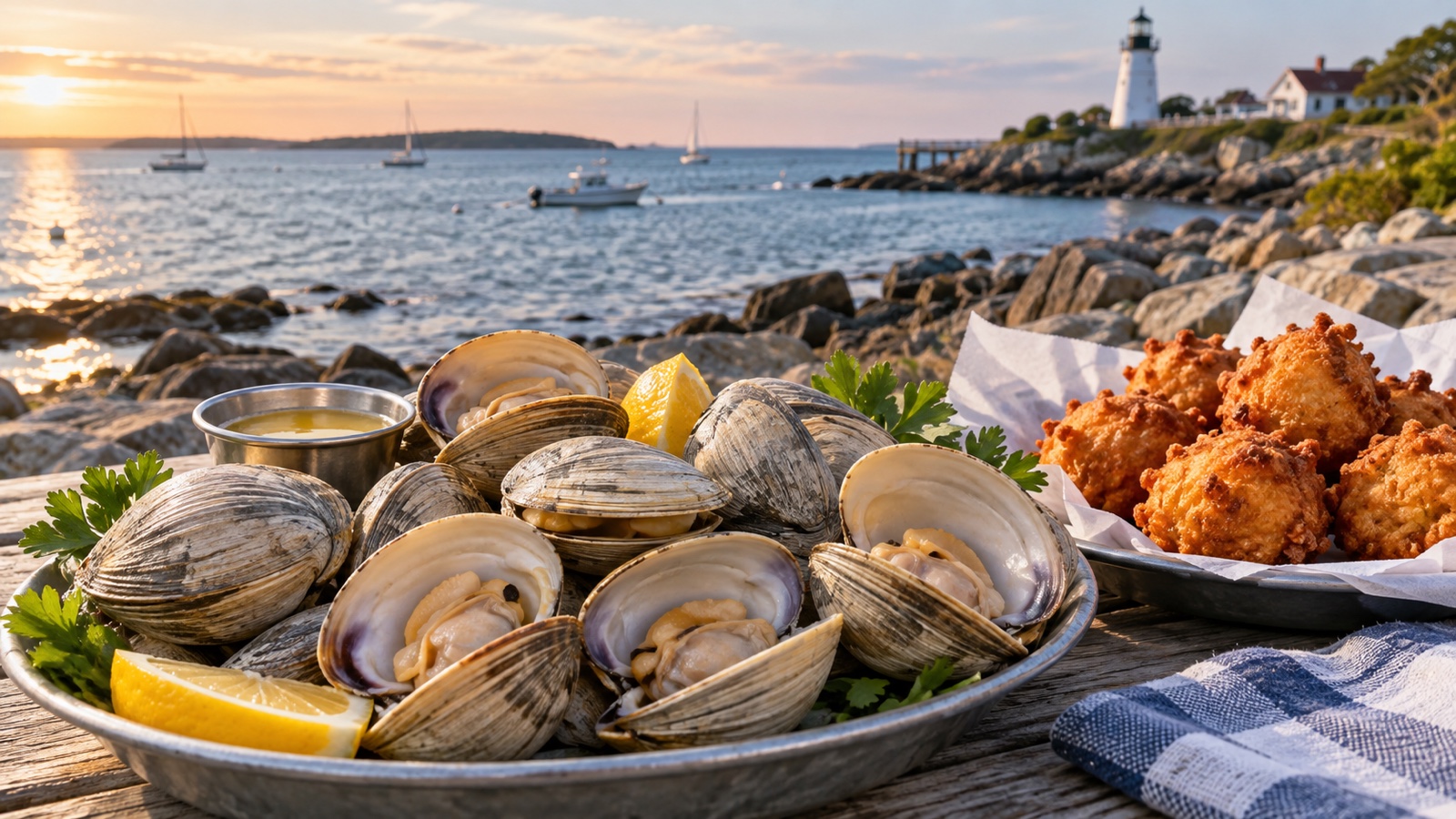
- Quahogs are hard-shell clams common in Narragansett Bay.
- The word quahog comes from a Narragansett-language word.
- Shellfish harvesting depends on water quality and public-health monitoring.
- The Ocean State earns its nickname through daily life, not just through coastline statistics.
Providence, mills & Rhode Island innovation
Rhode Island was early to American industrialization, and that history is much less picturesque than the mansions because mill labor involved long hours, child workers, immigrant labor, and difficult factory conditions. It also transformed how goods were made across the young United States.
- Samuel Slater established an influential water-powered textile mill in Pawtucket in 1793.
- The mill used machinery based on British textile technology Slater had learned before emigrating.
- Slater Mill is often associated with the beginning of America’s factory-system textile industry.
- Waterpower from the Blackstone River helped run early mills.
- The Blackstone Valley became one of America’s first major industrial corridors.
- Textile mills spread across Rhode Island during the 19th century.
- Immigrants from Ireland, French Canada, Portugal, Italy, and many other places worked in Rhode Island industries.
- Providence developed manufacturing in jewelry, silverware, machinery, textiles, and tools.
- Rhode Island School of Design was founded in Providence in 1877.
- RISD became one of America’s best-known art and design schools.
- Brown University was founded in 1764.
- It is one of the oldest universities in the United States.
- Brown is a member of the Ivy League.
- Johnson & Wales University also has a major Providence campus.
- Providence’s downtown rivers were partly covered by roadways during the 20th century.
- Major redevelopment projects later uncovered and redirected the rivers.
- WaterFire uses braziers installed in downtown rivers as a public-art event.
- Music, firelight, crowds, and moving boats turn the river corridor into a nighttime performance space.
- Hasbro has deep Rhode Island roots and was long headquartered in Pawtucket.
- Little Rhode Island has spent a surprising amount of time manufacturing either textiles, jewelry, or childhood.
Coffee milk, quahogs & 25 final Rhode Island facts
- Coffee milk is Rhode Island’s official state drink.
- It is made by mixing milk with sweet coffee syrup.
- Coffee syrup is more concentrated and sweeter than ordinary brewed coffee.
- The drink became especially popular during the 20th century.
- A “cabinet” in Rhode Island can mean a milkshake made with milk, syrup, and ice cream.
- Awful Awful is the name of a famous Rhode Island-style thick milkshake associated with Newport Creamery.
- Stuffies are baked stuffed quahog shells.
- The filling often includes chopped clam, bread crumbs, herbs, peppers, and seasonings.
- Clam cakes are fried batter fritters containing chopped clams.
- Rhode Island clear clam chowder uses broth without the milk of New England chowder or tomato of Manhattan-style chowder.
- Hot wieners are a regional Rhode Island diner specialty.
- They are commonly topped with seasoned meat sauce, mustard, onions, and celery salt.
- Ordering them “all the way” asks for the classic full topping combination.
- Del’s frozen lemonade is a Rhode Island summer institution.
- The business traces family lemonade traditions to Italy.
- The state bird is the Rhode Island Red chicken.
- The Rhode Island Red was developed as a productive American chicken breed.
- The state flower is the violet.
- The state tree is the red maple.
- The striped bass is the state fish.
- The harbor seal is the state marine mammal.
- The quahog is the state shell.
- Rhode Island hosted the first U.S. National Lawn Tennis Championship in Newport in 1881.
- The Providence Performing Arts Center opened as a movie palace in 1928.
- After 145 facts, Rhode Island’s size feels less like a limitation and more like a challenge it accepted personally.
Quick FAQ
Q: Is Rhode Island really an island?
A: No. Most of the state is mainland, although it includes many islands in Narragansett Bay and offshore.
Q: What is Rhode Island famous for?
A: Newport mansions, sailing, Narragansett Bay, religious-liberty history, colonial towns, Brown University, seafood, coffee milk, and being America’s smallest state.
Q: What is the capital of Rhode Island?
A: Providence is both the capital and largest city.
Q: Why did Rhode Island change its official state name?
A: Voters removed “and Providence Plantations” in 2020 amid concern about the word “plantations” and its modern association with slavery, leaving the official name State of Rhode Island.
Q: What is coffee milk?
A: It is milk mixed with sweet coffee-flavored syrup, and it is Rhode Island’s official state drink.

Ellie is the owner and sole author of Fun Facts, combining her mechanical engineering background with years of research-driven writing to deliver facts you can trust. Every article is thoroughly fact-checked and routinely updated as new science and sources emerge to keep information accurate and current. Her mission is to make learning delightful while upholding high standards of reliability and transparency.