
Ravens have the dramatic wardrobe of a gothic novel and the problem-solving skills of a bird that has already figured out where you hid the snacks. They plan, cache, imitate sounds, play in the air, remember competitors, form long partnerships, and make ordinary black-bird identification much more interesting.
Raven basics that make these birds stand out
- The common raven's scientific name is Corvus corax.
- Common ravens belong to the crow family, Corvidae.
- Crows, jays, magpies, nutcrackers, and jackdaws are also corvids.
- Common ravens occur across much of the Northern Hemisphere.
- Their range includes North America, Europe, Asia, North Africa, Greenland, and many Arctic regions.
- They live in deserts, tundra, mountains, forests, coastlines, farmland, and cities.
- Common ravens are among the largest living perching birds.
- Adults can have wingspans approaching 4 feet.
- They often weigh around 2 to 4 pounds, with regional variation.
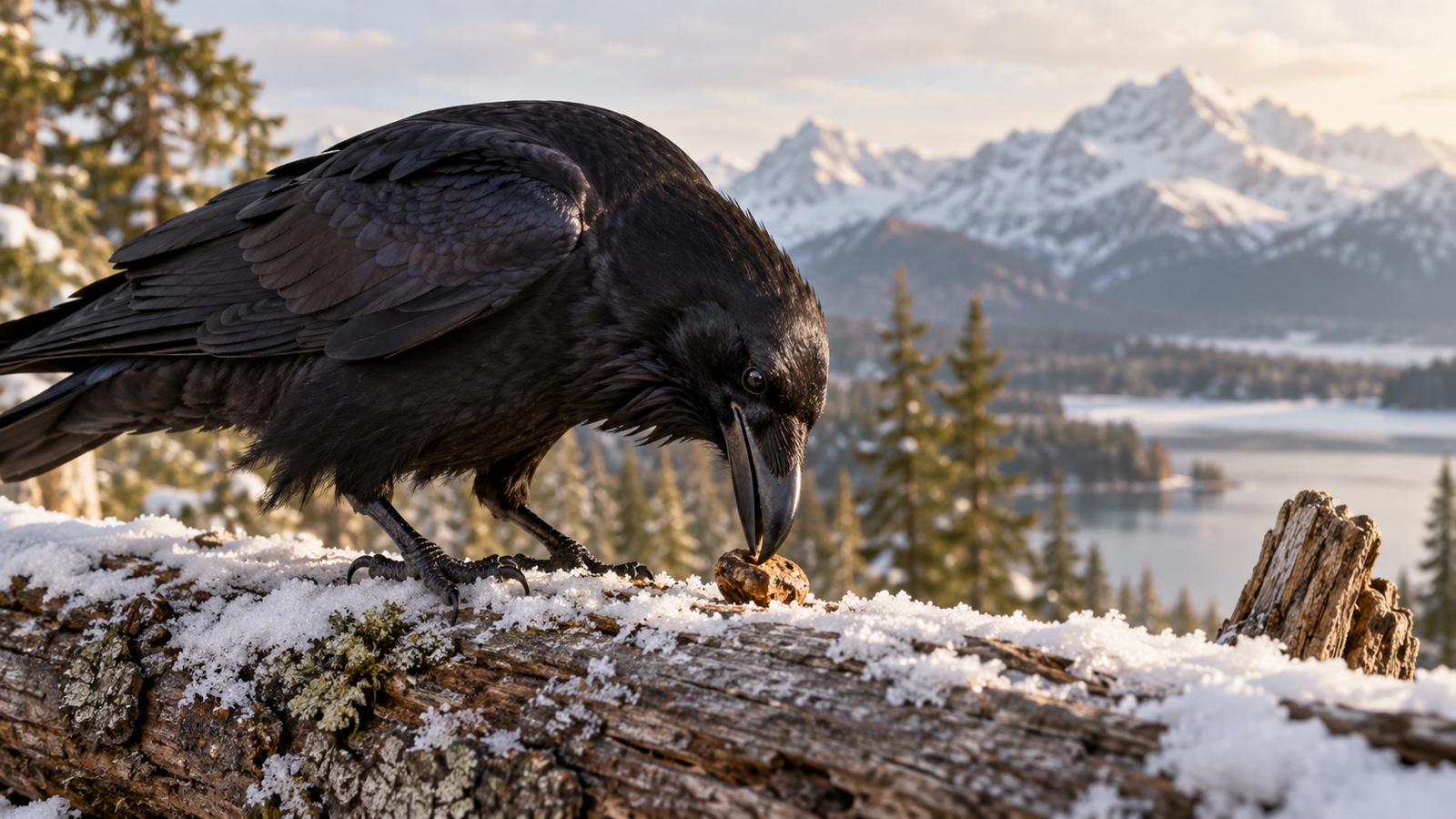
- Ravens have heavy, curved black bills.
- The feathers around the throat can look shaggy or pointed.
- Those elongated throat feathers are sometimes called hackles.
- Raven plumage looks black but can show blue, purple, or green iridescence in sunlight.
- The eyes of adults are dark brown.
- Young ravens can show bluish-gray eyes before they darken.
- Ravens walk and hop on the ground.
- They are strong, efficient fliers.
- Broad wings let ravens soar on rising air.
- They can travel long distances while using relatively little flapping.
- A raven is what happens when a crow family member decides subtlety is not part of the brand.

Ravens and crows are related, but they are not interchangeable
- Raven and crow are common names used for several species in the genus Corvus.
- There is no single anatomical rule that separates every bird called a raven from every bird called a crow.
- Common ravens are much larger than American crows.
- A raven's bill usually looks heavier and more curved.
- Ravens often show shaggy throat feathers that crows lack.
- A flying common raven usually shows a wedge-shaped tail.
- An American crow's tail looks more fan shaped.
- Raven wings can appear longer and narrower than a crow's wings.
- Ravens often soar for extended periods.
- Crows tend to use more frequent steady flapping during ordinary travel.
- A common raven's classic call is a deep croak.
- American crows are famous for clearer cawing calls.
- Both species have much larger vocal repertoires than their best-known sounds.
- Ravens can produce knocks, rattles, clicks, gurgles, and bell-like notes.
- Juvenile ravens can sound especially odd while practicing calls.
- Ravens can raise crown and throat feathers during displays.
- Body posture changes the apparent shape of the bird.
- In mixed areas, size is often the fastest useful clue.
- A distant bird with no scale can still fool experienced observers.
- My personal raven-identification rule is that if the “crow” suddenly looks built like a small eagle, I start reconsidering.
Raven intelligence is much more than a clever-bird slogan
- Ravens solve multi-step problems in laboratory and field studies.
- They learn through direct experience.
- They also learn by watching other birds.
- Ravens remember where they hide food.
- They remember which competitors were nearby during caching.
- A raven watched while hiding food may move that food later.
- This recaching behavior can reduce theft.
- Birds with experience stealing caches are especially sensitive to being watched.
- That suggests ravens use their own pilfering experience when predicting competitors.
- They distinguish familiar individuals from strangers.
- Ravens can remember social relationships over long periods.
- They track which birds outrank others in a group.
- Experiments suggest ravens can infer parts of a social hierarchy without personally fighting every bird.
- Ravens can delay gratification when waiting brings a better reward.
- Some studies show common ravens can plan for future tasks.
- They have selected and saved objects needed for a later problem.
- They can also make choices involving future bartering opportunities in controlled experiments.
- Raven cognition evolved in a very different brain structure from primate cognition.
- Bird brains are organized differently from mammal brains but can support remarkably complex behavior.
- A raven does not need a tiny human brain to solve a problem that I would probably overcomplicate with a spreadsheet.

They communicate, imitate, gesture, and play
Raven communication is the section where “big black bird that croaks” completely falls apart. Their calls vary by context, pairs coordinate with one another, juveniles experiment with sound, and researchers have even documented object-showing behaviors that resemble intentional gestures.
- Ravens have dozens of documented vocal call types.
- Different calls occur during alarm, courtship, feeding, aggression, and social contact.
- Individual voices can differ.
- Ravens can recognize calls from familiar birds.
- Pairs often communicate while moving through a territory.
- Common ravens can imitate sounds in captivity.
- Some individuals learn human words or short phrases.
- They can also mimic other animals and environmental noises.
- Mimicry does not mean the bird understands every copied sound as human language.
- Ravens use bill movements and body posture in visual communication.
- Researchers have observed ravens showing or offering objects to other ravens.
- Those behaviors may function as attention-getting social gestures.
- Juvenile ravens are famously playful.
- They manipulate sticks, stones, feathers, and human-made objects.
- Ravens play tugging and chasing games with one another.
- They perform rolls, dives, and other aerial maneuvers.
- Young ravens sometimes slide down snowy or smooth slopes.
- Play may help develop motor skills and social relationships.
- Adult ravens also engage in playful behavior.
- If you see a raven repeatedly doing something unnecessary and apparently entertaining, “because ravens enjoy messing around” is a legitimate hypothesis.
Food caching turns every meal into strategy
- Ravens are omnivores.
- They eat carrion, insects, eggs, fruit, grains, small animals, and human food.
- Road-killed animals can become important food sources.
- Ravens regularly scavenge carcasses opened by larger predators.
- Their bills are strong but cannot always tear thick hide easily.
- Wolves and other carnivores can make carcasses accessible to ravens.
- Ravens sometimes follow wolves or other predators.
- This relationship is usually best described as opportunistic rather than a simple partnership.
- Ravens can gather rapidly when a new carcass becomes available.
- They often cache extra food instead of eating everything immediately.
- A cache can be hidden under soil, snow, vegetation, or debris.
- Ravens may create many separate caches.
- They can recover food days or weeks later.
- Other ravens watch for caching opportunities.
- Food thieves force cachers to become more secretive.
- Ravens sometimes make false caching movements when another bird is watching.
- They can carry surprisingly large food items in the bill.
- Young nonbreeding ravens may gather in groups around rich food sources.
- Adults with territories can attempt to dominate food within those areas.
- A raven buffet includes both roadkill and stolen leftovers, which means restaurant ambiance is clearly not a deciding factor.
Raven relationships can last for years
Ravens spend their younger years in a fluid social world, but established adults often form long-term breeding pairs and defend large territories. Pair bonds are reinforced through close contact, coordinated displays, mutual preening, and years of learning how one particular partner behaves.
- Common ravens commonly form long-term monogamous pair bonds.
- A bonded pair can remain together across multiple breeding seasons.
- Pairs defend territories against other ravens.
- Territory size varies with food supply and habitat.
- Pairs perform coordinated flight and vocal displays.
- Mutual preening helps maintain feathers and social bonds.
- Ravens may sit close together while resting.
- Nonbreeding juveniles often live more socially than territorial adults.
- Young birds can gather at communal roosts.
- Roosts provide opportunities to learn where food is available.
- Juveniles form temporary alliances.
- Support from allies can influence conflict outcomes.
- Ravens remember birds that have treated them aggressively.
- They can also remember cooperative social partners.
- Social stress can change how ravens behave around others.
- Friendly interactions can reduce stress responses.
- Young ravens spend several years learning before breeding in many populations.
- That extended juvenile period provides time for social and foraging experience.
- Pair formation involves much more than simply meeting during one spring.
- Ravens have enough relationship history that a long-running bird soap opera would honestly be easier to write than a simple family tree.
Nests, chicks, mythology, and 25 final raven facts
- Ravens build large stick nests.
- Cliffs are classic nest sites.
- Tall trees are also widely used.
- Ravens now nest on towers, bridges, utility structures, and large buildings in some areas.
- A pair may reuse the same general nesting territory for years.
- The nest cup is lined with softer material.
- Wool, fur, bark, grasses, and human-made fibers can appear in nest lining.
- Females usually lay several eggs in a clutch.
- Common raven eggs are typically bluish or greenish with darker markings.
- The female performs most incubation.
- The male helps supply food during incubation.
- Both parents feed growing nestlings.
- Raven chicks hatch helpless and depend completely on adults.
- Young remain in the nest for several weeks.
- After fledging, juveniles continue receiving parental support.
- Golden eagles, large owls, and other predators can kill ravens or young.
- Eggs and nestlings are vulnerable to other climbing or flying predators.
- Adult ravens can cooperate to mob a threatening eagle or owl.
- Ravens have expanded into many human-altered landscapes because they exploit roads, landfills, livestock operations, and structures.
- High raven numbers can increase predation pressure on vulnerable species such as desert tortoises or nesting birds.
- Ravens appear prominently in Norse, Celtic, Indigenous North American, biblical, and many other cultural traditions.
- In Norse mythology, Odin is accompanied by ravens named Huginn and Muninn.
- Edgar Allan Poe's “The Raven” turned the bird into one of literature's most famous symbols of ominous memory.
- Real ravens are neither universally good omens nor bad omens; they are adaptable wild animals that humans have loaded with symbolism for thousands of years.
- After 145 facts, the raven feels more impressive without the supernatural layer: it can remember, plan, deceive competitors, maintain relationships, improvise, play, and thrive from Arctic cliffs to city rooftops using a bird brain that refuses to behave like an insult.

Quick FAQ
Q: What is the easiest way to tell a raven from a crow?
A: Common ravens are larger, heavier-billed, shaggier at the throat, and usually show a wedge-shaped tail in flight. Their classic call is also a deeper croak.
Q: Are ravens really intelligent?
A: Yes. Controlled studies document planning, caching strategy, social learning, problem-solving, memory, and sophisticated responses to competitors.
Q: Can ravens talk?
A: Some ravens can imitate human words and many other sounds, especially in captivity. Mimicry does not mean they use language exactly as humans do.
Q: Do ravens mate for life?
A: Common ravens commonly form long-term monogamous pair bonds that can persist for many breeding seasons, though real animal relationships are not guaranteed to last literally for life.
Q: Why do ravens follow wolves?
A: Wolves open carcasses and create scavenging opportunities. Ravens often exploit that food source, although the relationship is more complex than a simple intentional partnership.

Ellie is the owner and sole author of Fun Facts, combining her mechanical engineering background with years of research-driven writing to deliver facts you can trust. Every article is thoroughly fact-checked and routinely updated as new science and sources emerge to keep information accurate and current. Her mission is to make learning delightful while upholding high standards of reliability and transparency.