
The platypus sounds like a prank animal assembled from spare parts, but nearly every bizarre detail has a practical explanation. It lays eggs, senses electricity with its bill, closes its eyes underwater, produces milk without nipples, carries venomous spurs, and somehow makes all of that work in one very real Australian mammal.
Platypus basics are already wonderfully strange
- The platypus's scientific name is Ornithorhynchus anatinus.
- Platypuses are mammals.
- They belong to an ancient mammal group called monotremes.
- Monotremes lay eggs instead of giving birth to live young.
- Only five living monotreme species are recognized today.
- Those are the platypus and four echidna species.
- Platypuses are native to eastern Australia.
- They also live naturally in Tasmania.
- Their range includes rivers, creeks, lakes, and connected freshwater habitats.
- They are semiaquatic rather than fully aquatic.
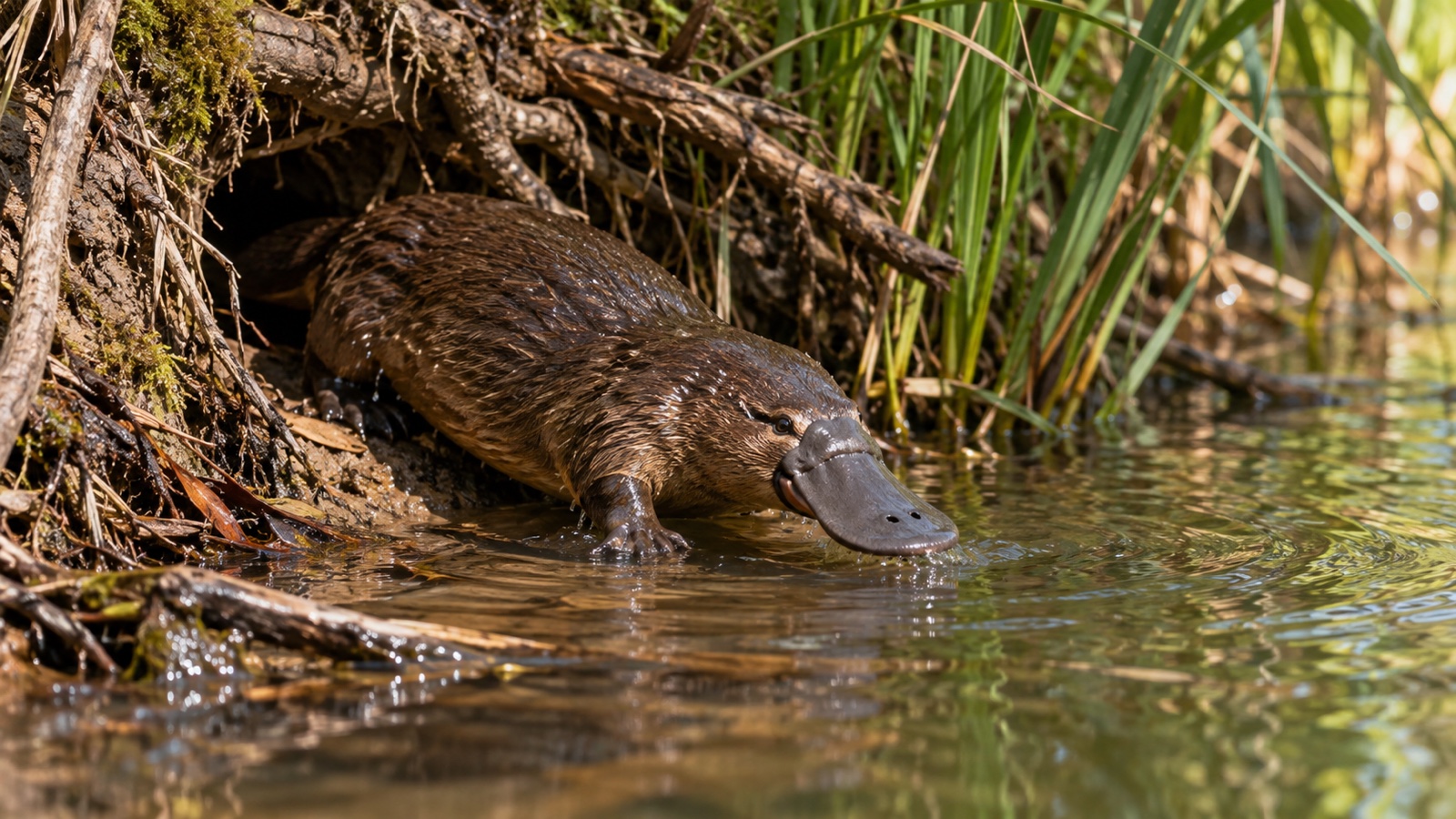
- An adult platypus usually spends part of each day resting in a riverbank burrow.
- It enters the water mainly to forage.
- Platypuses are generally most active around dusk, night, and dawn.
- Activity patterns vary with season, weather, and location.
- Males are usually larger than females.
- Body size also varies geographically.
- Tasmanian platypuses tend to be larger than many mainland animals.
- The broad bill is soft and flexible, not hard like a duck's beak.
- The tail is broad, flat, and covered with fur.
- If I had designed a mammal this way, nobody would have approved the first draft.
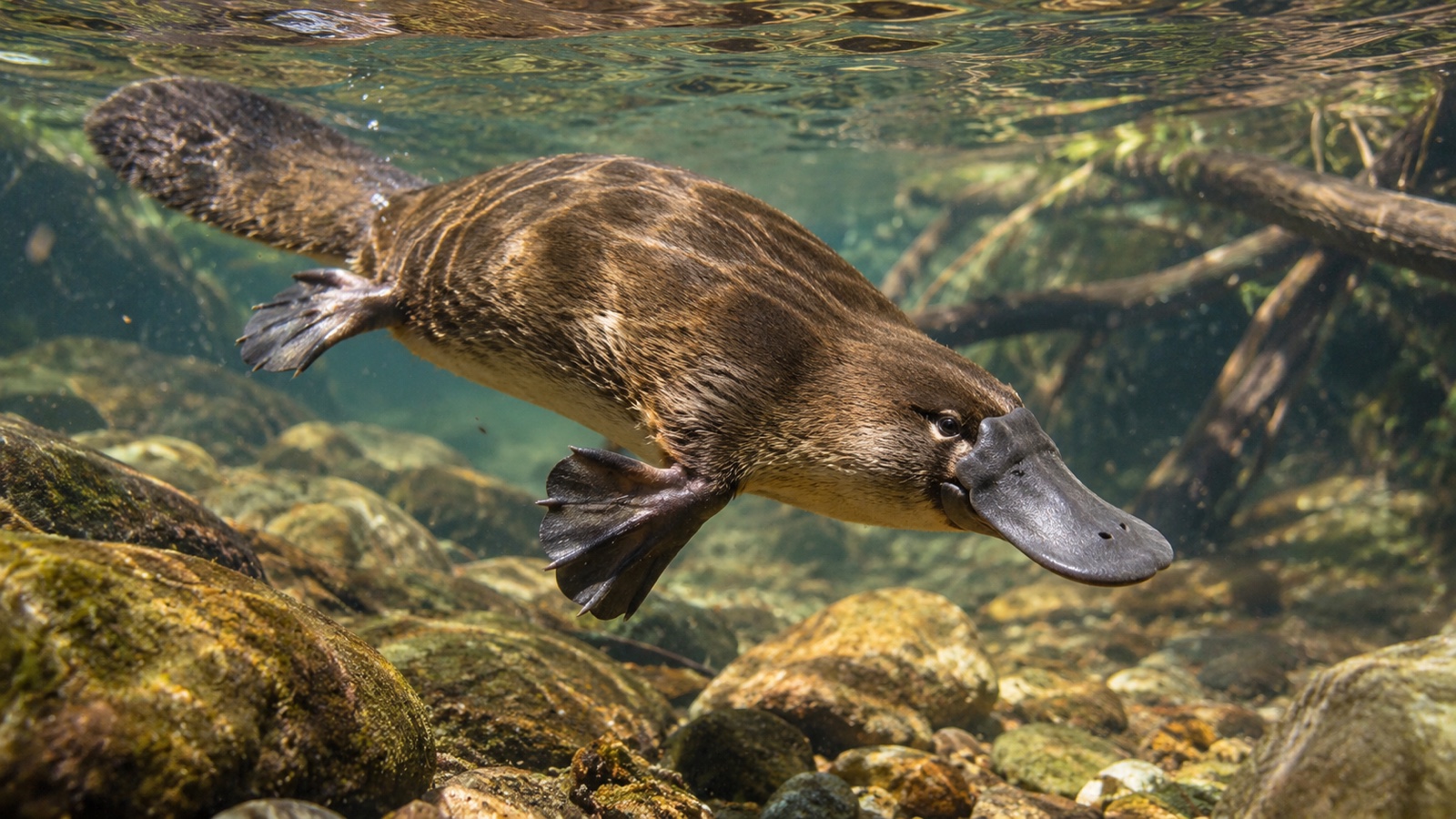
The bill can detect tiny electrical signals
- The platypus bill contains thousands of specialized sensory receptors.
- Some receptors detect touch and pressure.
- Others detect weak electrical fields.
- This ability is called electroreception.
- Muscle contractions in small prey produce tiny electrical signals.
- A platypus can detect those signals while searching underwater.
- It sweeps its bill from side to side near the bottom.
- That motion helps sample the environment for prey cues.
- Platypuses also sense water movement through mechanoreceptors in the bill.
- The brain combines electrical and mechanical information.
- This lets the animal estimate where prey is located.
- Electroreception is rare among mammals.
- Platypuses have one of the most highly developed mammalian electroreceptive systems known.
- They do not use the bill mainly to smell underwater.
- The nostrils close during dives.
- The eyes also close underwater.
- The external ear openings close during dives too.
- That means the bill becomes the main sensory tool while foraging underwater.
- Platypuses can still navigate and capture prey in murky water with little or no useful vision.
- Swimming with your eyes, ears, and nostrils shut sounds terrible until your face is basically a biological metal detector.
They swim with their front feet and steer with the rest of the body
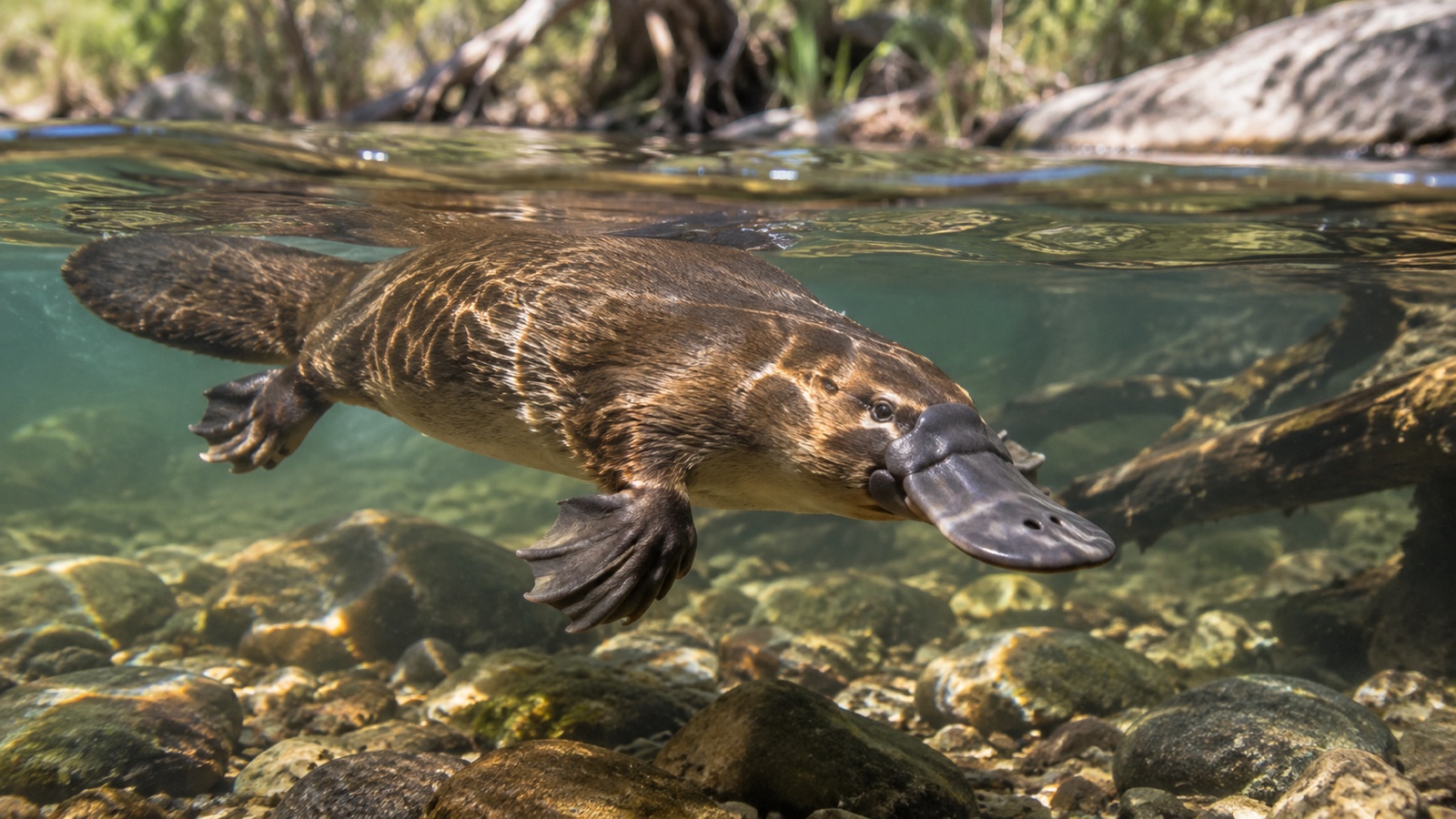
- Platypuses are powerful swimmers.
- The front feet are strongly webbed.
- Most forward propulsion comes from alternating strokes of the front feet.
- The hind feet contribute more to steering and stability.
- The tail also helps stabilize the body.
- Platypuses usually swim with a smooth rolling motion.
- They can remain underwater for roughly a minute or two during ordinary feeding dives.
- Most feeding dives are shorter than their maximum breath-hold ability.
- They commonly rest briefly at the surface between dives.
- Their dense fur traps an insulating layer of air.
- Platypus fur is among the densest fur of any mammal.
- That insulation is crucial in cold streams.
- The underfur is fine and woolly.
- Longer guard hairs help protect the insulating layer.
- Water does not easily penetrate all the way to the skin.
- On land, the front webbing folds back to expose claws.
- Those claws help with walking and digging.
- Platypuses look more awkward on land than in water.
- They can still travel overland between waterways when needed.
- The webbed feet work like swim paddles that conveniently convert back into digging tools.
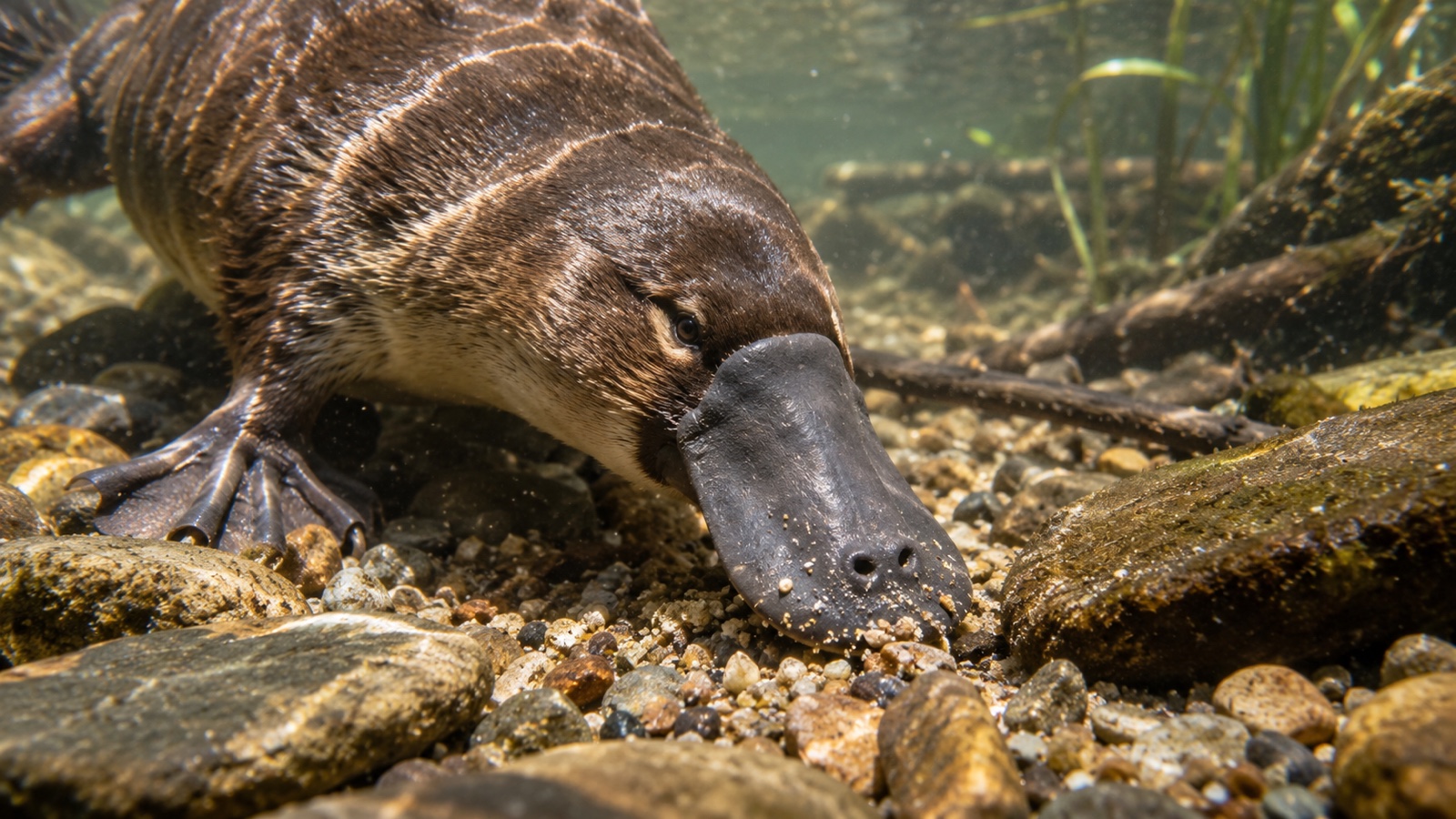
Adult platypuses have no functional teeth
Platypus meals are not chewed with ordinary mammal teeth. Adults crush food with tough keratinous grinding pads, and they often scoop gravel into cheek pouches while foraging, which turns the mouth into a tiny biological mortar and pestle.
- Platypuses mainly eat aquatic invertebrates.
- Common prey includes insect larvae, worms, freshwater shrimp, and crayfish.
- They may eat other small aquatic animals when available.
- Platypuses forage mostly along the bottom.
- They stir sediment with the bill.
- Food is temporarily stored in cheek pouches.
- A platypus often returns to the surface before swallowing its catch.
- Adults do not have functional teeth.
- Young platypuses develop teeth early in life.
- Those juvenile teeth are lost as the animal matures.
- Adults use hardened keratinous pads to grind food.
- Small stones and grit can assist with crushing prey.
- The tongue helps manipulate food against the grinding surfaces.
- Platypuses can consume a substantial fraction of their body weight in food each day.
- Energy needs increase in cold water.
- Lactating females have especially high energy demands.
- Platypuses do not have a large true stomach like many mammals.
- Their digestive tract lacks the strongly acidic stomach chamber familiar in many other species.
- Food passes relatively quickly through the digestive system.
- A toothless mammal eating armored crayfish sounds like bad planning until you add grinding plates and a mouthful of gravel.
Males carry venomous ankle spurs
- Adult male platypuses have a sharp spur on each hind ankle.
- The spur connects with a venom gland in the thigh region.
- Venom production becomes especially active during the breeding season.
- The spur can inject venom when the animal forcefully drives it into an opponent.
- The venom is thought to play an important role in competition between males.
- Platypus venom is not known to be normally fatal to healthy humans.
- It can cause extreme pain and severe swelling.
- Pain can persist for days or longer.
- Ordinary opioid pain medication may provide limited relief in severe cases.
- Platypus venom contains multiple biologically active peptides and proteins.
- Some venom components are unique or unusual compared with better-known snake venoms.
- Female platypuses develop small spur structures early in life.
- Those female spurs usually regress rather than becoming functional adult weapons.
- Platypuses are not the only venomous mammals.
- Slow lorises have a venomous bite system.
- Some shrews and solenodons also produce toxic saliva.
- Venomous mammals are nevertheless rare.
- Male platypuses should not be handled casually.
- Wildlife professionals use careful restraint methods when necessary.
- Everything about the platypus already seemed excessive before someone added ankle venom.
Females lay eggs and make milk without nipples
Platypus reproduction is where ordinary mammal expectations completely fall apart. The mother lays leathery eggs in a nesting burrow, curls around them for warmth, and later feeds the hatchlings with milk that seeps from mammary pores onto specialized grooves in her skin.
- Platypus breeding generally occurs during winter or spring depending on latitude.
- Females construct specialized nesting burrows.
- A nesting burrow can be much longer and more elaborate than an ordinary resting burrow.
- The female carries damp leaves and vegetation into the nest chamber.
- She grips nesting material with the tail against her body.
- Most females lay one to three eggs.
- Two eggs are common.
- The eggs have flexible leathery shells.
- They are much smaller than chicken eggs.
- The mother curls her body around the eggs during incubation.
- Incubation lasts roughly 10 days after the eggs are laid.
- Hatchlings are tiny, hairless, and extremely undeveloped.
- Baby platypuses are sometimes called puggles informally.
- “Puggle” is popular language rather than a strict scientific term.
- Female platypuses do not have nipples.
- Milk is secreted through openings in the skin.
- The milk collects along grooves and hairs on the mother's belly.
- The young lap or suck milk from those areas.
- Young remain in the nesting burrow for several months before emerging.
- The sentence “egg-laying mammal nurses puggles from milk patches” is somehow scientifically accurate from beginning to end.
Genes, conservation and 25 final platypus facts
- Platypus genetics preserve clues about early mammal evolution.
- The species has an unusual sex-chromosome system.
- Males have five X and five Y chromosomes involved in sex determination.
- Those ten sex chromosomes form a chain during cell division.
- Some platypus sex-chromosome genes resemble systems found in birds as well as other mammals.
- The platypus genome contains genes linked with milk production, egg laying, venom, smell, and electroreception.
- Platypus fur can fluoresce blue-green under ultraviolet light.
- The biological function of that fluorescence, if any, remains unknown.
- Early European scientists initially suspected preserved platypus specimens might be fabricated hoaxes.
- The combination of bill, fur, webbed feet, and tail looked too strange to trust.
- Detailed anatomical study eventually confirmed the animal was genuine.
- Egg laying in platypuses was debated by European scientists for decades.
- Direct evidence finally settled the question during the 19th century.
- Platypuses spend much of the day inside burrows.
- Burrow entrances are often hidden along riverbanks.
- Healthy riparian vegetation helps stabilize stream banks and support prey.
- Dams, drought, water extraction, pollution, habitat clearing, and altered stream flow can affect platypus populations.
- Fishing line, nets, and other entangling debris can injure platypuses.
- Closed-top yabby traps have killed air-breathing platypuses after animals entered and could not escape.
- Regulations on dangerous traps have changed in several Australian jurisdictions.
- Climate change can intensify drought and extreme flood cycles affecting freshwater habitat.
- Platypuses can survive natural floods, but very severe events may destroy burrows and alter feeding areas.
- The species is protected under Australian wildlife laws.
- Long-term monitoring is difficult because platypuses are secretive and mostly active at night.
- After 145 facts, the platypus still seems impossible, only now the impossible parts have electroreceptors, chromosomes, keratin pads, venom chemistry, and perfectly reasonable evolutionary explanations.
Quick FAQ
Q: Do platypuses really lay eggs?
A: Yes. Females usually lay one to three leathery eggs and incubate them in a nesting burrow.
Q: Are platypuses venomous?
A: Adult males have venomous hind-leg spurs that can cause severe pain and swelling. Females do not retain functional adult venom spurs.
Q: How do platypuses find food underwater?
A: They close their eyes, ears, and nostrils, then use touch and electroreceptors in the bill to detect prey.
Q: Do platypuses have nipples?
A: No. Milk seeps through mammary pores onto grooves and hairs on the mother's abdomen, where the young consume it.
Q: What is a baby platypus called?
A: “Puggle” is a popular informal term for a baby platypus, though it is not a formal scientific name.

Ellie is the owner and sole author of Fun Facts, combining her mechanical engineering background with years of research-driven writing to deliver facts you can trust. Every article is thoroughly fact-checked and routinely updated as new science and sources emerge to keep information accurate and current. Her mission is to make learning delightful while upholding high standards of reliability and transparency.