
Morocco can give you Atlantic surf, snowy mountain peaks, cedar forests, Sahara dunes, blue-painted lanes, Roman ruins, medieval medinas, and a tagine lid taller than my patience for bland hotel food. It sits close to Europe, belongs firmly to Africa, and carries Amazigh, Arab, African, Mediterranean, and Andalusian histories at once.
Morocco sits at Africa’s northwestern corner
- Morocco is located in northwestern Africa.
- The Atlantic Ocean forms most of its western coastline.
- The Mediterranean Sea borders northern Morocco.
- The Strait of Gibraltar separates Morocco from Spain by only about nine miles at its narrowest point.
- Rabat is the national capital.
- Casablanca is the country’s largest city.
- Morocco’s currency is the Moroccan dirham.
- Arabic and Amazigh are official languages.
- French is widely used in business, higher education, media, and administration despite not being an official language.
- Moroccan Arabic is commonly called Darija.
- Darija differs noticeably from Modern Standard Arabic.
- Amazigh languages are spoken by millions of Moroccans.
- The Tifinagh script is used officially for Amazigh.
- Morocco is a constitutional monarchy.
- The king is head of state.
- The national flag is red with a green five-pointed star.
- The green emblem is commonly called the Seal of Solomon.
- Morocco uses a national time system that is generally UTC+1 but makes a special annual adjustment around Ramadan.
- The country administers most of Western Sahara, whose sovereignty remains disputed internationally.
- Morocco is close enough to Europe to see across the strait on a clear day and still unmistakably its own African world.
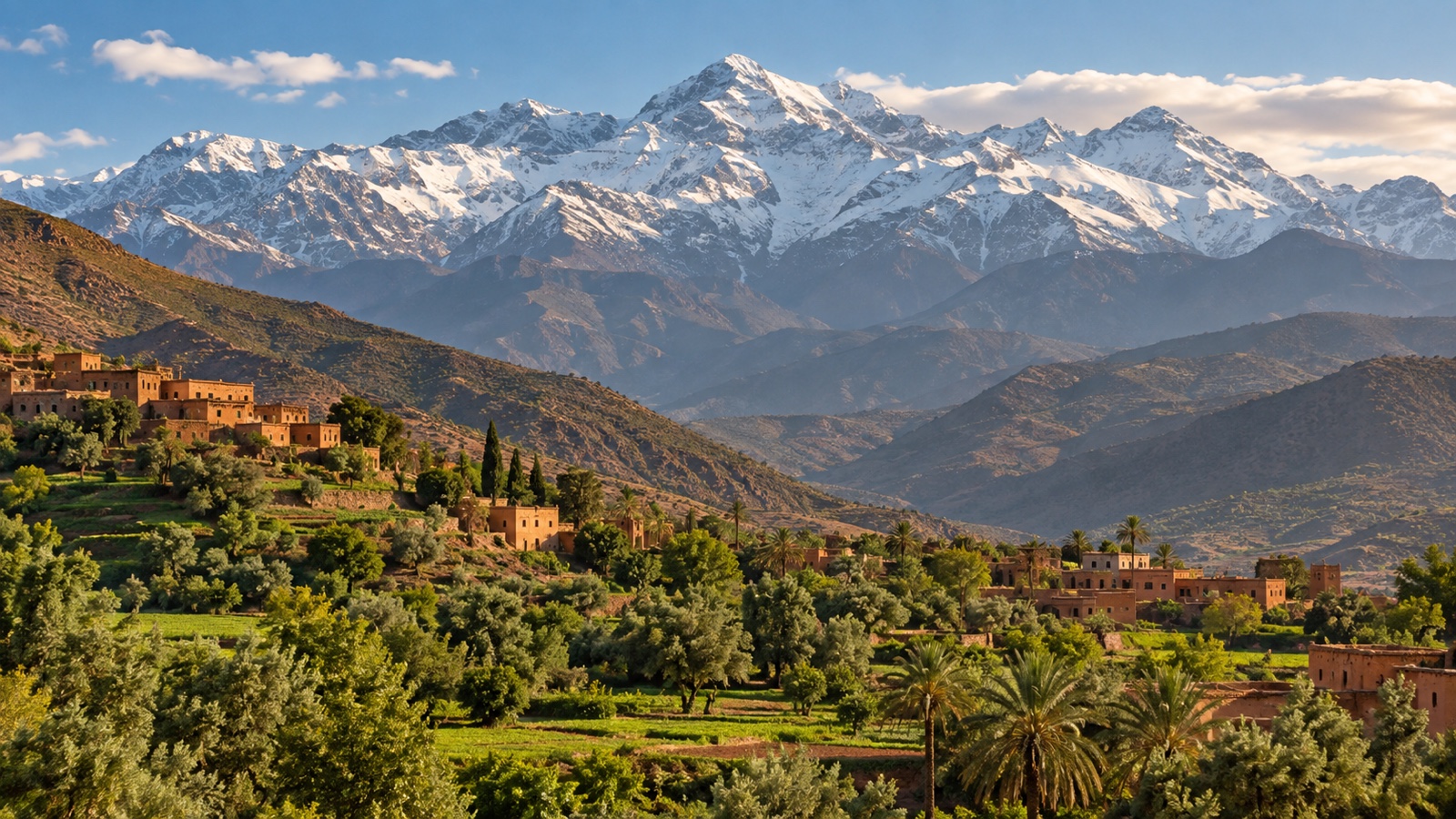
The Atlas Mountains divide climates and landscapes
- The Atlas Mountains cross Morocco from southwest to northeast.
- Morocco’s Atlas ranges include the High Atlas, Middle Atlas, and Anti-Atlas.
- Jebel Toubkal is the highest mountain in Morocco.
- It reaches 13,671 feet above sea level.
- Toubkal is also the highest peak in North Africa.
- Snow falls on the High Atlas in winter.
- Morocco even has ski areas in mountain regions.
- The Atlas Mountains influence rainfall by forcing moist air upward.
- Areas beyond the mountains become much drier.
- The Sahara begins in southeastern Morocco and the neighboring disputed Western Sahara region.
- Erg Chebbi is a famous field of tall sand dunes near Merzouga.
- Erg Chigaga is another major dune area farther southwest.
- Not all desert landscapes are sandy dunes.
- Rocky plateaus, gravel plains, dry valleys, and mountains cover large desert areas.
- The Rif Mountains rise in northern Morocco.
- Cedar forests grow in parts of the Middle Atlas.
- Barbary macaques live in those mountain forests.
- They are the only macaque species native to Africa north of the Sahara.
- Morocco’s coast supports beaches, lagoons, cliffs, and major fishing grounds.
- A country that contains both ski slopes and camel treks should probably come with more packing-list warnings.
Amazigh history runs far deeper than modern borders
- Amazigh peoples have lived across North Africa for thousands of years.
- “Berber” is an older outside label, while many people prefer Amazigh.
- The plural form is Imazighen.
- Amazigh identity includes many regional communities and languages.
- Ancient North African kingdoms existed long before Arab expansion.
- Roman rule reached parts of northern Morocco.
- Volubilis became a major Roman city.
- Its ruins include mosaics, arches, houses, and public buildings.
- Arab Muslim armies reached Morocco during the seventh and eighth centuries.
- Islam gradually became the dominant religion.
- Arabic spread alongside existing Amazigh languages rather than instantly replacing them.
- The Idrisid dynasty established an early Muslim state centered in Morocco during the late eighth century.
- Fez became an important religious and commercial center.
- The Almoravid dynasty emerged from Saharan and Amazigh networks.
- Almoravid rulers founded Marrakesh in the 11th century.
- The Almohad dynasty later controlled a large empire across North Africa and Iberia.
- Moroccan dynasties repeatedly connected sub-Saharan Africa, the Mediterranean, and al-Andalus.
- Jewish communities lived in Morocco for centuries and shaped trade, crafts, music, and urban life.
- Many Moroccan Jews emigrated during the 20th century, especially to Israel, France, Canada, and elsewhere.
- Morocco’s history makes more sense as a crossroads of African worlds than as a country sitting on the edge of somebody else’s map.
Fez, Marrakesh, Meknes and Rabat are imperial cities
Morocco has four cities commonly called imperial cities because different dynasties made them capitals. I love that this gives travelers four separate opportunities to get confidently lost in a medina while insisting the alley looked familiar.
- Fez is one of Morocco’s oldest major cities.
- Its old city is called Fes el Bali.
- Fes el Bali is a UNESCO World Heritage Site.
- The medina contains thousands of narrow lanes.
- Many streets are too narrow for ordinary cars.
- Donkeys and handcarts still move goods through some lanes.
- Al-Qarawiyyin was founded in Fez in the ninth century.
- It developed into an important center of Islamic learning.
- Marrakesh is famous for its red-toned walls and buildings.
- Jemaa el-Fnaa is the city’s best-known central square.
- The square fills with food stalls, performers, storytellers, and crowds, especially in the evening.
- The Koutoubia Mosque’s minaret is a major Marrakesh landmark.
- Meknes served as an imperial capital under Sultan Moulay Ismail.
- Bab Mansour is one of Meknes’s monumental gates.
- Rabat became the modern political capital under the French protectorate.
- The Hassan Tower is an unfinished 12th-century minaret in Rabat.
- The Mausoleum of Mohammed V stands nearby.
- Casablanca is not one of the traditional four imperial cities.
- Casablanca became the country’s largest modern commercial metropolis.
- Morocco has enough historic capitals that choosing one “old city day” feels wildly optimistic.
Medinas, riads, zellige and crafts make architecture feel handmade
- A medina is the historic walled or old urban quarter of many North African cities.
- Moroccan medinas often contain markets called souks.
- Traditional neighborhoods may organize crafts by trade or specialty.
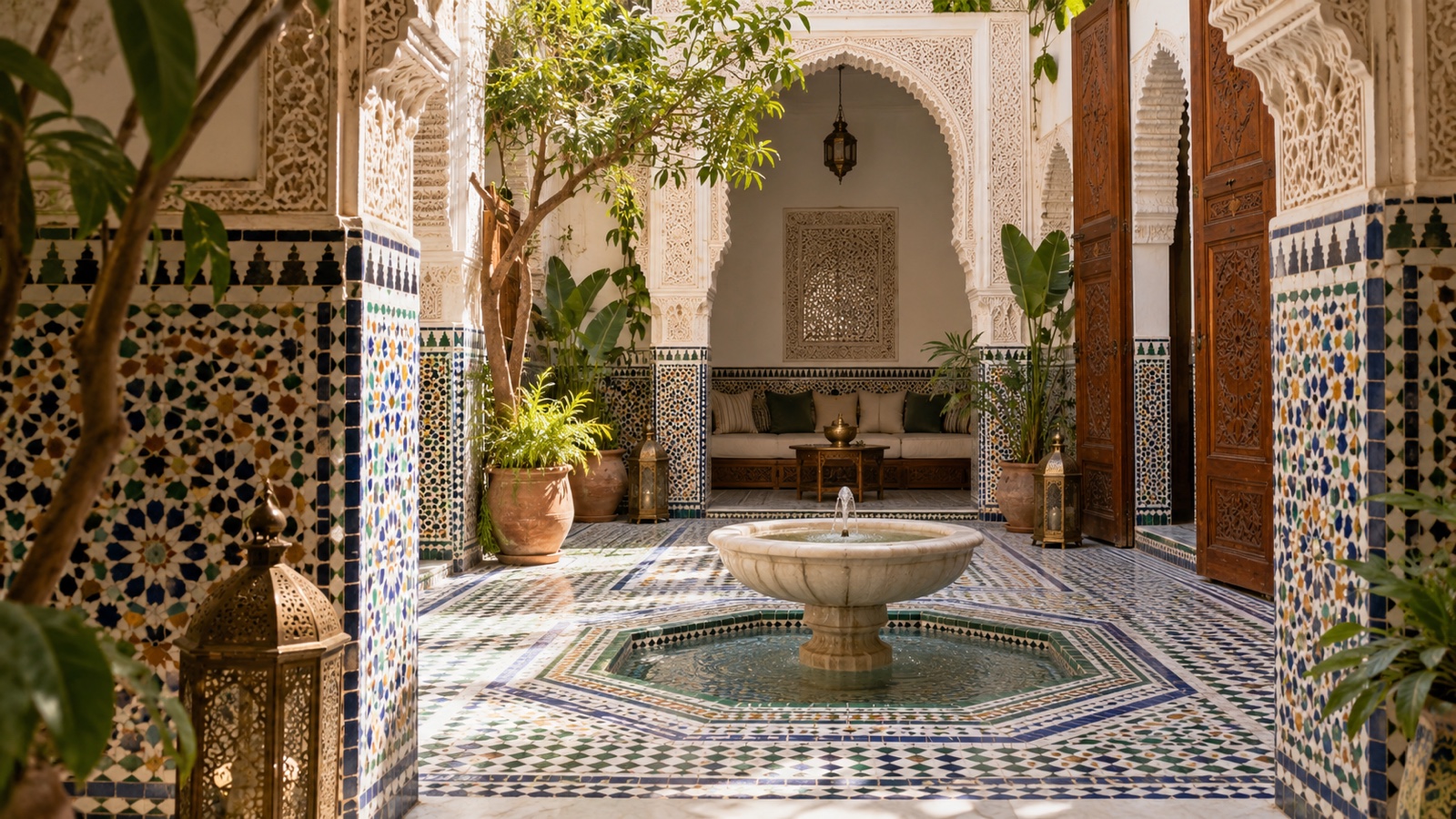
- A riad is a traditional urban house organized around an interior courtyard or garden.
- The word riad is related to the Arabic word for gardens.
- Many historic riads have been converted into guesthouses.
- Zellige is Moroccan mosaic tilework made from individually cut glazed pieces.
- Geometric patterns are a hallmark of zellige design.
- Tadelakt is a polished lime-plaster technique associated with Moroccan interiors.
- Carved plaster is another important decorative craft.
- Cedar wood is used for carved doors, ceilings, screens, and furniture.
- Moroccan carpets vary dramatically by region and weaving tradition.
- Some rural Amazigh rugs use bold geometric motifs.
- Fez is famous for traditional leather tanning.
- The Chouara Tanneries are among the city’s best-known craft sites.
- Leather hides are processed and dyed in open vats.
- Traditional craft work can involve difficult labor conditions that tourism photos tend to crop out.
- Brass lamps, ceramics, textiles, leather goods, and woodwork fill many markets.
- Bargaining is common in some traditional markets but not in every modern shop.
- I can admire a hand-cut tile wall for an unreasonable amount of time, which Morocco seems prepared to encourage.
Tagine, couscous and mint tea are social as much as culinary
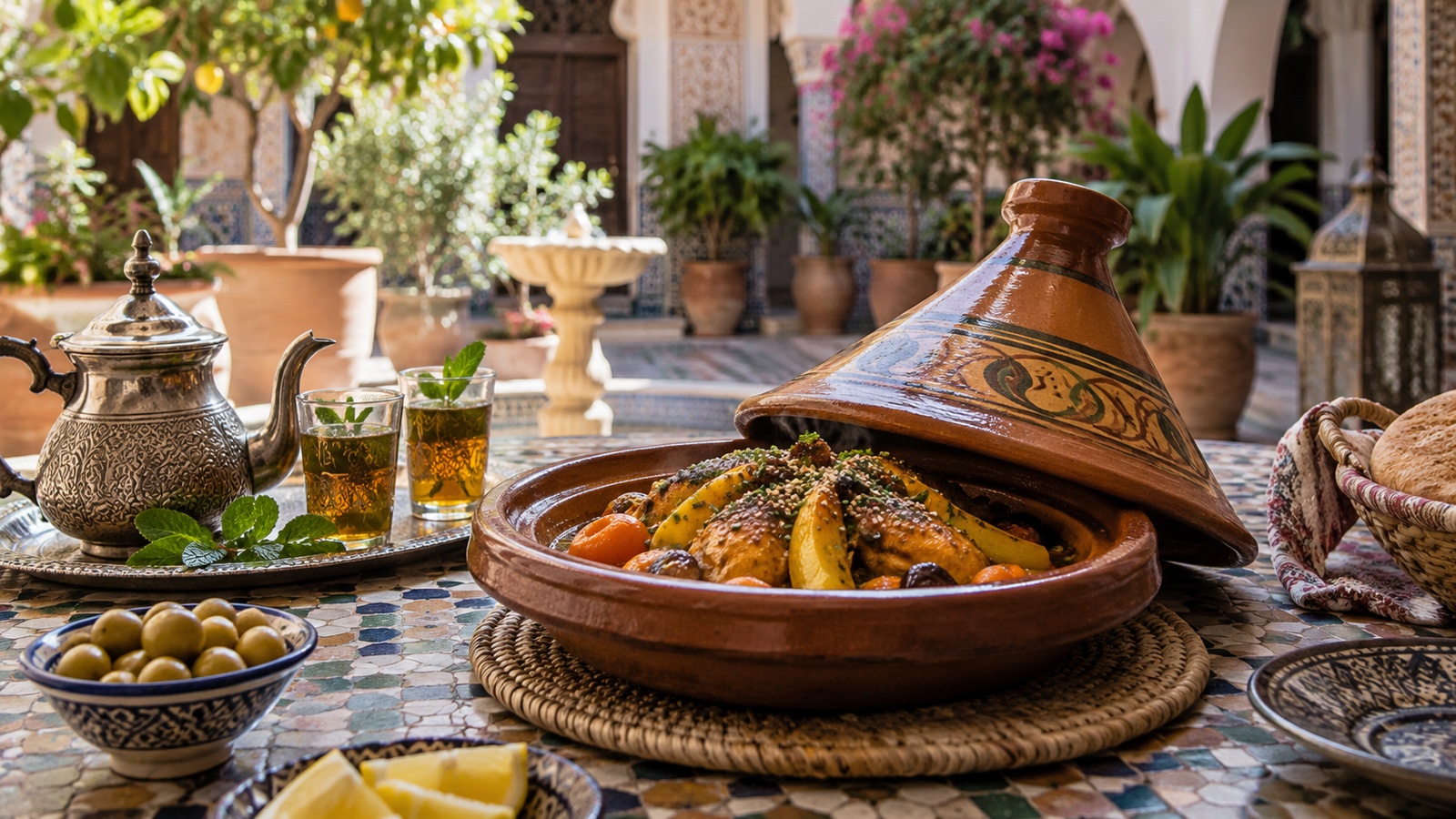
Moroccan food has convinced me that the phrase “just a little tea” cannot be trusted. Tea arrives sweet and fragrant, bread becomes a utensil, spices layer rather than simply burn, and a clay tagine somehow makes slow-cooked dinner look architectural.
- A tagine is both a cooking vessel and the dish cooked inside it.
- The traditional vessel has a shallow base and tall conical lid.
- The shape helps circulate steam during slow cooking.
- Tagines can combine meat, vegetables, fruit, olives, preserved lemon, herbs, and spices.
- Couscous is made from tiny granules of rolled semolina.
- Traditional preparation steams couscous rather than simply soaking instant granules.
- Friday couscous meals are common in many Moroccan families.
- Harira is a soup commonly made with tomatoes, legumes, herbs, and sometimes meat.
- Harira is especially associated with breaking the Ramadan fast.
- Pastilla is a layered pastry that can combine savory fillings with sweet-spice elements.
- Moroccan breads include round khobz loaves.
- Bread is often used to scoop shared dishes.
- Preserved lemons provide salty, intensely citrus flavor.
- Olives are grown widely in Morocco.
- Argan oil is produced from argan tree kernels in southwestern Morocco.
- Culinary argan oil has a nutty flavor.
- Cosmetic argan oil is processed differently from food oil.
- Moroccan mint tea commonly uses green tea, fresh mint, and substantial sugar.
- Tea pouring from height helps mix and aerate the drink.
- Any culture that turns pouring tea into a small performance has correctly understood hospitality.
Film sets, football, wildlife and 25 final Morocco facts
- Aït Benhaddou is a famous fortified earthen village near Ouarzazate.
- It is a UNESCO World Heritage Site.
- The site has appeared in numerous films and television productions.
- Ouarzazate has major film studios and is sometimes nicknamed a gateway to the Sahara.
- Morocco’s landscapes have doubled on screen for ancient Rome, biblical settings, fantasy worlds, and the Middle East.
- Essaouira is an Atlantic port city known for fortified walls and strong winds.
- The wind makes Essaouira popular with windsurfers and kitesurfers.
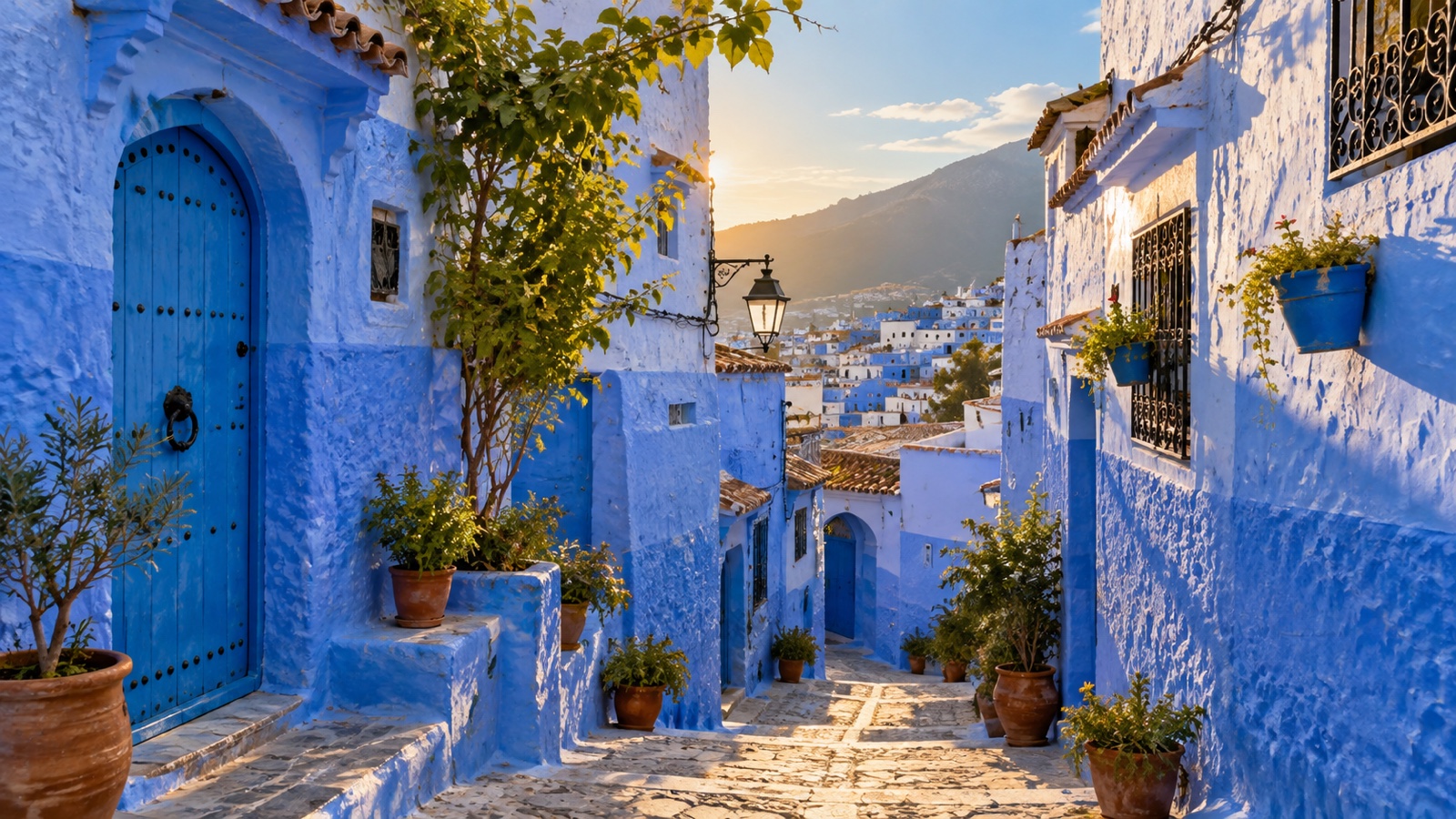
- Chefchaouen is famous for blue-painted streets and buildings.
- The exact historical reasons for the city’s blue tradition are debated.
- Morocco has important populations of Barbary macaques.
- Barbary lions once lived in Morocco but are extinct in the wild.
- The Atlas lion survives as a powerful national symbol.
- The Barbary sheep, or aoudad, lives in rocky North African landscapes.
- Morocco is an important stopover for migratory birds traveling between Europe and Africa.
- Football is the country’s most popular sport.
- Morocco became the first African and Arab men’s team to reach a FIFA World Cup semifinal in 2022.
- The national men’s team is nicknamed the Atlas Lions.
- Morocco will co-host the 2030 FIFA World Cup with Spain and Portugal, with anniversary matches planned in South America.
- The Hassan II Mosque in Casablanca stands partly over the Atlantic shoreline.
- Its minaret is one of the world’s tallest.
- Morocco became a French and Spanish protectorate in 1912.
- The country regained independence in 1956.
- King Mohammed VI has reigned since 1999.
- Morocco’s Atlantic coast supports major sardine and other fisheries.
- After 145 facts, Morocco still feels like a country where every mountain pass, tiled courtyard, bowl of couscous, and city gate opens onto another historical layer.
Quick FAQ
Q: Is Morocco in Africa?
A: Yes. Morocco is in northwestern Africa, with Atlantic and Mediterranean coastlines and a short sea crossing to Europe.
Q: What languages are spoken in Morocco?
A: Arabic and Amazigh are official. Moroccan Arabic, Amazigh languages, French, Spanish, and other languages are used in different communities and settings.
Q: What is Morocco famous for?
A: Marrakesh, Fez, Atlas Mountains, Sahara landscapes, medinas, tagines, mint tea, zellige tilework, souks, argan oil, historic architecture, and Atlantic beaches.
Q: What is the capital of Morocco?
A: Rabat is the capital, while Casablanca is the largest city.
Q: Is Western Sahara part of Morocco?
A: Morocco administers most of Western Sahara and claims it as part of the kingdom, but sovereignty is disputed and the territory’s final status remains unresolved internationally.

Ellie is the owner and sole author of Fun Facts, combining her mechanical engineering background with years of research-driven writing to deliver facts you can trust. Every article is thoroughly fact-checked and routinely updated as new science and sources emerge to keep information accurate and current. Her mission is to make learning delightful while upholding high standards of reliability and transparency.